

 Tweet
Tweet
First what is American Foulbrood?
According to Wikipedia:
"American foulbrood (AFB), caused by the spore- forming Paenibacillus larvae ssp. larvae (formerly classified as Bacillus larvae), is the most widespread and destructive of the bee brood diseases. Paenibacillus larvae is a rod-shaped bacterium, which is visible only under a high power microscope. Larvae up to 3 days old become infected by ingesting spores that are present in their food. Young larvae less than 24 hours old are most susceptible to infection. Spores germinate in the gut of the larva and the vegetative form of the bacteria begins to grow, taking its nourishment from the larva. Spores will not germinate in larvae over 3 days old. Infected larvae normally die after their cell is sealed. The vegetative form of the bacterium will die but not before it produces many millions of spores. Each dead larva may contain as many as 100 million spores. This disease only affects the bee larvae but is highly infectious and deadly to bee brood. Infected larvae darken and die."
******
Basically the bee larvae turn into goo that if poked with a tooth pick will draw out into a one inch or so long string from the brood comb. Initially the treatment for a hive badly infested with foul brood was to burn it. This resulted in expensive losses for beekeepers already struggling with Colony Collapse Disorder, mite infestations and other recent problems effecting their industry. If properly maintained hives can be used for decades.
New treatments for infected hives have been developed. At nuclear reactors in Boston and New Jersey pallets of hives are being exposed to radiation sufficient to destroy the foul brood. While this will not save the comb or bees at least some of the infected equipment can be recovered.
- Amish Country
******
According to Wikipedia:
"American foulbrood (AFB), caused by the spore- forming Paenibacillus larvae ssp. larvae (formerly classified as Bacillus larvae), is the most widespread and destructive of the bee brood diseases. Paenibacillus larvae is a rod-shaped bacterium, which is visible only under a high power microscope. Larvae up to 3 days old become infected by ingesting spores that are present in their food. Young larvae less than 24 hours old are most susceptible to infection. Spores germinate in the gut of the larva and the vegetative form of the bacteria begins to grow, taking its nourishment from the larva. Spores will not germinate in larvae over 3 days old. Infected larvae normally die after their cell is sealed. The vegetative form of the bacterium will die but not before it produces many millions of spores. Each dead larva may contain as many as 100 million spores. This disease only affects the bee larvae but is highly infectious and deadly to bee brood. Infected larvae darken and die."
******
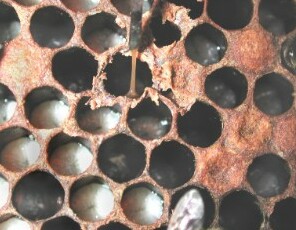
Basically the bee larvae turn into goo that if poked with a tooth pick will draw out into a one inch or so long string from the brood comb. Initially the treatment for a hive badly infested with foul brood was to burn it. This resulted in expensive losses for beekeepers already struggling with Colony Collapse Disorder, mite infestations and other recent problems effecting their industry. If properly maintained hives can be used for decades.
New treatments for infected hives have been developed. At nuclear reactors in Boston and New Jersey pallets of hives are being exposed to radiation sufficient to destroy the foul brood. While this will not save the comb or bees at least some of the infected equipment can be recovered.
- Amish Country
******
