Check out the FAQ,Terms of Service & Disclaimers by clicking the
link. Please register
to be able to post. By viewing this site you are agreeing to our Terms of Service and Acknowledge our Disclaimers.
FluTrackers.com Inc. does not provide medical advice. Information on this web site is collected from various internet resources, and the FluTrackers board of directors makes no warranty to the safety, efficacy, correctness or completeness of the information posted on this site by any author or poster.
The information collated here is for instructional and/or discussion purposes only and is NOT intended to diagnose or treat any disease, illness, or other medical condition. Every individual reader or poster should seek advice from their personal physician/healthcare practitioner before considering or using any interventions that are discussed on this website.
By continuing to access this website you agree to consult your personal physican before using any interventions posted on this website, and you agree to hold harmless FluTrackers.com Inc., the board of directors, the members, and all authors and posters for any effects from use of any medication, supplement, vitamin or other substance, device, intervention, etc. mentioned in posts on this website, or other internet venues referenced in posts on this website.
We are not asking for any donations. Do not donate to any entity who says they are raising funds for us.
Announcement
Collapse
No announcement yet.
Could migratory birds spread H7N9 around the world?
Could migratory birds spread H7N9 around the world?
Could it be possible?
...
University of Hong Kong microbiologist Professor Yuen Kwok-yung said on Friday he believed a large number of wild birds had already contracted the virus in eastern China, where all the cases of human H7N9 had occurred.
Re: Could migratory birds spread H7N9 around the world?
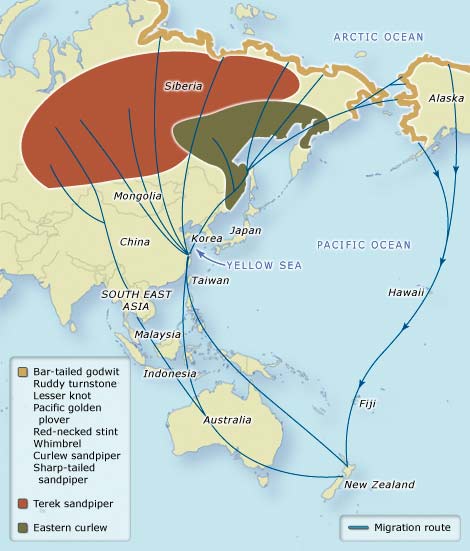
I was doing some reading on this yesterday and came across this article. It's worth a read as it gives some detail on what types of birds are found in different areas of the flyway during different seasons.
East Asia/Australasia Flyway at: xhttp://www.birdlife.org/datazone/userfiles/file/sowb/flyways/8_East_Asia_Australasia_Factsheet.pdf
A couple of other illustrations give the bigger picture.
"What information consumes is rather obvious: it consumes the attention of its recipients. Hence a wealth of information creates a poverty of attention, and a need to allocate that attention efficiently among the overabundance of information sources that might consume it." - Herbert Simon
"The benefits of education and of useful knowledge, generally diffused through a community, are essential to the preservation of a free government." - Sam Houston
Re: Could migratory birds spread H7N9 around the world?
Consider the overlaps with the flyways shown above:
.
"The next major advancement in the health of American people will be determined by what the individual is willing to do for himself"-- John Knowles, Former President of the Rockefeller Foundation
Re: Could migratory birds spread H7N9 around the world?
Rian Rossetti and Matthew WelchApril 26, 2013 06:00
How scared should we be of H7N9?
Q & A: Dr. Neil Fishman, for one, is cautiously optimistic.
GlobalPost talked to Dr. Neil Fishman, associate chief medical officer at the University of Pennsylvania Health System, about where to focus efforts to quell the outbreak, how the press is handling the news and just how likely it is that humans will one day transfer the virus to other humans.
GlobalPost: The current flu strain has been found in disparate areas of China. How does the wide spread of cases affect efforts to combat the virus?
Dr. Neil Fishman: There?s two critical things that are promising. One is that the virus has not been isolated in migratory birds. It?s only been found in chickens, ducks and pigeons in live poultry markets, so that makes it potentially easier to manage.
The other piece of promising news is that the closing of poultry markets appears to have led to a slowdown of the spread of disease. The focus needs to be on controlling the live poultry.
...
How likely is the international spread of H7N9?
Right now, less likely, because the virus has not been found in migratory birds, and there has not been human-to-human transmission. I will get concerned if the virus mutates and develops the ability for human-to-human transmission. Again, that has never occurred in the 10-plus years of the H5N1 outbreak, but we just need to follow it closely right now.
Re: Could migratory birds spread H7N9 around the world?
Translation Google
Global spread of H7N9 avian influenza risk prediction
Hejian Kui, Chen Yao
1 Introduction
Since the 4 1 confirmed the first case of H7N9 , the country has hundreds of people infected with H7N9 .H7N9 virus infection is highly pathogenic, has confirmed that 23 people died of H7N9 . Low pathogenicH7N9 virus infection in poultry, this feature makes the H7N9 in poultry widely disseminated. Although the CDC and the relevant departments to take effective measures to prevent the spread of H7N9 , H7N9 and from the the earliest discovery Shanghai, Jiangsu and Zhejiang, spread to Anhui, Jiangxi, Fujian, Beijing, Shandong, Henan and other places. H7N9 avian influenza has caused global concern about whether H7N9 will spread to other countries in the world, which countries have a higher risk of infection, H7N9 will spread out the channels through which is a global concern.
The route of transmission of H7N9 avian influenza prevention and control of H7N9 is very important. If the route of transmission of the H7N9 virus is mainly spread by migratory birds carry on some important sites for migratory birds, then we frequent monitoring can know the spread of H7N9 . For example, to monitor migratory birds in the USA and Alaska, can effectively assess the time and risk of H7N9 into North America. If the main route of transmission of the H7N9 virus as the trading of live poultry, customs monitoring of live poultry as the primary task of prevention and control of the spread of H7N9 .
To predict the spread of H7N9 is not an easy thing, mainly because : 1 , the number of infected poultry, the distribution is not clear. 2 , which migratory birds infected with H7N9 is not clear. Measures to be taken by countries in the prevention and control of avian influenza is unpredictable. Therefore, the current forecast the spread of H7N9 range and route of transmission can only be used as an assessment of the risks.
We study another avian influenza H5N1 transmission, coupled with the analysis of the data of the 140countries of the world in 2011 between the live animal, as well as migratory birds sorted out the number of ways. We predict the risk of the spread of H7N9 in European and Asian countries, as well as the possible route of transmission. This initial forecast help countries take to promote the prevention and control of H7N9.
2, results and discussion
Learned from the outbreak of the H5N1 avian influenza
H5N1 and H7N9 avian influenza can be spread among poultry and migratory birds, have much in common. The origin of the H5N1 presumably in southern China, but there is no definitive evidence. Since the 1996-1997first discovered in the Hong Kong region, has spread to dozens of countries in Asia, Europe, and Africa.H5N1 and H7N9 originated from China, by studying the H5N1 spread from China to other countries, to help us to predict the route of transmission of the H7N9 . By finishing the literature, we collected the time of the first outbreak of H5N1 in 52 countries . We found that the time of the outbreak of H5N1 can be divided into three stages. In the fall of 2003 to 2004, the first stage : this stage H5N1 outbreak concentrated in Southeast Asia, Thailand, Myanmar, Cambodia, Vietnam and other places. These countriesalong migratory routes in East Asia - Australia. East Asia, Japan and South Korea also H5N1 infection. The second stage is from 7 May 2005 to 11 May 2005 , this time H5N1 in Russia, Inner Mongolia, Kazakhstan, Croatia, Ukraine and other Central Asian and Eastern European countries. These countries in Central Asia along migratory routes. The third stage is from 2006 to 2006 , when the H5N1 outbreak in more than 20countries in Western Europe, Northern and Southern Europe . From here we can sum up the migration path of the spread of avian influenza and migratory birds are closely related and shows the characteristics of regionalization. Figure 1 , the global H5N1 outbreak timetable. The time of the outbreak in Thailand as a starting point (day 0 ) , to calibration the time of the outbreak of the other countries. Uncertain due to H5N1 in China, the origin of time, so do not use one of the outbreak of the Chinese as a starting point.
The H7N9 spread of forecast
In the case of countries not prohibited by the live animal, H7N9 may spread to Southeast Asia, Europe and other countries. According to the data of the migratory birds and live poultry, the risk of transmission of several major areas evaluated. ( a ) the spread of H7N9 will be roughly divided into three areas <TABLE style="BORDER-BOTTOM-STYLE: none; PADDING-BOTTOM: 0px; MARGIN: 0px; BORDER-LEFT-STYLE: none; PADDING-LEFT: 0px; PADDING-RIGHT: 0px; BORDER-COLLAPSE: collapse; WORD-WRAP: break-word; BORDER-TOP-STYLE: none; EMPTY-CELLS: show; BORDER-RIGHT-STYLE: none; PADDING-TOP: 0px" border=1 cellSpacing=0 cellPadding=0><TBODY style="PADDING-BOTTOM: 0px; MARGIN: 0px; PADDING-LEFT: 0px; PADDING-RIGHT: 0px; WORD-WRAP: break-word; PADDING-TOP: 0px"><TR style="PADDING-BOTTOM: 0px; MARGIN: 0px; PADDING-LEFT: 0px; PADDING-RIGHT: 0px; WORD-WRAP: break-word; PADDING-TOP: 0px"><TD style="BORDER-BOTTOM: rgb(0,0,0) 1px solid; BORDER-LEFT: rgb(0,0,0) 1px solid; PADDING-BOTTOM: 0px; MARGIN: 0px; PADDING-LEFT: 7px; WIDTH: 142px; PADDING-RIGHT: 7px; WORD-WRAP: break-word; BORDER-TOP: rgb(0,0,0) 1px solid; BORDER-RIGHT: rgb(0,0,0) 1px solid; PADDING-TOP: 0px" vAlign=top width=142>Zone
</TD></TR></TBODY></TABLE> Zone 1 countries adjacent to China and East Asia - Australia migratory winter habitat. Zone 1 of the first countries spread of the H7N9 Zone 2 countries will be affected first in Russia, then H7N9 spread through Russia to other countries of the zone 2 . Zone 3 countries risk is relatively small, its mode of transmission from Zone 2 Figure 2, H7N9 risk assessment
(B) interval spread spread by migratory birds, the region rely on trading Avian influenza virus transmission main ways: live animal ; 2, migratory birds; 3 , and dissemination; 4 , Wildfowl transactions;
For H7N9 , and spreads very limited; Wildfowl number of transactions is relatively small. Therefore, we mainly consider the trading of live poultry and migratory birds. By studying the 2011 United Nations data on international trade. We found no records to export live poultry in zone 1 and zone 2 to zone 3 trace export. Therefore, the pathway leading to the spread of H7N9 from China will not live poultry, but should mainly migratory birds. China and Southeast Asian countries bordering the boundary there may be some undocumented live animal will have a certain impact on the spread of H7N9 . At the same time zone 1 does not export live poultry to zone 2 , zone 2 to zone 3 a small amount of live poultry. Taken together, theZone 1 and Zone 2 is the most likely route of migratory birds, and Zone 3 will exist the risk of migratory birds and live poultry. We also noted that within each zone of live animal is very active trading volume.Thus become the main route of transmission in each zone countries within the live poultry trade fairs . Figure 3 : The main countries of live poultry transactions. Abscissa is the country of export, the vertical axis is the importing country. Color bar represents the volume of transactions ( U.S. $ ).
Table 1: Area of live poultry transaction amount (U.S. $)
3, methods Migratory data. According to Kilpatrick et al ( PNAS, 103-19368, sorted out in 2006 ), Asia, Europe and Africa migratory data to estimate the migration routes of of 54,081,501 migratory birds in the period 2005-2006 . More migratoryinfectious bird days data is not attached. Trade Obtained from the Food and Agriculture Organization of the United Nations 2011 trade data between countries . Among them, live animal code H1-0105.
Table 2: the number of migratory birds in the continents (PNAS, 103-19368,2006)
Disclaimer: This article is the author of a best efforts, the H7N9 made risk assessment based on current data . Because of capacity constraints, the data is not comprehensive and may be a variety of changes, the assessment made in this article may be distorted and inaccurate.
Digression: Nature published in the April 24, in a news: "Mapping the H7N9 avian flu outbreaks, which specifically describes the the aviation line on the global spread of H7N9, in order to predict other high-risk cities. According to our research, the nature of this exposition is incorrect, currently of H7N9 only limited human-to-human transmission, air transport is not the global spread of H7N9 main ways.
Re: Could migratory birds spread H7N9 around the world?
One problem with comparing spread of H5N1 to H7N9 in wild migratory birds, is that H5N1 killed many birds, while H7N9 doesn't. While this may imply that H7N9 could spread more successfully in the migratory population, H7N9 also appears to not spread well even within confined bird populations - which would lead me to speculate that it will mostly stay out of migratory birds.
After watching how H5N1 spread, I believe that H7N9 is more likely to spread via humans - unless an "unknown" widespread vector is discovered.
.
"The next major advancement in the health of American people will be determined by what the individual is willing to do for himself"-- John Knowles, Former President of the Rockefeller Foundation

 Tweet
Tweet



Comment