Announcement

Collapse
No announcement yet.

Seasonal Flu 2008 - 2009

Collapse
X
 
  • Filter
  • Time
  • Show
Clear All
new posts

  • Re: Seasonal Flu 2008 - 2009

    USA. W.Va. teen dies of flu complications - UPI.com
    W.Va. teen dies of flu complications

    Published: March 20, 2009 at 4:08 PM
    CHARLESTON, W.Va., March 20 (UPI) --

    A 15-year-old girl has died in South Charleston, W.Va., of complications from the flu, health officials say.


    Kanawha-Charleston Health Department officials said Emily Kaitlyn Sims became the state's first reported pediatric influenza death since 2004 with her death on March 5, the Charleston (W. Va.) Daily Mail said Friday.

    Rahul Gupta, the health department's director, said the teen died shortly after being showing signs of the flu and visiting her family physician.

    Sims was freshman and an honor student at St. Albans High School at the time of her death.

    Gupta said Thursday that tests are being conducted to determine if methicillin-resistant Staphylococcus aureus bacteria had anything to do with Sims' death.

    "One of the things we have to worry about is MRSA, or the super-bug," Gupta told the Daily Mail. "There is no proof at this point that this is what this young lady had. We're waiting on future testing."
    -
    <cite cite="http://www.upi.com/Top_News/2009/03/20/WVa_teen_dies_of_flu_complications/UPI-15821237579699/">W.Va. teen dies of flu complications - UPI.com</cite>

    Comment


    • Re: Seasonal Flu 2008 - 2009

      <table border="1"> <caption> INFLUENZA VIRUSES ISOLATED BY
      WHO/NREVSS Collaborating Laboratories
      2008 - 2009 Season
      </caption> <tbody><tr> <th id="header1" width="70">Week</th> <th id="header2" width="90">A(H1)</th> <th id="header3" width="70">A(H3)</th> <th id="header4" width="70">A(Unk)</th> <th id="header5" width="70"> B </th> <th id="header6" align="right">Total # Tested</th> <th id="header7" align="right">% Positive</th> </tr> <tr><td headers="header1" align="right"> 40 </td> <td headers="header2" align="right"> 3 </td> <td headers="header3" align="right"> 0 </td> <td headers="header4" align="right"> 8 </td> <td headers="header5" align="right"> 6 </td> <td headers="header6" align="right"> 2598 </td> <td headers="header7" align="right"> 0.65 </td></tr> <tr><td headers="header1" align="right"> 41 </td> <td headers="header2" align="right"> 4 </td> <td headers="header3" align="right"> 4 </td> <td headers="header4" align="right"> 8 </td> <td headers="header5" align="right"> 6 </td> <td headers="header6" align="right"> 2632 </td> <td headers="header7" align="right"> 0.84 </td></tr> <tr><td headers="header1" align="right"> 42 </td> <td headers="header2" align="right"> 13 </td> <td headers="header3" align="right"> 3 </td> <td headers="header4" align="right"> 15 </td> <td headers="header5" align="right"> 6 </td> <td headers="header6" align="right"> 2746 </td> <td headers="header7" align="right"> 1.35 </td></tr> <tr><td headers="header1" align="right"> 43 </td> <td headers="header2" align="right"> 22 </td> <td headers="header3" align="right"> 0 </td> <td headers="header4" align="right"> 24 </td> <td headers="header5" align="right"> 14 </td> <td headers="header6" align="right"> 3198 </td> <td headers="header7" align="right"> 1.88 </td></tr> <tr><td headers="header1" align="right"> 44 </td> <td headers="header2" align="right"> 12 </td> <td headers="header3" align="right"> 3 </td> <td headers="header4" align="right"> 21 </td> <td headers="header5" align="right"> 5 </td> <td headers="header6" align="right"> 3320 </td> <td headers="header7" align="right"> 1.23 </td></tr> <tr><td headers="header1" align="right"> 45 </td> <td headers="header2" align="right"> 32 </td> <td headers="header3" align="right"> 2 </td> <td headers="header4" align="right"> 23 </td> <td headers="header5" align="right"> 11 </td> <td headers="header6" align="right"> 3920 </td> <td headers="header7" align="right"> 1.73 </td></tr> <tr><td headers="header1" align="right"> 46 </td> <td headers="header2" align="right"> 25 </td> <td headers="header3" align="right"> 2 </td> <td headers="header4" align="right"> 23 </td> <td headers="header5" align="right"> 12 </td> <td headers="header6" align="right"> 4145 </td> <td headers="header7" align="right"> 1.5 </td></tr> <tr><td headers="header1" align="right"> 47 </td> <td headers="header2" align="right"> 27 </td> <td headers="header3" align="right"> 1 </td> <td headers="header4" align="right"> 31 </td> <td headers="header5" align="right"> 23 </td> <td headers="header6" align="right"> 4540 </td> <td headers="header7" align="right"> 1.81 </td></tr> <tr><td headers="header1" align="right"> 48 </td> <td headers="header2" align="right"> 40 </td> <td headers="header3" align="right"> 1 </td> <td headers="header4" align="right"> 46 </td> <td headers="header5" align="right"> 24 </td> <td headers="header6" align="right"> 4636 </td> <td headers="header7" align="right"> 2.39 </td></tr> <tr><td headers="header1" align="right"> 49 </td> <td headers="header2" align="right"> 41 </td> <td headers="header3" align="right"> 5 </td> <td headers="header4" align="right"> 57 </td> <td headers="header5" align="right"> 14 </td> <td headers="header6" align="right"> 5355 </td> <td headers="header7" align="right"> 2.18 </td></tr> <tr><td headers="header1" align="right"> 50 </td> <td headers="header2" align="right"> 71 </td> <td headers="header3" align="right"> 9 </td> <td headers="header4" align="right"> 66 </td> <td headers="header5" align="right"> 37 </td> <td headers="header6" align="right"> 5788 </td> <td headers="header7" align="right"> 3.16 </td></tr> <tr><td headers="header1" align="right"> 51 </td> <td headers="header2" align="right"> 73 </td> <td headers="header3" align="right"> 18 </td> <td headers="header4" align="right"> 107 </td> <td headers="header5" align="right"> 56 </td> <td headers="header6" align="right"> 6057 </td> <td headers="header7" align="right"> 4.19 </td></tr> <tr><td headers="header1" align="right"> 52 </td> <td headers="header2" align="right"> 71 </td> <td headers="header3" align="right"> 11 </td> <td headers="header4" align="right"> 152 </td> <td headers="header5" align="right"> 51 </td> <td headers="header6" align="right"> 5828 </td> <td headers="header7" align="right"> 4.89 </td></tr> <tr><td headers="header1" align="right"> 53 </td> <td headers="header2" align="right"> 113 </td> <td headers="header3" align="right"> 17 </td> <td headers="header4" align="right"> 168 </td> <td headers="header5" align="right"> 48 </td> <td headers="header6" align="right"> 6185 </td> <td headers="header7" align="right"> 5.59 </td></tr> <tr><td headers="header1" align="right"> 01 </td> <td headers="header2" align="right"> 164 </td> <td headers="header3" align="right"> 26 </td> <td headers="header4" align="right"> 281 </td> <td headers="header5" align="right"> 81 </td> <td headers="header6" align="right"> 6623 </td> <td headers="header7" align="right"> 8.33 </td></tr> <tr><td headers="header1" align="right"> 02 </td> <td headers="header2" align="right"> 194 </td> <td headers="header3" align="right"> 20 </td> <td headers="header4" align="right"> 419 </td> <td headers="header5" align="right"> 95 </td> <td headers="header6" align="right"> 6717 </td> <td headers="header7" align="right"> 10.84 </td></tr> <tr><td headers="header1" align="right"> 03 </td> <td headers="header2" align="right"> 337 </td> <td headers="header3" align="right"> 44 </td> <td headers="header4" align="right"> 618 </td> <td headers="header5" align="right"> 184 </td> <td headers="header6" align="right"> 7463 </td> <td headers="header7" align="right"> 15.85 </td></tr> <tr><td headers="header1" align="right"> 04 </td> <td headers="header2" align="right"> 537 </td> <td headers="header3" align="right"> 71 </td> <td headers="header4" align="right"> 894 </td> <td headers="header5" align="right"> 345 </td> <td headers="header6" align="right"> 8881 </td> <td headers="header7" align="right"> 20.8 </td></tr> <tr><td headers="header1" align="right"> 05 </td> <td headers="header2" align="right"> 619 </td> <td headers="header3" align="right"> 44 </td> <td headers="header4" align="right"> 1351 </td> <td headers="header5" align="right"> 642 </td> <td headers="header6" align="right"> 11190 </td> <td headers="header7" align="right"> 23.74 </td></tr> <tr><td headers="header1" align="right"> 06 </td> <td headers="header2" align="right"> 770 </td> <td headers="header3" align="right"> 59 </td> <td headers="header4" align="right"> 1300 </td> <td headers="header5" align="right"> 875 </td> <td headers="header6" align="right"> 12094 </td> <td headers="header7" align="right"> 24.84 </td></tr> <tr><td headers="header1" align="right"> 07 </td> <td headers="header2" align="right"> 745 </td> <td headers="header3" align="right"> 58 </td> <td headers="header4" align="right"> 1031 </td> <td headers="header5" align="right"> 844 </td> <td headers="header6" align="right"> 11068 </td> <td headers="header7" align="right"> 24.2 </td></tr> <tr><td headers="header1" align="right"> 08 </td> <td headers="header2" align="right"> 574 </td> <td headers="header3" align="right"> 52 </td> <td headers="header4" align="right"> 865 </td> <td headers="header5" align="right"> 977 </td> <td headers="header6" align="right"> 10678 </td> <td headers="header7" align="right"> 23.11 </td></tr> <tr><td headers="header1" align="right"> 09 </td> <td headers="header2" align="right"> 301 </td> <td headers="header3" align="right"> 29 </td> <td headers="header4" align="right"> 731 </td> <td headers="header5" align="right"> 861 </td> <td headers="header6" align="right"> 8754 </td> <td headers="header7" align="right"> 21.96 </td></tr> <tr><td headers="header1" align="right"> 10 </td> <td headers="header2" align="right"> 107 </td> <td headers="header3" align="right"> 13 </td> <td headers="header4" align="right"> 402 </td> <td headers="header5" align="right"> 580 </td> <td headers="header6" align="right"> 5076 </td> <td headers="header7" align="right"> 21.71 </td></tr> </tbody></table>
      Return to Current Report
      <!-- #################################### --> <!-- BEGIN SiteCatalyst/Omniture code here--> <!-- Version: 1.2 - Date Created: 08/04/2004--> <script language="JavaScript" type="text/javascript"> <!-- var s_pageName=document.title var s_channel="CDC Flu" var s_prop1= s_pageName + " ^ " + s_channel var s_code=' '//--> </script> <script language="JavaScript" src="http://www.cdc.gov/JScript/s_code.js" type="text/javascript"></script> <script language="JavaScript" type="text/javascript"> <!-- var s_wd=window,s_tm=new Date;if(s_code!=' '){s_code=s_dc( 'cdcgov');if(s_code)document.write(s_code)}else document.write('<im'+'g src="http://mtrics.cdc.gov/b/ss/cdcgov/1/G.5--FB/s'+s_tm.getTime()+'?[AQB]' +'&j=1.0&[AQE]" height="1" width="1" border="0" alt="" />') //--> </script>

      Comment


      • Re: Seasonal Flu 2008 - 2009

        CIDRAP >> Type B viruses rise as overall flu activity declines
        Type B viruses rise as overall flu activity declines

        Robert Roos * News Editor
        Mar 23, 2009 (CIDRAP News) ?

        The second week of March brought a slight decline in influenza activity across the country, with 30 states still reporting widespread cases, down from 35 states a week earlier, according to the Centers for Disease Control and Prevention (CDC).


        As overall activity has decreased, however, the season has seen an increase in the proportion of influenza B viruses, the one type of flu that is not very well-matched by this year's vaccine, the CDC reported. The spread of B viruses also poses a challenge for decisions about antiviral treatment, the agency said.

        Eighteen states reported regional flu activity, and two?Utah and West Virginia?reported only local activity. Seven percent of all deaths reported through the CDC's mortality reporting system were attributed to pneumonia and influenza, which is below the epidemic threshold of 8%.

        However, the proportion of medical visits attributed to flu-like illness in the CDC's flu surveillance network was 2.9%, still above the national baseline of 2.4%.

        Six more flu-related deaths in children were reported, bringing the total for the season to 32, the CDC report said. That compares with 88 fatal cases in children in 2007-08 and 78 in 2006-07. The six deaths occurred between Feb 15 and Mar 7.

        Influenza A viruses have predominated through the season overall, making up 70.8% of those that have been typed, the CDC reported. But type B viruses have increased lately: of 1,102 lab-confirmed flu cases for the week, 580 (52.6%) were type B.

        Of 210 type B viruses that have been antigenically tested by the CDC this season, only 44 belonged to the Yamagata lineage targeted by the B strain in this year's vaccine. The other 166 isolates belonged to the Victoria lineage and are not related to the vaccine, the agency said. However, all the A/H1N1 and A/H3N2 isolates tested so far have been related to the corresponding strains in the vaccine.

        Among type A viruses, H1N1 has been predominant this season. That pattern continued in the latest report, with 107 of 120 type A isolates that were subtyped identified as H1N1. Nearly all H1N1 isolates (98.9%) tested for drug resistance this season have been resistant to the antiviral oseltamivir (Tamiflu) but sensitive to zanamivir and to the adamantine drugs.

        In contrast, all A/H3N2 viruses have been susceptible to oseltamivir and zanamivir but resistant to the adamantanes. Type B viruses are also susceptible to oseltamivir and zanamivir, but the adamantanes are not effective against them.

        Given the differences in drug sensitivity among the three types of flu, the growing proportion of B viruses "presents challenges for the selection of antiviral medications for the treatment and prophylaxis of influenza," the CDC report said. "Health care providers should be aware of the possibility of increased influenza B circulation in their area, and continue [to] test patients for influenza and consult local surveillance data when evaluating patients with acute respiratory infections during the influenza season."

        The CDC revised its recommendations on antiviral treatment for flu last December, after discovering the high rate of oseltamivir resistance in H1N1 viruses.In other developments, the Rapid City Journal in South Dakota today reported a flood of patients with flu-like symptoms in local clinics and said many of them had received flu shots early in the season.

        A physician's assistant at an urgent care center said about half of her patients who tested positive for flu had been vaccinated, but most of the shots were early in the season, the report said. A physician quoted in the story suggested that the immunity conferred by vaccination starts to wane after about 3 months, though it can still lessen the severity of flu after that.

        However, online CDC information says the protection provided by a flu vaccine lasts the whole season. Researchers have found no benefit from getting a second shot later in the season, it says.

        William Schaffner, MD, a flu immunization expert and chair of the Department of Preventive Medicine at Vanderbilt University School of Medicine in Nashville, agreed.

        "Immunization even in September ought to have you protected throughout the flu season," he told CIDRAP News. "What we're seeing is a very late influenza season. We know that the vaccine is a pretty good vaccine but not a perfect one. So some people will acquire a milder case despite vaccination. Because it's occurring so late in the season, the question arises about the duration of protection."

        If flu activity had peaked in December or January, there would have been cases in people who had been vaccinated and were only partially protected, he said. But in that case the question of duration wouldn't have come up, simply because of the date.

        Schaffner also allowed that the recent increase in type B viruses, many of which are not well-matched by the vaccine, may be playing a role in cases in vaccinated people. "A late season tends to be Bs, and indeed we only have one [B] strain in the vaccine. So the vaccine once again may provide only partial protection," he said.

        He noted that there has been considerable discussion of putting both type B lineages in the flu vaccine, making a quadrivalent (four-strain) vaccine. "I'm in favor of that," he said.

        See also:
        CDC flu update http://www.cdc.gov/flu/weekly/
        Mar 23 Rapid City Journal report http://www.rapidcityjournal.com/arti...c839895916.txt
        -
        <cite cite="http://www.cidrap.umn.edu/cidrap/content/influenza/general/news/mar2309flu.html">CIDRAP >> Type B viruses rise as overall flu activity declines</cite>

        Comment


        • Re: Seasonal Flu 2008 - 2009

          Japan
          March 24 17:52

          B flare-up on the flu virus

          The number of patients reporting flu to the country's medical institutions nationwide, an increase of three days this month to 15 consecutive weeks, the epidemic has rekindled the National Institute of Infectious Diseases 24, according to preliminary figures released Sunday . B appears to be on the virus.

          Annual prevalence of type B virus, A behind-the spread, as the lead in the overall resurgence of the epidemic since the survey started in 1987, the first time.

          Senior Researcher Yasui Yoshinori call infectious disease information center "for more travel on spring break, could also spread to areas not in vogue," and has cautioned.

          According to the call of infection, an epidemic season, the patients reported a decrease in the peak of late, increased again in late February. Sunday February 22 to report a patient of the week was 12.05 per point is, next week (March 1) is 13.49, next week (8 day) and 14.85 increase. The latest 15 weeks before an increase of 16.50, and three weeks in a row.

          By prefecture, 15 to a fixed point of the number of reports per week, the top angle 46.25. Miyagi (37.48), Niigata (28.94), Chiba (28.85), Shizuoka (26.29) and more, have a big epidemic in the Tohoku region. (Joint)

          Comment


          • Re: Seasonal Flu 2008 - 2009

            Originally posted by ironorehopper View Post
            CIDRAP >> Type B viruses rise as overall flu activity declines
            Type B viruses rise as overall flu activity declines


            The CDC revised its recommendations on antiviral treatment for flu last December, after discovering the high rate of oseltamivir resistance in H1N1 viruses.In other developments, the Rapid City Journal in South Dakota today reported a flood of patients with flu-like symptoms in local clinics and said many of them had received flu shots early in the season.

            A physician's assistant at an urgent care center said about half of her patients who tested positive for flu had been vaccinated, but most of the shots were early in the season, the report said. A physician quoted in the story suggested that the immunity conferred by vaccination starts to wane after about 3 months, though it can still lessen the severity of flu after that.

            However, online CDC information says the protection provided by a flu vaccine lasts the whole season. Researchers have found no benefit from getting a second shot later in the season, it says.


            See also:
            CDC flu update http://www.cdc.gov/flu/weekly/
            Mar 23 Rapid City Journal report http://www.rapidcityjournal.com/arti...c839895916.txt
            -
            <cite cite="http://www.cidrap.umn.edu/cidrap/content/influenza/general/news/mar2309flu.html">CIDRAP >> Type B viruses rise as overall flu activity declines</cite>
            Vaccine failures or lowered activity have been widely reported for Tamiflu resistant H1N1 (in Japan, Taiwan, and Italy). Those reports specifically tested the influenza that produced a reduced titer or was isolated from vaccinated patients.

            Comment


            • Re: Seasonal Flu 2008 - 2009

              Flu lurking for people who got shots early
              By Lynn Taylor Rick, Journal staff
              A later-than-usual flu season is flooding Rapid City clinics with aching, coughing, sneezing, miserable patients, many who got their flu shots early in the season.
              Deb Brandt, a physician assistant at Rapid City Medical Center's Urgent Care, said that on Wednesday, the clinic checked in 106 people in 11 hours. There were cases of strep, mono and plenty of influenza. Three other Rapid City clinics report a similarly busy schedule.
              Brandt said about half of her patients who tested positive for influenza had their shots, but "most of the flu shots were early."
              The Centers for Disease Control and Prevention says the flu season generally runs October through May and recommends getting the influenza vaccine before December to ensure the antibodies developed from the shot are ready when flu activity is at its highest.
              Oftentimes, however, flu vaccines become most readily available in early October, so that's when people get them. Then, if flu season comes later, as it has this year, some of the best protection may have worn off.
              But that doesn't mean it won't do them any good, said Dr. Kevin Weiland, a Rapid City physician. The influenza vaccine tends to provide the strongest protection for the first three months after it is given, but it can help lesson the severity of the flu even after that time, Weiland said.
              Brandt said most of the patients with influenza who had their shot were much less sick than their counterparts who didn't get vaccinated.
              Weiland said that although it is most important to get the flu shot when it becomes available -- even if it's very early in the season -- he believes that people who have the luxury of choosing when they get their shot might be better off getting vaccinated later in the fall.
              "Personally, I don't give myself the flu shot until I hear about the first case of flu in the state," he said. "Then, when the flu season peaks out, my vaccine is peaked out at the same time."
              Beth Boersma, infection control nurse with Rapid City Regional Hospital, said the flu vaccine is designed to get people through the entire influenza season. But because no one can predict when the peak will be, she recommends sticking to the CDC recommendations of getting it "before December."
              "It's just the smart thing to do before the flu season arrives, and we never know if it's going to be early or late," she said.
              Boersma said in most cases, people won't be given a second flu shot during the same season, even if they received a vaccination early. The CDC reports no benefit to receiving more than one dose per influenza season, even among the elderly and people with weakened immune systems.
              Even though flu season is under way in Rapid City, it isn't too late to be immunized. Boersma said people should expect that the vaccine will take two weeks to fully protect them.
              And anyone can improve the odds of not getting the flu by practicing good hygiene: Wash hands thoroughly and often, avoid touching your face and cover your mouth and nose with a tissue when sneezing or coughing.
              And perhaps most important, avoid other people if you have the flu.
              State Department of Health weekly flu update
              This week's influenza activity ranks as "widespread" in South Dakota.
              • 643 of 2,845 reported rapid antigen tests (23 percent) positive this week (532 A and 111 B); total 2,257 positive tests for the season.
              • 37 confirmed cases of influenza reported this week (32 A and 5 B) from 11 counties (Brown, Codington, Davison, Dewey, Hutchinson, Lincoln, Meade, Minnehaha, Pennington, Shannon, Todd). A total of 267 confirmed cases so far this season (242 A and 25 B).
              • 40&#37; of confirmed influenza cases are children 0-9 years old; 3 percent of cases are people 60 years and older.
              • 10 influenza hospitalizations reported this week (69 reported for this season).
              • 48 percent of hospitalizations are children 0-9 years old; 16 percent of hospitalizations are people 60 years and older.
              • One influenza-associated death; three deaths this season.
              • Schools: 3 percent of students absent due to illness in 226 reporting schools.

              Contact Lynn Taylor Rick at 394-8414 or lynn.taylorrick@rapidcityjournal.com.


              Comment


              • Re: Seasonal Flu 2008 - 2009

                #426:
                "Boersma said in most cases, people won't be given a second flu shot during the same season, even if they received a vaccination early. The CDC reports no benefit to receiving more than one dose per influenza season, even among the elderly and people with weakened immune systems."

                Why is that?

                Vaccine flu strains body immunity response "fatigue", or something else

                Comment


                • Re: Seasonal Flu 2008 - 2009

                  Originally posted by tropical View Post
                  #426:
                  "Boersma said in most cases, people won't be given a second flu shot during the same season, even if they received a vaccination early. The CDC reports no benefit to receiving more than one dose per influenza season, even among the elderly and people with weakened immune systems."

                  Why is that?

                  Vaccine flu strains body immunity response "fatigue", or something else
                  Vaccines fail because viruses CHANGE (to survive). Giving the same shot again against the target that is no longer a match doesn't protect any better than the first shot that failed.

                  Comment


                  • Re: Seasonal Flu 2008 - 2009

                    Originally posted by niman View Post
                    Vaccines fail because viruses CHANGE (to survive). Giving the same shot again against the target that is no longer a match doesn't protect any better than the first shot that failed.
                    Thank you Dr. Niman for the answer.

                    The answer is correct in a case of missed vaccination strain if there is that what's happened, and it is clear.

                    But I wonder with my question because of an statement in the cited post text #426 where seems that the CDC, and in the previous post #425, the "researchers" from the Iron. text released the statement:
                    "Researchers have found no benefit from getting a second shot later in the season, it says"

                    The above sentence can be fited in a visure of the whole text, which claim an "early vaccination" as the possible reason of flu infections of already vaccinated persons, because of the deminish valence of the immune system response after the max. at the 3th month from vaccination.

                    So, the general reading impression is that the news text statements authors, wants to point to an early time of vaccination as the main reason of not wanting to revaccinate such persons, instead to point to an missed vacc. strain, or an flu strain changing after the first months of circulation through the population.

                    Apart the case of strain changing or missed vaccine, I wonder what can be the reason to not revaccinate the already vaccinated population after the first 4-5 months passed (10)/11/12/1/2/(3)?

                    Comment


                    • Re: Seasonal Flu 2008 - 2009

                      Originally posted by tropical View Post
                      Thank you Dr. Niman for the answer.

                      The answer is correct in a case of missed vaccination strain if there is that what's happened, and it is clear.

                      But I wonder with my question because of an statement in the cited post text #426 where seems that the CDC, and in the previous post #425, the "researchers" from the Iron. text released the statement:
                      "Researchers have found no benefit from getting a second shot later in the season, it says"

                      The above sentence can be fited in a visure of the whole text, which claim an "early vaccination" as the possible reason of flu infections of already vaccinated persons, because of the deminish valence of the immune system response after the max. at the 3th month from vaccination.

                      So, the general reading impression is that the news text statements authors, wants to point to an early time of vaccination as the main reason of not wanting to revaccinate such persons, instead to point to an missed vacc. strain, or an flu strain changing after the first months of circulation through the population.

                      Apart the case of strain changing or missed vaccine, I wonder what can be the reason to not revaccinate the already vaccinated population after the first 4-5 months passed (10)/11/12/1/2/(3)?
                      The article from South Dakota presents STRONG evidence for vaccine mismatch (failure), if indeed 50&#37; of the flu cases had been vaccinated, because the vaccination rate of the population is well below 100%. Thus, if 100% of the target population was vaccinated, then 50% of the vaccinations would have failed, as indicated in the article. However, if only 50% of the target population was vaccinated, the finding of prior vaccinations in 50% of the flu patients would mean that vaccinations failed in 100% of the vaccinated population.

                      Comment


                      • Re: Seasonal Flu 2008 - 2009

                        Than we can rely on that if the vaccine is well matched and the flu strains at the field would not change enaugh from the vaccine during the first 6 months, the vacc. population can be successfully revaccinated - but in that case it would not be neccessary.

                        Thank you for the clearing Dr. N.

                        Comment


                        • Re: Seasonal Flu 2008 - 2009

                          Commentary

                          Comment


                          • Re: Seasonal Flu 2008 - 2009

                            Commentary

                            Tamiflu Resistant H1N1 Vaccine Failures Raise Concerns

                            Recombinomics Commentary 16:53
                            March 24, 2009

                            Deb Brandt, a physician assistant at Rapid City Medical Center's Urgent Care, said that on Wednesday, the clinic checked in 106 people in 11 hours. There were cases of strep, mono and plenty of influenza. Three other Rapid City clinics report a similarly busy schedule.
                            Brandt said about half of her patients who tested positive for influenza had their shots, but "most of the flu shots were early."

                            The above comments suggest that 50% of the flu patients in the Rapid City area served by the medical center had been vaccinated this season, and the vaccine failed to prevent infection. This figure is alarming, since the vaccination rate of the population is likely much lower than 100%, so the failure rate in those receiving the vaccine would be much higher than 50%.

                            The article suggested that the high failure rate was due a reduction in antibody levels in vaccinated patients, but vaccines fail because the circulating virus evolves away from the vaccine strain.

                            A media report on the article suggested that the failure rate may have been due to a resurgence of influenza B, which is not well matched with the current vaccine. However, South Dakota influenza data indicates that the level of influenza A is about 10 fold higher than influenza B for the season, and in the week prior to the report, the level of influenza A was still five fold higher than influenza B, suggesting that most patients were influenza A. Moreover, since the level of H1N1 is ten fold higher than H3N2, most of the cases would be oseltamivir resistant H1N1, because the levels of H274Y in H1N1 are near 100%.

                            Vaccine failure for H1N1 is supported by reports from other countries. In Italy, the first five confirmed H1N1 cases were Tamiflu resistant, and three of the five isolates were from vaccinated patients, supporting the failure rate described above in South Dakota.

                            Indirect evidence came from South Korea, were the vast majority of influenza cases are oseltamivir-resistant H1N1. Influenza exploded at the beginning of 2009, with ILI visits jumping to levels that were twice as high as last season.

                            Similar results were also reported in Japan, were school closings were widespread, and investigation sin the fall identified oseltamivir resistant H1N1 as the etiological agent. Moreover, H1N1 testing of isolates produced reduced titers relative to Brisbane/59, the vaccine strain for this season.

                            Reports from Taiwan also indicated that vaccines failed in 70% of the H1N1 cases and Tamiflu resistant H1N1 dominated in collections after December, 2008.

                            Although vaccine failures in H1N1 have not been discussed in weekly reports fvrom the CDC, a disclaimer was added in 2009, noting that cross reactivity with ferret reference sera was not always predictive of vaccine protection, and failures had already been reported in Asia.

                            This failure was not unexpected. Last season the H1N1 vaccine target changed from New Caledonia/20/1999 (clade 1) to Solomon Island/3/2006 (clade 2A). However, last season circulating clade 2A had been replaced by clade 2B (Brisbane/59/2007) and clade 2C (Hong Kong/2652/2006), but the vaccine was called a ?match? because the ferret reference sera was made against the Solomon Island virus grown in eggs, and there was significant cross reactivity with clade 2B and 2C. Consequently, all of the clade 2 viruses were called ?Solomon Island-like? and antigenically indistinguishable. However, the three clade 2 sub-clades were easily distinguished phylogenetically because of a large number of synonymous and non-synonymous changes, and the antigenic differences were confirmed when a new reference sera was made using Brisbane/59 grown in mammalian cells. That reference sera had a titer of 320 against Brisbane, which fell to 40 for Hong Kong, and was <40 for Solomon Island. Consequently, virus that was called ?Solomon Island-like? at the beginning of last season, was called ?Brisbane-like? in early 2008. In addition, the vaccine target from this season was changed from Solomon Island to Brisbane, acknowledging that the targets were anigenically distinct.

                            However, the Brisbane target was isolated in the summer of 2007 and by the fall, the clade 2B in circulation had already evolved away from the vaccine target, which was likely accelerated by the vaccine mismatch last season. Included in the evolution was H274Y, which was not present in the Brisbane strain. In addition, a second NA change, D354G, was also in the dominant strain that was oseltamivir resistant. Both of these changes had been reported previously in clade 2C, but not clade 2A.

                            Moreover, a subset in the osletamivir resistant strain also acquired A193T in HA. This change had been in earlier H1?s, including H1N1 in circulation in the 1940?s as well as H1N2 in 2003. However, it was also in clade 2C, including the prototype, Hong Kong strain, but none of the recent strains had been selected as the H1N1 vaccine target, so the acquisition of A193T in clade 2B signaled a significant change in US and UK isolates in late 2007. This change was also spreading to other countries in early 2008, prior to vaccine target selection for this season.

                            However, the 2007 Brisbane isolate was the target for the current season, as well as the upcoming 2009 season in the southern hemisphere. The importance of A193T became more obvious in the summer of 2008, when osletamivir resistance went to 100% in South Africa. The dominant strain evolved from the dominant oseltamivir resistant strain in the northern hemisphere and contained A193T, as well as two adjacent changes, N187S and G189N. This strain was also widespread in Australia, where oseltamivir resistance was also approaching 100%, yet these changes were not incorporated into the 2009 target for the southern hemisphere.

                            The importance of A193T and adjacent changes was more obvious in isolates from this season. Oseltamivir resistance in clade 2B was close to 100% and those isolates with H274Y also had A193T as well as 1 or 2 changes at flanking positions (187, 189, and 196). Each position had two or more changes in the 2008/2009 isolates. The version dominant in Japan, South Korea, Taiwan, and Italy had A193T paired up with G189A. The dominant strain in the US had A193T with G189V and H196R. Other versions were similar to the South African / Australia strain, but had G189S instead of G189N. Others had A193T with N187D or H196N. Thus, although all of the reported sequences for H274Y positive H1N1 this season had A193T plus one or two flanking changes, none were in the H1N1 target for 2008 or 2009, and the recently announced target for the 2009/2010 season is unchanged.

                            Thus, the failure to note the significant H1N1 changes last season and this season, in association with H274Y hitch-hiking, and in the selection of the vaccine target for next season, is cause for concern.

                            .
                            "The next major advancement in the health of American people will be determined by what the individual is willing to do for himself"-- John Knowles, Former President of the Rockefeller Foundation

                            Comment


                            • Re: Seasonal Flu 2008 - 2009

                              Given the incidences of seasonal vaccine mismatches, how can we be confident that any pandemic influenza vaccine selection would not be a mismatch? Under pressure for fast results, would the mismatch possibility increase?

                              How often are mismatches theoretically avoidable vs. unavoidable?

                              .
                              "The next major advancement in the health of American people will be determined by what the individual is willing to do for himself"-- John Knowles, Former President of the Rockefeller Foundation

                              Comment


                              • Re: Seasonal Flu 2008 - 2009

                                SORRY! THIS IS THE SAME ARTICLE AS #424 ABOVE.
                                I DIDN'T KNOW UNTIL I POST.


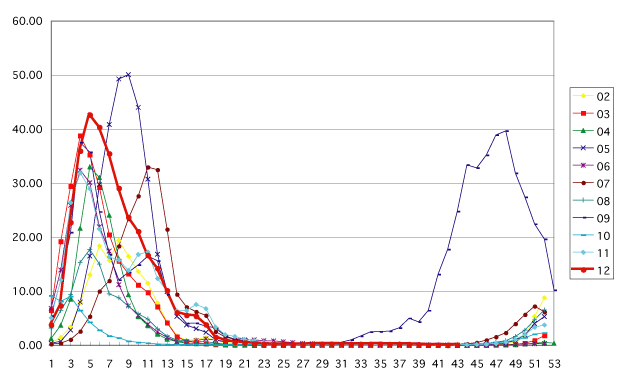
                                Influenza is revived – B type virus spreading.
                                Source:http://www.47news.jp/CN/200903/CN2009032401000729.html

                                According to the preliminary figure issued by the National Institute of
                                Infectious Diseases (NIID) on March 24, the number of flu patients reported
                                by medical institutions accross the country increased for three consecutive
                                weeks (until March 15). Flu infection is revived and influenza B virus is
                                presumably spreading.

                                While B type usually spreads after A type, it is for the first time since the
                                survey started in 1987 that B type revives the flu infection as a whole.

                                “As travelors increase during spring vacation, infection may spread further in
                                the area which is not affected so far.” warns Yoshinori Yasui, chief
                                researcher in the Infectious Disease Surveillance Center of the NIID.

                                According to the NIID, this season’s influenza peaked in the 2nd half of
                                January; the number of reports decreased since then, but started to increase
                                again in the 2nd half of February.

                                The number of patients per survey point was 12.05 in the 3rd week of
                                February (until Feb. 22) and has been increasing in the following three
                                weeks; 13.49 in the week until Mar. 1, 14.85 in the week until Mar. 8, and,
                                finally in the latest report, 16.50 in the week until Mar. 15.

                                On the prefecture basis, Yamagata is at the top with 46.25 patients per
                                survey point, followed by Miyagi (37.48), Niigata (28.94), Chiba (28.85) and
                                Shizuoka (26.29). Spread is obvious in Tohoku (North East) area.

                                2009/03/24 17:53 [Kyodo News]

                                Number of Patients per Survey Point: NIID


                                ML Flu DB supports the above.


                                *ML flu database (http://ml-flu.children.jp/) is a private online
                                database of influenza information, started in winter 2000. 300 volunteers of
                                doctors now provide clinical level information to the database in order to
                                share quick information on influenza.


                                _______________________
                                SN1987A

                                Comment

                                Working...
                                X