
 Tweet
Tweet
PNAS: H3N2 And H5N1 Reassortment
# 4372
The concern for a good many years has been that the highly pathogenic (and deadly) H5N1 bird flu virus would someday find a way to adapt more fully to humans, and spark a devastating pandemic.
Thus far, H5N1?s saving grace is that it transmits poorly among humans. A mutation, or a reassortment of the virus, could alter its transmissibility.
And that could change everything overnight.
Flu Viruses are made up of 8 gene segments, and when two flu viruses infect the same cell in a host simultaneously, they can sometimes swap genetic material and create a new hybrid virus.
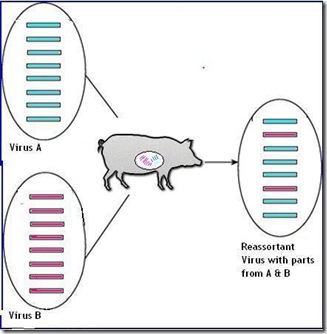
This is called reassortment, and this is how some pandemic viruses have been created in the past.
In a study released today in PNAS, scientists have taken the H5N1 virus and a seasonal H3N2 virus and have produced (using reverse genetics) all 254 possible reassortant combinations of the two, and have tested them for pathogenicity on mice.
First the abstract to the study (slightly reformatted for readability), followed by a link to a PhysOrg.com story on the study:
The `surprise? in this research was the production of multiple hybrid strains that were even more virulent (in mice) than H5N1 alone.
This report from PhysOrg.com.
Unknown is how likely any of these combinations is to occur naturally; outside of the lab.
# 4372
The concern for a good many years has been that the highly pathogenic (and deadly) H5N1 bird flu virus would someday find a way to adapt more fully to humans, and spark a devastating pandemic.
Thus far, H5N1?s saving grace is that it transmits poorly among humans. A mutation, or a reassortment of the virus, could alter its transmissibility.
And that could change everything overnight.
Flu Viruses are made up of 8 gene segments, and when two flu viruses infect the same cell in a host simultaneously, they can sometimes swap genetic material and create a new hybrid virus.

This is called reassortment, and this is how some pandemic viruses have been created in the past.
In a study released today in PNAS, scientists have taken the H5N1 virus and a seasonal H3N2 virus and have produced (using reverse genetics) all 254 possible reassortant combinations of the two, and have tested them for pathogenicity on mice.
First the abstract to the study (slightly reformatted for readability), followed by a link to a PhysOrg.com story on the study:
Reassortment between avian H5N1 and human H3N2 influenza viruses creates hybrid viruses with substantial virulence
Chengjun LiMasato HattaChairul A. NidomYukiko MuramotoShinji WatanabeGabriele NeumannYoshihiro Kawaoka
Edited by Robert G. Webster, St. Jude Children?s Research Hospital, Memphis, TN, and approved December 14, 2009 (received for review November 5, 2009)
Abstract
The spread of avian H5N1 influenza viruses around the globe has become a worldwide public health concern. To evaluate the pathogenic potential of reassortant viruses between currently cocirculating avian H5N1 and human H3N2 influenza viruses, we generated all the 254 combinations of reassortant viruses between A/chicken/South Kalimantan/UT6028/06 (SK06, H5N1) and A/Tokyo/Ut-Sk-1/07 (Tok07, H3N2) influenza viruses by reverse genetics.
We found that the presence of Tok07 PB2 protein in the ribonucleoprotein (RNP) complex allowed efficient viral RNA transcription in a minigenome assay and that RNP activity played an essential role in the viability and replicative ability of the reassortant viruses. When the pathogenicity of 75 reassortant H5 viruses was tested in mice, 22 were more pathogenic than the parental SK06 virus, and three were extremely virulent.
Strikingly, all 22 of these viruses obtained their PB2 segment from Tok07 virus. Further analysis showed that Tok07 PB1 alone lacked the ability to enhance the pathogenicity of the reassortant viruses but could do so by cooperating with Tok07 PB2.
Our data demonstrate that reassortment between an avian H5N1 virus with low pathogenicity in mice and a human virus could result in highly pathogenic viruses and that the human virus PB2 segment functions in the background of an avian H5N1 virus, enhancing its virulence.
Our findings highlight the importance of surveillance programs to monitor the emergence of human H5 reassortant viruses, especially those containing a PB2 segment of human origin.
This study has an impressive pedigree that includes such familiar names as Yoshihiro Kawaoka, C.A. Nidom, and no less than Dr. Robert Webster. Chengjun LiMasato HattaChairul A. NidomYukiko MuramotoShinji WatanabeGabriele NeumannYoshihiro Kawaoka
Edited by Robert G. Webster, St. Jude Children?s Research Hospital, Memphis, TN, and approved December 14, 2009 (received for review November 5, 2009)
Abstract
The spread of avian H5N1 influenza viruses around the globe has become a worldwide public health concern. To evaluate the pathogenic potential of reassortant viruses between currently cocirculating avian H5N1 and human H3N2 influenza viruses, we generated all the 254 combinations of reassortant viruses between A/chicken/South Kalimantan/UT6028/06 (SK06, H5N1) and A/Tokyo/Ut-Sk-1/07 (Tok07, H3N2) influenza viruses by reverse genetics.
We found that the presence of Tok07 PB2 protein in the ribonucleoprotein (RNP) complex allowed efficient viral RNA transcription in a minigenome assay and that RNP activity played an essential role in the viability and replicative ability of the reassortant viruses. When the pathogenicity of 75 reassortant H5 viruses was tested in mice, 22 were more pathogenic than the parental SK06 virus, and three were extremely virulent.
Strikingly, all 22 of these viruses obtained their PB2 segment from Tok07 virus. Further analysis showed that Tok07 PB1 alone lacked the ability to enhance the pathogenicity of the reassortant viruses but could do so by cooperating with Tok07 PB2.
Our data demonstrate that reassortment between an avian H5N1 virus with low pathogenicity in mice and a human virus could result in highly pathogenic viruses and that the human virus PB2 segment functions in the background of an avian H5N1 virus, enhancing its virulence.
Our findings highlight the importance of surveillance programs to monitor the emergence of human H5 reassortant viruses, especially those containing a PB2 segment of human origin.
The `surprise? in this research was the production of multiple hybrid strains that were even more virulent (in mice) than H5N1 alone.
This report from PhysOrg.com.
Virus hybridization could create pandemic bird flu
<small>February 22, 2010 </small> Genetic interactions between avian H5N1 influenza and human seasonal influenza viruses have the potential to create hybrid strains combining the virulence of bird flu with the pandemic ability of H1N1, according to a new study.
In laboratory experiments in mice, a single gene segment from a human seasonal flu virus, H3N2, was able to convert the avian H5N1 virus into a highly pathogenic form. The findings are reported the week of Feb. 22 in the online early edition of the Proceedings of the National Academy of Sciences.
"Some hybrids between H5N1 virus and seasonal influenza viruses were more pathogenic than the original H5N1 viruses. That is worrisome," says Yoshihiro Kawaoka, a virologist at the University of Wisconsin-Madison and senior author of the new study.
The H5N1 bird flu virus has spread worldwide through bird populations and has caused 442 confirmed human cases and 262 deaths, according to the World Health Organization. To date, however, bird flu has not been able to spread effectively between people.
"H5N1 virus has never acquired the ability to transmit among humans, which is why we haven't had a pandemic. The worry is that the pandemic H1N1 virus may provide that nature in the background of this highly pathogenic H5N1 virus," says Kawaoka, a professor of pathobiological sciences at the UW-Madison School of Veterinary Medicine.
(Continue . . . )
<small>February 22, 2010 </small> Genetic interactions between avian H5N1 influenza and human seasonal influenza viruses have the potential to create hybrid strains combining the virulence of bird flu with the pandemic ability of H1N1, according to a new study.
In laboratory experiments in mice, a single gene segment from a human seasonal flu virus, H3N2, was able to convert the avian H5N1 virus into a highly pathogenic form. The findings are reported the week of Feb. 22 in the online early edition of the Proceedings of the National Academy of Sciences.
"Some hybrids between H5N1 virus and seasonal influenza viruses were more pathogenic than the original H5N1 viruses. That is worrisome," says Yoshihiro Kawaoka, a virologist at the University of Wisconsin-Madison and senior author of the new study.
The H5N1 bird flu virus has spread worldwide through bird populations and has caused 442 confirmed human cases and 262 deaths, according to the World Health Organization. To date, however, bird flu has not been able to spread effectively between people.
"H5N1 virus has never acquired the ability to transmit among humans, which is why we haven't had a pandemic. The worry is that the pandemic H1N1 virus may provide that nature in the background of this highly pathogenic H5N1 virus," says Kawaoka, a professor of pathobiological sciences at the UW-Madison School of Veterinary Medicine.
(Continue . . . )
Unknown is how likely any of these combinations is to occur naturally; outside of the lab.
Nature, of course, has a huge and extensive laboratory, that is open for business 24/7.
However remote, one would do well to consider the wisdom of betting against the possibility.

Comment