
 Tweet
Tweet
Re: Australia Influenza Surveillance 2013
Updated information is indicated with a *
New South Wales
Week 31 Ending 4 August 2013
Summary:
For the week ending 4 August 2013, influenza activity continued to increase. There is no indication yet that influenza activity has peaked in the current influenza season.
Emergency Department surveillance ? the index of increase for influenza-like illness (ILI) presentations was above the seasonal threshold. The current level is consistent with the winter influenza season.
Laboratory surveillance ? the proportion of respiratory samples positive for influenza A and B increased this week (14.6%), predominantly influenza A(H1N1)pdm09. Other respiratory virus activity is also high.
Community illness surveillance ? data collected from eGPs, ASPREN and FluTracking on ILI activity in NSW show small increases. National and International influenza surveillance ? No new human cases of infection with the novel avian influenza A(H7N9) strain from China; otherwise low influenza activity worldwide.
For more information: NSW Health - Infectious Diseases Alert
*Queensland
Week ending August 4th.
There were 143 cases of influenza virus infection reported this week. Of these cases, 58 were attributed to influenza B virus, 71 were listed as Influenza A unsubtyped, 4 as A/H3N2 and 10 as A/H1N1(pdm09). 17 hospitalizations occurred (public hospitals only). There have been 1,952 influenza cases year-to-date.
There have been 152 hospital admissions including 18 to ICU.
For more information: QLD Health - Preventable Diseases
South Australia
21 July to 27 July 2013
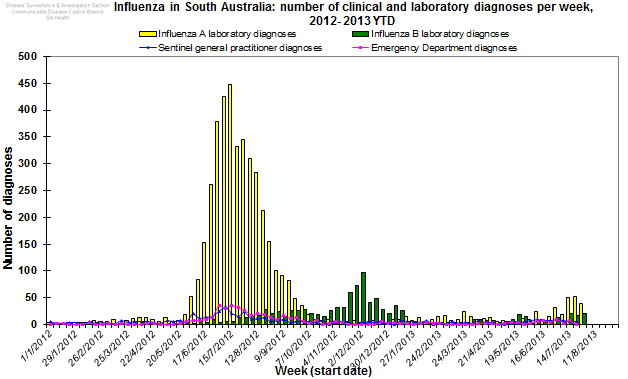
Seventy-one cases of influenza were reported this week, compared to 93 cases reported in the previous week. Of these cases, 46 were attributed to influenza A virus and 25 were typed as influenza B. There have been 1028 influenza cases notified year-to-date compared with 3,236 cases reported for the same period last year.
Cases comprised of 24 males and 47 females. Of these, 19% were children <10 years of age and 8% were reported in persons aged 65 years or older. Since the beginning of 2013, 18% of notified influenza cases were reported in children <10 years of age.
*
For more information: Communicable Diseases Control Branch
Tasmania
Week ending August 4th
Summary
There has been a modest increase in influenza notifications recently in Tasmania. Syndromic surveillance systems are reporting stable levels of influenza like illness (ILI) at levels lower than at this time in 2012. Respiratory pathogen testing suggests that influenza A, and other non-influenza viruses are contributing to ILI in Tasmania.
39 influenza notifications have been received during 2013 up to 4 August. There has been an increase in the number of influenza notifications (14 cases) received during the last week in July and the first week in August.
Influenza types
During 2013 up to 4 August, 32 Influenza A notifications and 7 Influenza B notifications were received. The majority of typed Influenza A have been Influenza A H1N1 (2009 strain).
For more information: DHHS Tasmania
*Victoria
Week Ending: August 11, 2013
Summary
? Influenza-like illness (ILI) activity is slightly lower this week with a presentation rate of 2.7 cases per 1000 patients seen, remaining under baseline levels. MMDS rates remained just above baseline levels.
? From the 198 swabs received from surveillance GPs this season (30/4/13 ? 11/8/13) seven have been positive for influenza A and 16 for influenza B.
? The majority of viruses detected through routine testing this week were influenza B. Of the 85 influenza viruses detected so far this year 14 were A(H1N1)pdm09, 23 were H3, six are untyped/ yet to be typed and 40 were influenza B.
? This week the Influenza Complications Network (FluCAN) reported seven hospitalisations, two from influenza B, 1 from influenza (H3N2) and four from influenza A untyped. Since 6/4/2013 FluCAN have reported 80 hospitalisations with confirmed influenza, of which one was a patient with A(H1N1)pdm09, 30 were untyped influenza A patients, 20 were influenza A(H3N2) and 29 were influenza B from the four Victorian sentinel hospitals. Of the 80 hospitalisations six were admitted to ICU, three were pregnant and 64 had comorbidities.
? Of the 87 influenza viruses analysed at the WHO Collaborating Centre for Reference and Research on Influenza year to date from Victoria, eight were A(H1N1)pdm09, 15 H3 and 64 influenza B. The majority of strain-typed influenza B viruses in Victoria in 2013 have been B/Massachusetts/2/2012-like, an antigenic drift variant of the B/Wisconsin/1/2010-like virus in the 2013 southern hemisphere vaccine.
? The total number of laboratory confirmed notifications to the National Notifiable Diseases Surveillance System (NNDSS) to date was 8,295, of which 1,652 (19.9%) were from Victoria.
For more information: Victorian Infectious Diseases Reference Laboratory
*Western Australia
WEEK ENDING 11TH OF AUGUST 2013
KEY POINTS
INFLUENZA AND INFLUENZA-LIKE ILLNESSES (ILI)
Summary: Influenza activity is currently increasing from a low base, and is consistent with that of
previous mild influenza seasons.
? GP sentinel surveillance indicates an increase in ILI consultations and influenza virus detections this
week.
? The majority of influenza virus detections in this reporting period were influenza A/H3N2 (58%), with
lesser amounts of influenza A/H1N1 2009 (16%) and influenza B virus (13%).
? Hospital presentations and admissions for ILI and influenza are increasing but are relatively low for this
time of year.
? Detections of non-influenza viruses declined overall, although metapneumovirus activity increased.
For more information: WA Virus Watch
*Nationally
For the period to Jan 1- Aug 17, 2013 there were 9,300 confirmed Influenza cases.
The majority of notifications have been in NSW with 2,564, QLD had 2,269, Victoria 1,901, SA 1,379, WA had 862, NT 183, ACT 92 and Tas 50.
For national data: National Notifiable Diseases Surveillance System
*Australian Sentinel Practices Research Network (ASPREN)
ASPREN is a national syndromic surveillance program co-ordinated by the Discipline of General Practice at the University of Adelaide and The Royal Australian College of General Practitioners. One of the conditions under surveillance is influenza like illness (ILI). General practitioners participating in the ASPREN program contribute data on the proportion of consultations which are ILI related.
No. 15, 2013
15th July ? 28th July 2013
INFLUENZA-LIKE-ILLNESS (ILI)
Nationally, ILI notifications increased slightly over the period with 226 and 193
notifications in week 29 and 30 respectively. ILI rates reported in this period increased
remained steady with 12 cases per 1000 consultations in weeks 29 and 30, compared
to 10 and 12 cases per 1000 in weeks 25 and 26 respectively. For the same reporting
period in 2012, ILI rates were higher at 23 and 19 cases per 1000 consultations
respectively (see Figure 1). On a state-by-state basis, it is important to note the
increased ILI rate in urban NSW and TAS.
For more information: ASPREN
*Flu Tracking
Flutracking Weekly Interim Report
Week #16 - ending 11 August 2013
Low levels of influenza-like illness activity.
This survey was sent on Monday 12 August 12:12 AM and by Thursday 15 August 9:00 AM we had received
14799 responses (14718 last week) from 9547 people responding for themselves and 5252 household members
across Australia.
Across Australia, fever and cough was reported by
2.7% of vaccinated participants and 3.5% of
unvaccinated participants. Fever, cough and absence
from normal duties was reported by 1.7% of vaccinated
participants and 2.3% of unvaccinated participants.
For participants this week, 8859/14797 (59.9%) have
received the seasonal vaccine so far. Of the 3072
participants who identified as working face-to-face with
patients, 2394 (77.9%) have received the vaccine.
For more information, or to enrol: Flu Tracking
*Australian influenza report 2013 - Current report:
Australian influenza report 2013?20 July to 02 August 2013 (#04/2013)
Current Report Summary
Although overall influenza activity remains relatively low, the steady national increase has continued.
Since the beginning of the year there have been 7,827 laboratory confirmed cases of influenza reported. Over the past fortnight there were 1,436 notifications, with almost a third reported from New South Wales (508).
Nationally, whilst influenza A remains the predominant influenza virus type, the proportion of influenza B notifications decreased slightly this fortnight. During the 2012 season there were very few notifications of influenza A(H1N1) pdm09. So far in 2013 whilst the majority of influenza A reports are unsubtyped, more than 10% of overall notifications have been reported as influenza A(H1N1) pdm09.
Across jurisdictions the distribution of influenza types and subtypes is variable. In Victoria there is a predominance of influenza type B, whereas most other states are reporting a predominance of influenza type A, with NSW reporting mostly A(H1N1)pdm09 and Western Australia mostly A(H3N2).
Over the past few weeks there has been a continued seasonal increase in influenza associated hospitalisations. Around 10% of influenza cases have been admitted directly to ICU. The age distribution of hospital admissions shows peaks in the 0-9 and over 60 years age groups.
The WHO has reported that influenza activity in the northern hemisphere temperate zones remains at inter-seasonal levels. In the temperate countries of South America and Southern Africa, influenza transmission peaked in late June and was primarily associated with influenza A(H1N1)pdm09.
The WHO has reported on an additional laboratory-confirmed case of human infection with avian influenza A(H7N9) virus in China. This is the second new confirmed case since 29 May 2013. There continues to be no evidence of sustainable human-to-human transmission. A recent serology study on members of the general public and poultry workers found evidence which supports suspicions that poultry are the source of the outbreak and mild or asymptomatic cases are more common than initially thought.
The United States has reported further cases of the influenza A(H3N2) variant virus that were associated with fair attendance and contact with swine. The virus detected is the same as the variant viruses detected during the 2012 multi-state outbreak, which was also associated with swine exposure at agricultural fairs.
For more information see Department of Health and Ageing
Updated information is indicated with a *
New South Wales
Week 31 Ending 4 August 2013
Summary:
For the week ending 4 August 2013, influenza activity continued to increase. There is no indication yet that influenza activity has peaked in the current influenza season.
Emergency Department surveillance ? the index of increase for influenza-like illness (ILI) presentations was above the seasonal threshold. The current level is consistent with the winter influenza season.
Laboratory surveillance ? the proportion of respiratory samples positive for influenza A and B increased this week (14.6%), predominantly influenza A(H1N1)pdm09. Other respiratory virus activity is also high.
Community illness surveillance ? data collected from eGPs, ASPREN and FluTracking on ILI activity in NSW show small increases. National and International influenza surveillance ? No new human cases of infection with the novel avian influenza A(H7N9) strain from China; otherwise low influenza activity worldwide.
For more information: NSW Health - Infectious Diseases Alert
*Queensland
Week ending August 4th.
There were 143 cases of influenza virus infection reported this week. Of these cases, 58 were attributed to influenza B virus, 71 were listed as Influenza A unsubtyped, 4 as A/H3N2 and 10 as A/H1N1(pdm09). 17 hospitalizations occurred (public hospitals only). There have been 1,952 influenza cases year-to-date.
There have been 152 hospital admissions including 18 to ICU.
For more information: QLD Health - Preventable Diseases
South Australia
21 July to 27 July 2013
Seventy-one cases of influenza were reported this week, compared to 93 cases reported in the previous week. Of these cases, 46 were attributed to influenza A virus and 25 were typed as influenza B. There have been 1028 influenza cases notified year-to-date compared with 3,236 cases reported for the same period last year.
Cases comprised of 24 males and 47 females. Of these, 19% were children <10 years of age and 8% were reported in persons aged 65 years or older. Since the beginning of 2013, 18% of notified influenza cases were reported in children <10 years of age.
*
For more information: Communicable Diseases Control Branch
Tasmania
Week ending August 4th
Summary
There has been a modest increase in influenza notifications recently in Tasmania. Syndromic surveillance systems are reporting stable levels of influenza like illness (ILI) at levels lower than at this time in 2012. Respiratory pathogen testing suggests that influenza A, and other non-influenza viruses are contributing to ILI in Tasmania.
39 influenza notifications have been received during 2013 up to 4 August. There has been an increase in the number of influenza notifications (14 cases) received during the last week in July and the first week in August.
Influenza types
During 2013 up to 4 August, 32 Influenza A notifications and 7 Influenza B notifications were received. The majority of typed Influenza A have been Influenza A H1N1 (2009 strain).
For more information: DHHS Tasmania
*Victoria
Week Ending: August 11, 2013
Summary
? Influenza-like illness (ILI) activity is slightly lower this week with a presentation rate of 2.7 cases per 1000 patients seen, remaining under baseline levels. MMDS rates remained just above baseline levels.
? From the 198 swabs received from surveillance GPs this season (30/4/13 ? 11/8/13) seven have been positive for influenza A and 16 for influenza B.
? The majority of viruses detected through routine testing this week were influenza B. Of the 85 influenza viruses detected so far this year 14 were A(H1N1)pdm09, 23 were H3, six are untyped/ yet to be typed and 40 were influenza B.
? This week the Influenza Complications Network (FluCAN) reported seven hospitalisations, two from influenza B, 1 from influenza (H3N2) and four from influenza A untyped. Since 6/4/2013 FluCAN have reported 80 hospitalisations with confirmed influenza, of which one was a patient with A(H1N1)pdm09, 30 were untyped influenza A patients, 20 were influenza A(H3N2) and 29 were influenza B from the four Victorian sentinel hospitals. Of the 80 hospitalisations six were admitted to ICU, three were pregnant and 64 had comorbidities.
? Of the 87 influenza viruses analysed at the WHO Collaborating Centre for Reference and Research on Influenza year to date from Victoria, eight were A(H1N1)pdm09, 15 H3 and 64 influenza B. The majority of strain-typed influenza B viruses in Victoria in 2013 have been B/Massachusetts/2/2012-like, an antigenic drift variant of the B/Wisconsin/1/2010-like virus in the 2013 southern hemisphere vaccine.
? The total number of laboratory confirmed notifications to the National Notifiable Diseases Surveillance System (NNDSS) to date was 8,295, of which 1,652 (19.9%) were from Victoria.
For more information: Victorian Infectious Diseases Reference Laboratory
*Western Australia
WEEK ENDING 11TH OF AUGUST 2013
KEY POINTS
INFLUENZA AND INFLUENZA-LIKE ILLNESSES (ILI)
Summary: Influenza activity is currently increasing from a low base, and is consistent with that of
previous mild influenza seasons.
? GP sentinel surveillance indicates an increase in ILI consultations and influenza virus detections this
week.
? The majority of influenza virus detections in this reporting period were influenza A/H3N2 (58%), with
lesser amounts of influenza A/H1N1 2009 (16%) and influenza B virus (13%).
? Hospital presentations and admissions for ILI and influenza are increasing but are relatively low for this
time of year.
? Detections of non-influenza viruses declined overall, although metapneumovirus activity increased.
For more information: WA Virus Watch
*Nationally
For the period to Jan 1- Aug 17, 2013 there were 9,300 confirmed Influenza cases.
The majority of notifications have been in NSW with 2,564, QLD had 2,269, Victoria 1,901, SA 1,379, WA had 862, NT 183, ACT 92 and Tas 50.
For national data: National Notifiable Diseases Surveillance System
*Australian Sentinel Practices Research Network (ASPREN)
ASPREN is a national syndromic surveillance program co-ordinated by the Discipline of General Practice at the University of Adelaide and The Royal Australian College of General Practitioners. One of the conditions under surveillance is influenza like illness (ILI). General practitioners participating in the ASPREN program contribute data on the proportion of consultations which are ILI related.
No. 15, 2013
15th July ? 28th July 2013
INFLUENZA-LIKE-ILLNESS (ILI)
Nationally, ILI notifications increased slightly over the period with 226 and 193
notifications in week 29 and 30 respectively. ILI rates reported in this period increased
remained steady with 12 cases per 1000 consultations in weeks 29 and 30, compared
to 10 and 12 cases per 1000 in weeks 25 and 26 respectively. For the same reporting
period in 2012, ILI rates were higher at 23 and 19 cases per 1000 consultations
respectively (see Figure 1). On a state-by-state basis, it is important to note the
increased ILI rate in urban NSW and TAS.
For more information: ASPREN
*Flu Tracking
Flutracking Weekly Interim Report
Week #16 - ending 11 August 2013
Low levels of influenza-like illness activity.
This survey was sent on Monday 12 August 12:12 AM and by Thursday 15 August 9:00 AM we had received
14799 responses (14718 last week) from 9547 people responding for themselves and 5252 household members
across Australia.
Across Australia, fever and cough was reported by
2.7% of vaccinated participants and 3.5% of
unvaccinated participants. Fever, cough and absence
from normal duties was reported by 1.7% of vaccinated
participants and 2.3% of unvaccinated participants.
For participants this week, 8859/14797 (59.9%) have
received the seasonal vaccine so far. Of the 3072
participants who identified as working face-to-face with
patients, 2394 (77.9%) have received the vaccine.
For more information, or to enrol: Flu Tracking
*Australian influenza report 2013 - Current report:
Australian influenza report 2013?20 July to 02 August 2013 (#04/2013)
Current Report Summary
Although overall influenza activity remains relatively low, the steady national increase has continued.
Since the beginning of the year there have been 7,827 laboratory confirmed cases of influenza reported. Over the past fortnight there were 1,436 notifications, with almost a third reported from New South Wales (508).
Nationally, whilst influenza A remains the predominant influenza virus type, the proportion of influenza B notifications decreased slightly this fortnight. During the 2012 season there were very few notifications of influenza A(H1N1) pdm09. So far in 2013 whilst the majority of influenza A reports are unsubtyped, more than 10% of overall notifications have been reported as influenza A(H1N1) pdm09.
Across jurisdictions the distribution of influenza types and subtypes is variable. In Victoria there is a predominance of influenza type B, whereas most other states are reporting a predominance of influenza type A, with NSW reporting mostly A(H1N1)pdm09 and Western Australia mostly A(H3N2).
Over the past few weeks there has been a continued seasonal increase in influenza associated hospitalisations. Around 10% of influenza cases have been admitted directly to ICU. The age distribution of hospital admissions shows peaks in the 0-9 and over 60 years age groups.
The WHO has reported that influenza activity in the northern hemisphere temperate zones remains at inter-seasonal levels. In the temperate countries of South America and Southern Africa, influenza transmission peaked in late June and was primarily associated with influenza A(H1N1)pdm09.
The WHO has reported on an additional laboratory-confirmed case of human infection with avian influenza A(H7N9) virus in China. This is the second new confirmed case since 29 May 2013. There continues to be no evidence of sustainable human-to-human transmission. A recent serology study on members of the general public and poultry workers found evidence which supports suspicions that poultry are the source of the outbreak and mild or asymptomatic cases are more common than initially thought.
The United States has reported further cases of the influenza A(H3N2) variant virus that were associated with fair attendance and contact with swine. The virus detected is the same as the variant viruses detected during the 2012 multi-state outbreak, which was also associated with swine exposure at agricultural fairs.
For more information see Department of Health and Ageing
 , predominantly influenza B. Other respiratory virus activity are decreasing.
Comment