Check out the FAQ,Terms of Service & Disclaimers by clicking the
link. Please register
to be able to post. By viewing this site you are agreeing to our Terms of Service and Acknowledge our Disclaimers.
FluTrackers.com Inc. does not provide medical advice. Information on this web site is collected from various internet resources, and the FluTrackers board of directors makes no warranty to the safety, efficacy, correctness or completeness of the information posted on this site by any author or poster.
The information collated here is for instructional and/or discussion purposes only and is NOT intended to diagnose or treat any disease, illness, or other medical condition. Every individual reader or poster should seek advice from their personal physician/healthcare practitioner before considering or using any interventions that are discussed on this website.
By continuing to access this website you agree to consult your personal physican before using any interventions posted on this website, and you agree to hold harmless FluTrackers.com Inc., the board of directors, the members, and all authors and posters for any effects from use of any medication, supplement, vitamin or other substance, device, intervention, etc. mentioned in posts on this website, or other internet venues referenced in posts on this website.
We are not asking for any donations. Do not donate to any entity who says they are raising funds for us.
Announcement
Collapse
No announcement yet.
Canada April 26 + A/H1N1 Cases - 427 total deaths as of 02/04/2010
Re: Canada Suspected/Confirmed Swine Flu Cases April 26 +
I found this very interesting in that his symptoms got better and quickly trned worse.
Wed May. 27 2009 8:01:10 PM
Man who died from H1N1 was otherwise healthy: family
The family of a Scarborough man whose death has been linked to H1N1 flu says the 44-year-old diabetic was very healthy until developing a cough last week.
The father of two took some time off but went back to work on Friday because he was feeling better. He started feeling sick again later that day, according to his colleagues.
His family says he suddenly started coughing Saturday morning and couldn't stop. He was not responsive by the time paramedics arrived on the scene, and they were unable to revive him.
He leaves behind a wife and two young children.
Ontario's acting chief medical officer has said people with certain chronic medical conditions appear to be at greater risk of dying from swine flu if they catch it.
Re: Canada Suspected/Confirmed Swine Flu Cases April 26 +
Don't know the answer to you question Dr. Woodson. However in Ontario it is expected to wane and they will continue surveillance throughout the summer as mentioned below:
...Seasonal flu wanes
At the start of the province's investigation of the outbreak, cases of seasonal H3N2 flu were running three to one over H1N1 cases, Williams noted.
"It's now switched around. So in the last week, 60 per cent of the tests being done were H1N1, so it's reversed."
Cases of seasonal flu, which leads to 5,000 premature deaths in Canada each year, tend to decline heading into summer.
"I think as we see these little waves or blips where it seems to bounce, it's like waves coming ashore. They tend to get shallower and shallower as you move into the summer season," Williams said.
As of May 22, a total of 805 laboratory-confirmed cases of H1N1 flu virus have been reported in Canada, according to the Public Health Agency of Canada.
Ontario plans to continue its regular flu surveillance throughout the summer.
The aim is not to count all cases, Williams said, but to spot check whether the virus is present and whether new cases are arising. The information will guide health officials on whether to ramp up enhanced surveillance in the fall...
Re: Canada Suspected/Confirmed Swine Flu Cases April 26 +
Dr. Woodson,
I think things are settling a bit in BC.
The flu reports here are compiled from 3 main sources:
-ILI sentinel reports
-MSP (Medical Services Plan) tracking - every doctor visit is billed to the province and must be coded for the presentig condition
-lab results
These three data inputs do give a generally good picture of the situation on the ground IMO.
indicates high ILI activity for weeks 17 and 18 and a subsequent drop in week 19. Of course it could be that people are simply not going in to see their practitioner as the general opinion is that the flu is no longer something to see a dr about unless symptoms are very severe.
Also, there was a surge in testing but the positive cases as a percentage remain low.
Re: Canada Suspected/Confirmed Swine Flu Cases April 26 +
Some excerpts about the Ontario numbers from the source below:
Swine flu cases on the rise in GTA MAP
Theresa Boyle
Health Reporter
The latest results of confirmed swine flu cases in Ontario show a 41 per cent increase in the number of infected people, the majority of them in the Greater Toronto Area....
...Provincial officials say the increase in numbers is due to more monitoring, testing and clearing of a backlog of cases.
"The large increase in cases is due to enhanced surveillance, increased laboratory testing capacity and the processing of a backlog of tests conducted on the weekend by public health officials," Dr. David Williams, Ontario's acting chief medical officer of health, stated in a news release.
Toronto has had 237 cases, or almost half of the total cases in the province....
...Provincial numbers are a day or two old and Yaffe said there are actually even more cases in the city.
"I hope the numbers will go down but at this point they are still going up," she said.
Yaffe offered some reasons Toronto is seeing larger numbers than other parts of the province.
"We have a larger population to begin with and a more dense population. People are closer together and it spreads person to person," she said.
"It depends on the behaviour of people who get ill, whether they go to their physician or hospital. Then it depends on the behaviour of the physician or hospital they see in terms of whether they get tested or not," she added.
The number of cases reported is also a reflection of testing behaviour, Yaffe explained.
"Not everyone with the flu gets tested so those numbers only reflect the people who got tested and were positive," she said, adding she would not be surprised if more people in Toronto get tested than in other areas of the province.
"In Toronto, we are more sensitized post-SARS," she said.
...The province is currently recommending testing for the virus for people who are severely ill.[/B]
"We know the virus is here so it makes no significant difference to the individual's care. Where it makes a difference is knowing if the virus is circulating," Yaffe said.
Epidemiological Update Map for Canada, by Province & Territory
Laboratory-Confirmed Cases of H1N1 Flu Virus
May 29, 2009, 15h00 EDT
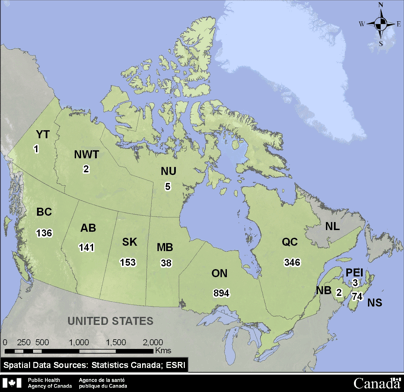
As of May 29 2009, a total of 1,336 laboratory-confirmed cases of H1N1 flu virus have been reported in 9 provinces and 2 territory in Canada (see Table 1 below).
********************************************
Table 1: Summary of laboratory-confirmed cases of H1N1 flu virus reported to the Public Health Agency of Canada, by the provinces and territories as of May 29, 2009 at 15:00 EDT.
Province / Territory -- (1)NEW Laboratory-Confirmed Cases reported since May 27, 2009-- TOTAL Laboratory-confirmed Cases (including today?s cases)---Total Deaths(2)
British Columbia 2-122-0
Alberta 12-121-1
Saskatchewan 19-123-0
Manitoba 5-11- 0
Ontario 131-626-1
Quebec 46-253-0
New Brunswick 0-2-0
Nova Scotia 2-73- 0
Prince Edward Island 0-3-0
Newfoundland 0-0-0
Yukon 0-1-0
Northwest Territories 0-0-0
Nunavut 1-1-0
Total 218-1,336- 2
(1) Note: P/Ts may choose to announce cases that have been confirmed after 15:00 EDT.
These cases will be reflected in the next epidemiological update.
(2) Number of deaths is included in the number of cases
*******************************************
As of May 29, 2009, the average age reported is 22 years or younger (median: 17 years; range: <1 ? 80 years). To date 47 hospitalizations and two deaths have been reported among laboratory-confirmed cases. The most recent date of symptom onset is May 23, 2009.
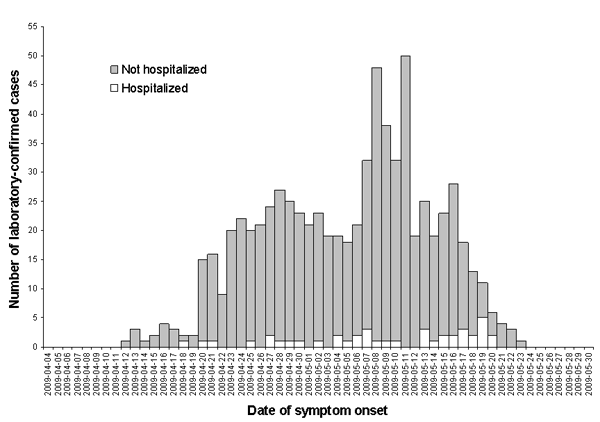
The following graph, also known as an epidemic curve, is up to date as of May 27, 2009. The graph illustrates the course of the current H1N1 flu virus outbreak in Canada. It shows the date when symptoms of H1N1 flu virus began for each of the laboratory-confirmed cases.
Figure 1. Number of Laboratory-Confirmed H1N1 Flu Virus Cases in Canada by Date of Onset as reported to the Public Health Agency of Canada as of May 27, 2009 15:00 EDT (N=732).
Source: Provincial/Territorial Ministries of Health
When interpreting the graph, it should be noted that:
* The graph is prepared retrospectively and is updated daily using the information available at that time. It is not as current as Table 1 that contains the summary of laboratory-confirmed cases, as information about the date of onset of symptoms takes more time to compile.
* There is always a delay from the date that an illness starts to the date the case is reported to public health authorities. This delay is the result of the time required for patients to see their physicians, laboratory testing to be completed, and results to be communicated to public health authorities.
Epidemiological Update Map for Canada, by Province & Territory
Laboratory-Confirmed Cases of H1N1 Flu Virus
June 1, 2009, 15h00 EDT
As of June 1st 2009, a total of 1,530 laboratory-confirmed cases of H1N1 flu virus have been reported in 9 provinces and 3 territories in Canada (see Table 1 below).
*************************************
Table 1: Summary of laboratory-confirmed cases of H1N1 flu virus reported to the Public Health Agency of Canada, by the provinces and territories as of June 1st , 2009 at 15:00 EDT.
Province / Territory (1)NEW Laboratory-Confirmed Cases reported since May 29, 2009 TOTAL Laboratory-confirmed Cases (including today?s cases) (2)Total Deaths
British Columbia 10-132-0
Alberta 5-126-1
Saskatchewan 30-153-0
Manitoba 0-11- 0
Ontario 89-715-1
Quebec 56-309-0
New Brunswick 0-2-0
Nova Scotia 0-73- 0
Prince Edward Island 0-3-0
Newfoundland 0-0-0
Yukon 0-1-0
Northwest Territories 1-1-0
Nunavut 3-4-0
Total 194-1530-2
(1) Note: P/Ts may choose to announce cases that have been confirmed after 15:00 EDT.
These cases will be reflected in the next epidemiological update.
(2) Number of deaths is included in the number of cases
****************
As of May 29, 2009, the average age reported is 22 years or younger (median: 17 years; range: <1 ? 80 years). To date 57 hospitalizations and two deaths have been reported among laboratory-confirmed cases. The most recent date of symptom onset is May 23, 2009.
The following graph, also known as an epidemic curve, is up to date as of May 27, 2009. The graph illustrates the course of the current H1N1 flu virus outbreak in Canada. It shows the date when symptoms of H1N1 flu virus began for each of the laboratory-confirmed cases.
Figure 1. Number of Laboratory-Confirmed H1N1 Flu Virus Cases in Canada by Date of Onset as reported to the Public Health Agency of Canada as of May 27, 2009 15:00 EDT (N=732).
Source: Provincial/Territorial Ministries of Health
When interpreting the graph, it should be noted that:
* The graph is prepared retrospectively and is updated daily using the information available at that time. It is not as current as Table 1 that contains the summary of laboratory-confirmed cases, as information about the date of onset of symptoms takes more time to compile.
* There is always a delay from the date that an illness starts to the date the case is reported to public health authorities. This delay is the result of the time required for patients to see their physicians, laboratory testing to be completed, and results to be communicated to public health authorities.
Epidemiological Update Map for Canada, by Province & Territory
Laboratory-Confirmed Cases of H1N1 Flu Virus
June 3, 2009, 15h00 EDT
As of June 3rd 2009, a total of 1,795 laboratory-confirmed cases of H1N1 flu virus have been reported in 9 provinces and 3 territories in Canada (see Table 1 below).
*************************************
Table 1: Summary of laboratory-confirmed cases of H1N1 flu virus reported to the Public Health Agency of Canada, by the provinces and territories as of June 3, 2009 at 15:00 EDT.
Province / Territory NEW Laboratory-Confirmed Cases reported since June 1, 2009(1) TOTAL Laboratory-confirmed Cases (including today?s cases) (2) Total Deaths
British Columbia 4-136-0
Alberta 15-141-1
Saskatchewan 0-153-0
Manitoba 27-38-0
Ontario 179-894-2
Quebec 37-346-0
New Brunswick 0-2-0
Nova Scotia 1-74- 0
Prince Edward Island 0-3-0
Newfoundland 0-0-0
Yukon 0-1-0
Northwest Territories 1-2-0
Nunavut 1-5-0
Total 265-1,795- 3
(1) Note: P/Ts may choose to announce cases that have been confirmed after 15:00 EDT.
These cases will be reflected in the next epidemiological update.
(2) Number of deaths is included in the number of cases
******************************************
As of June 1, 2009, the average age reported is 23 years (median: 17 years; range: <1 ? 80 years). To date 98 hospitalizations and three deaths have been reported among laboratory-confirmed cases. The most recent date of symptom onset is May 27, 2009.
The following graph, also known as an epidemic curve, is up to date as of 1 June, 2009. The graph illustrates the course of the current H1N1 flu virus outbreak in Canada. It shows the date when symptoms of H1N1 flu virus began for each of the laboratory-confirmed cases.
Number of laboratory-confirmed H1N1 flu virus cases in Canada by date of onset as reported to the Public Health Agency of Canada as of 1 June 2009 15:00 EDT (N=863).
Figure 1. Number of laboratory-confirmed H1N1 flu virus cases in Canada by date of onset as reported to the Public Health Agency of Canada as of 1 June 2009 15:00 EDT (N=863).
Source: Provincial/Territorial Ministries of Health
When interpreting the graph, it should be noted that:
* The graph is prepared retrospectively and is updated daily using the information available at that time. It is not as current as Table 1 that contains the summary of laboratory-confirmed cases, as information about the date of onset of symptoms takes more time to compile.
* There is always a delay from the date that an illness starts to the date the case is reported to public health authorities. This delay is the result of the time required for patients to see their physicians, laboratory testing to be completed, and results to be communicated to public health authorities.
Manitoba health officials won't comment on mystery flu on northern reserve
Published Wednesday June 3rd, 2009
Steve Lambert, THE CANADIAN PRESS
WINNIPEG - Manitoba health officials refused to comment Wednesday on a mysterious flu that has sent at least a dozen people from an isolated reserve to hospital in Winnipeg.
While most people are experiencing mild symptoms, the flu has caused two pregnant women to fall seriously ill, including one who lost her child, according to Chief David McDougall of the St. Theresa Point First Nation.
It has also prompted the community to cancel some public events.
"People like to play canasta with each other at the community hall. It's those kind of social interactions that people have had to hold in abeyance for now," McDougall said from the community roughly 500 kilometres northeast of Winnipeg.
Tests are underway to see if the illnesses are being caused by the new H1N1 swine flu virus that has circulated in many countries. The provincial and federal governments have sent more doctors and nurses to the remote community of 3,200, which is accessible only by air.
Health officials would not discuss St. Theresa Point on Wednesday, and would only say that 27 new cases of swine flu have been confirmed across the province, bringing the total to 38. Of the new cases, three were from the sprawling health region that includes St. Theresa Point.
"We don't provide community names because we don't want to breach any personal health information," said Elise Weiss, the province's acting chief public health officer.
The uncertainty has prompted some residents of the reserve to wear masks. Band officials are asking people to wash their hands frequently and take other precautions. But they say they don't want to overreact.
"People are asked to limit contact with each other and also to use proper coughing etiquette," McDougall said. "I don't want people to get overly alarmed."
Limiting contact is a tall order in St. Theresa Point, where a housing shortage has forced some families to share homes. Some two-bedroom homes are shared by up to 12 people.
Such conditions make it harder for reserves to fight disease outbreaks, says the Assembly of Manitoba Chiefs.
"Those communities in that area, many of them lack even running water (and) there's overcrowding," assembly Grand Chief Ron Evans said. "Those are real big issues that we all have to try and contend with and find a workable solutio
Epidemiological Update Map for Canada, by Province & Territory
Laboratory-Confirmed Cases of H1N1 Flu Virus
June 5, 2009, 15h00 EDT
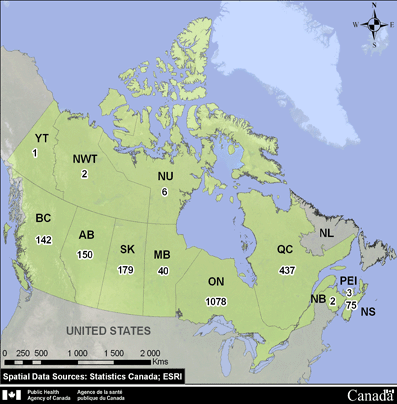
As of June 5, 2009, a total of 2,115 laboratory-confirmed cases of H1N1 flu virus have been reported in 9 provinces and 3 territories in Canada (see Table 1 below).
*******************
Table 1: Summary of laboratory-confirmed cases of H1N1 flu virus reported to the Public Health Agency of Canada, by the provinces and territories as of June 5, 2009 at 15:00 EDT.
Province / Territory NEW Laboratory-Confirmed Cases reported since June 3, 2009(1) TOTAL Laboratory-confirmed Cases (including today?s cases) (2)Total Deaths
British Columbia 6 142 0
Alberta 9 150 1
Saskatchewan 26 179 0
Manitoba 2 40 0
Ontario 184 1078 2
Quebec 91 437 0
New Brunswick 0 2 0
Nova Scotia 1 75 0
Prince Edward Island 0 3 0
Newfoundland 0 0 0
Yukon 0 1 0
Northwest Territories 0 2 0
Nunavut 1 6 0
Total 320 2115 3
(1) Note: P/Ts may choose to announce cases that have been confirmed after 15:00 EDT. These cases will be reflected in the next epidemiological update.
(2) Number of deaths is included in the number of cases
As of June 3rd 2009, the median age reported is 17 years (mean 22 years; range: <1 ? 80 years). To date 96 hospitalizations and three deaths have been reported among laboratory-confirmed cases. The most recent date of symptom onset is May 31st, 2009. Please note that an incorrect number of hospitalizations were previously reported therefore the value today has decreased.
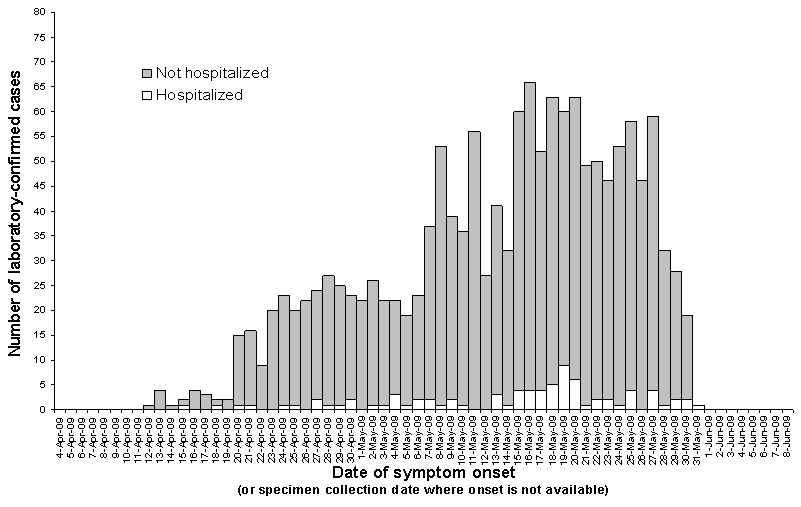
The following graph, also known as an epidemic curve, is up to date as of June 3rd, 2009. The graph illustrates the course of the current H1N1 flu virus outbreak in Canada. It shows the date when symptoms of H1N1 flu virus began for each of the laboratory-confirmed cases.
Figure 1. Number of laboratory-confirmed H1N1 flu virus cases in Canada by date of onset (or specimen collection date where onset is not available) as reported to the Public Health Agency of Canada as of 3 June 2009 15:00 EDT (N=1,503).
Source: Provincial/Territorial Ministries of Health
When interpreting the graph, it should be noted that:
* The graph is prepared retrospectively and is updated daily using the information available at that time. It is not as current as Table 1 that contains the summary of laboratory-confirmed cases, as information about the date of onset of symptoms takes more time to compile.
* There is always a delay from the date that an illness starts to the date the case is reported to public health authorities. This delay is the result of the time required for patients to see their physicians, laboratory testing to be completed, and results to be communicated to public health authorities.
Epidemiological Update Map for Canada, by Province & Territory
Laboratory-Confirmed Cases of H1N1 Flu Virus
June 08, 2009, 15h00 EDT
As of June 8 2009, a total of 2,446 laboratory-confirmed cases of H1N1 flu virus have been reported in all provinces and territories in Canada except Newfoundland (see Table 1 below).
********************************************
Table 1: Summary of laboratory-confirmed cases of H1N1 flu virus reported to the Public Health Agency of Canada, by the provinces and territories as of June 8, 2009 at 15:00 EDT.
Province / Territory NEW Laboratory-Confirmed Cases reported since June 5, 2009(1) TOTAL Laboratory-confirmed Cases (including today?s cases) (2)Total Deaths
British Columbia 3 145 0
Alberta 22 172 1
Saskatchewan 31 210 0
Manitoba 0 40 0
Ontario 145 1223 2
Quebec 110 547 1
New Brunswick 0 2 0
Nova Scotia 1 76 0
Prince Edward Island 0 3 0
Newfoundland 0 0 0
Yukon 0 1 0
Northwest Territories 0 2 0
Nunavut 19 25 0
Total 331 2446 4
(1) Note: P/Ts may choose to announce cases that have been confirmed after 15:00 EDT.
These cases will be reflected in the next epidemiological update.
(2) Number of deaths is included in the number of cases
******************************
To date 121 hospitalizations and four deaths have been reported among laboratory-confirmed cases. The most recent date of symptom onset is June 2nd, 2009.
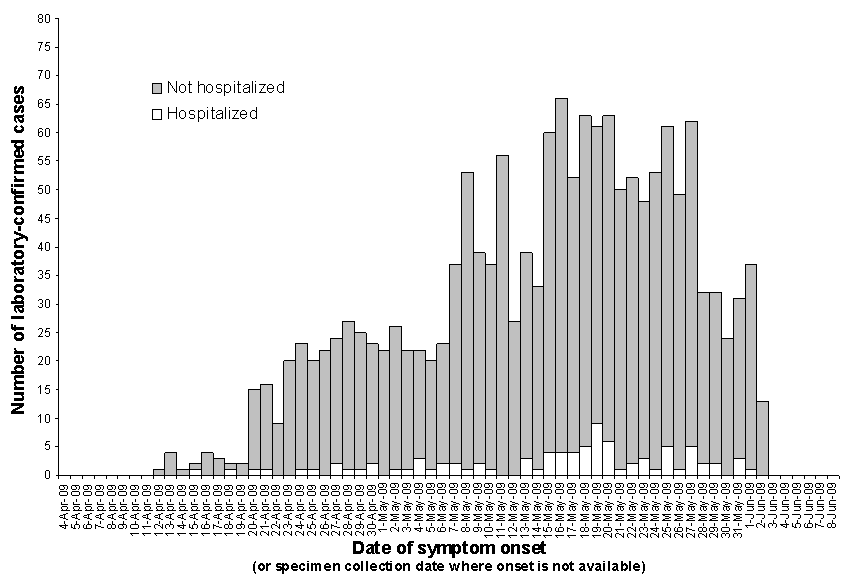
The following graph, also known as an epidemic curve, is up to date as of June 5, 2009. The graph illustrates the course of the current H1N1 flu virus outbreak in Canada. It shows either the date when symptoms of H1N1 flu virus began or, if this date was not available, the date when a specimen was collected, for each of the laboratory-confirmed cases.
Figure 1. Number of laboratory-confirmed H1N1 flu virus cases in Canada by date of onset (or specimen collection date where onset date is not available) as reported to the Public Health Agency of Canada as of 5 June 2009 15:00 EDT (N=1,608).
Source: Provincial/Territorial Ministries of Health
When interpreting the graph, it should be noted that:
* The graph is prepared retrospectively and is updated daily using the information available at that time. It is not as current as Table 1 that contains the summary of laboratory-confirmed cases, as information about the date of onset of symptoms takes more time to compile.
* There is always a delay from the date that an illness starts to the date the case is reported to public health authorities. This delay is the result of the time required for patients to see their physicians, laboratory testing to be completed, and results to be communicated to public health authorities.
Epidemiological Update Map for Canada, by Province & Territory
Laboratory-Confirmed Cases of H1N1 Flu Virus
June 10, 2009, 15h00 EDT
As of June 10 2009, a total of 2,978 laboratory-confirmed cases
************************************************** *******
Table 1: Summary of laboratory-confirmed cases of H1N1 flu virus reported to the Public Health Agency of Canada, by the provinces and territories as of June 10, 2009 at 15:00 EDT.
Province / Territory NEW Laboratory-Confirmed Cases reported since June 8, 2009(1) TOTAL Laboratory-confirmed Cases (including today?s cases) (2)Total Deaths
British Columbia 6 151 0
Alberta 24 195 1
Saskatchewan 11 221 0
Manitoba 16 56 0
Ontario 339 1562 2
Quebec 64 611 1
New Brunswick 0 2 0
Nova Scotia 2 78 0
Prince Edward Island 0 3 0
Newfoundland 0 0 0
Yukon 0 1 0
Northwest Territories 0 2 0
Nunavut 71 96 0
Total 533 2978 4
(1) Note: P/Ts may choose to announce cases that have been confirmed after 15:00 EDT.
These cases will be reflected in the next epidemiological update.
2() Number of deaths is included in the number of cases
************************************************** ******
To date 138 hospitalizations and four deaths have been reported among laboratory-confirmed cases. The most recent date of symptom onset is June 5th, 2009.
The following graph, also known as an epidemic curve, is up to date as of June 8th, 2009. The graph illustrates the course of the current H1N1 flu virus outbreak in Canada. It shows either the date when symptoms of H1N1 flu virus began or, if this date was not available, the date when a specimen was collected, for each of the laboratory-confirmed cases.
Figure 1. Number of laboratory-confirmed H1N1 flu virus cases in Canada by date of onset (or specimen collection date where onset date is not available) as reported to the Public Health Agency of Canada as of 8 June 2009 15:00 EDT (N=2,004).
Source: Provincial/Territorial Ministries of Health
When interpreting the graph, it should be noted that:
* The graph is prepared retrospectively and is updated daily using the information available at that time. It is not as current as Table 1 that contains the summary of laboratory-confirmed cases, as information about the date of onset of symptoms takes more time to compile.
* There is always a delay from the date that an illness starts to the date the case is reported to public health authorities. This delay is the result of the time required for patients to see their physicians, laboratory testing to be completed, and results to be communicated to public health authorities.
Epidemiological Update Map for Canada, by Province & Territory
Laboratory-Confirmed Cases of H1N1 Flu Virus
June 12, 2009, 15h00 EDT
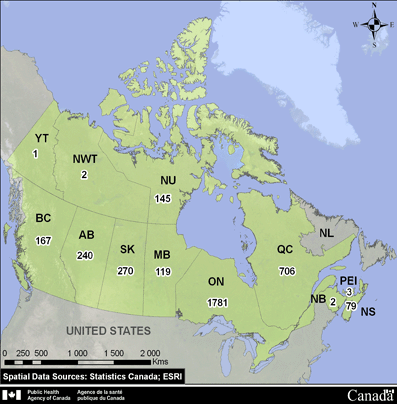
As of June 12 2009, a total of 3,515 laboratory-confirmed cases of H1N1 flu virus have been reported in all provinces and territories in Canada except Newfoundland (see Table 1 below).
Table 1: Summary of laboratory-confirmed cases of H1N1 flu virus reported to the Public Health Agency of Canada, by the provinces and territories as of June 12, 2009 at 15:00 EDT.
Province / Territory NEW Laboratory-Confirmed Cases reported since June 10, 2009 (1) TOTAL Laboratory-confirmed Cases (including today?s cases) (2)Total Deaths
British Columbia 16 167 0
Alberta 45 240 1
Saskatchewan 52 270 0
Manitoba 63 119 0
Ontario 219 1781 2
Quebec 95 706 1
New Brunswick 0 2 0
Nova Scotia 1 79 0
Prince Edward Island 0 3 0
Newfoundland 0 0 0
Yukon 0 1 0
Northwest Territories 0 2 0
Nunavut 49 145 0
Total 540 3515 4
(1) Note: P/Ts may choose to announce cases that have been confirmed after 15:00 EDT. These cases will be reflected in the next epidemiological update.
(2) Number of deaths is included in the number of cases
To date 182 hospitalizations and four deaths have been reported among laboratory-confirmed cases. Please note that since Manitoba was not able to report on hospitalizations on 12 June 2009, this total only includes those reported by Manitoba up to 10 June 2009 15:00 EDT. The most recent date of symptom onset is June 8th, 2009 (see Figure 1).
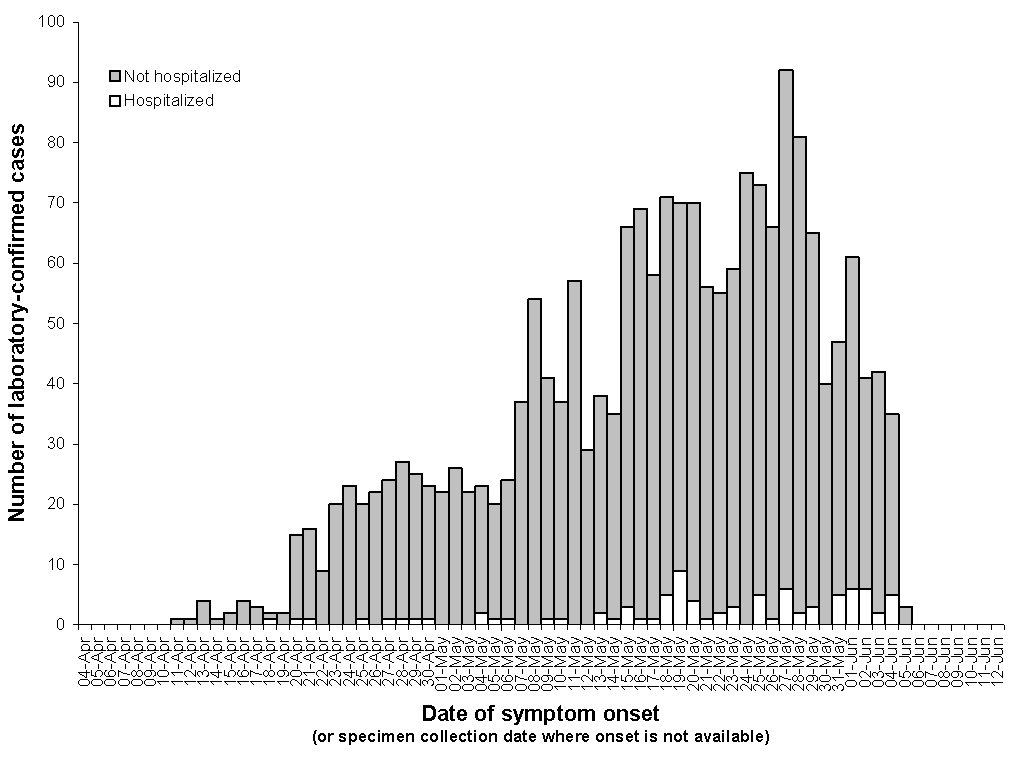
The following graph, also known as an epidemic curve, is up to date as of June 10th, 2009. The graph illustrates the course of the current H1N1 flu virus outbreak in Canada. It shows either the date when symptoms of H1N1 flu virus began or, if this date was not available, the date when a specimen was collected, for each of the laboratory-confirmed cases.
Figure 1. Number of laboratory-confirmed H1N1 flu virus cases in Canada by date of onset (or specimen collection date where onset date is not available) and hospitalization status as reported to the Public Health Agency of Canada as of 10 June 2009 15:00 EDT (N=2,474).
Source: Provincial/Territorial Ministries of Health
When interpreting the graph, it should be noted that:
* The graph is prepared retrospectively and is updated daily using the information available at that time. It is not as current as Table 1 that contains the summary of laboratory-confirmed cases, as information about the date of onset of symptoms takes more time to compile.
* There is always a delay from the date that an illness starts to the date the case is reported to public health authorities. This delay is the result of the time required for patients to see their physicians, laboratory testing to be completed, and results to be communicated to public health authorities.
Laboratory-Confirmed Cases of H1N1 Flu Virus
June 15, 2009, 15h00 EDT
As of June 15 2009, a total of 4,049 laboratory-confirmed cases of H1N1 flu virus have been reported in all provinces and territories in Canada except Newfoundland (see Table 1 below).
Table 1: Summary of laboratory-confirmed cases of H1N1 flu virus reported to the Public Health Agency of Canada, by the provinces and territories as of June 15, 2009 at 15:00 EDT.
Province / Territory NEW Laboratory-Confirmed Cases reported since June 15, 2009(1) New deaths reported as of June 15, 2009 TOTAL Laboratory-confirmed Cases (including today?s cases) (2 ) Total Deaths
British Columbia 5 0 172 0
Alberta 24 0 264 1
Saskatchewan 57 0 327 0
Manitoba 35 0 154 0
Ontario 126 0 1907 2
Quebec 265 3 971 4
New Brunswick 0 0 2 0
Nova Scotia 2 0 81 0
Prince Edward Island 0 0 3 0
Newfoundland 1 0 1 0
Yukon 0 0 1 0
Northwest Territories 0 0 2 0
Nunavut 19 0 164 0
Total 534 3 4049 7
(1) Note: P/Ts may choose to announce cases that have been confirmed after 15:00 EDT. These cases will be reflected in the next epidemiological update.
(2) Number of deaths is included in the number of cases
(3) Please note that it includes two cases that were not reported last week.
************************************************** *********
To date, 212 hospitalizations and seven deaths have been reported among laboratory-confirmed cases. The most recent date of symptom onset is June 8th, 2009 (see Figure 1).
The following graph, also known as an epidemic curve, is up to date as of June 10th, 2009. The graph illustrates the course of the current H1N1 flu virus outbreak in Canada. It shows either the date when symptoms of H1N1 flu virus began or, if this date was not available, the date when a specimen was collected, for each of the laboratory-confirmed cases.
Number of laboratory-confirmed H1N1 flu virus cases in Canada by date of onset (or specimen collection date where onset date is not available) and hospitalization status as reported to the Public Health Agency of Canada as of 10 June 2009 15:00 EDT (N=2,474).
Figure 1. Number of laboratory-confirmed H1N1 flu virus cases in Canada by date of onset (or specimen collection date where onset date is not available) and hospitalization status as reported to the Public Health Agency of Canada as of 10 June 2009 15:00 EDT (N=2,474).
Source: Provincial/Territorial Ministries of Health
When interpreting the graph, it should be noted that:
* The graph is prepared retrospectively and is updated daily using the information available at that time. It is not as current as Table 1 that contains the summary of laboratory-confirmed cases, as information about the date of onset of symptoms takes more time to compile.
* There is always a delay from the date that an illness starts to the date the case is reported to public health authorities. This delay is the result of the time required for patients to see their physicians, laboratory testing to be completed, and results to be communicated to public health authorities.
Epidemiological Update Map for Canada, by Province & Territory
Laboratory-Confirmed Cases of H1N1 Flu Virus
June 19, 2009, 15h00 EDT
As of June 19, 2009, a total of 5,710 laboratory-confirmed cases of H1N1 flu virus have been reported in all provinces and territories in Canada (see Table 1 below). To date, 349 hospitalizations and thirteen deaths have been reported among laboratory-confirmed cases.
Table 1: Summary of laboratory-confirmed cases of H1N1 flu virus reported to the Public Health Agency of Canada, by the provinces and territories as of June 19, 2009 at 15:00 EDT.
Province / Territory NEW laboratory-confirmed cases(1) reported as of June 19, 2009 New deaths reported as of June 19, 2009 TOTAL laboratory-confirmed cases (including today?s cases) Total deaths(2)
British Columbia 18 0 209 0
Alberta 97 0 498 1
Saskatchewan 129 0 510 0
Manitoba 35 0 295 2
Ontario 261 1 2528 3
Quebec 233 0 1349 7
New Brunswick 1 0 3 0
Nova Scotia 7 0 98 0
Prince Edward Island 0 0 3 0
Newfoundland 4 0 7 0
Yukon 0 0 1 0
Northwest Territories 1 0 5 0
Nunavut 19 0 204 0
Total 805 1 5710 13
(1) Note: P/Ts may choose to announce cases that have been confirmed after 15:00 EDT. These cases will be reflected in the next epidemiological update.
(2) Number of deaths is included in the number of cases.
************************************************** *******
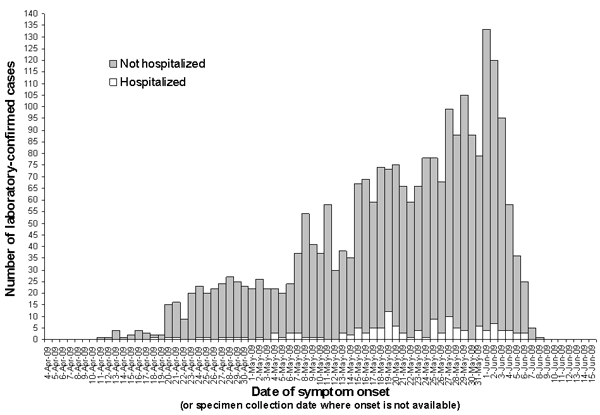
The following graph, also known as an epidemic curve, is up to date as of June 19th, 2009. The graph illustrates the course of the current H1N1 flu virus outbreak in Canada. It shows either the date when symptoms of H1N1 flu virus began or, if this date was not available, the date when a specimen was collected, for each of the laboratory-confirmed cases.
Figure 1. Number of laboratory-confirmed H1N1 flu virus cases in Canada by date of onset (or specimen collection date where date of onset is not available) and hospitalization status as reported to the Public Health Agency of Canada as of 19 June 2009 15:00 EDT (N=4,114 from a total of 4,268 reported).
Figure 1. Number of laboratory-confirmed H1N1 flu virus cases in Canada by date of onset (or specimen collection date where date of onset is not available) and hospitalization status as reported to the Public Health Agency of Canada as of 19 June 2009 15:00 EDT (N=4,114 from a total of 4,268 reported).
Source: Provincial/Territorial Ministries of Health
When interpreting the graph, it should be noted that:
* The graph is prepared retrospectively and is updated daily using the information available at that time. It is not as current as Table 1 that contains the summary of laboratory-confirmed cases, as information about the date of onset of symptoms takes more time to compile.
* There is always a delay from the date that an illness starts to the date the case is reported to public health authorities. This delay is the result of the time required for patients to see their physicians, laboratory testing to be completed, and results to be communicated to public health authorities.


 Tweet
Tweet







Comment