
 Tweet
Tweet
 Google: A different kind of company name
A different kind of company name
4/01/2010 12:01:00 AM
Early last month the mayor of Topeka, Kansas stunned the world by announcing that his city was changing its name to Google. We?ve been wondering ever since how best to honor that moving gesture. Today we are pleased to announce that as of 1AM (Central Daylight Time) April 1st, Google has officially changed our name to Topeka.
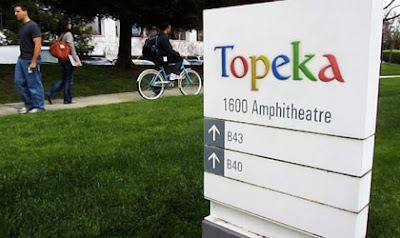
We didn?t reach this decision lightly; after all, we had a fair amount of brand equity tied up in our old name. But the more we surfed around (the former) Topeka?s municipal website, the more kinship we felt with this fine city at the edge of the Great Plains.
In fact, <STRIKE>Topeka</STRIKE> Google Mayor Bill Bunten expressed it best: ?Don?t be fooled. Even Google recognizes that all roads lead to Kansas, not just yellow brick ones.?
For 150 years, its fortuitous location at the confluence of the Kansas River and the Oregon Trail has made the city formerly known as Topeka a key jumping-off point to the new world of the West, just as for 150 months the company formerly known as Google has been a key jumping-off point to the new world of the web. When in 1858 a crucial bridge built across the Kansas River was destroyed by flooding mere months later, it was promptly rebuilt ? and we too are accustomed to releasing 2.0 versions of software after stormy feedback on our ?beta? releases. And just as the town's nickname is "Top City," and the word ?topeka? itself derives from a term used by the Kansa and Ioway tribes to refer to ?a good place to dig for potatoes,? we?d like to think that our website is one of the web's top places to dig for information.
In the early 20th century, the former Topeka enjoyed a remarkable run of political prominence, gracing the nation with Margaret Hill McCarter, the first woman to address a national political convention (1920, Republican); Charles Curtis, the only Native American ever to serve as vice president (?29 to ?33, under Herbert Hoover); Carrie Nation, leader of the old temperance movement (and wielder of American history?s most famous hatchet); and, most important, Alfred E. Neuman, arguably the most influential figure to an entire generation of Americans. We couldn?t be happier to add our own chapter to this storied history.
A change this dramatic won?t happen without consequences, perhaps even some disruptions. Here are a few of the thorny issues that we hope everyone in the broader Topeka community will bear in mind as we begin one of the most important transitions in our company?s history:
 Finally, we want to be clear that this initiative is a one-shot deal that will have no bearing on which municipalities are chosen to participate in our experimental ultra-high-speed broadband project, to which Google, Kansas has been just one of many communities to apply.
Posted by Eric Schmidt, Chairman and Chief Executive Officer, Topeka Inc.
4/01/2010 12:01:00 AM
Early last month the mayor of Topeka, Kansas stunned the world by announcing that his city was changing its name to Google. We?ve been wondering ever since how best to honor that moving gesture. Today we are pleased to announce that as of 1AM (Central Daylight Time) April 1st, Google has officially changed our name to Topeka.

We didn?t reach this decision lightly; after all, we had a fair amount of brand equity tied up in our old name. But the more we surfed around (the former) Topeka?s municipal website, the more kinship we felt with this fine city at the edge of the Great Plains.
In fact, <STRIKE>Topeka</STRIKE> Google Mayor Bill Bunten expressed it best: ?Don?t be fooled. Even Google recognizes that all roads lead to Kansas, not just yellow brick ones.?
For 150 years, its fortuitous location at the confluence of the Kansas River and the Oregon Trail has made the city formerly known as Topeka a key jumping-off point to the new world of the West, just as for 150 months the company formerly known as Google has been a key jumping-off point to the new world of the web. When in 1858 a crucial bridge built across the Kansas River was destroyed by flooding mere months later, it was promptly rebuilt ? and we too are accustomed to releasing 2.0 versions of software after stormy feedback on our ?beta? releases. And just as the town's nickname is "Top City," and the word ?topeka? itself derives from a term used by the Kansa and Ioway tribes to refer to ?a good place to dig for potatoes,? we?d like to think that our website is one of the web's top places to dig for information.
In the early 20th century, the former Topeka enjoyed a remarkable run of political prominence, gracing the nation with Margaret Hill McCarter, the first woman to address a national political convention (1920, Republican); Charles Curtis, the only Native American ever to serve as vice president (?29 to ?33, under Herbert Hoover); Carrie Nation, leader of the old temperance movement (and wielder of American history?s most famous hatchet); and, most important, Alfred E. Neuman, arguably the most influential figure to an entire generation of Americans. We couldn?t be happier to add our own chapter to this storied history.
A change this dramatic won?t happen without consequences, perhaps even some disruptions. Here are a few of the thorny issues that we hope everyone in the broader Topeka community will bear in mind as we begin one of the most important transitions in our company?s history:
- Correspondence to both our corporate headquarters and offices around the world should now be addressed to Topeka Inc., but otherwise can be addressed normally.
- Google employees once known as ?Googlers? should now be referred to as either ?Topekers? or ?Topekans,? depending on the result of a board meeting that?s ongoing at this hour. Whatever the outcome, the conclusion is clear: we aren?t in Google anymore.
- Our new product names will take some getting used to. For instance, we?ll have to assure users of Topeka News and Topeka Maps that these services will continue to offer news and local information from across the globe. Topeka Talk, similarly, is an instant messaging product, not, say, a folksy midwestern morning show. And Project Virgle, our co-venture with Richard Branson and Virgin to launch the first permanent human colony on Mars, will henceforth be known as Project Vireka.
- We don?t really know what to tell Oliver Google Kai?s parents, except that, if you ask us, Oliver Topeka Kai would be a charming name for their little boy.
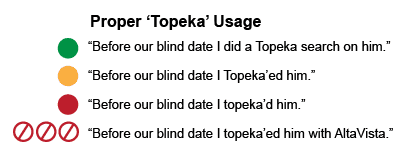
- As our lawyers remind us, branded product names can achieve such popularity as to risk losing their trademark status (see cellophane, zippers, trampolines, et al). So we hope all of you will do your best to remember our new name?s proper usage:
 Finally, we want to be clear that this initiative is a one-shot deal that will have no bearing on which municipalities are chosen to participate in our experimental ultra-high-speed broadband project, to which Google, Kansas has been just one of many communities to apply.
Posted by Eric Schmidt, Chairman and Chief Executive Officer, Topeka Inc.


 1957: The respected BBC news show Panorama announced that thanks to a very mild winter and the virtual elimination of the dreaded spaghetti weevil, Swiss farmers were enjoying a bumper spaghetti crop. It accompanied this announcement with footage of Swiss peasants pulling strands of spaghetti down from trees. Huge numbers of viewers were taken in. Many called the BBC wanting to know how they could grow their own spaghetti tree. To this the BBC diplomatically replied, "place a sprig of spaghetti in a tin of tomato sauce and hope for the best."
  1985: Sports Illustrated published a story about a new rookie pitcher who planned to play for the Mets. His name was Sidd Finch, and he could reportedly throw a baseball at 168 mph with pinpoint accuracy. This was 65 mph faster than the previous record. Surprisingly, Sidd Finch had never even played the game before. Instead, he had mastered the "art of the pitch" in a Tibetan monastery under the guidance of the "great poet-saint Lama Milaraspa." Mets fans celebrated their teams' amazing luck at having found such a gifted player, and Sports Illustrated was flooded with requests for more information. In reality this legendary player only existed in the imagination of the author of the article, George Plimpton.
  1962: In 1962 there was only one tv channel in Sweden, and it broadcast in black and white. The station's technical expert, Kjell Stensson, appeared on the news to announce that, thanks to a new technology, viewers could convert their existing sets to display color reception. All they had to do was pull a nylon stocking over their tv screen. Stensson proceeded to demonstrate the process. Thousands of people were taken in. Regular color broadcasts only commenced in Sweden on April 1, 1970.
  1996: The Taco Bell Corporation announced it had bought the Liberty Bell and was renaming it the Taco Liberty Bell. Hundreds of outraged citizens called the National Historic Park in Philadelphia where the bell was housed to express their anger. Their nerves were only calmed when Taco Bell revealed, a few hours later, that it was all a practical joke. The best line of the day came when White House press secretary Mike McCurry was asked about the sale. Thinking on his feet, he responded that the Lincoln Memorial had also been sold. It would now be known, he said, as the Ford Lincoln Mercury Memorial.
  1977: The British newspaper The Guardian published a special seven-page supplement devoted to San Serriffe, a small republic said to consist of several semi-colon-shaped islands located in the Indian Ocean. A series of articles affectionately described the geography and culture of this obscure nation. Its two main islands were named Upper Caisse and Lower Caisse. Its capital was Bodoni, and its leader was General Pica. The Guardian's phones rang all day as readers sought more information about the idyllic holiday spot. Only a few noticed that everything about the island was named after printer's terminology. The success of this hoax is widely credited with launching the enthusiasm for April Foolery that gripped the British tabloids in subsequent decades.
Comment