
 Tweet
Tweet
Nipah outbreak in Faridpur District,Bangladesh, 2010Nipah outbreak in Faridpur District,Bangladesh, 2010
Physicians at Faridpur Medical College Hospital recognized a cluster of encephalitis cases within Faridpur District in January 2010. A subsequent feld investigation suggested that the initial cases acquired Nipah through drinking raw date palm sap and subsequent transmission occurred through person-to-person contact. In March 2010, one of the hospital physicians who cared for two Nipah patients died from Nipah encephalitis. To prevent further outbreaks of Nipah virus, people in the ?Nipah belt? should be warned about the risk of drinking fresh date palm sap. Practical steps to interrupt contamination of date palm sap should be introduced, and protective measures to reduce patient to caregiver transmission undertaken.
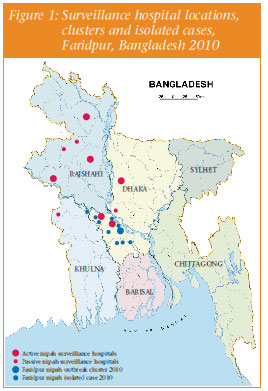
Eight outbreaks of Nipah encephalitis have been recognized in Bangladesh from 2001 to 2008 (1,2). The Institute for Epidemiology Disease Control and Research (IEDCR) of the Government of Bangladesh, in collaboration with ICDDR,B, established 10 Nipah surveillance sites beginning in February 2006 in hospitals located in the region where prior Nipah outbreaks were recognized (Figure 1). The objective of the surveillance is to identify outbreaks of encephalitis and to characterize the conditions and risk factors for transmission of the responsible viruses. Each of the six active site submits a monthly report to IEDCR and ICDDR,B on the number of meningo-encephalitic cases, while the four passive sites only report if they suspect a high number of encephalitis cases.
Senior physicians and paediatricians of corresponding active surveillance hospitals are the focal persons and each hospital has a designated Nipah surveillance study physician. The active surveillance sites maintain a registry throughout the year of patients who fulfil the enrollment criteria based on encephalitis and/or pulmonary presentation (3). The encephalitic presentation includes fever with evidence of acute brain pathology, i.e. altered mental status, new onset of seizures, or a new neurological deficit. Respiratory presentation includes acute onset <7 days of symptoms with fever, severe shortness of breath and chest radiograph with diffuse infiltrates.
To cost effectively focus scarce public health surveillance resources, active surveillance focuses on identifying clusters of patients with meningo-encephalitis. We define a cluster as two or more persons living within a 30 minute walk of each other who develop similar symptoms within 21 days of each other. Surveillance physicians keep a detailed address of each case in the registry that they match cases with using distance and time. They also ask individual patients or attendants about recent deaths in their community or any other cases with similar symptoms not yet reported. When active surveillance identifies a cluster they report it to IEDCR and ICDDR,B and we promptly conduct an epidemiological investigation in the community to search for more cases of meningo-encephalitis syndrome and to collect additional samples to try to identify the aetiology of the disease.
To identify all hospital reported cases that occur during the usual Nipah season from January to March, we collected blood and cerebrospinal fluid samples at three active surveillance sites, Faridpur, Rajshahi and Rangpur Medical College Hospitals, which admit the largest number of acute meningo-encephalitis cases. We tested these samples for anti-Nipah IgM by ELISA at IEDCR and ICDDR,B virology laboratory in Dhaka to confirm both clusters and isolated cases.
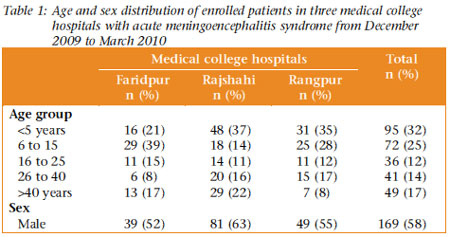
In December 2009, an experienced surveillance officer from Rajbari Sadar Hospital reported a suspected Nipah encephalitis case and referred the patient to Faridpur Medical College Hospital, where a blood sample was collected that was found positive for IgM antibody against Nipah virus. We then initiated sample collection from each meningo-encephalitis case from Faridpur surveillance hospital. In total, from December 2009 to March 2010, we enrolled 331 cases from the six active surveillance sites. Among them 293 (89%) cases were from Faridpur, Rajshahi and Rangpur Medical College Hospitals. Fifty seven percent of cases (167) were under 15 years of age (Table 1). No Nipah cases were confirmed by laboratory testing from Rangpur and Rajshahi Medical College Hospitals. We found twelve anti-Nipah IgM positive cases at Faridpur Medical College Hospital: two of them were part of a cluster, and the remainder were isolated cases from a widespread geographic area in and around Faridpur district (Figure 1).
During this same period, we investigated seven meningo-encephalitis clusters: one from Rangpur; and three each from Rajshahi and Faridpur. In Rangpur and in Rajshahi we could not find any exposure history, or epidemiological links between cases of these clusters and each case was anti-Nipah IgM negative.
In Faridpur, the first cluster consisted of two cases, both of which had fever, with features of brain pathology, but both of whom tested anti-Nipah IgM negative. The second Faridpur cluster involved two cases who also had fever with features of brain pathology, but with no epidemiological link between them. One Nipah antibody negative case survived, but a Nipah antibody positive case, who collected date palm sap and had a history of drinking raw date palm sap, died. The third Faridpur cluster was reported to IEDCR and ICDDR,B on 14 January 2010, and consisted of eight cases. We defined probable cases as people with fever and altered mental status or new onset of seizures or respiratory distress. Confirmed Nipah cases were serum anti-Nipah IgM antibody positive. The index case was a 45 year old male from Bhanga sub-district who died after being admitted to the hospital. Another 40-year old female case, who was a neighbour of the index case, presented with vomiting, headache, convulsion, altered mental status, and loss of consciousness, and died at home. Both of them were probable cases. Two other cases from the 40-year old female?s family, 10 and 11 year old girls, who were admitted in hospital with a clinical diagnosis of encephalitis, died. One girl was found anti-Nipah IgM positive. The other girl was a probable Nipah case.
After one week, the study physician from Fardipur Medical College Hospital reported another upsurge of cases from the same sub-district. The investigation team identified two more probable and two more confirmed Nipah encephalitis cases. These four cases were all between 32 and 60 years of age; three of the four died.
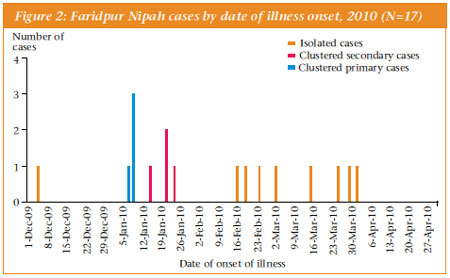
We observed two generations of Nipah transmission in this large cluster. The male index case had a history of drinking raw date palm sap with other family members and his house was under a bat roost. He had no physical contact with subsequent cases of the first generation. The subsequent three cases had onset of illness on a same day (Figure 2). All three cases were from a single family, living about 250 meters away from a bat roost, who drank raw date palm sap together during the previous week. After another seven days, three other persons who had a history of close physical contact with the index case became sick. All of them died. None of them had a history of drinking raw date palm sap within the last one month. The last case of the cluster, the wife of the index case, was the only survivor. She had reported drinking raw date palm sap and had contact with the index case.
As part of Nipah surveillance, we also investigated all isolated laboratory confirmed Nipah positive cases. Among the nine cases identified between December 2009 to April 2010, one case was an intern doctor, who had very recently joined the paediatric department of Fardipur Medical College Hospital. He performed several physical examinations, without any personal protective equipment, on two young girls, aged 5 and 7 years old, who had been admitted to the hospital with encephalitis. One of these two children died, and the doctor died after six days. All three were Nipah antibody positive. The overall case fatality rate of Nipah encephalitis cases was 88% (15/17).
Reported by: Faridpur Medical College Hospital, Faridpur; Institute of Epidemiology Disease Control and Research, Ministry of Health and Family Welfare, Government of Bangladesh; Programme of Infectious Diseases and Vaccine Sciences, ICDDR,B
Supported by: Institute of Epidemiology Disease Control and Research, Ministry of Health and Family Welfare, Government of Bangladesh; The Centers for Disease Control and Prevention, Atlanta, USA and the U.S. National Institutes of Health Division of Microbiology and Infectious Diseases, International Collaborations in Infectious Disease Opportunity Pool, Consortium of Conservative Medicine and Wild Life Trust.
Comments This large Nipah outbreak, across a wide geographic area in Faridpur district in 2010, suggests repeated introduction of the virus from its wildlife reservoir in Pteropus bats into people. Two of the infected persons subsequently transmitted the virus to caregivers, including a physician.
Previous outbreak investigations in Bangladesh provide compelling evidence of person-to-person transmission of Nipah infection (4). However, the infection and death of a physician who cared for Nipah patients was the first reported nosocomial transmission of Nipah virus in Bangladesh. Repeated episodes of person-to-person transmission of Nipah virus emphasize the importance of interrupting viral transmission through body fluids, both at household level and at healthcare facilities.
Several protective interventions to prevent person-to-person transmission should be prioritized through the development of appropriate, culturally sensitive health messages for the caregiver focusing on frequent hand washing, avoiding sharing of food and bed, and maintaining a three feet distance while caring for patients (two hands length). Also prompt isolation of patients with meningo-encephalitis syndrome during the Nipah virus season and implementation of basic infection control measures can reduce the risk to hospital staff and patients (5). As the laboratory diagnosis for Nipah virus is not available during initial evaluation of patients with meningo-encephalitis syndrome, health care workers should routinely practice basic infection control measures with every patient. Novice physicians should receive specific training on personal protective measures before beginning hospital duties.
References
Luby SP, Gurley ES, Hossain MJ. Transmission of human infection with Nipah virus. Clin Infect Dis 2009;49:1743-8.
ICDDR,B. Outbreaks of Nipah virus in Rajbari and Manikgonj, February 2008. Health Sci Bul 2008;6:12-3.
Hossain MJ, Gurley ES, Montgomery JM, Bell M, Carroll DS, Hsu VP, et al. Clinical presentation of Nipah virus infection in Bangladesh. Clin Infect Dis 2008;46:977-84.
Gurley ES, Montgomery JM, Hossain MJ, Bell M, Azad AK, Islam MR, et al. Person-to-person transmission of Nipah virus within a Bangladeshi Community. Emerg infect dis 2007;13:1031-7.
Chadha MS, Comer JA, Lowe L, Rota PA, Rollin PE, Belline WJ, et al. Nipah virus-associated encephalitis
Physicians at Faridpur Medical College Hospital recognized a cluster of encephalitis cases within Faridpur District in January 2010. A subsequent feld investigation suggested that the initial cases acquired Nipah through drinking raw date palm sap and subsequent transmission occurred through person-to-person contact. In March 2010, one of the hospital physicians who cared for two Nipah patients died from Nipah encephalitis. To prevent further outbreaks of Nipah virus, people in the ?Nipah belt? should be warned about the risk of drinking fresh date palm sap. Practical steps to interrupt contamination of date palm sap should be introduced, and protective measures to reduce patient to caregiver transmission undertaken.
Eight outbreaks of Nipah encephalitis have been recognized in Bangladesh from 2001 to 2008 (1,2). The Institute for Epidemiology Disease Control and Research (IEDCR) of the Government of Bangladesh, in collaboration with ICDDR,B, established 10 Nipah surveillance sites beginning in February 2006 in hospitals located in the region where prior Nipah outbreaks were recognized (Figure 1). The objective of the surveillance is to identify outbreaks of encephalitis and to characterize the conditions and risk factors for transmission of the responsible viruses. Each of the six active site submits a monthly report to IEDCR and ICDDR,B on the number of meningo-encephalitic cases, while the four passive sites only report if they suspect a high number of encephalitis cases.
Senior physicians and paediatricians of corresponding active surveillance hospitals are the focal persons and each hospital has a designated Nipah surveillance study physician. The active surveillance sites maintain a registry throughout the year of patients who fulfil the enrollment criteria based on encephalitis and/or pulmonary presentation (3). The encephalitic presentation includes fever with evidence of acute brain pathology, i.e. altered mental status, new onset of seizures, or a new neurological deficit. Respiratory presentation includes acute onset <7 days of symptoms with fever, severe shortness of breath and chest radiograph with diffuse infiltrates.
To cost effectively focus scarce public health surveillance resources, active surveillance focuses on identifying clusters of patients with meningo-encephalitis. We define a cluster as two or more persons living within a 30 minute walk of each other who develop similar symptoms within 21 days of each other. Surveillance physicians keep a detailed address of each case in the registry that they match cases with using distance and time. They also ask individual patients or attendants about recent deaths in their community or any other cases with similar symptoms not yet reported. When active surveillance identifies a cluster they report it to IEDCR and ICDDR,B and we promptly conduct an epidemiological investigation in the community to search for more cases of meningo-encephalitis syndrome and to collect additional samples to try to identify the aetiology of the disease.
To identify all hospital reported cases that occur during the usual Nipah season from January to March, we collected blood and cerebrospinal fluid samples at three active surveillance sites, Faridpur, Rajshahi and Rangpur Medical College Hospitals, which admit the largest number of acute meningo-encephalitis cases. We tested these samples for anti-Nipah IgM by ELISA at IEDCR and ICDDR,B virology laboratory in Dhaka to confirm both clusters and isolated cases.
In December 2009, an experienced surveillance officer from Rajbari Sadar Hospital reported a suspected Nipah encephalitis case and referred the patient to Faridpur Medical College Hospital, where a blood sample was collected that was found positive for IgM antibody against Nipah virus. We then initiated sample collection from each meningo-encephalitis case from Faridpur surveillance hospital. In total, from December 2009 to March 2010, we enrolled 331 cases from the six active surveillance sites. Among them 293 (89%) cases were from Faridpur, Rajshahi and Rangpur Medical College Hospitals. Fifty seven percent of cases (167) were under 15 years of age (Table 1). No Nipah cases were confirmed by laboratory testing from Rangpur and Rajshahi Medical College Hospitals. We found twelve anti-Nipah IgM positive cases at Faridpur Medical College Hospital: two of them were part of a cluster, and the remainder were isolated cases from a widespread geographic area in and around Faridpur district (Figure 1).
During this same period, we investigated seven meningo-encephalitis clusters: one from Rangpur; and three each from Rajshahi and Faridpur. In Rangpur and in Rajshahi we could not find any exposure history, or epidemiological links between cases of these clusters and each case was anti-Nipah IgM negative.
In Faridpur, the first cluster consisted of two cases, both of which had fever, with features of brain pathology, but both of whom tested anti-Nipah IgM negative. The second Faridpur cluster involved two cases who also had fever with features of brain pathology, but with no epidemiological link between them. One Nipah antibody negative case survived, but a Nipah antibody positive case, who collected date palm sap and had a history of drinking raw date palm sap, died. The third Faridpur cluster was reported to IEDCR and ICDDR,B on 14 January 2010, and consisted of eight cases. We defined probable cases as people with fever and altered mental status or new onset of seizures or respiratory distress. Confirmed Nipah cases were serum anti-Nipah IgM antibody positive. The index case was a 45 year old male from Bhanga sub-district who died after being admitted to the hospital. Another 40-year old female case, who was a neighbour of the index case, presented with vomiting, headache, convulsion, altered mental status, and loss of consciousness, and died at home. Both of them were probable cases. Two other cases from the 40-year old female?s family, 10 and 11 year old girls, who were admitted in hospital with a clinical diagnosis of encephalitis, died. One girl was found anti-Nipah IgM positive. The other girl was a probable Nipah case.
After one week, the study physician from Fardipur Medical College Hospital reported another upsurge of cases from the same sub-district. The investigation team identified two more probable and two more confirmed Nipah encephalitis cases. These four cases were all between 32 and 60 years of age; three of the four died.
We observed two generations of Nipah transmission in this large cluster. The male index case had a history of drinking raw date palm sap with other family members and his house was under a bat roost. He had no physical contact with subsequent cases of the first generation. The subsequent three cases had onset of illness on a same day (Figure 2). All three cases were from a single family, living about 250 meters away from a bat roost, who drank raw date palm sap together during the previous week. After another seven days, three other persons who had a history of close physical contact with the index case became sick. All of them died. None of them had a history of drinking raw date palm sap within the last one month. The last case of the cluster, the wife of the index case, was the only survivor. She had reported drinking raw date palm sap and had contact with the index case.
As part of Nipah surveillance, we also investigated all isolated laboratory confirmed Nipah positive cases. Among the nine cases identified between December 2009 to April 2010, one case was an intern doctor, who had very recently joined the paediatric department of Fardipur Medical College Hospital. He performed several physical examinations, without any personal protective equipment, on two young girls, aged 5 and 7 years old, who had been admitted to the hospital with encephalitis. One of these two children died, and the doctor died after six days. All three were Nipah antibody positive. The overall case fatality rate of Nipah encephalitis cases was 88% (15/17).
Reported by: Faridpur Medical College Hospital, Faridpur; Institute of Epidemiology Disease Control and Research, Ministry of Health and Family Welfare, Government of Bangladesh; Programme of Infectious Diseases and Vaccine Sciences, ICDDR,B
Supported by: Institute of Epidemiology Disease Control and Research, Ministry of Health and Family Welfare, Government of Bangladesh; The Centers for Disease Control and Prevention, Atlanta, USA and the U.S. National Institutes of Health Division of Microbiology and Infectious Diseases, International Collaborations in Infectious Disease Opportunity Pool, Consortium of Conservative Medicine and Wild Life Trust.
Comments This large Nipah outbreak, across a wide geographic area in Faridpur district in 2010, suggests repeated introduction of the virus from its wildlife reservoir in Pteropus bats into people. Two of the infected persons subsequently transmitted the virus to caregivers, including a physician.
Previous outbreak investigations in Bangladesh provide compelling evidence of person-to-person transmission of Nipah infection (4). However, the infection and death of a physician who cared for Nipah patients was the first reported nosocomial transmission of Nipah virus in Bangladesh. Repeated episodes of person-to-person transmission of Nipah virus emphasize the importance of interrupting viral transmission through body fluids, both at household level and at healthcare facilities.
Several protective interventions to prevent person-to-person transmission should be prioritized through the development of appropriate, culturally sensitive health messages for the caregiver focusing on frequent hand washing, avoiding sharing of food and bed, and maintaining a three feet distance while caring for patients (two hands length). Also prompt isolation of patients with meningo-encephalitis syndrome during the Nipah virus season and implementation of basic infection control measures can reduce the risk to hospital staff and patients (5). As the laboratory diagnosis for Nipah virus is not available during initial evaluation of patients with meningo-encephalitis syndrome, health care workers should routinely practice basic infection control measures with every patient. Novice physicians should receive specific training on personal protective measures before beginning hospital duties.
References
Luby SP, Gurley ES, Hossain MJ. Transmission of human infection with Nipah virus. Clin Infect Dis 2009;49:1743-8.
ICDDR,B. Outbreaks of Nipah virus in Rajbari and Manikgonj, February 2008. Health Sci Bul 2008;6:12-3.
Hossain MJ, Gurley ES, Montgomery JM, Bell M, Carroll DS, Hsu VP, et al. Clinical presentation of Nipah virus infection in Bangladesh. Clin Infect Dis 2008;46:977-84.
Gurley ES, Montgomery JM, Hossain MJ, Bell M, Azad AK, Islam MR, et al. Person-to-person transmission of Nipah virus within a Bangladeshi Community. Emerg infect dis 2007;13:1031-7.
Chadha MS, Comer JA, Lowe L, Rota PA, Rollin PE, Belline WJ, et al. Nipah virus-associated encephalitis

Comment