
 Tweet
Tweet
in French
-------------------------------------
Institut de veille sanitaire, Saint-Maurice, France
Introduction – Routine surveillance conducted by the French Institute
for public Health Surveillance showed an increase in mortality during
the 2011/2012 winter. The aim of this paper is to describe the fluctuations
in mortality during the winter and to compare this episode to the one
observed during winter 2008/2009.
Methods – From mortality data and estimation of French population
between 2008 and 2011 transmitted by the National Institute of
Statistics and Economic Studies (INSEE), the number of deaths per
100,000 inhabitants recorded during the 2011/2012 winter were
compared with values from previous years. The analysis was conducted
by age group and region.
Results – Between 6 February and 18 March 2012, an excess of nearly
6,000 deaths (+13%
 was estimated, compared to numbers recorded
 in previous years. This result is observed especially among the elderly
(over 85 years old) and is distributed heterogeneously between regions.
This excess mortality is similar to the one observed during winter 2008/2009.
Discussion – This study provides a first estimate of the excess of mortality
observed at the beginning of 2012, which corresponds to the excess observed
in the sample of cities with a computerized civil-status office, covering 70%
of the national mortality. The concomitant occurrence of several factors
(cold weather and seasonal epidemics including influenza) over the same
period may at least partly explain this phenomenon. However, their respective
share in this increase is still to be evaluated.
Key words : Mortality, winter, syndromic surveillance, SurSaUD®
------------------------------------


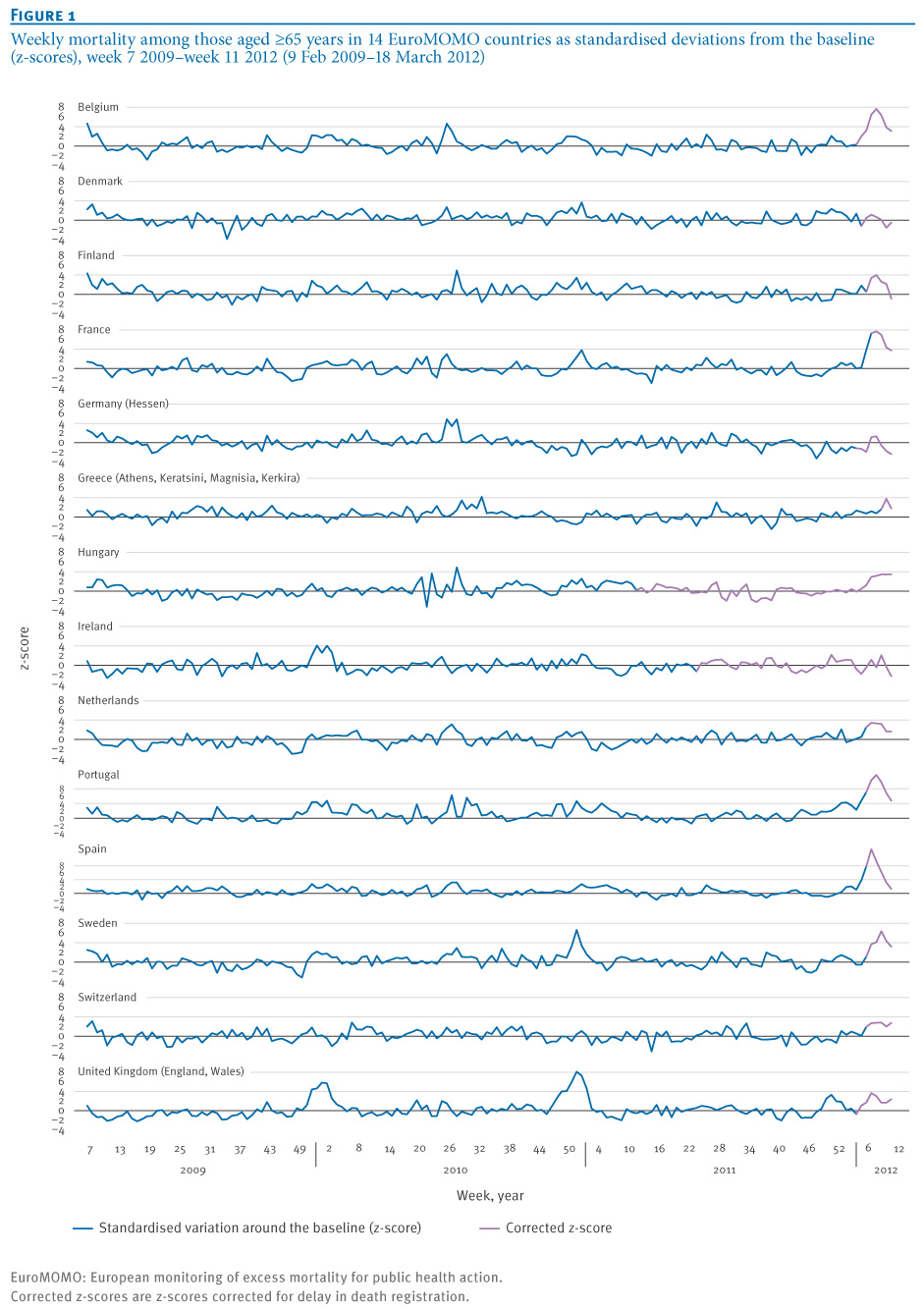
Excess mortality among the elderly in 12 European countries, February and March 2012
----------------------------------------------------
Introduction
Since July 2004, the Institut de veille sanitaire
(InVS) has implemented a monitoring
daily health of the French population from the
non-specific surveillance system SurSaUD (monitoring)
(health emergencies and deaths) [1]. The monitoring
of the mortality in routine was integrated with SurSaUD
in connection with the Institute national statistics and economic
studies (Insee).
It is based on data from the administrative part
death certificates and registered by State offices civil
including transmission of data to the Insee is dematerialised.
Although still poorly deployed electronic certificationdeath by
the Centre of epidemiology on the causesmedical death (Inserm-
Cepidc) also contributes to this systemmonitoring through information
from the partmedical certificate of death [2]. The death follows
a cycleannual with marked seasonal variations. Thus, outside any
unusual event, the general level of mortalityis higher in the
winter and in the summer low. Episodesexcess mortality were noted from
time to time, in particularin the 2008-2009 winter where almost
6 000 excess deathshad been registered [3]. This episode was a
partner in theconcomitant occurrence of a wave of cold and seasonal
epidemics(influenza virus, respiratory syncytial (RSV) and other
diseases)(respiratory). These factors are described in the literature to
influence the evolution of mortality on the year[4, 5]. In the
winter of 2011-2012, the monitoring of mortalityconducted by the
InVS has shown a clear increase in the workforcedeath from
early February 2012. The objective
of this article is to describe the fluctuations in mortality in
the winter of 2011-2012,compared to the previous winters, and
put it in epidemic and climate changes during this period.The characteristics
of this episode of excess deaths are also compared to the episode
of the winter of 2008-2009.centered on the week S (S-2, S + 2)
of the three years 2008, 2010 and 2011, applied to the estimate
of the population of the year 2012.The year 2009 has been excluded
from the reference period, the six first weeks having been affected
by a major excess mortality. The excess of death (O-E) is measured
by the difference between observed and expected death. The ratio
(O/E)is defined by the relationship between observed and expected
numbers death. The confidence interval of fish to 95% of the ratio
mortality was calculated. This same method was used to estimate the excess
mortality in the winter 20082009[3]. The analysis is conducted
all ages combined and slices age of 10 seniors 55 years or more.
THE weekly evolution of the number of certified electronic death is
also parsed for three major classes of age. Analysis However, must
be considered with caution because it takes into account of all
institutions that use this method of certification and does not
take account of the influence of the rise in support the system,
which remains very moderate since mid-2010.but with a more moderate
than excess observed in the 85 years or more.In week 10, the numbers
for this class are similar to those of previous years. In total,
on the sample of municipalities participating in the system of
monitoring SurSaUD (70% of national mortality), excess of nearly
6,000 deaths(+ 13%) is estimated, all ages, over the period of
sixweek of February 6 to March 18, 2012, compared to the years 2008,
2010 and 2011 (table 1). Much of the excessmortality occurs in
persons aged 85 to 94 years.with 2850 deaths in excess (+ 18%).
People of 95 years or more, the excess is of the order of
1000 additional deaths(+ 31%). From the information from the electronic
certification,the number of deaths following a close dynamic:
a progression more marked at the beginning of the year 2012 with
reaches peak in week 8, followed by a decrease and a return to
the week 12, at numbers comparable to those observed before this
period(figure 2). This evolution is observed in people of 75 years
or more.
Material
mortality data Mortality allcauses among 3382 Commons transmitting
certificates of death of dematerialized way in 2011
(80% of national mortality)1,042 daily send their
data since 2004, this that represents about 70% of the total mortality
observed daily in France. This proportion differs according to
region: it varies 60% of the total mortality in the Limousin, Poitou
regions.Charentes, France 80% in regions Provence-Alpes-Cote
d'Azur (Paca) and Ile-de-France. To study the mortality on winter
2011-2012 compared to previous years the analysis is based on
data recorded by these 1,042 Commons. For each deceased individual,
the InVS has its characteristics demographic (age and sex), the
commune and the date of death.Electronic certification of death
in addition to the characteristics demographic and administrative
of deceased individuals, data issues of electronic certification
also provide the gross medical causes of death. In this analysis,
only the dynamics of mortality all causes observed from this method
of certification is presented as illustrative.This data source
covering only 5% of French mortality total, it does not allow a
reliable analysis by cause of death.Regional disparities Over the
period of 6 weeks between February 6-March 18, 2012, almost all
of the regions has been affected by this episode of excess, with
excesses Variant of + 8% in Alsace to + 22% PACA mortality expected
(table 2).Results weekly Fluctuations the mortality in the winter
of 2011-2012 at the national level The number of deaths per 100,000
population, all ages combined,has progressed from week 45
(early November 2011);following the usual seasonal pattern of
mortality. The numbers of deaths recorded on end of 2011 to January
2012 were slightly lower in the order of 2 to 4 per cent, to those
observed the previous years. This sous-mortalite was more marked in
the classes of age between 65 and 84 years (figure 1). Between
the weeks 6 and 11 (from February 6 to March 18, 2012), an excess
of the number death is observed, with a dynamic characterized by
a first phase of rapid progression of mortality between the weeks
5 and 7, and a stabilization of the workforce to a level high on
the weeks 8 and 9, followed by a decrease in the mortality until
week 12. From week 12, workforce find values close to those observed
the years earlier in the same period (figure 1). Analysis classes age
shows that this increase is particularly seniors over age 85, for
which the indicator mortality is significantly higher than three
years previous (figure 1). Seniors 75 to 84 years.There is also
an increase in mortality from week 6,.Comparison of the winter
2008-2009 and 2011-2012 The excess mortality observed during the
winter 2008/2009 had also over a period of 6 weeks, with excess comparable
(in absolute number and proportion) of 5800 deaths(+ 14%) established
on the same sample of Commons used for the analysis of the winter
2011-2012 [3]. The elderly 75 years or more were the most affected.
On the other hand, distribution geographic of the excess of mortality
according to the regions in the course Winter 2011-2012 differs
markedly from that observed in Winter 2008-2009 (figure 3). In
2012, a North-South gradient excess of mortality is observed, the
southern regions of the France being the most affected. Conversely,
in 2009, the excess characterized by a gradient Southeast/Northwest
regions located in the Northwest and southern France being the most
affected.
Demographic data
Workforce population by Department, age
and sex between 1 January 2006 and 2012 are estimates and population
projections established by the Insee.
Methods
The ageing of the
population French mechanical way to increase leads of the population
of the higher age classes. Thus, the number of people aged 85 years
or more is spent $ 1.1 millionin 2005 to nearly 1.7 million in
2012, representing a 55% increase.To take into account these demographic
changes of the population in the variations of mortality, tracking
fluctuations mortality is established from a flag set by the relationship
between the observed number of deaths and the estimated population of
the year. This indicator is expressed in number of deaths for 100000
inhabitants. The analysis is given by age and by region. Quantitative
assessment of the excess of death on the months of February and
March, 2012 is based on a comparison the observed (O) number of
deaths over this period to a number expected(E) the number expected
death of a week S is estimated from of the average rate of mortality
over the period of five weeks
Discussion
Between February 6 and March 18, 2012, an increase in the number of deaths
was recorded compared to previous years and more particularly concerned the
elderly (85 years or more). THE demographic evolution of
the population is not sufficient to explain fully this increase,
since it remains while considered a mortality indicator adjusted
on the evolutionof the population. This excess of approximately
6,000 deaths is estimated to 1042 Commons with a civil registry
office with the transmission of data to the Insee is dematerialised.
These municipalities cover 70% of the mortality in France Metropolitan.
To date, it is not possible to quantify with accuracy the total
excess deaths. work on data comprehensive and consolidated, which
will be available only in several months, will allow this calculation.
However, the system of monitoring SurSaUD helped to objectify
very quickly this increase in deaths and provide a first estimate
of its importance. Insee also works actively in the extension
may have contributed to a reduced
vaccine effectiveness in people the most elderly [8]. Finally,
in this period, other respiratory epidemics and gastroenteritis
have also been observed through the InVS monitoring networks. The
occurrence of events Climate (cold wave) or epidemic can be directly or
indirectly responsible for a part of mortality, with Sometimes
a delay of several days to several weeks. In addition to their
direct effect on mortality, these various events can lead to a
destabilization of the general State in the most vulnerable
(pathologies, chronic)(old) that could lead to death. The concurrent
and dynamic temporal and geographic of these two events, climate and
epidemic, must be explored, in particular to better understanding
the North-South gradient of the excess. The work for a better understanding
of the phenomenon must also be pursued, by relying on an analysis
of deaths by cause medical. Information on the issues of medical
causes the electronic certification of death is available real-time
monitoring SurSaUD system.However, the low share (5%) of the
covered national mortality This system does not permit a reliable
analysis by cause on the episode of this winter 2012. The rise
in charge of certification Electronics will allow more rapid understanding
of such a increased mortality and requires the mobilization of institution
1institutions [2]. On the other hand, mortality data comprehensive
and coded the Inserm-Cepidc issues are available until 2010. They
can be used for a comprehensive study the episode of the winter
of 2008-2009 according to medical causes death and make assumptions
on the distribution of mortality by medical cause this winter 2011-
2012. This analys is the episode of 2009 could also provide informationon
Sources:
InVS - DCAR / Insee.the dematerializationthe offices of civil
status, which will thus cover alarge share of national mortality.
In Europe, many countries have also observed an excess over this
period,with intensity marked in Spain, in Portugal, in Sweden and
Belgium and more moderate Netherlands, in Switzerland, too Finland,
Hungary, Ireland and Greece [6]. An event analogue was observed
in the winter of 2008-2009, with a excess mortality comparable
all ages and age classes.Considering the comprehensive data of
the Inserm cepidc, the excess total of mortality amounted to approximately
10000 deaths (+ 15%). Of Similarly to the winter of 2008-2009,
the increase mortality in the months of February and March 2012
could be related with the concomitant occurrence of different factors
in the course of this period, while the share of this increase
due each of them will be known to date:-the France has been a period
of intense cold over a period of 13 consecutive days between
1 and 13 February; -the winter flu epidemic has been developing throughout
the territory as soon as mid-February, with the peak reached in
week 9 at the national level.This epidemic was characterized,
on the one hand, by the predominance the virus influenza A (H3N2)
known to have a greater impact the health of older persons [7]
and, on the other hand, by the traffic in this outbreak of virus
variants at the H3N2 which

the characteristic social deaths, opening the venue
of amelioration for a better prevention
cibliee and adaptive for this population
references:
Hebd. 2012;(1):7-10.
[1] Caillère N, Fouillet A, Henry V, Vilain P, Mathieu A, Maire
B, et al. Le systeme francais de surveillance sanitaire des urgences
et des deces
(SurSaUD). Saint-Maurice: Institut de veille sanitaire ; 2012. 12 p.
http://www.invs.sante.fr/fr/Publicat...nitaire-des-ur gences-et-des-deces-SurSaUD-R
[2] Fouillet A, Pavillon G, Vicente P, Caillère N, Aouba
A, Jougla E, et al. La certification electronique
des deces, France, 2007-2011. Bull Epide©miol
[3] Fouillet A, Ilef D, Josseran
L. Surveillance de la mortalité en France au cours
de l'hiver 2008-2009, premiers éléments.
Bull Epidemiol Hebd 2009;(15) :133-7.
[4] Analitis A, Katsouyanni K, Biggeri A, Forsberg B, Bisanti L, et al.
Effects of there on mortality: results from 15 cities
within the PHEWE project. Am J 2008;168(12):1397-408.
Baccini M, cold wea European Epidemiol.
[5] Dushoff J, Plotkin J, Viboud C, Earn DJ, Simonsen L.
Mortality due to influenza in the United States -
an annualized regression approach using multiple-cause
mortality data. Am J Epidemiol. 2006;163(2):181-7.
[6] Mazick A, Gergonne B, Nielsen
J, Wuillaume F, Virtanen MJ, Fouillet A, et al.
Excess mortality among the elderly in 12 European countries,
February and March 2012. Euro Surveill. 2012;17(14):pii-20138.
[7] European Centre for Disease Prevention and Control. Seasonal
influenza 2011-2012 in Europe (EU/ EEA countries). Risk assessment.
Stockholm: ECDC; 2012. 21 p.

[8] Bonmarin I, Belchior E, Le Start Y, Lévy-Bruhl D. First estimates
of influenza vaccine effectiveness among severe influenza cases,
France, 2011/12. Euro Surveill. 2012;17(18):pii=20163.
http://www.eurosurveillance.org/ViewArticle. aspx?ArticleId=20163