Check out the FAQ,Terms of Service & Disclaimers by clicking the
link. Please register
to be able to post. By viewing this site you are agreeing to our Terms of Service and Acknowledge our Disclaimers.
FluTrackers.com Inc. does not provide medical advice. Information on this web site is collected from various internet resources, and the FluTrackers board of directors makes no warranty to the safety, efficacy, correctness or completeness of the information posted on this site by any author or poster.
The information collated here is for instructional and/or discussion purposes only and is NOT intended to diagnose or treat any disease, illness, or other medical condition. Every individual reader or poster should seek advice from their personal physician/healthcare practitioner before considering or using any interventions that are discussed on this website.
By continuing to access this website you agree to consult your personal physican before using any interventions posted on this website, and you agree to hold harmless FluTrackers.com Inc., the board of directors, the members, and all authors and posters for any effects from use of any medication, supplement, vitamin or other substance, device, intervention, etc. mentioned in posts on this website, or other internet venues referenced in posts on this website.
We are not asking for any donations. Do not donate to any entity who says they are raising funds for us.
Announcement
Collapse
No announcement yet.
Flash reports in US east cost consistent with meteor shower: Nasa (Straits Times, March 23 2013)
Re: Flash reports in US east cost consistent with meteor shower: Nasa (Straits Times, March 23 2013)
Eastern USA Fireball March 22, 2013
By Robert Lunsford, in Fireball Logs, Fireball Sightings
The American Meteor Society has received over 500 reports of a bright meteor that occurred near 2000 (8:00pm EDT) on Friday evening March 22, 2013. The witnesses range from along the Atlantic coast ranging from Maine to North Carolina. This object was also seen as far inland as Ohio. Individual reports may be viewed in the 2013 AMS Fireball Table. Refer to event #667 for 2013.
For those not familiar with meteors and fireballs, a fireball is a meteor that is larger than normal. Most meteors are only the size of small pebbles. A meteor the size of a softball can produce light equivalent to the full moon for a short instant. The reason for this is the extreme velocity at which these objects strike the atmosphere. Even the slowest meteors are still traveling at 10 miles per SECOND, which is much faster than a speeding bullet. Fireballs occur every day over all parts of the Earth. It is rare though for an individual to see more than one or two per lifetime as they also occur during the day, on a cloudy night, or over a remote area where no one sees it. Observing during one of the major annual meteor showers can increase your chance of seeing another one of these bright meteors.
Meteors often appear much closer than they really are. There is often a common misconception that the object appeared nearby when in fact the actual flight path was several hundred miles away and was witnessed over several states. It is your perspective that makes meteors appear to strike the horizon when in fact they are still high in the atmosphere. This is much like a jetliner seen low in your sky. It appears low to you but for someone located many miles away in that direction, the jetliner is passing high overhead. Meteors become visible at approximately 50 miles above the Earth?s surface. Friction slows these objects down until they fall below the velocity necessary to produce light. At this point they still lie at least 5 miles high in the sky. They are invisible below this altitude and cannot be seen as they basically free falling to the ground at 200mph. Very few meteors actually reach the ground as 99.99% completely disintegrate while still 10-20 miles up in the atmosphere.
The American Meteor Society, Ltd. is established to inform, encourage, and support the research activities of people who are interested in the field of Meteor Astronomy
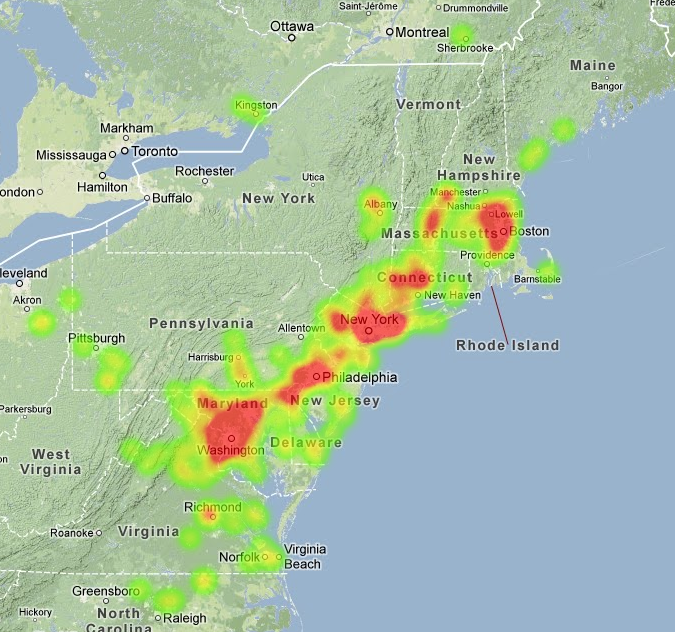
Here?s a heat map of the witness sightings for the March 22nd, 2013 Northeast Fireball. Click map below to view event sightings page.
Heat Map For March 22nd, 2013 Northeast Fireball (last update: 03/23 ? 11am ET)
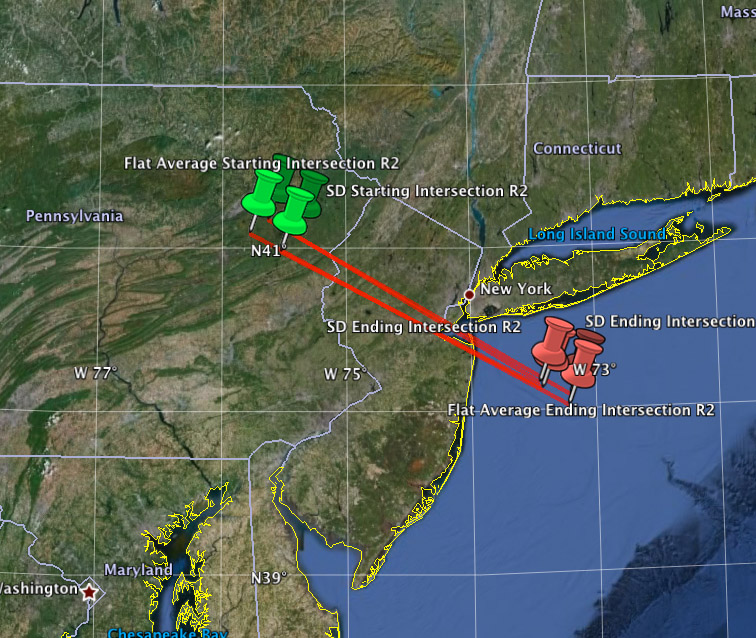
Here?s an estimated trajectory model for the meteor spotted in the northeast earlier tonight. This model is calculated by computing the intersection points of each witness with all other witnesses. These points are then averaged for the starting and ending points of the meteor. Click map below to view event sightings page.

 Tweet
Tweet
 Flash reports in US east cost consistent with meteor shower: Nasa (Straits Times, March 23 2013)

Comment