Announcement

Collapse
No announcement yet.

Deepwater Horizon oil spill disaster- Update on BP's attempt to stop the oil leaks - The Macondo 252 well is now officially DEAD

Collapse
X
 
  • Filter
  • Time
  • Show
Clear All
new posts

  • #16
    Re: US Oil Spill Response Team: Plan To Deploy Dome In 6-8 Days

    Deep-sea ice crystals stymie Gulf oil leak


    May 8, 2010 6:45 PM (42 mins ago) By HARRY R. WEBER and

    SARAH LARIMER, AP

    (AP Photo/David Quinn)
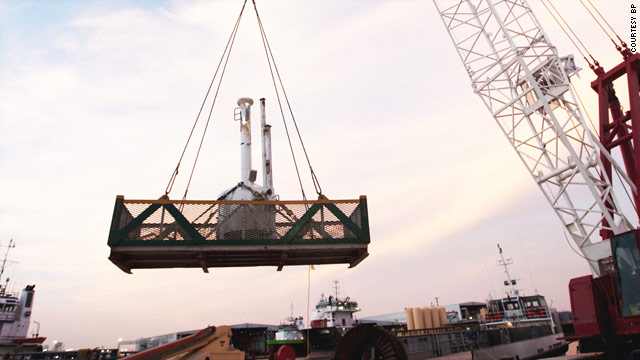
    A crane ship floats in support of a relief platform at the Deep Sea Horizon oil spill site in the Gulf of Mexico, Saturday, May 8, 2010.


    ON THE GULF OF MEXICO (Map, News) -

    A novel but risky attempt to use a 100-ton steel-and-concrete box to cover a deepwater oil well gushing toxic crude into the Gulf of Mexico was aborted Saturday after ice crystals encased it, an ominous development as thick blobs of tar began washing up on Alabama's white sand beaches.

    The setback left the mission to cap the ruptured well in doubt. It had taken about two weeks to build the box and three days to cart it 50 miles out then slowly lower it to the well a mile below the surface, but the frozen depths were too much for it to handle.

    Still, BP officials overseeing the cleanup efforts were not giving up just yet on hopes that a containment box - either the one brought there or a larger one being built - could cover the well and be used to capture the oil and funnel it to a tanker at the surface to be carted away. Officials said it would be at least Monday before a decision was made on what next step to take.

    "I wouldn't say it's failed yet," BP chief operating officer Doug Suttles said.

    "What I would say is what we attempted to do ... didn't work."

    /.../
    At Examiner.com we help you excel personal finance, boost income, invest wisely, travel smart, reach financial freedom faster, and enjoy life on a budget.

    Comment


    • #17
      Re: US Oil Spill Response Team: Plan To Deploy Dome

      After Saturday's containment box failure, BP may try again with a smaller version

      By The Associated Press

      May 09, 2010, 7:19PM

      Excerpts:

      Among the plans under consideration:

      -- Deploying a new, smaller containment box in the hope that it would be less likely to get clogged. Officials said the new box could be in place by midweek.

      "We're going to pursue the first option that's available to us and we think it'll be the top hat," the smaller box, BP Chief Operating Officer Doug Suttles said.

      -- Cutting the riser pipe, which extends from the mile-deep well, undersea and using larger piping to bring the gushing oil to a drill ship on the surface, a tactic considered difficult and less desirable because it will increase the flow of oil.

      -- Shooting mud and concrete directly into the well's blowout preventer, a device that was supposed to shut off the flow of oil after a deadly April 20 oil rig explosion but failed. The technique, known as a "top kill," is supposed to plug up the well and would take two to three weeks.

      -- Try again using the containment box that failed to work Saturday after finding a way to keep the crystals from building up.

      The engineers appear to be "trying anything people can think of" to stop the leak, said Ed Overton, a Louisiana State University professor of environmental studies.

      "Hopefully these are low-risk type of operations," he said. "We don't want to do anything to make it flow more."

      --------------------------------------------
      BP spokesman Mark Proegler said no decisions have been made on what step the company will take next. A decision could come as early as Monday.

      Philip Johnson, a petroleum engineering professor at the University of Alabama, said cutting the riser pipe and slipping a larger pipe over the cut end could conceivably divert the flow of oil to the surface.

      "That's a very tempting option," he said. "The risk is when you cut the pipe, the flow is going to increase. ... That's a scary option, but there's still a reasonable chance they could pull this off."

      Johnson was less optimistic that a smaller containment box would be less susceptible to being clogged by icelike crystals.

      "My suspicion is that it's likely to freeze up anyway," he said. "But I think they should be trying everything they can."

      --------------------------------------------
      BP officials were not giving up hopes that a containment box -- either the one brought there or another one being built -- could cover the well. Crews planned Sunday to secure the box about 1,600 feet from the massive leak site, much farther away from where it was placed Saturday, according to a daily activity sheet reviewed by The Associated Press.

      Full text at:

      Comment


      • #18
        Re: US Oil Spill Response Team: Plan To Deploy Dome

        Smaller containment dome being lowered toward spill

        by Associated Press
        wwltv.com
        Posted on May 11, 2010 at 9:34 PM
        Updated yesterday at 10:21 PM

        ON THE GULF OF MEXICO -- A second, smaller oil containment box was lowered into the sea near the blown-out well in the Gulf of Mexico.

        The box was being slowly submerged to the seabed Tuesday. But it won't be placed over the spewing well right away. BP spokesman Bill Salvin says engineers want to make sure everything is configured correctly and avoid the same buildup of ice crystals that stymied their first attempt at using a larger box that was about 100 tons.

        This box will be connected to a ship on the surface by a pipe-within-a-pipe when it's lowered. Crews plan to pump in heated water and methanol so ice won't build up.

        Salvin said undersea robots will position the box over the gusher by Thursday.

        More than 4 million gallons of oil have spewed from the well since a drilling rig exploded April 20.

        Comment


        • #19
          Re: US Oil Spill Response Team: Plan To Deploy Dome

          'Top hat' reaches Gulf of Mexico floor, BP says

          By the CNN Wire Staff<SCRIPT type=text/javascript>cnnAuthor = "By the CNN Wire Staff ";</SCRIPT>
          <SCRIPT type=text/javascript>if(location.hostname.indexOf( 'edition.' ) > -1) {document.write('May 12, 2010 -- Updated 1249 GMT (2049 HKT)');} else {document.write('May 12, 2010 8:49 a.m. EDT');}</SCRIPT>May 12, 2010 8:49 a.m. EDTMay 12, 2010 -- Updated 1249 GMT (2049 HKT)

          <!--endclickprintinclude--><!-- google_ad_section_end --><!--startclickprintexclude--><!--endclickprintexclude--><!-- google_ad_section_start --><!-- CONTENT --><!--startclickprintinclude--><SCRIPT language=JavaScript type=text/javascript>var clickExpire = "-1";</SCRIPT><!-- REAP --><!--startclickprintexclude--><!--===========IMAGE============--><!--===========/IMAGE===========-->
          <!--===========CAPTION==========-->BP built the smaller "top hat" dome after a larger vessel developed glitches Saturday.

          <!--===========/CAPTION=========--><!--endclickprintexclude--><!-- /REAP --><!-- google_ad_section_end -->
          Venice, Louisiana (CNN) -- The "top hat" oil containment device has reached the sea floor in the Gulf of Mexico and should be in position over a leaking well head and operational by the end of the week, BP said Wednesday.

          A larger containment vessel was unsuccessful in stopping the flow of oil from the gusher about 5,000 feet underwater. The spill is sending 210,000 gallons of crude into the Gulf of Mexico each day.

          The "top hat," a 5-foot-tall, 4-foot-diameter structure, weighs less than 2 tons. The structure was deployed by the drill ship Enterprise.
          BP built the smaller dome after a much larger, four-story containment vessel designed to cap the larger of two leaks in the well developed glitches Saturday. Ice-like hydrate crystals formed when gas combined with water and blocked the top of the dome, making it buoyant.

          The new device would keep most of the water out at the beginning of the capping process and would allow engineers to pump in methanol to keep the hydrates from forming, said Doug Suttles, BP's chief operating officer for exploration and production. Methanol is a simple alcohol that can be used as an antifreeze.


          Secretary of the Interior Ken Salazar said the success of this latest attempt to cap the well could be known in the next few days.

          "On this Thursday, we should know whether or not this alternative top hat cofferdam is going to work," Salazar said on CNN's "The Situation Room." "And then the next key date is Saturday, because by Saturday they will have the diagnostics completed through X-rays and gamma rays and pressure ratings to be able to make decisions about what the next steps are."

          If attempts to cap the well fail, BP may try to plug the leak by shooting debris -- shredded tires, golf balls and similar objects -- under extremely high pressure into the well's blowout preventer in an attempt to clog it and stop the leak. The blowout preventer has been partially successful in sealing the well, but did not fully close when the rig exploded and sank.

          Suttles said BP also is drilling a relief well to try to divert the flow to another pipe.
          "That started about a week ago," Suttles said. "That work continues. The well is at about 9,000 feet."
          /.../

          Comment


          • #20
            Re: US Oil Spill Response Team: Plan To Deploy Dome

            Update on Gulf of Mexico Oil Spill Response

            Release date: 13 May 2010

            BP today provided an update on developments in the response to the MC252 oil well incident in the Gulf of Mexico.
            <!--END:Plain Text para-->

            <!-- Begin: Links. --><!-- End: Links -->
            Subsea Source Control and Containment

            <!--END: Addition of header tag for TB07 -->
            Subsea efforts continue to focus on, firstly, progressing options to stop the flow of oil from the well through interventions via the blow out preventer (BOP) and, secondly, attempts to contain the flow of oil at source to reduce the amount spreading on the surface. These efforts are being carried out in conjunction with governmental authorities and other industry experts.

            Further investigation of the failed BOP, using remotely-operated vehicles and a variety of diagnostic techniques, has increased our understanding of the condition of the BOP and allowed planning to continue for a number of potential interventions, including for a so-called ?top kill? of the well.

            This would involve first injecting material of varying densities and sizes (also known as ?junk shot?) into the internal spaces of the BOP to provide a seal, before pumping specialised heavy fluids into the well to prevent further flow up the well. Plans for this option are being developed in preparation for potential application next week.
            <!--END:Plain Text para-->

            <!-- Begin: Links. --><!-- End: Links -->
            Work to deploy a second system designed to contain the oil flow subsea has continued. A small dome or ?top hat? has been taken out to the well site and placed on the seabed in preparation for deployment. Such a system has never been used in water depths of 5,000 feet and its successful operation is not certain. The deployment of this system is expected to be attempted within the next few days.

            All of the techniques being attempted or evaluated to contain the flow of oil on the seabed involve significant uncertainties because they have not been tested in these conditions before.

            Work on the first relief well, which began on Sunday May 2, continues. It is expected to take some three months to complete. The drilling rig that will drill the second relief well is currently en route to the site, expected to arrive by Friday.

            Comment


            • #21
              Re: US Oil Spill Response Team: Plan To Deploy Dome

              BP to try smaller pipe to stem Gulf oil gusher

              by Jeffery Collins / The Associated Press
              wwltv.com
              Posted on May 13, 2010 at 11:40 AM

              HAMMOND, La. -- BP officials say they have decided to first try sucking oil away from the gushing Gulf well with a tube that will be inserted into the jagged pipe leaking on the seafloor.

              Company spokesman Bill Salvin said BP hopes to start moving the 6-inch tube into the leaking 21-inch pipe -- known as the riser -- on Thursday night. The smaller tube will be surrounded by a stopper to keep oil from leaking into the sea.

              The tube will then siphon the oil to a tanker at the surface.

              Salvin says engineers have to first move the smaller tube past seawater that has gotten into the riser. The seawater could mix with methane to form crystals that could clog the pipe.

              BP says the next option is a small containment box called a "top hat," which is already on the seafloor.

              Comment


              • #22
                Re: US Oil Spill Response Team: Plan To Deploy Dome


                The safest and most inclusive global community of photography enthusiasts. The best place for inspiration, connection, and sharing!

                Comment


                • #23
                  Re: US Oil Spill Response Team: Plan To Deploy Dome

                  Insertion tube strategy chosen to address Gulf of Mexico oil leak

                  By Jaquetta White, The Times-Picayune

                  May 13, 2010, 6:54PM


                  Gerald Herbert/The Associated PressScot Knapp, a crew member on the supply vessel Joe Griffin, turns a valve Tuesday to transfer fuel to the Development Driller III platform, background left, which was drilling the relief well at the site of the Deepwater Horizon oil spill in the Gulf of Mexico.

                  BP will attempt to contain the oil spilling into the Gulf of Mexico using a tube inserted directly into the gash in the riser pipe, BP spokesman Brian Ferguson said Thursday.

                  The company had been deciding since Wednesday between two methods of containment: the riser insertion tube and a containment box called a top hat.

                  "The top hat is still a solution that's in play, but the engineers have elected to go with the riser insertion tube and that process is being worked on now," Ferguson said.

                  The insertion tube is already at the site of the oil spill, where a drilling rig exploded April 20 and subsequently sank. The company planned to lower the tube 5,000 feet Thursday evening and position it on the seabed near where a busted pipe is spewing oil. Ferguson did not know when the tube would be attached to the pipe or activated.

                  The 6-inch in diameter insertion tube, which will be pushed directly into the 21-inch riser pipe, is surrounded by a gasket that will prevent the oil from escaping. The tube will be attached to a ship waiting on the surface.

                  BP introduced the riser insertion tube as an alternative to the top hat Wednesday. The company believes the method will prevent frozen hydrate crystals from blocking the flow of oil onto the drill ship.

                  BP's first attempt at capturing the escaping oil was stymied when its previous containment box, a 78-ton metal and concrete contraption, failed because frozen crystals, called hydrates, blocked the pipe opening where oil would come out after being sucked from the well. The hydrates were also so numerous that they threatened to lift the containment dome from the sea floor. The hydrate crystals form in cold temperatures and under high pressure where water combines with gases.

                  Both the 78-ton containment box and the smaller 2-ton top hat remain staged on the seabed near the sunken rig, Ferguson said.

                  BP had no other updates about efforts to contain and stop the flow of oil Thursday. The "junk shot," a plan for permanently shutting the well by plugging it with debris, could still be attempted next week, Ferguson said.

                  Meanwhile, a remedy that experts believe will be the most effective way of shutting in the well -- but also the most time consuming -- is months from completion. Drilling will resume next week on a relief well that would permanently shut the damaged well by pumping in cement.

                  BP announced on Wednesday that it had drilled the well about halfway, about 9,000 feet, before suspending drilling temporarily in order to test the well.Going the rest of the way will take about three months.

                  "Drilling goes in stages, and the deeper you get the longer it takes and the more complex things are," Ferguson said.

                  Seemingly small tasks like changing out the drill bit can take hours because the drill has to travel thousands of feet back to the surface, Ferguson said.
                  .../

                  Comment


                  • #24
                    Re: US Oil Spill Response Team: Plan To Deploy Dome

                    <CITE class=vcard>BP tries mile-long tube, latest bid to stop leak</CITE>
                    <CITE class=vcard></CITE>
                    <CITE class=vcard>By JEFFREY COLLINS, Associated Press Writer Jeffrey Collins, Associated Press Writer </CITE>? <ABBR class=recenttimedate title=2010-05-15T08:13:31-0700>43 mins ago</ABBR>
                    <!-- end .byline -->
                    HAMMOND, La. ? At first, BP tried to stop the oil rushing into the Gulf of Mexico by flipping a blowout preventer switch. A week ago, they attempted to capture the leak with a 100-ton box. The latest experiment?

                    Trying to guide a skinny, mile-long tube into the gusher to siphon oil to the surface.

                    BP PLC technicians were gingerly moving joysticks to guide deep-sea robots and thread the 6-inch tube into the 21-inch pipe spewing oil from the ocean floor. That work continued Saturday morning for a second day, BP said.

                    The tube is intended to suck oil up like a straw to a tanker on the surface, while a stopper surrounding it would keep crude from leaking into the sea.
                    The company also received word that federal regulators had approved spraying chemical dispersants beneath the sea, a contentious development because it has never been done underwater.

                    Traditionally used on the ocean surface, chemical dispersants act like a detergent to break the oil into small globules, which allows it to disperse more quickly into the water or air before currents can wash it ashore.

                    Louisiana officials claim BP and the Environmental Protection Agency ignored their concerns about how the chemicals may harm the sea floor.
                    ...

                    Full text at:

                    Comment


                    • #25
                      Re: US Oil Spill Response Team: Plan To Deploy Dome

                      <CITE class=vcard>BP confident latest try to capture oil will work</CITE>
                      <CITE class=vcard></CITE>
                      <CITE class=vcard>By JEFFREY COLLINS, Associated Press Writer Jeffrey Collins, Associated Press Writer </CITE>? <ABBR class=recenttimedate title=2010-05-15T15:34:36-0700>1 hr 53 mins ago</ABBR>
                      <!-- end .byline -->
                      ROBERT, La. ? BP was confident Saturday its latest experiment using a mile-long pipe would capture much of the oil flowing into the Gulf of Mexico, even as the company disclosed yet another setback in the environmental disaster.

                      Engineers hit a snag when they tried to connect two pieces of equipment a mile below the water's surface. BP PLC chief operating officer Doug Suttles said one piece of equipment, called the framework, had to be brought to the water's surface so that adjustments could be made to where it fits with the long tube that connects to a tanker above.

                      The framework holds a pipe and stopper, and engineers piloting submarine robots will try to use it to plug the massive leak and send the crude through the lengthy pipe to the surface.

                      "The frame shifted, so they were unable to make that connection," said Suttles, who believes the adjustments will make the device work.

                      At least 210,000 gallons of oil has been gushing into the Gulf of Mexico since an oil rig exploded April 20 and sank two days later. Eleven people were killed in the blast.

                      BP's latest idea seems to have the best chance for success so far, said Ed Overton, a LSU professor of environmental studies. At the surface this would be easy, Overton said, but using robots in 5,000 feet of water with oil gushing out of the pipe makes things much more difficult.

                      "It's something like threading the eye of a needle. But that can be tough to do up here. And you can imagine how hard it would be to do it down there with a robot," Overton said.

                      The tube could capture more than three-quarters of the leak; BP also must contend with a smaller leak that's farther away. If the tube works, it would be the first time the company has been able to capture any of the oil before it fouls the Gulf waters.

                      /.../

                      Comment


                      • #26
                        Re: US Oil Spill Response Team: Plan To Deploy Dome

                        DATE: May 16, 2010 11:45:16 CST

                        Update on Riser Insertion Tube Tool progress

                        ROBERT, La. - The Unified Area Command for the response to the Deepwater Horizon oil spill continues to advance multiple subsea options to contain and ultimately stop the flow of oil from the MC 252 well in the Gulf of Mexico.

                        Overnight the Riser Insertion Tube Tool was successfully tested and inserted into the leaking riser, capturing some amounts of oil and gas. The oil was stored on board the Discoverer Enterprise drill ship 5,000 feet above on the water's surface, and natural gas was burned through a flare system on board the ship.

                        The test was halted temporarily when the tube was dislodged. While this is disappointing, it is not unexpected given the challenging operating environment.

                        Technicians have fully inspected the system and have re-inserted the tool.

                        The tool is fashioned from a 4-inch pipe and is inserted into the leaking riser, from which the majority of the flow is coming. While not collecting all of the leaking oil, this tool is an important step in reducing the amount of oil being released into Gulf waters.

                        The procedure - never attempted before at such depths - involves inserting a 5-foot length of the specifically-designed tool into the end of the existing, damaged riser from where the oil and gas is leaking. In a procedure approved by federal agencies and the Federal On Scene Coordinator, methanol will also be flowed into the riser to help prevent the formation of gas crystals, known as hydrates. Gas and oil will then flow to the surface to the Discoverer Enterprise drillship.

                        The Enterprise has the capability to separate the oil, gas and water mixture safely and eventually store or offload the recovered oil onto another vessel.
                        We will continue to provide updates as they become available.
                        For information about the response effort, visit www.deepwaterhorizonresponse.com.

                        Comment


                        • #27
                          Re: US Oil Spill Response Team: Plan To Deploy Dome

                          BP marks first success in containing oil spill

                          Excerpt:

                          "After other attempts to contain the spill failed, BP Plc succeeded in inserting a tube into the leaking well and capturing some oil and gas.

                          The underwater operation used guided robots to insert a small tube into a 21-inch (53-cm) pipe, known as a riser, to funnel the oil to a ship at the surface.

                          "It's working as planned and we are very slowly increasing the rate that is coming from the riser tool up to the surface," BP senior executive vice president Kent Wells told reporters at BP's U.S. headquarters in Houston.

                          "So we do have oil and gas coming to the ship now."

                          Not all of the oil was being trapped, however. Wells said it was too early to say how much had been siphoned.

                          "This is a good step forward," said Satish Nagarajaiah, professor in civil and mechanical engineering at Rice University in Houston, but he said the siphon tool is unlikely to capture more than 15-20 percent of the oil.

                          "NOT A SOLUTION"

                          The Obama administration downplayed the significance of BP's latest breakthrough.

                          "This technique is not a solution to the problem, and it is not yet clear how successful it may be," Secretary of Homeland Security Janet Napolitano and Secretary of the Interior Ken Salazar said in a joint statement.

                          Preparations for a maneuver to inject mud into the well to stop the leak for good were ongoing and would be completed in seven to 10 days, Wells said. Undersea robots are preparing pipes and hoses around the well to pump up to 40 barrels (1,680 gallons) per minute of mud into the well.

                          BP's best near-term hope of stopping oil from pouring from the well is "kill mud," a heavy mixture of synthetic materials that technicians will attempt to shoot into the well to form a barrier to prevent oil and gas from escaping."

                          Full text:

                          Comment


                          • #28
                            Re: US Oil Spill Response Team: Plan To Deploy Dome

                            BP hopes 'top kill' to stop oil can start Sunday

                            by Greg Bluestein / The Associated Press
                            wwltv.com
                            Posted on May 19, 2010 at 2:28 PM
                            Updated today at 4:22 PM

                            ROBERT, La. -- BP PLC says it hopes to start the next phase of its effort to halt the flow of oil gushing into the Gulf of Mexico on Sunday or early next week.

                            Oil has been spewing from the blown-out well since an offshore rig exploded off the Louisiana coast April 20 and sank two days later.

                            The "top-kill" method BP hopes to start involves shooting heavy mud into crippled equipment on top of the well to stem the flow of oil and gas. The company's engineers hope to quickly follow it up by aiming cement at the well to permanently keep down the oil.

                            Engineers could also use another strategy called the "junk shot," which involves shooting knotted rope, pieces of tires and golf balls into the blowout preventer. Crews hope they will lodge into the nooks and crannies of the device to plug it.

                            Comment


                            • #29
                              Re: US Oil Spill Response Team: Plan To Deploy Dome

                              BP says 'top kill' unlikely before Tuesday

                              by Greg Bluestein / Associated Press

                              wwltv.com
                              Posted on May 21, 2010 at 2:35 PM
                              Updated today at 2:38 PM

                              ROBERT, La. -- BP now says it will likely be at least Tuesday before engineers can shoot heavy mud into a blown-out well spewing oil into the Gulf of Mexico.

                              Three ultra-deepwater rigs and other equipment are at the site where the Deepwater Horizon oil platform exploded April 20. They're preparing for a delicate procedure called a "top kill" that BP hopes will stop the flow of oil from the well.

                              Crews will pump in heavy drilling mud, which is a thick, viscous fluid that's twice the density of water. That should stop the oil, and then they'll use cement to keep more from gushing out.

                              BP's Doug Suttles says this hasn't been tried at 5,000 feet underwater before, so engineers want to make sure everything is just right.

                              Comment


                              • #30
                                Re: US Oil Spill Response Team: Plan To Deploy Dome

                                BP: Mile-long tube collecting less oil than before

                                BP: Mile-long tube collecting less oil than before

                                by Greg Bluestein / Associated Press
                                wwltv.com
                                Posted on May 23, 2010 at 11:37 AM
                                Updated today at 11:51 AM


                                COVINGTON, La. -- Three top Obama administration officials are returning to the Gulf Coast to monitor the massive oil spill that seems to have no end in sight, as BP PLC officials said Sunday that one of their efforts to slow the leak wasn't working as effectively as before.

                                BP spokesman John Curry told The Associated Press on Sunday that a mile-long tube inserted into the leaking well siphoned some 57,120 gallons of oil within the past 24 hours, a sharp drop from the 92,400 gallons of oil a day that the device was sucking up on Friday. However, the company has said the amount of oil siphoned will vary widely from day to day.

                                Engineers are working furiously to stem the growing ooze as more wildlife and delicate coastal wetlands are tainted despite the oil-absorbing booms placed around shorelines to protect them.

                                /.../

                                Comment

                                Working...
                                X