
 Tweet
Tweet
 Euro Surveill. High frequency of cross-reacting antibodies against 2009 pandemic influenza A(H1N1) virus among the elderly in Finland
High frequency of cross-reacting antibodies against 2009 pandemic influenza A(H1N1) virus among the elderly in Finland (Euro Surveill., edited)
Eurosurveillance, Volume 15, Issue 5, 04 February 2010
Research articles
High frequency of cross-reacting antibodies against 2009 pandemic influenza A(H1N1) virus among the elderly in Finland
N Ikonen ( )<sup>1</sup>, M Strengell<sup>1</sup>, L Kinnunen<sup>2</sup>, P ?sterlund<sup>1</sup>, J Pirhonen<sup>1</sup>, M Broman<sup>1</sup>, I Davidkin<sup>1</sup>, T Ziegler<sup>1</sup>, I Julkunen<sup>1</sup>
<hr>
Citation style for this article: Ikonen N, Strengell M, Kinnunen L, ?sterlund P, Pirhonen J, Broman M, Davidkin I, Ziegler T, Julkunen I. High frequency of cross-reacting antibodies against 2009 pandemic influenza A(H1N1) virus among the elderly in Finland. Euro Surveill. 2010;15(5):pii=19478. Available online: http://www.eurosurveillance.org/View...rticleId=19478
Date of submission: 11 December 2009
<hr>
Since May 2009, the pandemic influenza A(H1N1) virus has been spreading throughout the world. Epidemiological data indicate that the elderly are underrepresented among the ill individuals. Approximately 1,000 serum specimens collected in Finland in 2004 and 2005 from individuals born between 1909 and 2005, were analysed by haemagglutination-inhibition test for the presence of antibodies against the 2009 pandemic influenza A(H1N1) and recently circulating seasonal influenza A viruses. Ninety-six per cent of individuals born between 1909 and 1919 had antibodies against the 2009 pandemic influenza virus, while in age groups born between 1920 and 1944, the prevalence varied from 77% to 14%. Most individuals born after 1944 lacked antibodies to the pandemic virus. In sequence comparisons the haemagglutinin (HA) gene of the 2009 pandemic influenza A(H1N1) virus was closely related to that of the Spanish influenza and 1976 swine influenza viruses. Based on the three-dimensional structure of the HA molecule, the antigenic epitopes of the pandemic virus HA are more closely related to those of the Spanish influenza HA than to those of recent seasonal influenza A(H1N1) viruses. Among the elderly, cross-reactive antibodies against the 2009 pandemic influenza virus, which likely originate from infections caused by the Spanish influenza virus and its immediate descendants, may provide protective immunity against the present pandemic virus.
<hr>
Introduction
In March and April 2009, a previously unknown variant of influenza A(H1N1) virus was able to cause sporadic infection clusters and epidemics in North America [1] and Mexico [2]. Rapid identification of the virus indicated that it was a novel H1N1-reassortant influenza A virus that originated from a triple reassortant North American swine influenza A virus that had acquired two virus genes (NA and M) from an Eurasian swine influenza A virus; the virus thus contains genetic material from avian (PA and PB2), human (PB1) and two lineages of swine influenza A viruses [3,4]. Compared with seasonal H1N1 viruses the novel virus is genetically and antigenically very different from human H1N1 viruses that have been circulating during the last 60 to 70 years [5]. Since the majority of the world?s population is lacking immunity against this new virus, it has been spreading throughout the world with an unprecedented speed. On 11 June 2009, the World Health Organization (WHO) declared the first pandemic of the 21st century to have started, caused by the 2009 pandemic influenza A(H1N1) virus.
Epidemiological analyses initially from Mexico [6] and the United States (US) [4], and later from Europe [7] and the southern hemisphere [8,9] revealed that the disease is affecting children, young adults and the general population under 65 years of age. Recent reports from Japan [10], the US [11,12] and the United Kingdom (UK) [13] have suggested that pre-existing antibodies and thus cross-protection against the pandemic virus exist in some individuals, especially those that are currently over 65 years-old. At present only limited data on this is available from Europe.
Rapid isolation and characterisation of the 2009 pandemic influenza virus, the fast dissemination of the early virus isolates to laboratories around the world, and the swift generation of reassortant and recombinant vaccine viruses enabled vaccine manufacturers to start mass production of pandemic virus vaccines rapidly. Presently, many vaccine producers have been successful in preparing functional vaccines and mass vaccinations are ongoing in a number of countries. Following recommendations by the WHO, the European Centre for Disease Prevention and Control (ECDC), and other relevant agencies, many countries have made their own vaccination prioritisations, in which health professionals, pregnant women, people with chronic underlying diseases, and children and young adults are among the first groups to be vaccinated. In order to have a better view of the possible pre-existing cross-reactive immunity against the 2009 pandemic influenza virus in the Finnish population we measured pre-existing antibodies to this virus in more than 1,000 serum samples collected in 2004 and 2005, long before the present pandemic, from individuals born between the years 1909 and 2005.
Methods
Serum specimens
The study had been approved by the ethical committee of the Helsinki University Central Hospital. The serum specimens analysed were obtained from the virus diagnostic unit at the Central Laboratory Services of the Helsinki University Hospital (HUSLAB). The sera had been collected in 2004 and 2005 from persons representing different age groups and from different parts of the country. Only the age and sex of the individual and the collection date of the sample were known. Altogether 1,031 serum specimens were analysed.
Viruses and laboratory methods
We isolated a number of 2009 pandemic influenza A(H1N1) viruses from patients suffering from an acute respiratory infection. Nucleotide sequence analysis of almost the entire genome of three early Finnish isolates, and haemagglutinin (HA) and neuraminidase (NA) sequence data from 25 viruses subsequently identified in our laboratory revealed that the Finnish viruses were almost identical to the prototype pandemic vaccine virus (A/California/07/2009) and represented typical North American/European pandemic virus strains.
For the present study we selected the pandemic influenza A/Finland/554/2009 H1N1 isolate (GenBank accession numbers GQ328866-7 and GQ283487-91) as a representative virus for the immunological analysis. The virus was derived from a nasopharyngeal aspirate obtained from a patient who had recently returned from Chicago. The virus was isolated in Madin-Darby canine kidney (MDCK) cells. The pandemic influenza A/Finland/554/2009 H1N1 (HA-titre 32) and the seasonal influenza A/Finland/814/2001 H1N1 (New Caledonia-like, HA-titre 64) and A/Finland/715/2000 H3N2 (Panama-like, HA-titre 64) viruses were grown in MDCK cultures. For safety reasons the pandemic virus was inactivated with β-propiolactone (Ferrak, Berlin, Germany), which did not reduce the antigenicity of the virus.
Antibody responses to the pandemic and seasonal influenza A viruses were determined with the haemagglutination-inhibition (HI) test using standard microtitre procedures [14]. Serum specimens were pretreated with Vibrio cholerae filtrate (Denka Seiken, Tokyo, Japan) to remove non-specific inhibitors and with packed guinea pig erythrocytes to remove non-specific agglutinins. In the analysis four HA units of virus and 0.75% guinea pig erythrocytes were used.
Statistical analyses
The mean antibody levels in different age groups against the three viruses were calculated as geometric mean titres and standard deviations (SD) of the means. The results are presented as the geometric means with one SD unit. The ranges of antibody titres are also given. For HI titre values under 10 an arbitrary value of 5 was assigned in order to enable the calculation of geometric means.
Amino acid sequence comparisons of viral HA gene
The HA sequences of the 2009 pandemic influenza A (H1N1) viruses (A/California/7/2009 and A/Finland/554/2009) were compared with those of three Spanish influenza viruses (GenBank accession numbers AF116575-6, AF117241) genes as well as with six other seasonal human influenza A(H1N1) viruses from 1933 to 2007 (CY009284, CY009612, CY021053, CY030230, CY033577, CY045756 and FJ969540) and with the swine influenza A(H1N1) virus that caused a human outbreak in Fort Dix in the US in 1976 (CY039991). Comparisons were done only for the HA1 region (327 of 566 amino acids) because this region contains the major antigenic epitopes of the molecule (see Figure 2). Sequence comparisons at amino acid level were conducted in MEGA4 (Molecular Evolutionary Genetics Analysis software version 4.0 [15]). In pairwise sequence comparisons the gaps were included.
Structural analysis of amino acid differences in the HA molecule
Three-dimensional structures of several influenza A virus HA proteins have been determined. Of the human H1 virus subtypes, the HA structures of A/South Carolina/1/18 and A/Puerto Rico/8/34 have been resolved by crystallography [16]. For our analysis we selected the structure of A/South Carolina/1/18 HA (RCSP Protein Data Bank accession number 1ruz) as the basis for analysing the locations of amino acid differences between the HA structures of the Spanish influenza, the pandemic influenza A/Finland/554/2009 H1N1, the seasonal influenza Puerto Rico/8/1934 H1N1 and the seasonal vaccine A/Brisbane/59/2007 H1N1 virus. The representations were done using RasMol Molecular Graphics software version 2.7.3 [17].
Results
Antibody levels
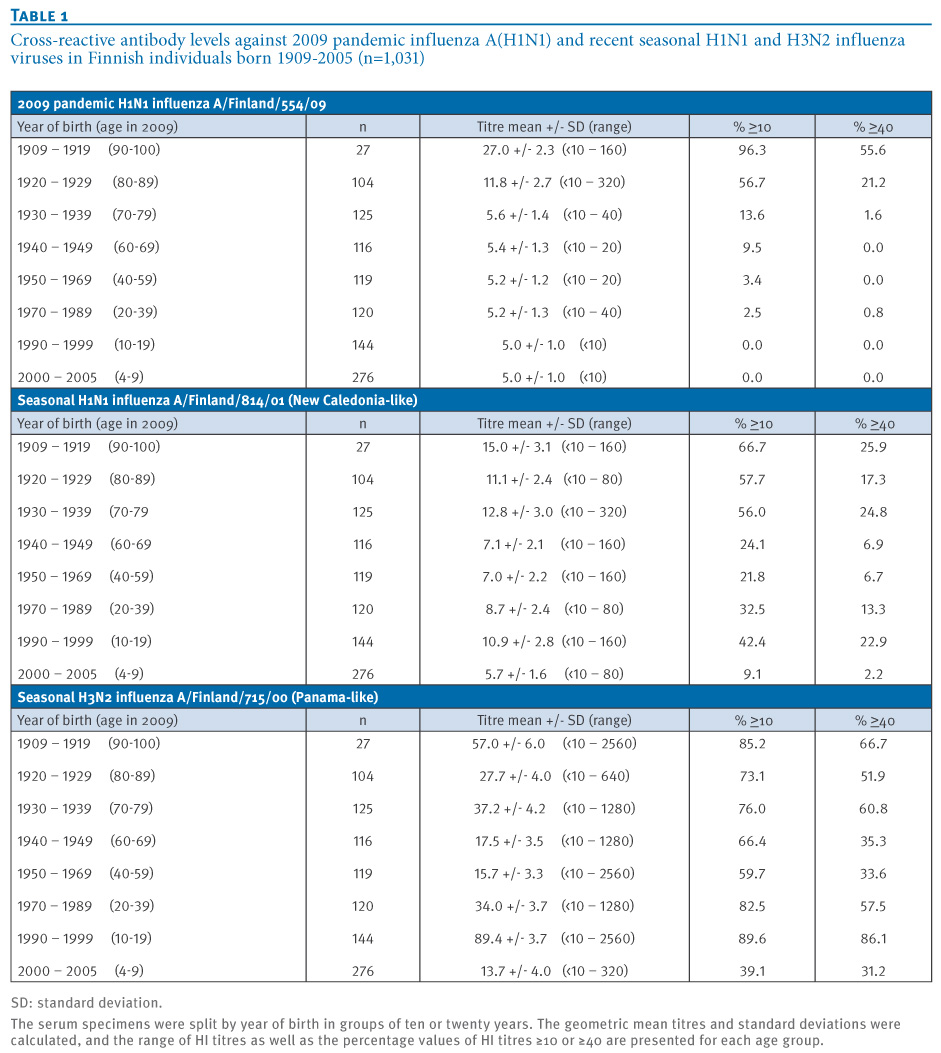
Antibody levels against a representative 2009 pandemic influenza virus, A/Finland/554/2009 showed that the oldest individuals (born between 1909 and 1919) had a very high prevalence of antibodies to the 2009 pandemic influenza A(H1N1) virus. More than 96% of these individuals had detectable antibodies (titres ≥10), and in more than 55% of them, antibody titres of ≥40 were detected, which is generally considered to be a protective level. In younger age groups the prevalence of detectable antibodies against 2009 pandemic influenza virus decreased gradually with increasing year of birth (Table 1). Only some (10-14%) of the individuals born between 1930 and 1949 had cross-reactive antibodies against the pandemic virus. It is of note that some individuals in the oldest age-group had very high antibody levels with HI titres ranging between 160 and 320. Antibodies against seasonal H1N1 and H3N2 influenza viruses were found in 9-67% and 39-90% of all the individuals, respectively, depending on the age group (Table 1).
Table 1. Cross-reactive antibody levels against 2009 pandemic influenza A(H1N1) and recent seasonal H1N1 and H3N2 influenza viruses in Finnish individuals born 1909-2005 (n=1,031)

When the older age groups were divided into subgroups of five birth years (Figure 1), a gradual decrease in the frequency and levels of antibodies against the 2009 pandemic influenza virus was observed with increasing year of birth, indicating that high antibody levels were only found in individuals born in the mid 1920s or earlier. A relatively large proportion of individuals in these age groups also had antibodies against seasonal H1N1 and H3N2 influenza viruses.
Figure 1. Frequency of cross-reactive virus-specific antibodies against 2009 pandemic influenza A(H1N1) in people born between 1909 and 1949 in Finland (n=372)

Sequence comparisons
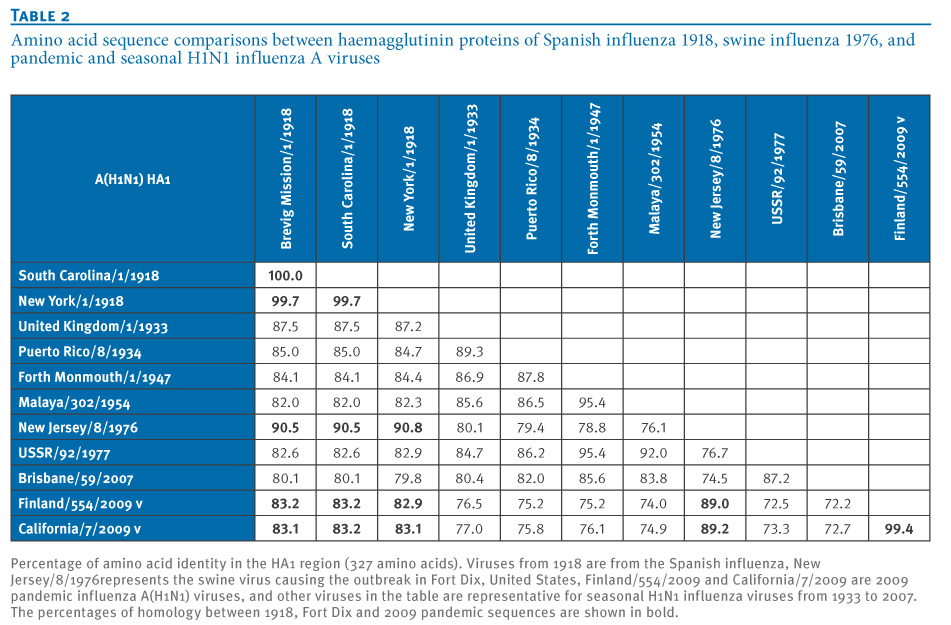
Amino acid sequence comparisons between different HA sequences (Table 2) revealed that the three 1918 influenza HA1 proteins are almost identical (99.7% identity). More than 99% sequence identity is also shown between the 2009 pandemic viruses, which can be verified by sequence comparison between any of the pandemic influenza HA genes submitted to GenBank (data not shown). It is of note that the seasonal influenza viruses from the 1930s had already significantly drifted from the Spanish influenza virus HA1 sequences and approximately 15% of the amino acids had been mutated giving an estimated evolutionary rate of 1% amino acid changes per year.
The HA1 proteins of the seasonal influenza A(H1N1) virus, A/Brisbane/59/2007, shows approximately 20% divergence from that of the Spanish influenza virus. Comparison of the 2009 pandemic influenza virus HA1 sequences revealed that the most closely related human H1N1 influenza viruses were in fact the viruses of the Spanish influenza (16.8 to 17.1 divergence) with the exception of the swine virus that caused the 1976 outbreak in Fort Dix (10.8 to 11.0 divergence). The seasonal H1N1 influenza viruses isolated between 1933 and 2007 showed 23.0 to 27.8% sequence differences to the pandemic H1N1 2009 virus (Table 2). Genetic data thus clearly indicate that the closest relatives of the 2009 pandemic virus are the Spanish influenza and Fort Dix virus strains.
Table 2. Amino acid sequence comparisons between haemagglutinin proteins of Spanish influenza 1918, swine influenza 1976, and pandemic and seasonal H1N1 influenza A viruses
Molecular and structural analysis
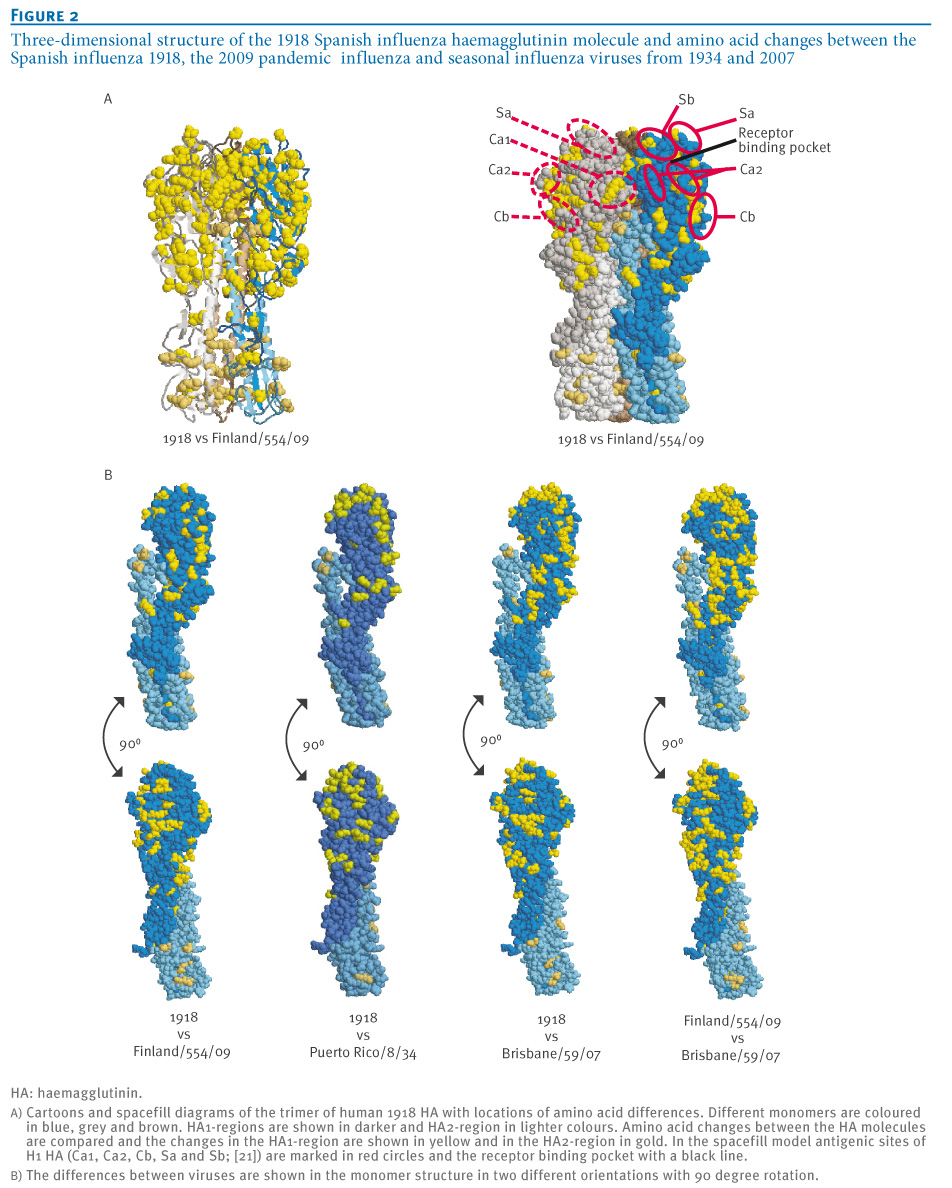
Figure 2 visualises the differences in the amino acids between the HA sequences of the 1918 Spanish and the 2009 pandemic influenza (A/Finland/554/2009), the 1918 Spanish and the 1934 seasonal influenza (Puerto Rico/8/1934), the 1918 Spanish and the 2007 seasonal influenza (A/Brisbane/59/2007) and between the 2009 pandemic and the 2007 seasonal influenza virus. The three-dimensional structure of a trimeric HA molecule is shown in Figure 2A, where the amino acids changes between the 1918 and the 2009 pandemic virus are marked. There are several changes on the surface of the HA molecule, and some of the changes are accumulated in the antigenic epitopes. However, other comparisons (Figure 2B) indicate that the changes between the HA molecules of the 1918 and the 1934 seasonal, the 1918 and the 2007 seasonal, and especially between those of the 2009 pandemic and 2007 seasonal virus are more numerous. Most of the amino acids at the distal end of the molecule, around the sialic acid receptor binding pocket, and the antigenic epitopes on the sides of the HA molecule are altered. Since the surface structure of the 2009 pandemic influenza (H1N1) virus HA molecule is dramatically different from that of seasonal H1N1 influenza viruses, it can be expected that immunity induced by seasonal H1N1 viruses (from strains isolated later than the 1930s to 1940s) does not provide significant cross-protection against infection with the present 2009 pandemic virus.
Figure 2. Three-dimensional structure of the 1918 Spanish influenza haemagglutinin molecule and amino acid changes between the Spanish influenza 1918, the 2009 pandemic influenza and seasonal influenza viruses from 1934 and 2007

Discussion and conclusion
This study demonstrates that in Finland, individuals born between 1909 and 1924 and to a lesser extent those born between 1925 and 1944 have pre-existing humoral immunity against the 2009 pandemic H1N1 influenza A virus. Genetic and structural analyses also revealed that the 2009 pandemic virus is more closely related to the 1918 Spanish influenza and to the 1976 Fort Dix outbreak swine viruses than to any other seasonal H1N1-type influenza viruses that have been isolated since the 1930s. It is highly likely that immunity induced by the Spanish influenza virus, as seen in the oldest individuals included in this study, provides cross-protection against the currently circulating 2009 pandemic influenza virus.
The sera selected for this study represent very well the general population in Finland, since the diagnostic laboratory received samples from all over the country and different age groups (0-96 years) were included. Historical records also indicate that the Spanish influenza was prevalent practically all around the world. In Finland the Spanish influenza was highly prevalent and found in almost all corners of the country including the most northern parts [18]. In this respect our serum material covers the Spanish influenza history in Finland very well, so that our results are likely to be representative and informative for the general situation in Europe. Recent studies from Japan, the US and the UK also describe the presence of cross-reactive antibodies to the 2009 pandemic influenza virus among the oldest age groups (born in 1930 or earlier) [10,11,13]. In order to obtain a clearer picture on the prevalence of cross-reactive antibodies in different age groups in Europe, there is a need to study retrospective serum materials collected from different European countries.
In case the cross-reactivity against the 2009 pandemic influenza virus is indeed due to infections caused by the Spanish influenza and/or its immediate descendant viruses in the late 1910s and the 1920s, this would seem to suggest that specific anti-influenza immunity can last for an extremely long time, even a lifetime. The 33-55% of individuals who were born between the years 1909 and 1924 had relatively high antibody levels (≥40 HI titres) against the 2009 pandemic influenza virus and are thus likely to be protected against infection with this virus. Antibody levels ≥40 as measured by the HI method are generally considered as protective and such post-vaccination antibody levels are an indication of an efficient vaccine-induced humoral immune response. There was also a very good correlation between the level of cross-reactivity in the older age groups and the evolution of the Spanish influenza virus descendants. Even if there is a considerable gap in available virus isolates and HA sequences between the years 1918 and 1933 we can estimate the evolutionary speed of the virus to be at least 1% of HA1 amino acids changes per year. Apparently, the evolution was so fast that the viruses circulating in the 1930s and 1940s were already quite distinct from the initial Spanish influenza virus (see Table 2 and Figure 2) and thus infections caused by those viruses were unable to induce significant cross-reactivity against the 2009 pandemic influenza virus.
Based on HA sequence data, the 2009 pandemic influenza A(H1N1) virus is more closely related to the Spanish influenza virus than to the present day seasonal influenza A(H1N1) viruses. It is thus likely that the Spanish influenza virus was transmitted from the human to the swine population after the first wave of 1918 pandemic and the evolution of the viral HA gene in pigs went on independently from that in humans [19]. However, since the HA proteins of the Spanish influenza and the 2009 pandemic influenza virus show 17% amino acid divergence, this gives an estimated evolutionary rate of approximately 0.2% amino acid changes per year, which is considerably slower than usually seen among human seasonal influenza A(H1N1) viruses. It is likely that the shorter life span of domestic pigs and their lack of pre-existing immunity allowed the virus to spread in swine populations without significant evolutionary pressure. In many ways this may reflect the present situation with the 2009 pandemic virus, which shows extremely low rates of evolution due to the lack of protective immunity in the majority of the world?s population. At present, the amino acid changes from the HA and NA gene sequences of the prototype pandemic strain and the and vaccine strain A/California/7/2009 to those of currently circulating 2009 pandemic influenza strains are less than 1% and 0.5%, respectively. Thus, basically any 2009 pandemic influenza A(H1N1) isolate can at present serve as a suitable strain for immunological analyses and vaccine production.
The availability of the three-dimensional structure of the 1918 influenza virus HA molecule allowed us to seek for molecular and immunological explanations of the humoral cross-reactivity between the Spanish influenza and the 2009 pandemic influenza viruses. The analysis clearly revealed that there are a number of amino acid differences in the important antigenic epitopes on the surface of the HA molecule, but these differences are far fewer between the 1918 Spanish influenza and the 2009 pandemic influenza virus HA molecules as compared to the differences seen between the 1918 Spanish influenza and seasonal viruses from 1934 or 2007 or between the 2009 pandemic and the 2007 seasonal influenza HA molecules.
Even though the comparison was done by modelling, it can be assumed that the overall structure of the HA molecule of H1 influenza viruses is highly conserved. All in all we can say that the critical antigenic epitopes between the 1918 Spanish influenza and the 2009 influenza viruses are at least partially conserved, which probably explains the observation that people who have been infected with the Spanish influenza virus or a closely related virus have good cross-reactive immunity against the 2009 pandemic virus.
The present study, as well as a previous study [20] showing the existence of B cell clones specific for the Spanish influenza HA in the elderly, indicate that immunological memory may last a whole lifetime. These observations also suggest that the driving force of human influenza A virus evolution is the host?s immune response that stimulates antigenic drift. Epidemiological analyses from North America, Europe and Australia [4,6-9] of the underrepresentation of the elderly in population groups contracting 2009 pandemic influenza suggest that persisting immunity against the Spanish influenza virus and its early variants may in fact give life-long immunity against the same or a very closely related virus strain such as the 2009 pandemic influenza A(H1N1) virus.
Acknowledgements
We thank A Villberg, R Santanen, O Rautio, S Maljanen and H Valtonen for excellent technical assistance. This study was funded by the Ministry of Health and Social Affairs in Finland and the Identification of Mechanisms Correlating with Susceptibility for Avian Influenza (IMECS) project (grant no 201169). IMECS has been made possible by contributions of the European Commission DG Research and the participating member states.
<hr>
References
-
--------
Eurosurveillance, Volume 15, Issue 5, 04 February 2010
Research articles
High frequency of cross-reacting antibodies against 2009 pandemic influenza A(H1N1) virus among the elderly in Finland
N Ikonen (
- Viral Infections Unit, National Institute for Health and Welfare (THL), Helsinki, Finland
- Diabetes Prevention Unit, National Institute for Health and Welfare (THL), Helsinki, Finland
<hr>
Citation style for this article: Ikonen N, Strengell M, Kinnunen L, ?sterlund P, Pirhonen J, Broman M, Davidkin I, Ziegler T, Julkunen I. High frequency of cross-reacting antibodies against 2009 pandemic influenza A(H1N1) virus among the elderly in Finland. Euro Surveill. 2010;15(5):pii=19478. Available online: http://www.eurosurveillance.org/View...rticleId=19478
Date of submission: 11 December 2009
<hr>
Since May 2009, the pandemic influenza A(H1N1) virus has been spreading throughout the world. Epidemiological data indicate that the elderly are underrepresented among the ill individuals. Approximately 1,000 serum specimens collected in Finland in 2004 and 2005 from individuals born between 1909 and 2005, were analysed by haemagglutination-inhibition test for the presence of antibodies against the 2009 pandemic influenza A(H1N1) and recently circulating seasonal influenza A viruses. Ninety-six per cent of individuals born between 1909 and 1919 had antibodies against the 2009 pandemic influenza virus, while in age groups born between 1920 and 1944, the prevalence varied from 77% to 14%. Most individuals born after 1944 lacked antibodies to the pandemic virus. In sequence comparisons the haemagglutinin (HA) gene of the 2009 pandemic influenza A(H1N1) virus was closely related to that of the Spanish influenza and 1976 swine influenza viruses. Based on the three-dimensional structure of the HA molecule, the antigenic epitopes of the pandemic virus HA are more closely related to those of the Spanish influenza HA than to those of recent seasonal influenza A(H1N1) viruses. Among the elderly, cross-reactive antibodies against the 2009 pandemic influenza virus, which likely originate from infections caused by the Spanish influenza virus and its immediate descendants, may provide protective immunity against the present pandemic virus.
<hr>
Introduction
In March and April 2009, a previously unknown variant of influenza A(H1N1) virus was able to cause sporadic infection clusters and epidemics in North America [1] and Mexico [2]. Rapid identification of the virus indicated that it was a novel H1N1-reassortant influenza A virus that originated from a triple reassortant North American swine influenza A virus that had acquired two virus genes (NA and M) from an Eurasian swine influenza A virus; the virus thus contains genetic material from avian (PA and PB2), human (PB1) and two lineages of swine influenza A viruses [3,4]. Compared with seasonal H1N1 viruses the novel virus is genetically and antigenically very different from human H1N1 viruses that have been circulating during the last 60 to 70 years [5]. Since the majority of the world?s population is lacking immunity against this new virus, it has been spreading throughout the world with an unprecedented speed. On 11 June 2009, the World Health Organization (WHO) declared the first pandemic of the 21st century to have started, caused by the 2009 pandemic influenza A(H1N1) virus.
Epidemiological analyses initially from Mexico [6] and the United States (US) [4], and later from Europe [7] and the southern hemisphere [8,9] revealed that the disease is affecting children, young adults and the general population under 65 years of age. Recent reports from Japan [10], the US [11,12] and the United Kingdom (UK) [13] have suggested that pre-existing antibodies and thus cross-protection against the pandemic virus exist in some individuals, especially those that are currently over 65 years-old. At present only limited data on this is available from Europe.
Rapid isolation and characterisation of the 2009 pandemic influenza virus, the fast dissemination of the early virus isolates to laboratories around the world, and the swift generation of reassortant and recombinant vaccine viruses enabled vaccine manufacturers to start mass production of pandemic virus vaccines rapidly. Presently, many vaccine producers have been successful in preparing functional vaccines and mass vaccinations are ongoing in a number of countries. Following recommendations by the WHO, the European Centre for Disease Prevention and Control (ECDC), and other relevant agencies, many countries have made their own vaccination prioritisations, in which health professionals, pregnant women, people with chronic underlying diseases, and children and young adults are among the first groups to be vaccinated. In order to have a better view of the possible pre-existing cross-reactive immunity against the 2009 pandemic influenza virus in the Finnish population we measured pre-existing antibodies to this virus in more than 1,000 serum samples collected in 2004 and 2005, long before the present pandemic, from individuals born between the years 1909 and 2005.
Methods
Serum specimens
The study had been approved by the ethical committee of the Helsinki University Central Hospital. The serum specimens analysed were obtained from the virus diagnostic unit at the Central Laboratory Services of the Helsinki University Hospital (HUSLAB). The sera had been collected in 2004 and 2005 from persons representing different age groups and from different parts of the country. Only the age and sex of the individual and the collection date of the sample were known. Altogether 1,031 serum specimens were analysed.
Viruses and laboratory methods
We isolated a number of 2009 pandemic influenza A(H1N1) viruses from patients suffering from an acute respiratory infection. Nucleotide sequence analysis of almost the entire genome of three early Finnish isolates, and haemagglutinin (HA) and neuraminidase (NA) sequence data from 25 viruses subsequently identified in our laboratory revealed that the Finnish viruses were almost identical to the prototype pandemic vaccine virus (A/California/07/2009) and represented typical North American/European pandemic virus strains.
For the present study we selected the pandemic influenza A/Finland/554/2009 H1N1 isolate (GenBank accession numbers GQ328866-7 and GQ283487-91) as a representative virus for the immunological analysis. The virus was derived from a nasopharyngeal aspirate obtained from a patient who had recently returned from Chicago. The virus was isolated in Madin-Darby canine kidney (MDCK) cells. The pandemic influenza A/Finland/554/2009 H1N1 (HA-titre 32) and the seasonal influenza A/Finland/814/2001 H1N1 (New Caledonia-like, HA-titre 64) and A/Finland/715/2000 H3N2 (Panama-like, HA-titre 64) viruses were grown in MDCK cultures. For safety reasons the pandemic virus was inactivated with β-propiolactone (Ferrak, Berlin, Germany), which did not reduce the antigenicity of the virus.
Antibody responses to the pandemic and seasonal influenza A viruses were determined with the haemagglutination-inhibition (HI) test using standard microtitre procedures [14]. Serum specimens were pretreated with Vibrio cholerae filtrate (Denka Seiken, Tokyo, Japan) to remove non-specific inhibitors and with packed guinea pig erythrocytes to remove non-specific agglutinins. In the analysis four HA units of virus and 0.75% guinea pig erythrocytes were used.
Statistical analyses
The mean antibody levels in different age groups against the three viruses were calculated as geometric mean titres and standard deviations (SD) of the means. The results are presented as the geometric means with one SD unit. The ranges of antibody titres are also given. For HI titre values under 10 an arbitrary value of 5 was assigned in order to enable the calculation of geometric means.
Amino acid sequence comparisons of viral HA gene
The HA sequences of the 2009 pandemic influenza A (H1N1) viruses (A/California/7/2009 and A/Finland/554/2009) were compared with those of three Spanish influenza viruses (GenBank accession numbers AF116575-6, AF117241) genes as well as with six other seasonal human influenza A(H1N1) viruses from 1933 to 2007 (CY009284, CY009612, CY021053, CY030230, CY033577, CY045756 and FJ969540) and with the swine influenza A(H1N1) virus that caused a human outbreak in Fort Dix in the US in 1976 (CY039991). Comparisons were done only for the HA1 region (327 of 566 amino acids) because this region contains the major antigenic epitopes of the molecule (see Figure 2). Sequence comparisons at amino acid level were conducted in MEGA4 (Molecular Evolutionary Genetics Analysis software version 4.0 [15]). In pairwise sequence comparisons the gaps were included.
Structural analysis of amino acid differences in the HA molecule
Three-dimensional structures of several influenza A virus HA proteins have been determined. Of the human H1 virus subtypes, the HA structures of A/South Carolina/1/18 and A/Puerto Rico/8/34 have been resolved by crystallography [16]. For our analysis we selected the structure of A/South Carolina/1/18 HA (RCSP Protein Data Bank accession number 1ruz) as the basis for analysing the locations of amino acid differences between the HA structures of the Spanish influenza, the pandemic influenza A/Finland/554/2009 H1N1, the seasonal influenza Puerto Rico/8/1934 H1N1 and the seasonal vaccine A/Brisbane/59/2007 H1N1 virus. The representations were done using RasMol Molecular Graphics software version 2.7.3 [17].
Results
Antibody levels
Antibody levels against a representative 2009 pandemic influenza virus, A/Finland/554/2009 showed that the oldest individuals (born between 1909 and 1919) had a very high prevalence of antibodies to the 2009 pandemic influenza A(H1N1) virus. More than 96% of these individuals had detectable antibodies (titres ≥10), and in more than 55% of them, antibody titres of ≥40 were detected, which is generally considered to be a protective level. In younger age groups the prevalence of detectable antibodies against 2009 pandemic influenza virus decreased gradually with increasing year of birth (Table 1). Only some (10-14%) of the individuals born between 1930 and 1949 had cross-reactive antibodies against the pandemic virus. It is of note that some individuals in the oldest age-group had very high antibody levels with HI titres ranging between 160 and 320. Antibodies against seasonal H1N1 and H3N2 influenza viruses were found in 9-67% and 39-90% of all the individuals, respectively, depending on the age group (Table 1).
Table 1. Cross-reactive antibody levels against 2009 pandemic influenza A(H1N1) and recent seasonal H1N1 and H3N2 influenza viruses in Finnish individuals born 1909-2005 (n=1,031)
When the older age groups were divided into subgroups of five birth years (Figure 1), a gradual decrease in the frequency and levels of antibodies against the 2009 pandemic influenza virus was observed with increasing year of birth, indicating that high antibody levels were only found in individuals born in the mid 1920s or earlier. A relatively large proportion of individuals in these age groups also had antibodies against seasonal H1N1 and H3N2 influenza viruses.
Figure 1. Frequency of cross-reactive virus-specific antibodies against 2009 pandemic influenza A(H1N1) in people born between 1909 and 1949 in Finland (n=372)

Sequence comparisons
Amino acid sequence comparisons between different HA sequences (Table 2) revealed that the three 1918 influenza HA1 proteins are almost identical (99.7% identity). More than 99% sequence identity is also shown between the 2009 pandemic viruses, which can be verified by sequence comparison between any of the pandemic influenza HA genes submitted to GenBank (data not shown). It is of note that the seasonal influenza viruses from the 1930s had already significantly drifted from the Spanish influenza virus HA1 sequences and approximately 15% of the amino acids had been mutated giving an estimated evolutionary rate of 1% amino acid changes per year.
The HA1 proteins of the seasonal influenza A(H1N1) virus, A/Brisbane/59/2007, shows approximately 20% divergence from that of the Spanish influenza virus. Comparison of the 2009 pandemic influenza virus HA1 sequences revealed that the most closely related human H1N1 influenza viruses were in fact the viruses of the Spanish influenza (16.8 to 17.1 divergence) with the exception of the swine virus that caused the 1976 outbreak in Fort Dix (10.8 to 11.0 divergence). The seasonal H1N1 influenza viruses isolated between 1933 and 2007 showed 23.0 to 27.8% sequence differences to the pandemic H1N1 2009 virus (Table 2). Genetic data thus clearly indicate that the closest relatives of the 2009 pandemic virus are the Spanish influenza and Fort Dix virus strains.
Table 2. Amino acid sequence comparisons between haemagglutinin proteins of Spanish influenza 1918, swine influenza 1976, and pandemic and seasonal H1N1 influenza A viruses
Molecular and structural analysis
Figure 2 visualises the differences in the amino acids between the HA sequences of the 1918 Spanish and the 2009 pandemic influenza (A/Finland/554/2009), the 1918 Spanish and the 1934 seasonal influenza (Puerto Rico/8/1934), the 1918 Spanish and the 2007 seasonal influenza (A/Brisbane/59/2007) and between the 2009 pandemic and the 2007 seasonal influenza virus. The three-dimensional structure of a trimeric HA molecule is shown in Figure 2A, where the amino acids changes between the 1918 and the 2009 pandemic virus are marked. There are several changes on the surface of the HA molecule, and some of the changes are accumulated in the antigenic epitopes. However, other comparisons (Figure 2B) indicate that the changes between the HA molecules of the 1918 and the 1934 seasonal, the 1918 and the 2007 seasonal, and especially between those of the 2009 pandemic and 2007 seasonal virus are more numerous. Most of the amino acids at the distal end of the molecule, around the sialic acid receptor binding pocket, and the antigenic epitopes on the sides of the HA molecule are altered. Since the surface structure of the 2009 pandemic influenza (H1N1) virus HA molecule is dramatically different from that of seasonal H1N1 influenza viruses, it can be expected that immunity induced by seasonal H1N1 viruses (from strains isolated later than the 1930s to 1940s) does not provide significant cross-protection against infection with the present 2009 pandemic virus.
Figure 2. Three-dimensional structure of the 1918 Spanish influenza haemagglutinin molecule and amino acid changes between the Spanish influenza 1918, the 2009 pandemic influenza and seasonal influenza viruses from 1934 and 2007
Discussion and conclusion
This study demonstrates that in Finland, individuals born between 1909 and 1924 and to a lesser extent those born between 1925 and 1944 have pre-existing humoral immunity against the 2009 pandemic H1N1 influenza A virus. Genetic and structural analyses also revealed that the 2009 pandemic virus is more closely related to the 1918 Spanish influenza and to the 1976 Fort Dix outbreak swine viruses than to any other seasonal H1N1-type influenza viruses that have been isolated since the 1930s. It is highly likely that immunity induced by the Spanish influenza virus, as seen in the oldest individuals included in this study, provides cross-protection against the currently circulating 2009 pandemic influenza virus.
The sera selected for this study represent very well the general population in Finland, since the diagnostic laboratory received samples from all over the country and different age groups (0-96 years) were included. Historical records also indicate that the Spanish influenza was prevalent practically all around the world. In Finland the Spanish influenza was highly prevalent and found in almost all corners of the country including the most northern parts [18]. In this respect our serum material covers the Spanish influenza history in Finland very well, so that our results are likely to be representative and informative for the general situation in Europe. Recent studies from Japan, the US and the UK also describe the presence of cross-reactive antibodies to the 2009 pandemic influenza virus among the oldest age groups (born in 1930 or earlier) [10,11,13]. In order to obtain a clearer picture on the prevalence of cross-reactive antibodies in different age groups in Europe, there is a need to study retrospective serum materials collected from different European countries.
In case the cross-reactivity against the 2009 pandemic influenza virus is indeed due to infections caused by the Spanish influenza and/or its immediate descendant viruses in the late 1910s and the 1920s, this would seem to suggest that specific anti-influenza immunity can last for an extremely long time, even a lifetime. The 33-55% of individuals who were born between the years 1909 and 1924 had relatively high antibody levels (≥40 HI titres) against the 2009 pandemic influenza virus and are thus likely to be protected against infection with this virus. Antibody levels ≥40 as measured by the HI method are generally considered as protective and such post-vaccination antibody levels are an indication of an efficient vaccine-induced humoral immune response. There was also a very good correlation between the level of cross-reactivity in the older age groups and the evolution of the Spanish influenza virus descendants. Even if there is a considerable gap in available virus isolates and HA sequences between the years 1918 and 1933 we can estimate the evolutionary speed of the virus to be at least 1% of HA1 amino acids changes per year. Apparently, the evolution was so fast that the viruses circulating in the 1930s and 1940s were already quite distinct from the initial Spanish influenza virus (see Table 2 and Figure 2) and thus infections caused by those viruses were unable to induce significant cross-reactivity against the 2009 pandemic influenza virus.
Based on HA sequence data, the 2009 pandemic influenza A(H1N1) virus is more closely related to the Spanish influenza virus than to the present day seasonal influenza A(H1N1) viruses. It is thus likely that the Spanish influenza virus was transmitted from the human to the swine population after the first wave of 1918 pandemic and the evolution of the viral HA gene in pigs went on independently from that in humans [19]. However, since the HA proteins of the Spanish influenza and the 2009 pandemic influenza virus show 17% amino acid divergence, this gives an estimated evolutionary rate of approximately 0.2% amino acid changes per year, which is considerably slower than usually seen among human seasonal influenza A(H1N1) viruses. It is likely that the shorter life span of domestic pigs and their lack of pre-existing immunity allowed the virus to spread in swine populations without significant evolutionary pressure. In many ways this may reflect the present situation with the 2009 pandemic virus, which shows extremely low rates of evolution due to the lack of protective immunity in the majority of the world?s population. At present, the amino acid changes from the HA and NA gene sequences of the prototype pandemic strain and the and vaccine strain A/California/7/2009 to those of currently circulating 2009 pandemic influenza strains are less than 1% and 0.5%, respectively. Thus, basically any 2009 pandemic influenza A(H1N1) isolate can at present serve as a suitable strain for immunological analyses and vaccine production.
The availability of the three-dimensional structure of the 1918 influenza virus HA molecule allowed us to seek for molecular and immunological explanations of the humoral cross-reactivity between the Spanish influenza and the 2009 pandemic influenza viruses. The analysis clearly revealed that there are a number of amino acid differences in the important antigenic epitopes on the surface of the HA molecule, but these differences are far fewer between the 1918 Spanish influenza and the 2009 pandemic influenza virus HA molecules as compared to the differences seen between the 1918 Spanish influenza and seasonal viruses from 1934 or 2007 or between the 2009 pandemic and the 2007 seasonal influenza HA molecules.
Even though the comparison was done by modelling, it can be assumed that the overall structure of the HA molecule of H1 influenza viruses is highly conserved. All in all we can say that the critical antigenic epitopes between the 1918 Spanish influenza and the 2009 influenza viruses are at least partially conserved, which probably explains the observation that people who have been infected with the Spanish influenza virus or a closely related virus have good cross-reactive immunity against the 2009 pandemic virus.
The present study, as well as a previous study [20] showing the existence of B cell clones specific for the Spanish influenza HA in the elderly, indicate that immunological memory may last a whole lifetime. These observations also suggest that the driving force of human influenza A virus evolution is the host?s immune response that stimulates antigenic drift. Epidemiological analyses from North America, Europe and Australia [4,6-9] of the underrepresentation of the elderly in population groups contracting 2009 pandemic influenza suggest that persisting immunity against the Spanish influenza virus and its early variants may in fact give life-long immunity against the same or a very closely related virus strain such as the 2009 pandemic influenza A(H1N1) virus.
Acknowledgements
We thank A Villberg, R Santanen, O Rautio, S Maljanen and H Valtonen for excellent technical assistance. This study was funded by the Ministry of Health and Social Affairs in Finland and the Identification of Mechanisms Correlating with Susceptibility for Avian Influenza (IMECS) project (grant no 201169). IMECS has been made possible by contributions of the European Commission DG Research and the participating member states.
<hr>
References
- Centers for Disease Control and Prevention (CDC). Swine influenza A (H1N1) infection in two children--Southern California, March-April 2009. MMWR Morb Mortal Wkly Rep. 2009;58(15):400-2.
- Centers for Disease Control and Prevention (CDC). Outbreak of swine-origin influenza A (H1N1) virus infection - Mexico, March-April 2009. MMWR Morb Mortal Wkly Rep. 2009;58(17):467-70.
- Shinde V, Bridges CB, Uyeki TM, Shu B, Balish A, Xu X, et al. Triple-reassortant swine influenza A (H1) in humans in the United States, 2005-2009. N Engl J Med. 2009;360(25):2616-25.
- Novel Swine-Origin Influenza A (H1N1) Virus Investigation Team, Dawood FS, Jain S, Finelli L, Shaw MW, Lindstrom S, et al. Emergence of a novel swine-origin influenza A (H1N1) virus in humans. N Engl J Med. 2009;360(25):2605-15.
- Garten RJ, Davis CT, Russell CA, Shu B, Lindstrom S, Balish A, et al. Antigenic and genetic characteristics of swine-origin 2009 A(H1N1) influenza viruses circulating in humans. Science. 2009;325(5937):197-201.
- Fraser C, Donnelly CA, Cauchemez S, Hanage WP, Van Kerkhove MD, Hollingsworth TD, et al. Pandemic potential of a strain of influenza A (H1N1): early findings. Science. 2009;324(5934):1557-61.
- ECDC working group on influenza A(H1N1)v. Preliminary analysis of influenza A(H1N1)v individual and aggregated case reports from EU and EFTA countries. Euro Surveill. 2009;14(23): pii=19238. Available from: http://www.eurosurveillance.org/View...rticleId=19238
- Baker MG, Wilson N, Huang QS, Paine S, Lopez L, Bandaranayake D, et al. Pandemic influenza A(H1N1)v in New Zealand: the experience from April to August 2009. Euro Surveill. 2009;14(34):pii=19319. Available from: http://www.eurosurveillance.org/View...rticleId=19319
- Kelly H, Grant K. Interim analysis of pandemic influenza (H1N1) 2009 in Australia: surveillance trends, age of infection and effectiveness of seasonal vaccination. Euro Surveill. 2009;14(31): pii=19288. Available from: http://www.eurosurveillance.org/View...rticleId=19288
- Itoh Y, Shinya K, Kiso M, Watanabe T, Sakoda Y, Hatta M, et al. In vitro and in vivo characterisation of new swine-origin H1N1 influenza viruses. Nature. 2009;460(7258):1021-5.
- Hancock K, Veguilla V, Lu X, Zhong W, Butler EN, Sun H, et al. Cross-Reactive Antibody Responses to the 2009 Pandemic H1N1 Influenza Virus. N Engl J Med. 2009.
- Centers for Disease Control and Prevention (CDC). Serum cross-reactive antibody response to a novel influenza A (H1N1) virus after vaccination with seasonal influenza vaccine. MMWR Morb Mortal Wkly Rep. 2009;58(19):521-4.
- Miller E, Hoschler K, Hardelid P, Stanford E, Andrews N, Zambon M. Incidence of 2009 pandemic influenza A H1N1 infection in England: a cross-sectional serological study. Lancet. Published Online 21 January 2010. DOI:10.1016/S0140-6736(09)62126-7.
- Kendal AP, Pereira MS, Skehel JJ, editors. Concepts and procedures for laboratory-based influenza surveillance. Atlanta, GA: US Department of Health and Human Services, Centres for Disease Control and Prevention; 1982.
- Tamura K, Dudley J, Nei M, Kumar S. MEGA4: Molecular Evolutionary Genetics Analysis (MEGA) software version 4.0. Mol Biol Evol. 2007;24(8):1596-9.
- Gamblin SJ, Haire LF, Russell RJ, Stevens DJ, Xiao B, Ha Y, et al. The structure and receptor binding properties of the 1918 influenza hemagglutinin. Science. 2004;303(5665):1838-42.
- Sayle RA, Milner-White EJ. RASMOL: biomolecular graphics for all. Trends Biochem Sci. 1995;20(9):374.
- Linnanm?ki E, editor. The Spanish influenza of 1918-1920 in Finland. Tampere Finland: Tammer-Paino; 2005.
- Reid AH, Taubenberger JK. The origin of the 1918 pandemic influenza virus: a continuing enigma. J Gen Virol. 2003;84(Pt 9):2285-92.
- Yu X, Tsibane T, McGraw PA, House FS, Keefer CJ, Hicar MD, et al. Neutralizing antibodies derived from the B cells of 1918 influenza pandemic survivors. Nature. 2008;455(7212):532-6.
- Brownlee GG, Fodor E. The predicted antigenicity of the haemagglutinin of the 1918 Spanish influenza pandemic suggests an avian origin. Philos Trans R Soc Lond B Biol Sci. 2001;356(1416):1871-6.
-
--------