Announcement

Collapse
No announcement yet.

Aug/18: NOAA has determined orange substance is fungal spores....Previous: Mysterious orange goo in Alaskan Arctic identified as tiny eggs

Collapse
X
 
  • Filter
  • Time
  • Show
Clear All
new posts

  • Aug/18: NOAA has determined orange substance is fungal spores....Previous: Mysterious orange goo in Alaskan Arctic identified as tiny eggs

    Bizarre orange goo invades Alaskan village; leaves experts baffled

    By Michael Sheridan
    DAILY NEWS STAFF WRITER
    Sunday, August 7th 2011, 9:51 AM


    City of Kivalina
    City Administrator Janet Mitchell said the village is requesting that an algae expert from the University of Alaska Fairbanks investigate.

    A massive patch of bright orange material washed up on the Alaskan coast, and has scientists baffled.

    The substance, which experts don't believe is man-made, could possibly be algae, but a kind no one has seen before.
    ...
    Since the substance was unknown, city officials cautioned residents to keep children away from the orange goo and for residents to boil their water before drinking it.

    Full text:
    Last edited by Emily; August 19, 2011, 01:17 AM. Reason: edit; title update

  • #2
    Re: Bizarre orange goo invades Alaskan village; leaves experts baffled

    Mystery substance comes to shore of Alaskan village

    August 5th, 2011
    09:44 PM ET

    Excerpt:

    The stuff on the shore had "an oily feel to it, like baby oil," resident Mida Swan said Friday. She said she detected no odor from the substance.

    The substance also may have rained down on the village Wednesday evening, because it was found in buckets that some residents used to collect rainwater that night, Mitchell said.
    ...
    Mitchell said the substance also was found in the Wulik River, which flows into the lagoon and is a source of the village's drinking water. She said the village would delay topping off its water storage tanks, which it does every summer so that it has enough water for the winter, until the substance is identified.

    Kivalina, a village of about 430 people, is about 650 miles northwest of Anchorage, Alaska.

    Full text:

    Mystery substance comes to shore of Alaskan village

    Comment


    • #3
      Mysterious orange goo in Alaskan Arctic identified as tiny eggs

      Mysterious orange goo in Alaskan Arctic identified as tiny eggs

      August 8, 2011 | 12:16 pm


      ...Scientists for the National Oceanic and Atmospheric Administration at Auke Bay in Juneau took samples of the weird orange material that was found floating in the harbor in Kivalina, 625 miles northwest of Anchorage -- and also on beaches, in rainwater and in a river 150 miles away. They concluded it was no man-made nightmare at all.

      Rather, it's a large mass of microscopic eggs, researchers concluded, quieting the international alarm.

      "We now think these are some sort of small crustacean egg or embryo, with a lipid oil droplet in the middle causing the orange color," said Jeep Rice, a lead scientist at the lab. "So this is natural. It is not chemical pollution; it is not a man-made substance."

      Full text:

      Comment


      • #4
        Re: Mysterious orange goo in Alaskan Arctic identified as tiny eggs

        I hope the orange material is just some sort of microscopic egg mass, but the Inupiat community at Kivalina seems to have been in residence for a long time.
        http://en.wikipedia.org/wiki/Kivalina,_Alaska

        If there weren't some sort of relatively recent onset climate change or industrial pollution factor behind the phenomenon, wouldn't they have observed it before? This information that Pathfinder found is very interesting, too:

        Mitchell said the substance also was found in the Wulik River
        If the orange substance is an egg mass, the responsible organism would have to adapted to both saltwater and freshwater environments. I noticed a zinc mining company uphill from Kivalina denied that their operations had anything to due with the bright orange phenomenon, but both natural processes and mining activities in the Brooks range could be generating orange pollution:


        http://pubs.usgs.gov/fs/fs-0092-95/fig3.gif
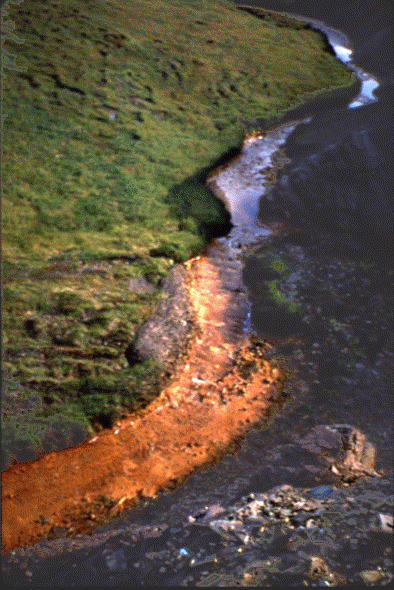
        Figure 3. False Wager Creek is locally precipitating jarosite (potassium and iron-rich sulfate mineral), seen as a bright orange "ferricrete" layer cementing stream pebbles and cobbles (stream width is about 1.5-2 m)

        Also noticed that the established zinc mine upstream is starting a major new open pit operation, (they demanded that some discharge regulations waived to do so), and also another mining company is doing exploration drilling in the Lik field nearby. The Lik field is alkaline from carbonate deposits, unlike the established mine, so since algae growth can be influenced by pH factors, I wondered about the mass being orange algae and found that Puget Sound in Washington state just had a big bloom of that.

        http://www.nwcn.com/news/Harmless-re...124310069.html

        I was a little worried that the orange algae blooms here and in Alaska might be related to Fukushima isotopes accumulating in the Northwest. A researcher found that seaweed in BC and Puget Sound had some evidence of radioisotope accumulation.)

        But we have had bright orange algae blooms in previous years here. They say it is harmless as far as toxicity, but I read that pollution from run-off does drive the orange algae blooms here.

        If NOAA identified a cellular structure in the orange mass that is animal in nature, would that rule out orange coloration of naturally occurring eggs by pollution from the mines or perhaps some marine animal eggs caught up in a mass of orange algae?

        I'm skeptical about the conclusions drawn in the LA Times article.
        _____________________________________________

        Ask Congress to Investigate COVID Origins and Government Response to Pandemic.

        i love myself. the quietest. simplest. most powerful. revolution ever. ---- nayyirah waheed

        "...there’s an obvious contest that’s happening between different sectors of the colonial ruling class in this country. And they would, if they could, lump us into their beef, their struggle." ---- Omali Yeshitela, African People’s Socialist Party

        (My posts are not intended as advice or professional assessments of any kind.)
        Never forget Excalibur.

        Comment


        • #5
          Re: Mysterious orange goo in Alaskan Arctic identified as tiny eggs

          Lots of fish eggs are orange, and big factory fishing vessels discard unacceptable fish egg skeins:

          http://labor.alaska.gov/esd_alaska_j...eams/atsea.htm

          Also fish hatchery operations discard some eggs, but probably not at the level found near Kivalina if that is what the orange mass is.

          <object width="560" height="349"><param name="movie" value="http://www.youtube.com/v/U1pJzbZtHso?version=3&amp;hl=en_US"></param><param name="allowFullScreen" value="true"></param><param name="allowscriptaccess" value="always"></param><embed src="http://www.youtube.com/v/U1pJzbZtHso?version=3&amp;hl=en_US" type="application/x-shockwave-flash" width="560" height="349" allowscriptaccess="always" allowfullscreen="true"></embed></object>

          NOAA scientists don't seem to think these are fish eggs, but rather small crustacean eggs or embryos, and what is still mysterious to me is the report that this material was found far upstream of the coast.

          http://news.discovery.com/earth/myst...ge-110809.html
          Mystery Orange Goo Invades Alaska Village

          Analysis by Christina Reed
          Tue Aug 9, 2011 03:12 PM ET

          [snip]
          Found several miles inland in the fresh water Wulik River, the orange material turned gooey and gave off a gaseous odor. But scooped out of the ocean, the substance had no odor and "was light to the touch, with the feel of baby oil," relayed Janet Mitchell, City Administrator for Kivalina, to Discovery News.
          It really sounds like the source of the material was the river that drains into the ocean by Kivalina. Seems like USGS would be involved in this investigation, too.
          Last edited by Emily; August 10, 2011, 03:03 AM. Reason: typo
          _____________________________________________

          Ask Congress to Investigate COVID Origins and Government Response to Pandemic.

          i love myself. the quietest. simplest. most powerful. revolution ever. ---- nayyirah waheed

          "...there’s an obvious contest that’s happening between different sectors of the colonial ruling class in this country. And they would, if they could, lump us into their beef, their struggle." ---- Omali Yeshitela, African People’s Socialist Party

          (My posts are not intended as advice or professional assessments of any kind.)
          Never forget Excalibur.

          Comment


          • #6
            Re: Mysterious orange goo in Alaskan Arctic identified as tiny eggs

            Kivalina residents are not reassured by the latest finding that the orange substance is composed of fungal spores of an unknown species. NOAA said the substance was tested for minerals and they found none, but apparently toxicology testing was not done. NOAA recommends filtering the spores out of drinking water.

            The article explains that NOAA would need more than just the spores of the fungus to have a chance at identifying it better.


            http://www.signonsandiego.com/news/2...fungal-spores/
            Orange goo on Alaska shore was fungal spores
            By RACHEL D'ORO, Associated Press
            6:03 p.m., Aug. 18, 2011
            Here's an Alaskan paper article:
            http://www.adn.com/2011/08/18/202088...-kivalina.html

            One of the comments brought up pigmentation changes seen in fungi exposed to radiation from the Chernobyl disaster and wondered if Fukushima radiation could be affecting fungi in Alaska. Here is some of the research from Chernobyl:

            http://www.flutrackers.com/forum/sho...814#post418814

            The research papers say that radiation can turn on long dormant genes in fungi and select for pigmented species that grow larger.

            Another commenter to the ADN article said that if you look up the river that drains into the Kivalina area, there is a bright patch of orange. Maybe instead of minerals, that is a patch of the fruiting bodies for these spores? Perhaps the mining is releasing natural radioisotopes?

            At any rate, these are spores that NOAA has never encountered before.

            http://www.npr.org/blogs/thetwo-way/...pores-not-eggs
            NPR
            Bill Chappel
            [snip]
            But researchers are not yet sure whether this particular type of rust fungus is one of the 7,800 species of rust fungi that have already been identified. For one thing, its spores have unusual spines covering their surface.

            "At this point, the best identification we can give to as the origin of these spores is a rust fungus," says Steve Morton, Ph.D., who works in the NOAA lab in Charleston, S.C., that conducted the full analysis. "The spores are unlike others we and our network of specialists have examined; however, many rust fungi of the Arctic tundra have yet to be identified."
            Last edited by Emily; August 19, 2011, 05:05 AM. Reason: Added ADN link.
            _____________________________________________

            Ask Congress to Investigate COVID Origins and Government Response to Pandemic.

            i love myself. the quietest. simplest. most powerful. revolution ever. ---- nayyirah waheed

            "...there’s an obvious contest that’s happening between different sectors of the colonial ruling class in this country. And they would, if they could, lump us into their beef, their struggle." ---- Omali Yeshitela, African People’s Socialist Party

            (My posts are not intended as advice or professional assessments of any kind.)
            Never forget Excalibur.

            Comment


            • #7
              Re: Aug/18: NOAA has determined orange substance is fungal spores....Previous: Mysterious orange goo in Alaskan Arctic identified as tiny eggs

              http://coastalscience.noaa.gov/news/...orest-service/
              Alaska ?Orange Goo? Rust Spores Confirmed

              Posted on February 9th, 2012 in Harmful Algal Blooms
              An ?orange goo? covered the shoreline of the the Inupiat village of Kivalina, Alaska last summer. It alarmed residents, perplexed local state and federal agencies and caused an international sensation via the press. Residents thought it was a harmful algal bloom similar to Noctiluca which is common to nearshore Alaska waters. Samples were sent NOAA?s Analytical Response Team who identified the orange substance as spores of a rust fungus, but not being experts of terrestrial plants did not make a species identification.
              Six months later the substance was identified by forest health professionals at the USDA Forest Service and the Canadian Forest Service to be spores of the rust fungus Chrysomyxa ledicola. This fungus is a plant pathogen that infects the foliage of spruce (Picea spp.) and Labrador tea (Ledum spp.).
              Many rust fungi have complex lifecycles, with five spore stages completed on two very different types of host plants. It is thought that the spore stage detected near Kivalina is the aeciospore stage, which is produced on current-year spruce foliage in late summer and spreads through the air to infect Labrador tea. Large scale outbreaks of spruce needle rust are not unprecedented in Alaska, and the large quantities of spores have been known to discolor river water.
              The rapid response by NCCOS scientists and outreach specialists to correctly identify the mysterious orange goo quickly resolved health concerns of local residents and provided correct information to the Alaska Fisheries. Spore identification was based on the physical features of the spores (shape, size and appendages) at high magnification using scanning electron microscopy. Genetic sequencing can also be used for identification, but the spores were too degraded for sequencing after storage in seawater.
              NCCOS researchers will support USDA?s summer 2012 collection effort by providing scanning electron microscopy identification of the spores to track the extent of this fungus in western Alaska.
              _____________________________________________

              Ask Congress to Investigate COVID Origins and Government Response to Pandemic.

              i love myself. the quietest. simplest. most powerful. revolution ever. ---- nayyirah waheed

              "...there’s an obvious contest that’s happening between different sectors of the colonial ruling class in this country. And they would, if they could, lump us into their beef, their struggle." ---- Omali Yeshitela, African People’s Socialist Party

              (My posts are not intended as advice or professional assessments of any kind.)
              Never forget Excalibur.

              Comment

              Working...
              X