medpedia.com FluTrackers

Tracking Infectious Diseases since 2006

FluTrackers.com Inc. is a 501(c)(3) charity

Official PayPal Seal
H1N1 Swine Flu Information Información Gripe H1N1 Information Grippe H1N1 Influenza H1N1 Informazioni FluTrackers Latest Posts

www www.flutrackers.com


Go Back   FluTrackers > Emerging Diseases, Hunger, & Other Health Threats > Seasonal flu 2008-2009

Reply
 
Thread Tools Search this Thread Display Modes
  #151  
Old November 27th, 2008, 11:29 AM
ironorehopper's Avatar
ironorehopper ironorehopper is online now
Membro del Comitato Consultivo, Editore e Direttore del Forum Italiano di FluTrackers
 
Join Date: Dec 2007
Location: PADUA
Posts: 12,355
Default Re: Seasonal Flu 2008 - 2009

Quote:
Originally Posted by ironorehopper View Post
To date, for the season 2008/2009 in Italy have been reported six laboratory-confirmed influenza cases.

Three influenza A subtype A/H3N2/Brisbane1007

and

Three influenza B cases, two of them imported (Uzbekistan and Senegal).

See: http://www.ministerosalute.it/influe...ir17-11-08.pdf and http://www.ministerosalute.it/influe...novembre08.pdf (in Italian)

See at FT: http://www.flutrackers.com/forum/sho...54&postcount=8 - http://www.flutrackers.com/forum/sho...50&postcount=9 - http://www.flutrackers.com/forum/sho...0&postcount=10 (in Italian).
-
------
Update for weeks 46 and 47 / 2008.

WEEK: 46 - 47 - TOT
FLU A / 3 / 3 / 6
A (unsubtyped) / ... / ... / ...
A/H3N2 / 3 / 3 / ...
A/H1N1 / ... / ... / ...
FLU B / 0 / 0 / ...
Total Samples positive / 3 / 3 / 6


http://www.flutrackers.com/forum/sho...6&postcount=12
__________________
GIMI69 (IRONOREHOPPER)
--

People come and go, but the creative force of great historical events, as well as important ideas and actions remain. (Aleksandr Romanovic Lurija, 1976)
--
A TIME'S MEMORY (Blog)
ATTRAVERSO QUESTI GIORNI (Blog)
tracciatore_traccia@libero.it
Reply With Quote
  #152  
Old November 27th, 2008, 12:29 PM
HenryN HenryN is offline
Retired
 
Join Date: Feb 2006
Posts: 20,294
Default Re: Seasonal Flu 2008 - 2009

http://www.cdc.gov/flu/weekly/weekly...oAllregt47.htm


INFLUENZA VIRUSES ISOLATED BY
WHO/NREVSS Collaborating Laboratories
2008 - 2009 Season
WeekA(H1)A(H3)A(Unk)B Total # Tested% Positive
40 2 0 9 6 2503 0.68
41 4 4 6 5 2502 0.76
42 12 3 15 5 2635 1.33
43 22 2 20 14 2863 2.03
44 9 1 18 3 2846 1.09
45 20 2 24 9 3309 1.66
46 22 2 10 8 2495 1.68
47 10 0 26 16 2080 2.5

Return to Current Report
Reply With Quote
  #153  
Old November 28th, 2008, 08:30 AM
HenryN HenryN is offline
Retired
 
Join Date: Feb 2006
Posts: 20,294
Default Re: Seasonal Flu 2008 - 2009

EISS - Weekly Electronic Bulletin
Week 47 : 17/11/2008-23/11/200828 November 2008, Issue N° 281

Influenza activity in Europe continues to be low

Summary: The level of influenza activity was low in all countries reporting data in week 47/2008. Since week 40/2008, sporadic laboratory-confirmed cases of influenza have been reported from 19 countries across Europe.

Epidemiological situation - week 47/2008: For the intensity indicator, the national network levels of influenza-like illness (ILI) and/or acute respiratory infection (ARI) were low in all the 27 countries providing data. For the geographical spread indicator, sporadic influenza activity was reported in nine countries (Belgium, Denmark, England, Ireland, Northern Ireland, Norway, Spain, Sweden and Switzerland) with no activity in the other 18 countries. Definitions for the epidemiological indicators can be found here.

Cumulative epidemiological situation – 2008-2009 season (weeks 40-47/2008): So far this season, the consultation rates for ILI and/or ARI are at levels usually seen outside the winter period (i.e. below the national baseline threshold).

Virological situation - week 47/2008: The total number of respiratory specimens collected by sentinel physicians in week 47/2008 was 435, of which 40 (9.2%) were positive for influenza virus: 38 type A (32 subtype H3 and six not subtyped) and two type B. In addition, 35 influenza virus detections were reported from non-sentinel sources (e.g. specimens collected for diagnostic purposes in hospitals): 34 type A (one subtype H1, eight subtype H3 and 25 not subtyped), and one type B. Detection of influenza viruses was reported from nine countries across Europe.

Cumulative virological situation – 2008-2009 season (weeks 40-47/2008): Of 281 virus detections (sentinel and non-sentinel) since week 40/2008, 255 were type A (118 subtype H3, 19 subtype H1 and 118 not subtyped) and 26 were type B.
Based on the antigenic and/or genetic characterisation of 55 influenza viruses, three were reported as A/Brisbane/59/2007 (H1N1)-like, 49 as A/Brisbane/10/2007 (H3N2)-like, one as B/Florida/4/2006-like (B/Yamagata/16/88 lineage) and two as B/Malaysia/2506/2004-like (B/Victoria/2/87 lineage) (click here).
The number of viruses tested for antiviral resistance remained unchanged compared to those reported in week 46 (click here).

Comment: Many countries continue to report sporadic influenza virus detection, although this has not been accompanied by significant increases in overall consultation rates. The 19 countries that have detected influenza viruses since week 40/2008 are geographically distributed throughout Europe. The majority (91%; 255/281) of virus detections up to week 47 have been type A. The proportion of type A viruses subtyped as H3 has increased from 83% (73/88) at week 45 to 86% (118/137) at week 47. However, while this subtype seems to account for a majority of viruses in some countries (e.g. UK, Spain, Sweden), it is still too soon to conclude which virus type or subtype may become dominant in Europe this season, as data remain less clear for many other larger countries..

Whilst influenza activity in Europe is currently low, reports of Respiratory Syncytial Virus (RSV) detections from countries in Europe that report them to EISS, showed continued increases in England, Ireland, the Netherlands and Northern Ireland). RSV infections induce clinical symptoms similar to influenza. Increase in RSV detections at this time of the year is a normal phenomenon in these countries.

Background: The Weekly Electronic Bulletin presents and comments on influenza activity in the 30 European countries that are members of EISS. In week 47/2008, 27 countries reported both clinical and virological data to EISS. The spread of influenza virus strains and their epidemiological impact in Europe are being monitored by EISS under the aegis of the European Centre for Disease Prevention and Control in Stockholm (Sweden) in collaboration with the WHO Collaborating Centre in London (UK).

Map

The map presents the intensity of influenza activity and the geographical spread as assessed by each of the networks in EISS.

Clicking on the map will, if available, take you through to the national web site. If 'regional' activity is reported, a pop-up text box will appear which describes the activity in greater detail.

Clicking on England and France will provide you with regional data.

Northern IrelandIcelandDenmarkNorwayNorwaySwedenSwedenDenmarkScotlandScotlandFinlandSwedenEnglandEnglandEnglandEnglandWalesIrelandThe NetherlandsBelgiumFranceFranceSwitzerlandGermanyGermanyBulgariaCzech RepublicSlovakiaSloveniaPolandPolandHungaryFranceItalyItalyItalyItalyItalySpainSpainSpainSpainSpainPortugalPortugal (Azores)GreeceEstoniaAlbaniaMacedoniaTurkeyTurkeyFinlandFinlandFinlandRomaniaRomaniaMaltaCyprusAustriaCroatiaBoznia and HerzegovinaMontenegroSerbiaLithuaniaLuxembourgLatviaDenmarkNorway
You may select the type of map : Intensity Geographical spread

A = Dominant virus A
H1N1 = Dominant virus A(H1N1)
H3N2 = Dominant virus A(H3N2)
H1N2 = Dominant virus A(H1N2)
B = Dominant virus B
A & B = Dominant virus A & B

= : stable clinical activity
+ : increasing clinical activity
- : decreasing clinical activity

Low = no influenza activity or influenza at baseline levels
Medium = usual levels of influenza activity
High = higher than usual levels of influenza activity
Very high = particularly severe levels of influenza activity

No activity = no evidence of influenza virus activity (clinical activity remains at baseline levels)
Sporadic = isolated cases of laboratory confirmed influenza infection
Local outbreak = increased influenza activity in local areas (e.g. a city) within a region,
or outbreaks in two or more institutions (e.g. schools) within a region. Laboratory confirmed.
Regional activity = influenza activity above baseline levels in one or more regions with
a population comprising less than 50% of the country's total population. Laboratory confirmed.
Widespread = influenza activity above baseline levels in one or more regions with a population
comprising 50% or more of the country's population. Laboratory confirmed.

Finland : Where available, the epidemiological data are provided by a health-care district in
South-Western Finland (the health-care district serves 54,000 inhabitants i.e. approximately one
percent of the Finnish population).
Network comments (where available)

Italy
Three further A/H3N2 influenza viruses have been isolated during this week.
Latvia
In week 47,a specimen from non-sentinel girl of 13 years old ,patient with ARI ,was positive for influenza A.It was the first laboratory- confirmed influenza case in Latvia
Switzerland
no influenza virus was detected during the week 47. One additional influenza A virus was detected during the week 46.
Table and graphs (where available)

IntensityGeographic
Spread
Sentinel
swabs
Percentage
positive
Dominant
type
ILI per
100,000
ARI per
100,000
Virology graph
and pie chart
AustriaLowNone482.1%None876.8(graphs)0.0(graphs)Click here
BelgiumLowSporadic90%None90.7(graphs)1834.3(graphs)Click here
BulgariaLowNone00%None0.0 (graphs)1007.9 (graphs)Click here
Czech RepublicLowNone340%None22.4 (graphs)948.3 (graphs)Click here
DenmarkLowSporadic40%None30.1 (graphs)0.0 (graphs)Click here
EnglandLowSporadic6923.2%Type A, Subtype H312.6 (graphs)703.5 (graphs)Click here
EstoniaLowNone60%None0.8(graphs)293.0(graphs)Click here
GermanyLowNone303.3%None0.0 (graphs)854.0 (graphs)Click here
GreeceLowNone00%None52.5(graphs)0.0(graphs)Click here
HungaryLowNone150%None100.6(graphs)0.0(graphs)Click here
IrelandLowSporadic812.5%Type B10.8 (graphs)0.0 (graphs)Click here
Italy119.1%None(graphs)Click here
LatviaLowNone10%None0.0 (graphs)717.2 (graphs)Click here
LithuaniaLowNone00%None0.2 (graphs)446.4 (graphs)Click here
LuxembourgLowNone60%None46.5 (graphs)2604.7 (graphs)Click here
NetherlandsLowNone60%None45.4 (graphs)0.0 (graphs)Click here
Northern IrelandLowSporadic540.0%Type A, Subtype H341.4 (graphs)0.0 (graphs)Click here
NorwayLowSporadic00%Type A, Subtype H1 and H335.9 (graphs)0.0 (graphs)Click here
PolandLowNone210%None33.1 (graphs)0.0 (graphs)Click here
PortugalLowNone728.6%Type A3.2 (graphs)0.0 (graphs)Click here
RomaniaLowNone120%None0.2 (graphs)981.5 (graphs)Click here
SerbiaLowNone30%None40.3(graphs)0.0(graphs)Click here
SlovakiaLowNone10%Type A161.4 (graphs)1430.4 (graphs)Click here
SloveniaLowNone60%None0.0 (graphs)1017.1 (graphs)Click here
SpainLowSporadic6917.4%Type A, Subtype H3N232.1 (graphs)0.0 (graphs)Click here
SwedenLowSporadic527.7%Type A3.1 (graphs)0.0 (graphs)Click here
SwitzerlandLowSporadic120%Type A14.5 (graphs)Click here
WalesLowNone2.7 (graphs)0.0 (graphs)Click here
Europe4359.2%Click here
Preliminary data

Intensity: Low = no influenza activity or influenza activity at baseline level; Medium= usual levels of influenza activity; High = higher than usual levels of influenza activity; Very high = particularly severe levels of influenza activity.
Percentage positive: percentage of sentinel swabs that tested positive for influenza A or B
Dominant type: this assessment is based on data from sentinel and non-sentinel sources
ARI: acute respiratory infection
ILI: influenza-like illness
Population: per 100,000 population

The bulletin text was written by an editorial team at the European Centre for Disease Prevention and Control (ECDC) and the Community Network of Reference Laboratories for Human Influenza in Europe (CNRL). Team members are Flaviu Plata, Phillip Zucs and Bruno Ciancio from ECDC, and Adam, Meijer Rod Daniels Alan Hay and Maria Zambon from CNRL. The bulletin text was reviewed by Olav Hungnes (Norwegian Institute of Public Health, Oslo, Norway), and Anne Mazick (Statens Serum Institut, Copenhagen, Denmark) on behalf of the EISS members.

Neither the European Centre for Disease Prevention and Control (ECDC), nor any person acting on his behalf is liable for the use that may be made of the information contained in this bulletin. Maps and commentary used in this Bulletin do not imply any opinions whatsoever of ECDC or its partners on the legal status of the countries and territories shown or concerning their borders.
EISS : Weekly Electronic Bulletin
Reply With Quote
  #154  
Old November 28th, 2008, 08:53 AM
HenryN HenryN is offline
Retired
 
Join Date: Feb 2006
Posts: 20,294
Default Re: Seasonal Flu 2008 - 2009

CountrySubgroupPeriodYearValueSource
Communicable Diseases -> Influenza -> Influenza viruses detected
(Periodicity: Week, Applied Time Period: from 44/2008 to 48/2008)
1.ArgentinaA (H1)4420080view
2.ArgentinaA (H1)4520080view
3.ArgentinaA (H1)4620080view
4.ArgentinaA (H3)4420080view
5.ArgentinaA (H3)4520080view
6.ArgentinaA (H3)4620080view
7.ArgentinaA (not suptyped)4420082view
8.ArgentinaA (not suptyped)4520083view
9.ArgentinaA (not suptyped)4620080view
10.BelarusA (H1)4420080view
11.BelarusA (H1)4520080view
12.BelarusA (H3)4420080view
13.BelarusA (H3)4520080view
14.BelarusA (not suptyped)4420086view
15.BelarusA (not suptyped)4520087view
16.BelgiumA (H1)4420080view
17.BelgiumA (H1)4520080view
18.BelgiumA (H1)4620080view
19.BelgiumA (H3)4420080view
20.BelgiumA (H3)4520080view
21.BelgiumA (H3)4620080view
22.BelgiumA (not suptyped)4420080view
23.BelgiumA (not suptyped)4520080view
24.BelgiumA (not suptyped)4620080view
25.BrazilA (H1)4420080view
26.BrazilA (H1)4520080view
27.BrazilA (H1)4620080view
28.BrazilA (H3)4420080view
29.BrazilA (H3)4520080view
30.BrazilA (H3)4620080view
31.BrazilA (not suptyped)4420080view
32.BrazilA (not suptyped)4520081view
33.BrazilA (not suptyped)4620080view
34.BulgariaA (H1)4420080view
35.BulgariaA (H1)4520080view
36.BulgariaA (H3)4420080view
37.BulgariaA (H3)4520080view
38.BulgariaA (not suptyped)4420080view
39.BulgariaA (not suptyped)4520080view
40.CameroonA (H1)4420080view
41.CameroonA (H1)4520082view
42.CameroonA (H1)4620080view
43.CameroonA (H1)4720080view
44.CameroonA (H3)4420080view
45.CameroonA (H3)4520080view
46.CameroonA (H3)4620080view
47.CameroonA (H3)4720080view
48.CameroonA (not suptyped)4420081view
49.CameroonA (not suptyped)4520083view
50.CameroonA (not suptyped)4620080view
51.CameroonA (not suptyped)4720080view
52.CanadaA (H1)4420080view
53.CanadaA (H1)4520080view
54.CanadaA (H1)4620080view
55.CanadaA (H1)4720080view
56.CanadaA (H3)4420080view
57.CanadaA (H3)4520080view
58.CanadaA (H3)4620080view
59.CanadaA (H3)4720080view
60.CanadaA (not suptyped)4420082view
61.CanadaA (not suptyped)4520085view
62.CanadaA (not suptyped)4620087view
63.CanadaA (not suptyped)47200816view
64.ChileA (H1)4420080view
65.ChileA (H1)4520080view
66.ChileA (H1)4620080view
67.ChileA (H3)4420080view
68.ChileA (H3)4520080view
69.ChileA (H3)4620080view
70.ChileA (not suptyped)4420081view
71.ChileA (not suptyped)4520080view
72.ChileA (not suptyped)4620084view
73.ChinaA (H1)44200817view
74.ChinaA (H1)45200811view
75.ChinaA (H1)46200817view
76.ChinaA (H1)4720087view
77.ChinaA (H3)4420082view
78.ChinaA (H3)4520082view
79.ChinaA (H3)4620087view
80.ChinaA (H3)4720088view
81.ChinaA (not suptyped)4420082view
82.ChinaA (not suptyped)4520081view
83.ChinaA (not suptyped)4620083view
84.ChinaA (not suptyped)4720083view
85.Costa RicaA (H1)4420080view
86.Costa RicaA (H1)4520080view
87.Costa RicaA (H3)4420080view
88.Costa RicaA (H3)4520080view
89.Costa RicaA (not suptyped)4420080view
90.Costa RicaA (not suptyped)4520080view
91.DenmarkA (H1)4420080view
92.DenmarkA (H1)4520080view
93.DenmarkA (H1)4620080view
94.DenmarkA (H1)4720080view
95.DenmarkA (H3)4420081view
96.DenmarkA (H3)4520080view
97.DenmarkA (H3)4620081view
98.DenmarkA (H3)4720081view
99.DenmarkA (not suptyped)4420080view
100.DenmarkA (not suptyped)4520080view
101.DenmarkA (not suptyped)4620080view
102.DenmarkA (not suptyped)4720080view
103.EgyptA (H1)4420080view
104.EgyptA (H1)4520080view
105.EgyptA (H3)4420080view
106.EgyptA (H3)4520083view
107.EgyptA (not suptyped)44200813view
108.EgyptA (not suptyped)4520087view
109.FinlandA (H1)4420080view
110.FinlandA (H1)4520080view
111.FinlandA (H1)4620080view
112.FinlandA (H1)4720080view
113.FinlandA (H3)4420080view
114.FinlandA (H3)4520080view
115.FinlandA (H3)4620080view
116.FinlandA (H3)4720080view
117.FinlandA (not suptyped)4420080view
118.FinlandA (not suptyped)4520080view
119.FinlandA (not suptyped)4620080view
120.FinlandA (not suptyped)4720080view
121.FranceA (H1)4420080view
122.FranceA (H1)4520080view
123.FranceA (H1)4620080view
124.FranceA (H1)4720080view
125.FranceA (H3)4420080view
126.FranceA (H3)4520080view
127.FranceA (H3)4620080view
128.FranceA (H3)4720080view
129.FranceA (not suptyped)4420080view
130.FranceA (not suptyped)4520080view
131.FranceA (not suptyped)4620080view
132.FranceA (not suptyped)4720080view
133.GermanyA (H1)4420080view
134.GermanyA (H1)4520080view
135.GermanyA (H1)4620080view
136.GermanyA (H1)4720080view
137.GermanyA (H3)4420080view
138.GermanyA (H3)4520080view
139.GermanyA (H3)4620081view
140.GermanyA (H3)4720081view
141.GermanyA (not suptyped)4420080view
142.GermanyA (not suptyped)4520080view
143.GermanyA (not suptyped)4620080view
144.GermanyA (not suptyped)4720080view
145.GreeceA (H1)4420080view
146.GreeceA (H1)4520080view
147.GreeceA (H3)4420080view
148.GreeceA (H3)4520080view
149.GreeceA (not suptyped)4420080view
150.GreeceA (not suptyped)4520080view
151.IndiaA (H1)4420080view
152.IndiaA (H1)4520080view
153.IndiaA (H3)4420080view
154.IndiaA (H3)4520080view
155.IndiaA (not suptyped)4420080view
156.IndiaA (not suptyped)4520080view
157.Iran (Islamic Republic of)A (H1)4420080view
158.Iran (Islamic Republic of)A (H1)4520081view
159.Iran (Islamic Republic of)A (H1)4620080view
160.Iran (Islamic Republic of)A (H1)4720080view
161.Iran (Islamic Republic of)A (H3)4420080view
162.Iran (Islamic Republic of)A (H3)4520080view
163.Iran (Islamic Republic of)A (H3)4620081view
164.Iran (Islamic Republic of)A (H3)4720082view
165.Iran (Islamic Republic of)A (not suptyped)4420080view
166.Iran (Islamic Republic of)A (not suptyped)4520080view
167.Iran (Islamic Republic of)A (not suptyped)4620080view
168.Iran (Islamic Republic of)A (not suptyped)4720080view
169.ItalyA (H1)4620080view
170.ItalyA (H1)4720080view
171.ItalyA (H3)4620082view
172.ItalyA (H3)4720083view
173.ItalyA (not suptyped)4620080view
174.ItalyA (not suptyped)4720080view
175.JapanA (H1)4420083view
176.JapanA (H1)4520082view
177.JapanA (H1)4620085view
178.JapanA (H3)4420087view
179.JapanA (H3)4520085view
180.JapanA (H3)4620082view
181.JapanA (not suptyped)4420080view
182.JapanA (not suptyped)4520080view
183.JapanA (not suptyped)4620080view
184.KenyaA (H1)4420080view
185.KenyaA (H1)4520080view
186.KenyaA (H1)4620080view
187.KenyaA (H1)4720080view
188.KenyaA (H1)4820080view
189.KenyaA (H3)4420080view
190.KenyaA (H3)4520080view
191.KenyaA (H3)4620080view
192.KenyaA (H3)4720080view
193.KenyaA (H3)4820080view
194.KenyaA (not suptyped)44200839view
195.KenyaA (not suptyped)4520087view
196.KenyaA (not suptyped)46200821view
197.KenyaA (not suptyped)47200846view
198.KenyaA (not suptyped)48200816view
199.LatviaA (H1)4420080view
200.LatviaA (H1)4520080view
201.LatviaA (H1)4620080view
202.LatviaA (H1)4720080view
203.LatviaA (H3)4420080view
204.LatviaA (H3)4520080view
205.LatviaA (H3)4620080view
206.LatviaA (H3)4720080view
207.LatviaA (not suptyped)4420080view
208.LatviaA (not suptyped)4520080view
209.LatviaA (not suptyped)4620080view
210.LatviaA (not suptyped)4720081view
211.MadagascarA (H1)4420080view
212.MadagascarA (H1)4520081view
213.MadagascarA (H1)4620080view
214.MadagascarA (H1)4720080view
215.MadagascarA (H3)4420080view
216.MadagascarA (H3)4520080view
217.MadagascarA (H3)4620080view
218.MadagascarA (H3)4720080view
219.MadagascarA (not suptyped)4420080view
220.MadagascarA (not suptyped)4520080view
221.MadagascarA (not suptyped)4620080view
222.MadagascarA (not suptyped)4720080view
223.MexicoA (H1)4420080view
224.MexicoA (H1)4520080view
225.MexicoA (H1)4620080view
226.MexicoA (H1)4720080view
227.MexicoA (H1)4820080view
228.MexicoA (H3)4420080view
229.MexicoA (H3)4520080view
230.MexicoA (H3)4620080view
231.MexicoA (H3)4720080view
232.MexicoA (H3)4820080view
233.MexicoA (not suptyped)4420081view
234.MexicoA (not suptyped)4520082view
235.MexicoA (not suptyped)4620080view
236.MexicoA (not suptyped)4720080view
237.MexicoA (not suptyped)4820080view
238.MongoliaA (H1)4420080view
239.MongoliaA (H3)4420080view
240.MongoliaA (not suptyped)4420080view
241.NetherlandsA (H1)4620080view
242.NetherlandsA (H3)4620081view
243.NetherlandsA (not suptyped)4620080view
244.New CaledoniaA (H1)4420080view
245.New CaledoniaA (H1)4520080view
246.New CaledoniaA (H1)4620080view
247.New CaledoniaA (H3)4420080view
248.New CaledoniaA (H3)4520080view
249.New CaledoniaA (H3)4620080view
250.New CaledoniaA (not suptyped)4420080view
251.New CaledoniaA (not suptyped)4520080view
252.New CaledoniaA (not suptyped)4620080view
253.NorwayA (H1)4420081view
254.NorwayA (H1)4520080view
255.NorwayA (H1)4620081view
256.NorwayA (H1)4720081view
257.NorwayA (H3)4420080view
258.NorwayA (H3)4520081view
259.NorwayA (H3)4620081view
260.NorwayA (H3)4720081view
261.NorwayA (not suptyped)4420080view
262.NorwayA (not suptyped)4520080view
263.NorwayA (not suptyped)4620082view
264.NorwayA (not suptyped)4720082view
265.OmanA (H1)4420080view
266.OmanA (H1)4520080view
267.OmanA (H1)4620080view
268.OmanA (H1)4720080view
269.OmanA (H1)4820080view
270.OmanA (H3)4420080view
271.OmanA (H3)4520082view
272.OmanA (H3)4620080view
273.OmanA (H3)4720080view
274.OmanA (H3)4820080view
275.OmanA (not suptyped)4420080view
276.OmanA (not suptyped)4520080view
277.OmanA (not suptyped)4620080view
278.OmanA (not suptyped)4720080view
279.OmanA (not suptyped)4820080view
280.PanamaA (H1)4420080view
281.PanamaA (H3)4420080view
282.PanamaA (not suptyped)4420080view
283.PolandA (H1)4420080view
284.PolandA (H1)4520080view
285.PolandA (H1)4620080view
286.PolandA (H1)4720080view
287.PolandA (H3)4420080view
288.PolandA (H3)4520080view
289.PolandA (H3)4620080view
290.PolandA (H3)4720080view
291.PolandA (not suptyped)4420081view
292.PolandA (not suptyped)4520080view
293.PolandA (not suptyped)4620080view
294.PolandA (not suptyped)4720080view
295.PortugalA (H1)4420080view
296.PortugalA (H1)4520080view
297.PortugalA (H1)4620081view
298.PortugalA (H1)4720080view
299.PortugalA (H3)4420080view
300.PortugalA (H3)4520083view
301.PortugalA (H3)4620080view
302.PortugalA (H3)4720080view
303.PortugalA (not suptyped)4420080view
304.PortugalA (not suptyped)4520080view
305.PortugalA (not suptyped)4620080view
306.PortugalA (not suptyped)4720084view
307.RomaniaA (H1)4420080view
308.RomaniaA (H1)4520080view
309.RomaniaA (H1)4620080view
310.RomaniaA (H1)4720080view
311.RomaniaA (H3)4420080view
312.RomaniaA (H3)4520083view
313.RomaniaA (H3)4620080view
314.RomaniaA (H3)4720080view
315.RomaniaA (not suptyped)4420080view
316.RomaniaA (not suptyped)4520080view
317.RomaniaA (not suptyped)4620080view
318.RomaniaA (not suptyped)4720080view
319.Russian FederationA (H1)4420084view
320.Russian FederationA (H1)4520080view
321.Russian FederationA (H1)4620088view
322.Russian FederationA (H3)4420085view
323.Russian FederationA (H3)4520084view
324.Russian FederationA (H3)4620084view
325.Russian FederationA (not suptyped)4420080view
326.Russian FederationA (not suptyped)4520080view
327.Russian FederationA (not suptyped)4620080view
328.SenegalA (H1)4420080view
329.SenegalA (H1)4520080view
330.SenegalA (H1)4620080view
331.SenegalA (H3)4420080view
332.SenegalA (H3)4520080view
333.SenegalA (H3)4620080view
334.SenegalA (not suptyped)4420080view
335.SenegalA (not suptyped)4520080view
336.SenegalA (not suptyped)4620080view
337.SloveniaA (H1)4420080view
338.SloveniaA (H1)4520080view
339.SloveniaA (H1)4620080view
340.SloveniaA (H1)4720080view
341.SloveniaA (H3)4420080view
342.SloveniaA (H3)4520080view
343.SloveniaA (H3)4620080view
344.SloveniaA (H3)4720080view
345.SloveniaA (not suptyped)4420080view
346.SloveniaA (not suptyped)4520080view
347.SloveniaA (not suptyped)4620080view
348.SloveniaA (not suptyped)4720080view
349.SpainA (H1)4420080view
350.SpainA (H1)4520080view
351.SpainA (H1)4620080view
352.SpainA (H1)4720080view
353.SpainA (H3)4420080view
354.SpainA (H3)4520080view
355.SpainA (H3)4620080view
356.SpainA (H3)4720080view
357.SpainA (not suptyped)4420080view
358.SpainA (not suptyped)4520080view
359.SpainA (not suptyped)4620080view
360.SpainA (not suptyped)4720080view
361.Sri LankaA (H1)4420080view
362.Sri LankaA (H1)4520080view
363.Sri LankaA (H1)4620080view
364.Sri LankaA (H1)4720080view
365.Sri LankaA (H3)4420080view
366.Sri LankaA (H3)4520080view
367.Sri LankaA (H3)4620080view
368.Sri LankaA (H3)4720080view
369.Sri LankaA (not suptyped)4420080view
370.Sri LankaA (not suptyped)4520080view
371.Sri LankaA (not suptyped)4620080view
372.Sri LankaA (not suptyped)4720080view
373.SwitzerlandA (H1)4420080view
374.SwitzerlandA (H1)4520080view
375.SwitzerlandA (H1)4620080view
376.SwitzerlandA (H1)4720080view
377.SwitzerlandA (H3)4420080view
378.SwitzerlandA (H3)4520080view
379.SwitzerlandA (H3)4620080view
380.SwitzerlandA (H3)4720080view
381.SwitzerlandA (not suptyped)4420080view
382.SwitzerlandA (not suptyped)4520082view
383.SwitzerlandA (not suptyped)4620084view
384.SwitzerlandA (not suptyped)4720080view
385.TunisiaA (H1)4420080view
386.TunisiaA (H1)4520081view
387.TunisiaA (H1)4620081view
388.TunisiaA (H3)4420080view
389.TunisiaA (H3)4520080view
390.TunisiaA (H3)4620080view
391.TunisiaA (not suptyped)4420080view
392.TunisiaA (not suptyped)4520080view
393.TunisiaA (not suptyped)4620080view
394.UkraineA (H1)4420080view
395.UkraineA (H3)4420080view
396.UkraineA (not suptyped)4420080view
397.United Kingdom of Great Britain and Northern IrelandA (H1)4420084view
398.United Kingdom of Great Britain and Northern IrelandA (H1)4520084view
399.United Kingdom of Great Britain and Northern IrelandA (H1)4620082view
400.United Kingdom of Great Britain and Northern IrelandA (H1)4720082view
401.United Kingdom of Great Britain and Northern IrelandA (H3)44200812view
402.United Kingdom of Great Britain and Northern IrelandA (H3)45200816view
403.United Kingdom of Great Britain and Northern IrelandA (H3)46200824view
404.United Kingdom of Great Britain and Northern IrelandA (H3)47200821view
405.United Kingdom of Great Britain and Northern IrelandA (not suptyped)4420080view
406.United Kingdom of Great Britain and Northern IrelandA (not suptyped)4520080view
407.United Kingdom of Great Britain and Northern IrelandA (not suptyped)4620080view
408.United Kingdom of Great Britain and Northern IrelandA (not suptyped)4720080view
409.United States of AmericaA (H1)4420089view
410.United States of AmericaA (H1)45200820view
411.United States of AmericaA (H1)46200822view
412.United States of AmericaA (H1)47200810view
413.United States of AmericaA (H3)4420081view
414.United States of AmericaA (H3)4520082view
415.United States of AmericaA (H3)4620082view
416.United States of AmericaA (H3)4720080view
417.United States of AmericaA (not suptyped)44200818view
418.United States of AmericaA (not suptyped)45200824view
419.United States of AmericaA (not suptyped)46200810view
420.United States of AmericaA (not suptyped)47200826view
Reply With Quote
  #155  
Old November 28th, 2008, 04:17 PM
HenryN HenryN is offline
Retired
 
Join Date: Feb 2006
Posts: 20,294
Default Re: Seasonal Flu 2008 - 2009

Influenza activity in Canada remains low; lab detections and ILI consultation rates continue to increase from previous weeks
During week 47, influenza activity in Canada remained low with the majority of the influenza surveillance regions reporting no activity. Slightly more regions (n=10; in BC, AB, ON & QC ) reported sporadic influenza activity this week compared to the previous week (see map). Twenty specimens tested positive for influenza in Canada this week (percentage positive =1.2%; 20/1,683) (see table). In week 47, the ILI consultation rate increased to 17 ILI consultations per 1,000 patient visits (see ILI graph), and is within the expected range for this week. The sentinel response rate was at 60%. No new influenza outbreaks were reported in week 47.

Antigenic Characterization & Antiviral Resistance:
Since 1 September 2008, the NML has antigenically characterized six influenza viruses: one influenza A/Brisbane/59/2007(H1N1)-like (from NS), two influenza A/Brisbane/10/2007(H3N2)-like (from BC & ON), two influenza B/Florida/4/2006-like (from ON and AB) and one B/Malaysia/2506/2004-like (from AB). A/Brisbane/59/2007(H1N1), A/Brisbane/10/2007(H3N2) and B/Florida/4/2006 are the influenza A and influenza B components recommended for the 2008-09 influenza vaccine. B/Malaysia/2506/2004 was the influenza B component for the 2007-2008 season vaccine (see pie chart).
Antiviral Resistance:
Since the start of the season, the NML has tested 2 influenza A isolates (1 H1N1 and 1 H3N2) for amantadine resistance and found that the H3N2 isolate was resistant to amantadine and the H1N1 isolate was susceptible; resulting in 50% (1/2) resistance among all influenza A isolates tested.
The NML has also tested 5 influenza isolates (1 A/H1N1, 1 A/H3N2 & 3 B) for oseltamivir (Tamiflu) resistance and found that the H1N1 isolate tested was resistant to oseltamivir due to the H274Y mutation whereas the H3N2 and B isolates were susceptible; resulting in 20% (1/5) resistance among all influenza isolates tested.
All 5 influenza isolates (1 A/H1N1, 1 A/H3N2 & 3 B) tested for zanamivir resistance to date were sensitive to zanamivir.
Influenza-associated Paediatric Hospitalizations:
No laboratory-confirmed influenza-associated paediatric hospitalizations have been reported through the Immunization Monitoring Program Active (IMPACT) network for the 2008-09 season.
International:

CDC: During week 47, a low level of influenza activity was reported in the United States. One state (Hawaii) reported local influenza activity however the majority reported either no activity or sporadic activity. Of the 2,080 specimens tested this week for influenza viruses, 52 (2.5%) were positive. Since 1 October 2008, the CDC has antigenically characterized 21 influenza viruses: 20 influenza A(H1) (all A/Brisbane/59/2007-like) and 1 influenza B (B/Florida/04/2006-like). Since 1 October, 2008, 34 influenza viruses (21 A(H1N1), 5 A (H3N2), and 8 B) have been tested for resistance to neuraminidase inhibitors. Of the A(H1N1) viruses tested, 95% (20/21) were resistant to oseltamivir however all were sensitive to zanamivir. All of the A(H3N2) and B viruses tested were sensitive to both oseltamivir and zanamivir. The CDC tested 10 influenza A viruses (6 H1, 4 H3) for amantadine resistance: all of the H1N1 viruses were sensitive to amantadine however all the H3N2 viruses were resistant. EISS: Influenza activity in Europe continues to be low. The majority (91%) of virus detections have been influenza A and 86% of those subtyped were shown to be A/H3. Limited data are available on antiviral resistance: 92% (11/12) of the influenza A(H1N1) viruses analysed to date are resistant to oseltamivir. These represent very early-season isolates and therefore it is too early to comment on the antiviral resistance pattern for Europe as a whole. Human Avian Influenza: No new cases of human H5N1 avian influenza infection have been reported by the WHO since 10 September 2008.Fightflu.ca : Canada's provinces and territories and the Public Health Agency of Canada launched fightflu.ca, a pan-Canadian web portal designed to provide Canadians with one-stop access to information about influenza and ways to limit its spread. The portal also provides fact sheets on influenza and tips for avoiding infection in over 10 languages.
Total number of influenza tests performed and number of positive tests by province/territory of testing laboratory, Canada, 2008-2009

Province of
reporting
laboratories
Report Period:
November 16, 2008 to November 22, 2008
Season to Date:
August 24, 2008 to November 22, 2008
Total #
Influenza
Tests
# of Positive Tests Total #
Influenza
Tests
# of Positive Tests
Influenza AInfluenza BTotal Influenza AInfluenza BTotal
NL
1700081000
PE
200026000
NS
17000143101
NB
800066000
QC
47313013348127229
ON
4801014484426
MB
62000543000
SK
84000822000
AB
506134461021113
BC
34112351314
Canada
16831642014607371653


Specimens from NT, YT, and NU are sent to reference laboratories in other provinces.
Note: Cumulative data includes updates to previous weeks; due to reporting delays, the sum of weekly report totals do not add up to cumulative totals.
Abbreviations: Newfoundland/Labrador (NL), Prince Edward Island (PE), New Brunswick (NB), Nova Scotia (NS), Quebec (QC), Ontario (ON), Manitoba (MB), Saskatchewan (SK), Alberta (AB), British Columbia (BC), Yukon (YT), Northwest Territories (NT), Nunavut (NU)
Respiratory virus laboratory detections in Canada, by geographic regions, are available weekly on the following website:
<http://www.phac-aspc.gc.ca/bid-bmi/dsd-dsm/rvdi-divr/index-eng.php>


Number of influenza surveillance regions† reporting widespread or localized influenza activity, Canada, by report week, 2008-2009 (N=54)


† sub-regions within the province or territory as defined by the provincial/territorial epidemiologist. Graph may change as late returns come in.


Influenza Activity Level by Provincial and Territorial
Influenza Surveillance Regions, Canada,
November 16, 2008 to November 22, 2008 (Week 47)


No Data
No Activity
Sporadic Activity
Localized Activity
Widespread
Activity

Note: Influenza activity levels, as represented on this map, are assigned and reported by Provincial and Territorial Ministries of Health, based on laboratory confirmations, sentinel ILI rates (see graphs and tables) and outbreaks. Please refer to detailed definitions. For areas where no data is reported, late reports from these provinces and territories will appear on the FluWatch website. Select single maps by report week to get this updated information.
<http://dsol-smed.phac-aspc.gc.ca/dsol-smed/fluwatch/fluwatch.phtml?lang=e>
Click on the map to view provinces/territories and maps for other weeks.


Influenza tests reported and percentage of tests positive, Canada, by report week, 2008-2009


Percent positive influenza tests, compared to other respiratory viruses, Canada, by reporting week, 2008-2009


Influenza strain characterization, Canada, cumulative, 2008-2009 influenza season by the Respiratory Viruses Section at the National Microbiology Laboratory
[N=6]


{Strain characterization, number identified, per cent of total number}
NACI recommends that the trivalent vaccine for the 2008-2009 season in Canada contain A/Brisbane/59/2007 (H1N1)-like virus; an A/Brisbane/10/2007 (H3N2)-like virus; and a B/Florida/4/2006-like virus.


Influenza-like illness (ILI) consultation rates, Canada, by report week,
2008-2009 compared to 1996/97 through to 2006/07 seasons


Note: No data available for mean rate in previous years for weeks 19 to 39 (1996-1997 through 2002-2003 seasons).


Number of New Outbreaks in Long Term Care Facilities, Canada, by Report Week, 2008-2009


Please note that the above graphs may change as late returns come in.
Single Maps | Dual Maps | Animated Maps | FluWatch Reports
Definitions for the 2008-2009 season

http://www.phac-aspc.gc.ca/fluwatch/.../index-eng.php
Reply With Quote
  #156  
Old December 3rd, 2008, 11:13 AM
ironorehopper's Avatar
ironorehopper ironorehopper is online now
Membro del Comitato Consultivo, Editore e Direttore del Forum Italiano di FluTrackers
 
Join Date: Dec 2007
Location: PADUA
Posts: 12,355
Default Re: Seasonal Flu 2008 - 2009

[ITALY: MINISTRY OF HEALTH] VIROLOGIC SURVEILLANCE FOR INFLUENZA (DECEMBER 3rd 2008)

[ITALY: MINISTRY OF HEALTH] VIROLOGIC SURVEILLANCE FOR INFLUENZA

[Manual translation by Ironorehopper - EDITED.]

Original PDF document (in Italian) LINK

December 3rd 2008

Update (Week 48/08)


ITALY
During this third week of surveillance, twenty-six samples were collected by network surveillance.

Of these, four were influenza positive.

Florence University, has isolated two viruses, one of them was already characterized as an influenza A/H3N2 virus, while the other is currently under further subtyping.

The other two viruses have been isolated by laboratory of Parma's University.

Antigenic characterization, done by NIC, on the A/H3N2 viruses isolated during the first two surveillance weeks, have demonstrated the viruses belong to A/H3N2/Brisbane/1007 lineage, reference strain for the current influenza vaccines.

Table represented below summarizes the results of the first three weeks of surveillance.

Note. It is possible that table reports different data compared to previous week(s), due to further virus characterization and isolation.

TYPE / WEEK: 46 / 47 / 48 / TOT
FLU A / 3 / 4 / 3 / 10
A (unsubtyped) / ... / ... / ... / ...
A/H3N2 / 3 / 4 / 3 / 10
A/H1N1 / ... / ... / ... / ...
FLU B / 0 / 0 / ... / ...
TOT CAMPIONI POSITIVI / 3 / 4 / 3 / 10


FROM THE WORLD


Europe
In the most part of European countries virus circulation is low and there were only sporadic isolation / characterization. Among the samples collected by European network, 75 were state positive; of them, 72 were influenza A (of them 40 H3N2, a H1N1 and 31 unsubtyped).

The remaining 3 were stated influenza B positive.

The circulation of RSV is increasing (respiratory syncitial virus) along with other respiratory viruses.

More information at:
http://www.eiss.org/index.cgi
http://www.grog.org/

USA
Influenza virus circulation remains low. Among samples collected and analyzed, only 56 (2.5%) of the total were influenza positive. 19% were influenza A, subtype H1, while the 50% were type A unsubtyped. The remaining 31% of the samples was influenza B positive.

Further information at:
http://www.cdc.gov/flu/
-
-----
__________________
GIMI69 (IRONOREHOPPER)
--

People come and go, but the creative force of great historical events, as well as important ideas and actions remain. (Aleksandr Romanovic Lurija, 1976)
--
A TIME'S MEMORY (Blog)
ATTRAVERSO QUESTI GIORNI (Blog)
tracciatore_traccia@libero.it
Reply With Quote
  #157  
Old December 3rd, 2008, 12:25 PM
HenryN HenryN is offline
Retired
 
Join Date: Feb 2006
Posts: 20,294
Default Re: Seasonal Flu 2008 - 2009

Quote:
Originally Posted by ironorehopper View Post
[ITALY: MINISTRY OF HEALTH] VIROLOGIC SURVEILLANCE FOR INFLUENZA (DECEMBER 3rd 2008)

[ITALY: MINISTRY OF HEALTH] VIROLOGIC SURVEILLANCE FOR INFLUENZA

USA
Influenza virus circulation remains low. Among samples collected and analyzed, only 56 (2.5%) of the total were influenza positive. 19% were influenza A, subtype H1, while the 50% were type A unsubtyped. The remaining 31% of the samples was influenza B positive.

Further information at:
http://www.cdc.gov/flu/
-
-----
Just to clarify, in the last CDC update, 100% of subtyped influenza A was H1N1 (and this season 20/21 have H274Y).
Reply With Quote
  #158  
Old December 3rd, 2008, 12:47 PM
HenryN HenryN is offline
Retired
 
Join Date: Feb 2006
Posts: 20,294
Default Re: Seasonal Flu 2008 - 2009

HPA National Influenza Summary 2008/2009

The HPA National Influenza Reports for 2008/09 season will be published fortnightly until activity begins to increase, when they will be published weekly. A short summary of activity will be made available in the weeks between the fortnightly reports. The next complete influenza report will be published on Wednesday 10 December 2008.

Reporting period: Week 48 (24/11/08-30/11/08)

Influenza activity remained stable at low levels across all the countries of the United Kingdom during week 48/08. Some clinical indicators of influenza have increased in England, Scotland and Wales but have slightly decreased in Northern Ireland in week 48/08, compared with week 47/08. Flu activity in countries with baseline activity thresholds are well below this level. Reports of influenza A from NHS and HPA laboratories have increased from 11 in week 47/08 to 37 in week 48/08, there have been no further influenza B reports and laboratory reports of RSV have also increased. Fifty-one samples referred to the Centre for Infections' Respiratory Virus Unit (RVU) tested positive for influenza A (48 (94.1%) A (H3) and 3 A (H1)), which is an increase from 21 in week 47/08. One sample was positive for influenza B and seven were positive for RSV. In week 48/08 three sentinel samples (7.7%) and seven routine samples (13.7%) from Scotland and four non-sentinel samples from Northern Ireland tested positive for influenza A. To date one sentinel and nine non-sentinel samples have been positive for influenza A in Wales.
Levels of influenza activity in Europe were low in week 47/08.
Neuraminidase inhibitor susceptibility testing on 30 influenza A (H3) isolates since week 36/08 showed that all are sensitive to oseltamivir and zanamivir, but resistant to amantadine. One influenza B isolate received in week 47/08 has been tested and is sensitive to oseltamivir and zanamivir. In the same time period, 18 influenza A (H1) isolates have been tested, of which 17 are resistant to oseltamivir but sensitive to zanamivir and amantadine. Of these 17, 14 are from South West England, one is from Wales, one from Central England and one from North England. Two oseltamivir-resistant influenza A (H1) specimens have been reported from Scotland.
Three outbreaks from nursing homes have been reported recently, one in south England in week 48/08 which has been confirmed as influenza A, and two, one in south west England and one in south east England, in week 49/08. The south west outbreak has been confirmed as influenza A. There has also been an influenza A positive outbreak in a renal unit in northern England.
Influenza vaccination uptake in England has continued to increase. The proportion vaccinated in the over 65 years old group increased from 68.3% in week 47/08 to 69.7% in week 48/08 and in the under 65 years at risk group it increased from 40% in week 47/08 to 42.2% in week 48/08.


Last reviewed: 3 December 2008

http://www.hpa.org.uk/web/HPAweb&HPA.../1211441457161
Reply With Quote
  #159  
Old December 3rd, 2008, 01:37 PM
HenryN HenryN is offline
Retired
 
Join Date: Feb 2006
Posts: 20,294
Default Re: Seasonal Flu 2008 - 2009

Commentary

http://www.recombinomics.com/News/12...74Y_UK_95.html
Reply With Quote
  #160  
Old December 4th, 2008, 05:01 AM
HenryN HenryN is offline
Retired
 
Join Date: Feb 2006
Posts: 20,294
Default Re: Seasonal Flu 2008 - 2009

Preliminary

EISS - Weekly Electronic Bulletin
Week 48 : 24/11/2008-30/11/2008, Issue N° 282


Map

The map presents the intensity of influenza activity and the geographical spread as assessed by each of the networks in EISS.

Clicking on the map will, if available, take you through to the national web site. If 'regional' activity is reported, a pop-up text box will appear which describes the activity in greater detail.

Clicking on England and France will provide you with regional data.

Northern IrelandIcelandDenmarkNorwayNorwaySwedenSwedenDenmarkScotlandScotlandFinlandSwedenEnglandEnglandEnglandEnglandWalesIrelandThe NetherlandsBelgiumFranceFranceSwitzerlandGermanyGermanyBulgariaCzech RepublicSlovakiaSloveniaPolandPolandHungaryFranceItalyItalyItalyItalyItalySpainSpainSpainSpainSpainPortugalPortugal (Azores)GreeceEstoniaAlbaniaMacedoniaTurkeyTurkeyFinlandFinlandFinlandRomaniaRomaniaMaltaCyprusAustriaCroatiaBoznia and HerzegovinaMontenegroSerbiaLithuaniaLuxembourgLatviaDenmarkNorway
You may select the type of map : Intensity Geographical spread

A = Dominant virus A
H1N1 = Dominant virus A(H1N1)
H3N2 = Dominant virus A(H3N2)
H1N2 = Dominant virus A(H1N2)
B = Dominant virus B
A & B = Dominant virus A & B

= : stable clinical activity
+ : increasing clinical activity
- : decreasing clinical activity

Low = no influenza activity or influenza at baseline levels
Medium = usual levels of influenza activity
High = higher than usual levels of influenza activity
Very high = particularly severe levels of influenza activity

No activity = no evidence of influenza virus activity (clinical activity remains at baseline levels)
Sporadic = isolated cases of laboratory confirmed influenza infection
Local outbreak = increased influenza activity in local areas (e.g. a city) within a region,
or outbreaks in two or more institutions (e.g. schools) within a region. Laboratory confirmed.
Regional activity = influenza activity above baseline levels in one or more regions with
a population comprising less than 50% of the country's total population. Laboratory confirmed.
Widespread = influenza activity above baseline levels in one or more regions with a population
comprising 50% or more of the country's population. Laboratory confirmed.

Finland : Where available, the epidemiological data are provided by a health-care district in
South-Western Finland (the health-care district serves 54,000 inhabitants i.e. approximately one
percent of the Finnish population).
Network comments (where available)

Bulgaria
No detection or isolation of Influenza viruses in sentinel and nonsentinel samples.
Italy
Three further A/H3N2 influenza viruses have been isolated during this last week.
Table and graphs (where available)

IntensityGeographic
Spread
Sentinel
swabs
Percentage
positive
Dominant
type
ILI per
100,000
ARI per
100,000
Virology graph
and pie chart
BelgiumLowSporadic137.7%None105.0(graphs)1995.7(graphs)Click here
BulgariaLowNone880%None0.0 (graphs)0.0 (graphs)Click here
Czech RepublicLowNone390%None29.1 (graphs)1032.3 (graphs)Click here
DenmarkLowSporadic50%None27.6 (graphs)0.0 (graphs)Click here
EnglandLowSporadic10424.0%Type A, Subtype H316.9 (graphs)823.3 (graphs)Click here
EstoniaLowNone50%None0.8(graphs)367.4(graphs)Click here
GermanyLowSporadic4214.3%None0.0 (graphs)849.0 (graphs)Click here
GreeceLowNone00%None58.7(graphs)0.0(graphs)Click here
HungaryLowSporadic114.6(graphs)0.0(graphs)Click here
IrelandLowSporadic425.0%Type A8.5 (graphs)0.0 (graphs)Click here
Italy2313.0%None(graphs)Click here
LatviaLowNone0.0 (graphs)856.8 (graphs)Click here
LithuaniaLowNone00%None0.8 (graphs)520.6 (graphs)Click here
Malta00%Type A(graphs)Click here
NetherlandsLowNone180%None36.5 (graphs)0.0 (graphs)Click here
Northern IrelandLowSporadic00%Type A, Subtype H338.1 (graphs)0.0 (graphs)Click here
NorwayLowSporadic1100.0%Type A, Subtype H335.3 (graphs)0.0 (graphs)Click here
PolandLowNone120%None41.0 (graphs)0.0 (graphs)Click here
PortugalLowSporadic850.0%Type A28.2 (graphs)0.0 (graphs)Click here
RomaniaLowNone70%None0.0 (graphs)946.4 (graphs)Click here
SerbiaLowNone20%None46.9(graphs)0.0(graphs)Click here
SlovakiaLowNone50%None191.8 (graphs)1547.4 (graphs)Click here
SloveniaLowNone120%None0.0 (graphs)1000.3 (graphs)Click here
SpainLowSporadic10321.4%Type A, Subtype H3N243.5 (graphs)0.0 (graphs)Click here
SwedenLowSporadic444.6%Type A and B2.6 (graphs)0.0 (graphs)Click here
SwitzerlandLowNone12.4 (graphs)Click here
WalesLowNone10%None5.7 (graphs)0.0 (graphs)Click here
Europe53612.1%Click here
Preliminary data

Intensity: Low = no influenza activity or influenza activity at baseline level; Medium= usual levels of influenza activity; High = higher than usual levels of influenza activity; Very high = particularly severe levels of influenza activity.
Percentage positive: percentage of sentinel swabs that tested positive for influenza A or B
Dominant type: this assessment is based on data from sentinel and non-sentinel sources
ARI: acute respiratory infection
ILI: influenza-like illness
Population: per 100,000 population

The bulletin text was written by an editorial team at the European Centre for Disease Prevention and Control (ECDC) and the Community Network of Reference Laboratories for Human Influenza in Europe (CNRL). Team members are Flaviu Plata, Phillip Zucs and Bruno Ciancio from ECDC, and Adam, Meijer Rod Daniels Alan Hay and Maria Zambon from CNRL. The bulletin text was reviewed by Olav Hungnes (Norwegian Institute of Public Health, Oslo, Norway), and Anne Mazick (Statens Serum Institut, Copenhagen, Denmark) on behalf of the EISS members.

Neither the European Centre for Disease Prevention and Control (ECDC), nor any person acting on his behalf is liable for the use that may be made of the information contained in this bulletin. Maps and commentary used in this Bulletin do not imply any opinions whatsoever of ECDC or its partners on the legal status of the countries and territories shown or concerning their borders.
EISS : Weekly Electronic Bulletin
Reply With Quote
  #161  
Old December 5th, 2008, 08:54 AM
HenryN HenryN is offline
Retired
 
Join Date: Feb 2006
Posts: 20,294
Default Re: Seasonal Flu 2008 - 2009

EISS - Weekly Electronic Bulletin
Week 48 : 24/11/2008-30/11/200805 December 2008, Issue N° 282

Overall low levels of influenza activity in Europe, despite slowly increasing activity in some countries

Summary: The level of influenza activity was low in all countries reporting data in week 48/2008. Since week 40/2008, sporadic laboratory-confirmed cases of influenza have been reported from 20 countries across Europe.

Epidemiological situation - week 48/2008: For the intensity indicator, the national network levels of influenza-like illness (ILI) and/or acute respiratory infection (ARI) were low in all the 25 countries providing data. Eleven countries, however, reported increasing clinical activity (Estonia, Hungary, Latvia, Lithuania, Poland, Serbia, Slovakia, Spain, Sweden, England (two out of three regions) and Portugal). For the geographical spread indicator, sporadic influenza activity was reported in 11 countries (Belgium, Denmark, England, Germany, Hungary, Ireland, Northern Ireland, Norway, Portugal, Spain and Sweden) with no activity in the other 14 countries. Definitions for the epidemiological indicators can be found here.

Cumulative epidemiological situation – 2008-2009 season (weeks 40-48/2008): So far this season, the consultation rates for ILI and/or ARI are at levels usually seen outside the winter period (i.e. below the national baseline threshold).

Virological situation - week 48/2008: The total number of respiratory specimens collected by sentinel physicians in week 48/2008 was 536, of which 65 (12.1%) were positive for influenza virus: 63 type A (49 subtype H3, two H1 and 12 not subtyped) and two type B. In addition, 72 influenza virus detections were reported from non-sentinel sources (e.g. specimens collected for diagnostic purposes in hospitals): 68 type A (20 subtype H3, one subtype H1 and 47 not subtyped) and four type B. Detection of influenza viruses was reported from 11 countries across Europe.

Cumulative virological situation – 2008-2009 season (weeks 40-48/2008): Of 430 virus detections (sentinel and non-sentinel) since week 40/2008, 395 were type A (197 subtype H3, 23 subtype H1 and 175 not subtyped) and 35 were type B.
Based on the antigenic and/or genetic characterisation of 79 influenza viruses, 70 were reported as A/Brisbane/10/2007 (H3N2)-like, five as A/Brisbane/59/2007 (H1N1)-like, three as B/Malaysia/2506/2004-like (B/Victoria/2/87 lineage) and one as B/Florida/4/2006-like (B/Yamagata/16/88 lineage) (click here).
Limited antiviral resistance data are available from only three countries (Austria, England and Norway). Most (18/19) of the A(H1N1) viruses analysed to date are oseltamivir-resistant but all 19 remain sensitive to zanamivir. Of 27 A(H3N2) viruses analysed to date for neuraminidase inhibitor susceptibility, all are sensitive to both oseltamivir and zanamivir. Of 26 A(H3N2) viruses analysed for adamantane susceptibility, all are resistant. Whilst these data represent early-season isolates from few countries, it appears that H1N1 is a minority circulating subtype. Most circulating influenza A at present appears to be H3N2 which remains fully sensitive to oseltamivir and zanamivir.

Comment: Many countries continue to report sporadic influenza virus detection, although this has not been accompanied by significant increases in overall consultation rates. Of the 11 countries that reported increasing clinical activity during week 48/2008, only four (Spain, Sweden, England and Portugal) also reported influenza virus detections. The 20 countries that have detected influenza viruses since week 40/2008 are geographically distributed throughout Europe. The majority (92%; 395/430) of virus detections up to week 48 have been type A. The proportion of type A viruses subtyped as H3 has increased from 86% (118/137) in week 47 to 90% (205/228) in week 48. Virological subtype analysis indicates that whilst there is mixed circulation of H1 and H3 in countries reporting isolates, the distribution so far appears to be mainly H3.

Whilst influenza activity in Europe is currently low, reports of Respiratory Syncytial Virus (RSV) detections from countries in Europe that report RSV detections to EISS, showed continued increases in England,
Ireland,
the Netherlands, Northern Ireland and Spain). Increase in RSV detections at this time of the year is a normal phenomenon in these countries. RSV infections induce clinical symptoms similar to influenza.

Background: The Weekly Electronic Bulletin presents and comments on influenza activity in the 30 European countries that are members of EISS. In week 48/2008, 27 countries reported either clinical and/or virological data to EISS. The spread of influenza virus strains and their epidemiological impact in Europe are being monitored by EISS under the aegis of the European Centre for Disease Prevention and Control in Stockholm (Sweden) in collaboration with the WHO Collaborating Centre in London (UK).
Map

The map presents the intensity of influenza activity and the geographical spread as assessed by each of the networks in EISS.

Clicking on the map will, if available, take you through to the national web site. If 'regional' activity is reported, a pop-up text box will appear which describes the activity in greater detail.

Clicking on England and France will provide you with regional data.

Northern IrelandIcelandDenmarkNorwayNorwaySwedenSwedenDenmarkScotlandScotlandFinlandSwedenEnglandEnglandEnglandEnglandWalesIrelandThe NetherlandsBelgiumFranceFranceSwitzerlandGermanyGermanyBulgariaCzech RepublicSlovakiaSloveniaPolandPolandHungaryFranceItalyItalyItalyItalyItalySpainSpainSpainSpainSpainPortugalPortugal (Azores)GreeceEstoniaAlbaniaMacedoniaTurkeyTurkeyFinlandFinlandFinlandRomaniaRomaniaMaltaCyprusAustriaCroatiaBoznia and HerzegovinaMontenegroSerbiaLithuaniaLuxembourgLatviaDenmarkNorway
You may select the type of map : Intensity Geographical spread

A = Dominant virus A
H1N1 = Dominant virus A(H1N1)
H3N2 = Dominant virus A(H3N2)
H1N2 = Dominant virus A(H1N2)
B = Dominant virus B
A & B = Dominant virus A & B

= : stable clinical activity
+ : increasing clinical activity
- : decreasing clinical activity

Low = no influenza activity or influenza at baseline levels
Medium = usual levels of influenza activity
High = higher than usual levels of influenza activity
Very high = particularly severe levels of influenza activity

No activity = no evidence of influenza virus activity (clinical activity remains at baseline levels)
Sporadic = isolated cases of laboratory confirmed influenza infection
Local outbreak = increased influenza activity in local areas (e.g. a city) within a region,
or outbreaks in two or more institutions (e.g. schools) within a region. Laboratory confirmed.
Regional activity = influenza activity above baseline levels in one or more regions with
a population comprising less than 50% of the country's total population. Laboratory confirmed.
Widespread = influenza activity above baseline levels in one or more regions with a population
comprising 50% or more of the country's population. Laboratory confirmed.

Finland : Where available, the epidemiological data are provided by a health-care district in
South-Western Finland (the health-care district serves 54,000 inhabitants i.e. approximately one
percent of the Finnish population).
Network comments (where available)

Bulgaria
No detection or isolation of Influenza viruses in sentinel and nonsentinel samples.
Italy
Three further A/H3N2 influenza viruses have been isolated during this last week.
Table and graphs (where available)

IntensityGeographic
Spread
Sentinel
swabs
Percentage
positive
Dominant
type
ILI per
100,000
ARI per
100,000
Virology graph
and pie chart
BelgiumLowSporadic137.7%None105.0(graphs)1995.7(graphs)Click here
BulgariaLowNone880%None0.0 (graphs)0.0 (graphs)Click here
Czech RepublicLowNone390%None29.1 (graphs)1032.3 (graphs)Click here
DenmarkLowSporadic50%None27.6 (graphs)0.0 (graphs)Click here
EnglandLowSporadic10424.0%Type A, Subtype H316.9 (graphs)823.3 (graphs)Click here
EstoniaLowNone50%None0.8(graphs)367.4(graphs)Click here
GermanyLowSporadic4214.3%None0.0 (graphs)849.0 (graphs)Click here
GreeceLowNone00%None58.7(graphs)0.0(graphs)Click here
HungaryLowSporadic114.6(graphs)0.0(graphs)Click here
IrelandLowSporadic425.0%Type A8.5 (graphs)0.0 (graphs)Click here
Italy2313.0%None(graphs)Click here
LatviaLowNone0.0 (graphs)856.8 (graphs)Click here
LithuaniaLowNone00%None0.8 (graphs)520.6 (graphs)Click here
Malta00%Type A(graphs)Click here
NetherlandsLowNone180%None36.5 (graphs)0.0 (graphs)Click here
Northern IrelandLowSporadic00%Type A, Subtype H338.1 (graphs)0.0 (graphs)Click here
NorwayLowSporadic1100.0%Type A, Subtype H335.3 (graphs)0.0 (graphs)Click here
PolandLowNone120%None41.0 (graphs)0.0 (graphs)Click here
PortugalLowSporadic850.0%Type A28.2 (graphs)0.0 (graphs)Click here
RomaniaLowNone70%None0.0 (graphs)946.4 (graphs)Click here
SerbiaLowNone20%None46.9(graphs)0.0(graphs)Click here
SlovakiaLowNone50%None191.8 (graphs)1547.4 (graphs)Click here
SloveniaLowNone120%None0.0 (graphs)1000.3 (graphs)Click here
SpainLowSporadic10321.4%Type A, Subtype H3N243.5 (graphs)0.0 (graphs)Click here
SwedenLowSporadic444.6%Type A and B2.6 (graphs)0.0 (graphs)Click here
SwitzerlandLowNone12.4 (graphs)Click here
WalesLowNone10%None5.7 (graphs)0.0 (graphs)Click here
Europe53612.1%Click here
Preliminary data

Intensity: Low = no influenza activity or influenza activity at baseline level; Medium= usual levels of influenza activity; High = higher than usual levels of influenza activity; Very high = particularly severe levels of influenza activity.
Percentage positive: percentage of sentinel swabs that tested positive for influenza A or B
Dominant type: this assessment is based on data from sentinel and non-sentinel sources
ARI: acute respiratory infection
ILI: influenza-like illness
Population: per 100,000 population

The bulletin text was written by an editorial team at the European Centre for Disease Prevention and Control (ECDC) and the Community Network of Reference Laboratories for Human Influenza in Europe (CNRL). Team members are Flaviu Plata, Phillip Zucs and Bruno Ciancio from ECDC, and Adam, Meijer Rod Daniels Alan Hay and Maria Zambon from CNRL. The bulletin text was reviewed by Olav Hungnes (Norwegian Institute of Public Health, Oslo, Norway), and Anne Mazick (Statens Serum Institut, Copenhagen, Denmark) on behalf of the EISS members.

Neither the European Centre for Disease Prevention and Control (ECDC), nor any person acting on his behalf is liable for the use that may be made of the information contained in this bulletin. Maps and commentary used in this Bulletin do not imply any opinions whatsoever of ECDC or its partners on the legal status of the countries and territories shown or concerning their borders.
EISS : Weekly Electronic Bulletin
Reply With Quote
  #162  
Old December 5th, 2008, 09:00 AM
HenryN HenryN is offline
Retired
 
Join Date: Feb 2006
Posts: 20,294
Default Re: Seasonal Flu 2008 - 2009

>>Limited antiviral resistance data are available from only three countries (Austria, England and Norway). Most (18/19) of the A(H1N1) viruses analysed to date are oseltamivir-resistant <<

The above comment indicates H1N1 Tamiflu resistance in Austria is at 100% (the one sensitive isolate was reported by England weeks ago).
Reply With Quote
  #163  
Old December 5th, 2008, 09:41 AM
HenryN HenryN is offline
Retired
 
Join Date: Feb 2006
Posts: 20,294
Default Re: Seasonal Flu 2008 - 2009

Commentary at

http://www.recombinomics.com/News/12...Y_Austria.html
Reply With Quote
  #164  
Old December 5th, 2008, 11:10 AM
AlaskaDenise's Avatar
AlaskaDenise AlaskaDenise is offline
Editor, Senior Moderator
 
Join Date: Mar 2006
Posts: 8,703
Default Re: Seasonal Flu 2008 - 2009

Quote:
Originally Posted by niman View Post
Commentary

100% H1N1 Tamiflu Resistance in Austria
Recombinomics Commentary 14:24
December 5, 2008

Limited antiviral resistance data are available from only three countries (Austria, England and Norway). Most (18/19) of the A(H1N1) viruses analyzed to date are oseltamivir-resistant

The above comments from the EISS report for Europe indicate H1N1 Tamiflu resistance in Austria is 100%. The previous report on resistance in Europe was 11/12 from England and Norway, so 7/7 of the most recent tests, which include 1-7 samples from Austria, have H274Y.

Some of the 7 recent samples could have come from England, since the resistance totals in England were last reported at 17/18, in addition to 2/2 in Scotland. Similar levels have been reported in North America (1/1 in Canada and 20/21 in the United States), confirming that H1N1 Tamiflu resistance in North America and Europe is at or near 100%.

.
__________________
"The next major advancement in the health of American people will be determined by what the individual is willing to do for himself"-- John Knowles, Former President of the Rockefeller Foundation
Reply With Quote
  #165  
Old December 5th, 2008, 11:11 AM
AlaskaDenise's Avatar
AlaskaDenise AlaskaDenise is offline
Editor, Senior Moderator
 
Join Date: Mar 2006
Posts: 8,703
Default Re: Seasonal Flu 2008 - 2009

Why does it appear there is more antiviral resistance in H1N1 and not H3N2?

.
__________________
"The next major advancement in the health of American people will be determined by what the individual is willing to do for himself"-- John Knowles, Former President of the Rockefeller Foundation
Reply With Quote
  #166  
Old December 5th, 2008, 11:26 AM
HenryN HenryN is offline
Retired
 
Join Date: Feb 2006
Posts: 20,294
Default Re: Seasonal Flu 2008 - 2009

Quote:
Originally Posted by AlaskaDenise View Post
Why does it appear there is more antiviral resistance in H1N1 and not H3N2?

.
The level of antiviral resistance is actually near 100% in H1N1 and H3N2. In H3N2 the resistance is to the amantadines and is primarily S31N. This change is also in clade 2C of H1N1.

For Tamiflu (oseltamivir) the level is 100% in clade 2B.

Thus, in Europe and North America virtually all seasonal flu has antiviral resistance.

H274Y in H1N1 likely came from H5N1, but after showing up in clade 2C in China, it jumped from clade to clade via recombination, before hitchhiking with the dominant H1N1 sub-clade, which is now dominant in Europe and North America.
Reply With Quote
  #167  
Old December 5th, 2008, 05:57 PM
HenryN HenryN is offline
Retired
 
Join Date: Feb 2006
Posts: 20,294
Default Re: Seasonal Flu 2008 - 2009

2008-2009 Influenza Season Week 48 ending November 29, 2008
(All data are preliminary and may change as more reports are received.)
Synopsis:

During week 48 (November 23-29, 2008), a low level of influenza activity was reported in the United States.
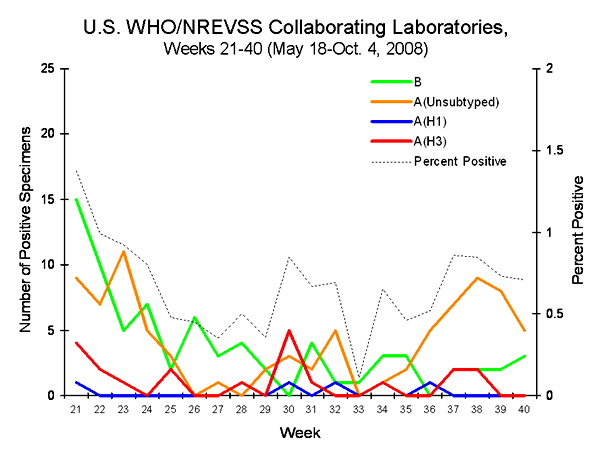
  • Forty-three (2.0%) specimens tested by U.S. World Health Organization (WHO) and National Respiratory and Enteric Virus Surveillance System (NREVSS) collaborating laboratories, and reported to CDC/Influenza Division, were positive for influenza.
  • The proportion of deaths attributed to pneumonia and influenza (P&I) was below the epidemic threshold.
  • The proportion of outpatient visits for influenza-like illness (ILI) was below national and region-specific baseline levels.
  • One state reported local influenza activity; Puerto Rico and 22 states reported sporadic influenza activity; and the District of Columbia and 27 states reported no influenza activity.
National and Regional Summary of Select Surveillance Components

Region
Data for current weekData cumulative for the season
Out-patient ILI*% positive for flu†Number of jurisdictions reporting regional or widespread activity‡A (H1)A (H3)A Unsub-typedBPediatric Deaths
NationNormal2.0 % 0 of 51 11216154830
New EnglandNormal0.6 % 0 of 601510
Mid-AtlanticNormal0.1 % 0 of 320210
East North CentralNormal4.5 % 0 of 540360
West North CentralNormal0.0 % 0 of 700210
South AtlanticNormal2.1 % 0 of 98253320
East South CentralNormal0.0 % 0 of 400000
West South CentralNormal5.9 % 0 of 418041270
MountainNormal2.1 % 0 of 8491040
PacificNormal3.4 % 0 of 576438110

* Elevated means the % of visits for ILI is at or above the national or region-specific baseline
† National data is for current week; regional data is for the most recent three weeks.
‡ Includes all 50 states and the District of Columbia
U.S. Virologic Surveillance:

WHO and NREVSS collaborating laboratories located in all 50 states and Washington D.C. report to CDC the number of respiratory specimens tested for influenza each week. Results of these tests performed during the current week, and cumulative totals for the season, are summarized in the table below.
Week 48Cumulative for the Season
No. of specimens tested213624657
No. of positive specimens (%)43 (2.0%)365 (1.5%)
Positive specimens by type/subtype
Influenza A32 (74.4%)282 (77.3%)
A (H1)4 (12.1%)112 (39.7%)
A (H3)2 (6.1%)16 (5.7%)
A (unsubtyped)26 (78.8%)154 (54.6%)
Influenza B11 (25.6%)83 (22.7%)

Twenty-six states from eight of the nine surveillance regions have reported laboratory-confirmed influenza this season with three states accounting for 275 (75.3%) of the 365 reported influenza viruses.

View WHO-NREVSS Regional Bar Charts| View Chart Data | View Full Screen
Antigenic Characterization:

CDC has antigenically characterized 30 influenza viruses [20 influenza A (H1), three influenza A (H3) and seven influenza B viruses] collected by U.S. laboratories since October 1, 2008.
All influenza A (H1) viruses were characterized as A/Brisbane/59/2007-like and all influenza A (H3) viruses were characterized as A/Brisbane/10/2007-like, the influenza A (H1N1) and influenza A (H3N2) components included in the 2008-09 influenza vaccine.
Influenza B viruses currently circulating can be divided into two antigenically distinct lineages represented by the B/Yamagata/16/88 and B/Victoria/02/87 viruses. Four influenza B viruses were characterized as B/Florida/04/2006-like, belonging to the B/Yamagata lineage, the influenza B component of the 2008-09 influenza vaccine, while the remaining three viruses belong to the B/Victoria lineage.
Data on antigenic characterization should be interpreted with caution given that:
  1. Few U.S. isolates are available for testing because of limited flu activity thus far.
  2. The majority of viruses antigenically characterized to date come from only two states and may not be nationally representative.
  3. Antigenic characterization data is based on hemagglutination inhibition (HI) testing using a panel of reference ferret antisera and results may not correlate with clinical protection against circulating viruses provided by influenza vaccination.
Annual influenza vaccination is expected to provide the best protection against those virus strains which are most similar to the vaccine strains, but can also provide at least partial protection against strains that are related, but antigenically distinct from vaccine strains. Limited to no protection may be expected when the vaccine and circulating virus strains are so different as to be from different lineages, as is seen with the two lineages of influenza B viruses.
Antiviral Resistance:

Since October 1, 2008, 25 influenza A (H1N1), five influenza A (H3N2), and nine influenza B viruses from 11 states have been tested for antiviral resistance; however, 72% of the viruses tested were from only two states. Twenty-four of 25 influenza A (H1N1) viruses tested were resistant to oseltamivir; while all 25 viruses were sensitive to zanamivir. All influenza A (H3N2) and B viruses tested were sensitive to oseltamivir and zanamivir.
Twenty-five influenza A (H1N1) and five influenza A (H3N2) viruses were tested for adamantane resistance. All influenza A (H1N1) viruses were sensitive to the adamantanes. All influenza A (H3N2) viruses tested were resistant to the adamantanes. The adamantanes are not effective against influenza B viruses.
Only one state has reported local influenza activity during the 2008-09 season in the United States to date, thus the number of virus specimens available for antiviral resistance testing is limited in both the overall number tested and in the number of states that have submitted specimens. Limited data on antiviral resistance, as well as the uncertainty regarding which influenza virus types or subtypes will circulate during the season, make it impossible to provide an indication of the prevalence of influenza viruses resistance to oseltamivir or the adamantanes (amantadine and rimantadine) nationally or regionally at this time. CDC has solicited a representative sample of viruses from WHO collaborating laboratories in the United States, and more specimens are expected as influenza activity increases.
Pneumonia and Influenza (P&I) Mortality Surveillance

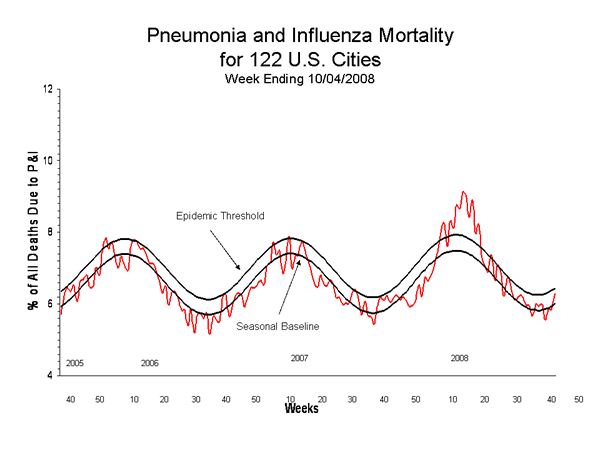
During week 48, 6.7% of all deaths reported through the 122-Cities Mortality Reporting System were due to P&I. This percentage is below the epidemic threshold of 7.1% for week 48.

View Full Screen
Influenza-Associated Pediatric Mortality

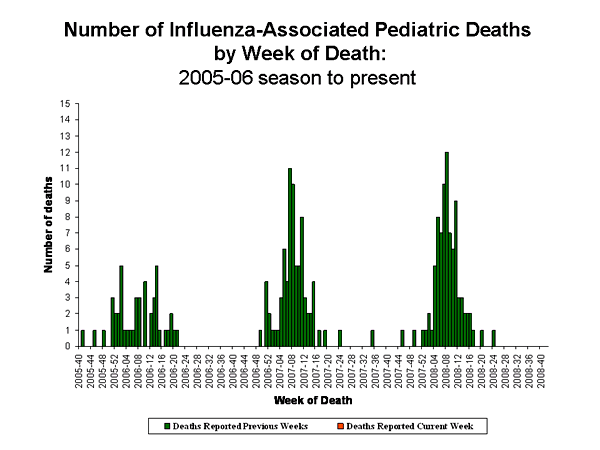
No influenza-associated pediatric deaths were reported during week 48.

View Full Screen
Influenza-Associated Hospitalizations

Laboratory-confirmed influenza-associated hospitalizations are monitored in two population-based surveillance networks: the Emerging Infections Program (EIP) and the New Vaccine Surveillance Network (NVSN). EIP and NVSN estimated rates of hospitalization for influenza will be reported every two weeks starting later this season.
Outpatient Illness Surveillance:

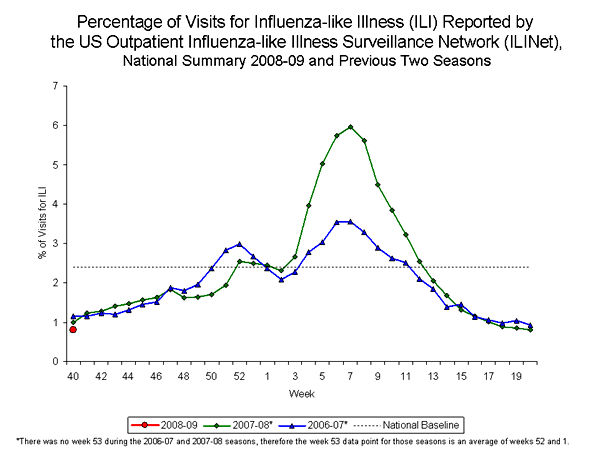
During week 48, 1.3% of patient visits reported through the U.S. Outpatient Influenza-like Illness Surveillance Network (ILINet) (formerly known as the U.S. Influenza Sentinel Provider Surveillance Network) were due to influenza-like illness (ILI). This percentage is less than the national baseline of 2.4%. On a regional level, the percentage of visits for ILI ranged from 0.4% to 2.4%. All nine regions reported percentages of visits for ILI below their respective region-specific baselines.

View Sentinel Providers Regional Charts | View Chart Data |View Full Screen
Geographic Spread of Influenza as Assessed by State and Territorial Epidemiologists:


During week 48 the following influenza activity was reported:
  • Local influenza activity was reported by one state (Hawaii).
  • Sporadic activity was reported in Puerto Rico and 22 states (Alaska, Arizona, Arkansas, California, Colorado, Connecticut, Florida, Idaho, Indiana, Massachusetts, Maryland, Michigan, New Hampshire, New York, Oregon, Pennsylvania, Rhode Island, South Dakota, Texas, Utah, West Virginia, and Wisconsin).
  • No influenza activity was reported in the District of Columbia and 27 states (Alabama, Delaware, Georgia, Illinois, Iowa, Kansas, Kentucky, Louisiana, Maine, Minnesota, Mississippi, Missouri, Montana, Nebraska, Nevada, New Jersey, New Mexico, North Carolina, North Dakota, Ohio, Oklahoma, South Carolina, Tennessee, Vermont, Virginia, Washington, and Wyoming).

--------------------------------------------------------------------------------
A description of surveillance methods is available at: http://www.cdc.gov/flu/weekly/fluactivity.htm
Reply With Quote
  #168  
Old December 5th, 2008, 06:16 PM
HenryN HenryN is offline
Retired
 
Join Date: Feb 2006
Posts: 20,294
Default Re: Seasonal Flu 2008 - 2009

INFLUENZA VIRUSES ISOLATED BY
WHO/NREVSS Collaborating Laboratories
2008 - 2009 Season
WeekA(H1)A(H3)A(Unk)B Total # Tested% Positive
40 2 0 9 6 2520 0.67
41 4 4 6 5 2541 0.75
42 12 3 15 5 2667 1.31
43 22 2 20 14 2896 2
44 9 1 19 4 2969 1.11
45 22 2 23 9 3404 1.65
46 24 2 10 9 2626 1.71
47 13 0 26 20 2898 2.04
48 4 2 26 11 2136 2.01

Return to Current Report

http://www.cdc.gov/flu/weekly/weekly...oAllregt48.htm
Reply With Quote
  #169  
Old December 5th, 2008, 06:45 PM
HenryN HenryN is offline
Retired
 
Join Date: Feb 2006
Posts: 20,294
Default Re: Seasonal Flu 2008 - 2009

Commentary

http://www.recombinomics.com/News/12...74Y_US_96.html
Reply With Quote
  #170  
Old December 5th, 2008, 06:51 PM
AlaskaDenise's Avatar
AlaskaDenise AlaskaDenise is offline
Editor, Senior Moderator
 
Join Date: Mar 2006
Posts: 8,703
Default Re: Seasonal Flu 2008 - 2009

Quote:
Originally Posted by niman View Post
Commentary

H1N1 Tamiflu Resistance in the United States Increases to 96%
Recombinomics Commentary 23:38
December 5, 2008

Twenty-four of 25 influenza A (H1N1) viruses tested were resistant to oseltamivir

Twenty-five influenza A (H1N1) and five influenza A (H3N2) viruses were tested for adamantane resistance. All influenza A (H1N1) viruses were sensitive to the adamantanes. All influenza A (H3N2) viruses tested were resistant to the adamantanes.

The above comments from the CDC week 48 report indicates the four most recently tested H1N1 isolates were oseltamivir resistant, raising the frequency in the United States to 96% and extending the streak of Tamiflu resistance to the 23 most recently tested samples.

The latest report significantly increases the number of H1N1 isolates tested for amantadine resistance. Since all are sensitive, it is likely that the H1N1 in the United States is clade 2B (Brisbane/59) and not clade 2C (Hong Kong), which was 100% amantadine resistant last season in the United States.

Thus, clade 2B has become the dominant H1N1 sub-clade in the United States, and has also been the dominant influenza A isolate in the United States since 112/128 subtypes influenza A was H1N1. Similarly, clade 2B is the most common influenza in the United States at this time since 282/365 isolates are influenza A.

The resistance levels in H1N1 in the United States is similar to other countries in North America and Europe, where levels are at or near 100% for Canada (1/1), England (19/20), and Scotland (2/2) and at 100% in Norway and Austria.

At this time H3N2 is the dominant influenza A subtype reported in Europe, but in the United States, the vast majority of influenza A is H1N1, raising concerns regarding the current antiviral recommendations for seasonal flu, which includes oseltamivir.


.
__________________
"The next major advancement in the health of American people will be determined by what the individual is willing to do for himself"-- John Knowles, Former President of the Rockefeller Foundation
Reply With Quote
  #171  
Old December 6th, 2008, 01:53 PM
Dutchy's Avatar
Dutchy Dutchy is offline
Editor, Senior Moderator
 
Join Date: Aug 2006
Location: Netherlands
Posts: 10,613
Default Re: Seasonal Flu 2008 - 2009

Summer flu

Worst flu in 5 years hits late and hard

December 06, 2008 11:15pm

FLU season has hit South Australia late, and it is not yet over, SA Health warns.

In the past month there have been dozens of cases of the potentially deadly Influenza A strain, and of the less potent Influenza B strain, reported to the department.

Many more cases go unreported. Two nursing home residents have died and dozens became critically ill after catching Influenza A this year.

SA Health chief medical officer Professor Paddy Phillips said the hope now was for a steady decline in the number of flu cases.

"Unfortunately influenza is around all year, so it's never too late to have a flu vaccination," he said. "(Without the vaccination) we would have expected more cases, and more problems with the influenza."

SA Health figures show there have been 449 cases reported so far this year.

That rate is the highest in five years, but Professor Phillips said it was difficult to compare figures because flu was made a notifiable disease this year.

Whooping cough (or pertussis) is also high, with about twice as many cases as last year.

Professor Phillips said whooping cough tended to go in cycles every three to four years.

"We've had more than usual this year," he said.

"Again, it's vaccine-preventable. If you're not vaccinated you can really get sick."

Shigella, a highly infectious stomach bug, is at the highest rate it's been in five years. National figures also show SA has a shingles rate twice the national average.

Professor Phillips said every year some things went up while others went down.

Dillon Francis, 31, of Houghton, is still recovering from a bout of the flu.

He said that as a bartender he has heard from numerous people in the past few weeks who have been battling colds and the flu. "I've had the flu before and it's terrible,"
he said.

"(This time) it started with aches and pains, and I was freezing cold, even under the blankets with a tracksuit and the electric blanket on. I've got a fairly good immune system so it only lasted about four days. "I ended up getting antibiotics because I developed tonsillitis as well."

http://www.news.com.au/adelaidenow/s...3-2682,00.html
__________________
~~~ Dutchy.123@gmail.com ~~~ http://twitter.com/Dutchy123 ~~~
Reply With Quote
  #172  
Old December 8th, 2008, 08:01 AM
HenryN HenryN is offline
Retired
 
Join Date: Feb 2006
Posts: 20,294
Default Re: Seasonal Flu 2008 - 2009

Commentary

http://www.recombinomics.com/News/12...smatch_US.html
Reply With Quote
  #173  
Old December 8th, 2008, 09:11 AM
AlaskaDenise's Avatar
AlaskaDenise AlaskaDenise is offline
Editor, Senior Moderator
 
Join Date: Mar 2006
Posts: 8,703
Default Re: Seasonal Flu 2008 - 2009

Quote:
Originally Posted by niman View Post
Commentary

Mismatched Flu Antiviral Recommendations in the United States
Recombinomics Commentary 12:41
December 8, 2008

Limited data on antiviral resistance, as well as the uncertainty regarding which influenza virus types or subtypes will circulate during the season, make it impossible to provide an indication of the prevalence of influenza viruses resistance to oseltamivir or the adamantanes (amantadine and rimantadine) nationally or regionally at this time. CDC has solicited a representative sample of viruses from WHO collaborating laboratories in the United States, and more specimens are expected as influenza activity increases.

Based on the level of oseltamivir resistance observed in only one influenza subtype, H1N1, and the persisting high levels of resistance to the adamantanes in H3N2 viruses, CDC continues to recommend the use of oseltamivir and zanamivir for the treatment or prevention of influenza in the United States.

The above comments are from recent CDC weekly reports on influenza. The statement on uncertainty is from the latest (week 48) update, while the statement on antiviral recommendations was in the week 46 report.

However, the antiviral situation in the United States is quite straight forward, and unlikely to change with additional near term data. Resistance to the adamantines is at or near 100% for H3N2, while resistance to oseltamivir (Tamiflu) is at or near 100% for H1N1. Since the vast majority of influenza A in the United States is H1N1 at this time, the current recommendations discourage use of adamantines, when most influenza A is sensitive, and encourage oseltamivir, when most influenza A is resistant, creating a significant mismatch in antiviral recommendations for the United States.

The basis for a prediction of near term stasis is based on results for this season for North America and Europe, where oseltamivir resistance is approximately 100% for H1N1 and adamantine resistance is approximately 100% for H3N2. Although resistance levels in H3N2 has been largely unchanged in recent seasons, the level of oseltamivir resistance (H274Y) has evolved significantly over the past few seasons, but the levels of 100% began to appear in the 2008 season in the southern hemisphere, and now is confirmed in the northern hemisphere for this season.

Initially, H274Y appeared on a number of H1N1 genetic backgrounds in patients not receiving oseltamivir. H274Y was reported in clade 2C (Hong Kong) in the 2005/2006 season in China. It then appeared in clade 1 (New Caledonia) in the United States and England in 2006/2007. Last season it was in clade 2B in the United States and England, but did not initially dominate. A second change, D3548G, which had been in clade 2C and clade 2A (Solomon Island) previously, was acquired by clade 2B via recombination, and this sub-clade, which both H274Y and D354G began to dominate.

In south countries in Europe (Norway, France, Russia) and North America (Canada) levels increased to more than 40% of H1N1 isolates. In the United States the level was closer to 10% because clade 2B and 2C were co-circulating and there was no reported H274Y in clade 2C in the United States. Moreover, most of clade 2B also did not have H274Y.

However, the following flu season in the summer hemisphere, the sub-clade with H274Y and D354G seed the season, and resistance levels rose to 100%, raising concerns that the new 2008/2009 season in the northern hemisphere would also be seeded by the same sub-clade and resistance would also increase to 100%. H1N1 resistance testing Europe and North America have confirmed the increase to 100%.

In the United States this season H274Y levels rose to close to 100% in clade 2B, and initial testing failed to identify clade 2C (which was at 100% adamantine resistance in the US last season). Thus, the levels of antiviral resistance in influenza A are related to the relative levels of H1N1 and H3N2, and at this time H1N1 levels are widespread and account for 80% or more of influenza A isolates in multiple regions.

As a result, the current antiviral recommendations in the United States are mismatched with the levels in co-circulation. The vast majority of influenza A is H1N1 which is oseltamivir resistance and adamantine sensitive, yet use of adamantines are discouraged and oseltamivir is encouraged in current CDC recommendations.


.
__________________
"The next major advancement in the health of American people will be determined by what the individual is willing to do for himself"-- John Knowles, Former President of the Rockefeller Foundation
Reply With Quote
  #174  
Old December 10th, 2008, 02:44 PM
HenryN HenryN is offline
Retired
 
Join Date: Feb 2006
Posts: 20,294
Default Re: Seasonal Flu 2008 - 2009

HPA Weekly National Influenza Report
Summary of UK* surveillance of influenza and other seasonal respiratory illness


10 December 2008 (Week 50
)

Summary
Clinical indices of acute respiratory illness (England, Wales, Scotland and Northern Ireland)
The overall influenza-like illness incidence rate**
remained below the baseline activity threshold (30 per
100, 000) at 16.5 per 100,000 in week 48/08 and nearly
doubled to 27.6 per 100,000 in week 49/08 (Figure 1).
The rate in the northern region increased from 8.1 per
100,000 in week 48/08 to 15.1 per 100,000 in week 49/
*Incorporating data from the Royal College of General Practitioners (RCGP) (England and Wales), The National
Public Health Service for Wales (NPHS), Health Protection Scotland (HPS), Communicable Disease Surveillance
Centre Northern Ireland (CDSC Northern Ireland), the Office for National Statistics (ONS) (England and Wales),
Medical Officers of Schools Association (MOSA) (England) and NHS Direct (England and Wales).
Figure 1


: RCGP consultation rate for influenza – like illness, 2008/09 and recent years, England and Wales
During weeks 48/08 and 49/08, influenza activity across the UK appeared to be increasing. GP consultation rates
have increased sharply but remain within baseline levels in England, they have also increased slightly and remain
within baseline in Scotland and Wales. In Northern Ireland the rate has greatly increased but thresholds have not yet
been set. Thresholds for NHS Direct in England and Wales have been exceeded. Of the samples referred to the
Centre for Infections’ Respiratory Virus Unit (RVU) during weeks 48/08 and 49/08, 139 were positive for influenza A,
eight A (H1) and 131 A (H3) and two for influenza B. Other NHS and HPA laboratories in England and Wales reported
97 influenza A and one influenza B positive specimens during these two weeks. Four Scottish and eight Northern Irish
influenza A positive specimens were reported in weeks 48 and 49/08. Nine outbreaks of respiratory illness were
reported from England and Northern Ireland in week 49/08, several have been confirmed as influenza A and others
are still under investigation. The weekly vaccine uptake rates for the over 65 years increased from 69.7% in week 48/
08 to 71.4% in week 49/08 and in the under 65 years at risk group it increased from 42.2% to 43.4% in the same time
period. Influenza activity was at low levels throughout the rest of Europe with 11 countries reporting increasing activity
in week 48/08.
As influenza activity is increasing, we will now be publishing full reports weekly.
England and Wales
Royal College of General Practitioners
(


http://www.rcgp.org.uk/bru/index.asp)

Covered in this report:
Data, except that from ONS, MOSA and non-UK sources: 24/11/08 - 07/12/08 (Weeks 48 and 49, 2008 )
Data from ONS, MOSA and non-UK sources: 17/11/08 - 30/11/08 (Weeks 47 and 48, 2008)
** RCGP incidence rates in this report only refer to first or new episodes of infection diagnosed by a GP.
Neuraminidase inhibitor susceptibility testing on 30 A (H3) isolates since week 36/08 showed that all are sensitive to
oseltamivir and zanamivir but resistant to amantadine. All of the four influenza B isolates received since week 36/08
are sensitive to oseltamivir and zanamivir


. Twenty-three of 24 A (H1) specimens tested in the same time frame are
resistant to oseltamivir but sensitive to zanamivir and amantadine. The majority of these resistant viruses come from
the south west of England with the remaining from Wales and northern England. Two influenza A (H1) isolates have
been found to be resistant to oseltamivir in Scotland this season.
Antiviral drug susceptibility test
08, an increase from 20.1 per 100,000 to 37.5 per 100,000
was seen in the central region and in the south it increased
from 17.6 per 100,000 to 25.1 per 100,00 in weeks 48
and 49/08 respectively. The rate was highest in the 15-44
year age group at 32.1 per 100,000 in week 49/08 (Figure
2).
The rate for acute bronchitis has been increasing steadily
over the season, it increased from 132.7 per 100,000 in
week 48/08 to 151.9 per 100,000 in week 49/08.
2
0
2 5
5 0
7 5
1 0 0
1 2 5
1 5 0
4 0 4 2 4 4 4 6 4 8 5 0 5 2 2 4 6 8 1 0 1 2 1 4 1 6 1 8 2 0
W e e k
Rate per 100 000 population
E n g l a n d ( R C G P )
S c o t l a n d ( H P S )
W a l e s ( N P H S )
N o r t h e r n I r e l a n d ( C D S C N I )
Figure 3


: GP Consultation rates for influenza/influenza-like illness in the U.K
QSurveillance
HPA and Nottingham University Division of Primary
Care.
(


http://www.qresearch.org)

Northern Ireland
CDSC Northern Ireland
(


http://www.cdscni.org.uk/)

The combined rate for influenza and influenza-like illness
nearly doubled from 42.8 per 100,000 (updated rate) in
week 48/08 to 69.2 per 100,000 in week 48/08 (Figure 3).
This rate has cosistently been highest in the 15-64 year
age group. No threshold has been set for Northern Ireland.
This primary care surveillance system uses
QSurveillance, a database of general practice derived
data. During weeks 48/08 and 49/08, over 3200 practices
reported from England, Wales, Scotland and Northern
Ireland covering a population of over 22 million. The rate
of influenza-like illness increased from 14 per 100,000
in week 48/08 to 19 per 100,000 in week 49/08. The
highest rates have consistently been in the 15-44 year
age group. In both weeks the rates were highest in
London, Northern Ireland and the West Midlands.
NHS Direct total call activity
England and Wales
(


http://www.nhsdirect.nhs.uk/)

Cold/flu and fever calls increased and exceeded the
baseline levels from week 48/08 to 49/08. The proportion
of cold/flu calls increased from 0.9% in week 48 to 1.2%
in week 49/08 (1.2% is the theshold). Fever calls in the 5-
14 age group made up 8.1% of the total calls in week 48/
08, this increased to 10.0% in week 49/08 which exceeds
the threshold of 9%.
Wales
National Public Health Service
(


http://www.wales.nhs.uk/sites/home.cfm?OrgID=368)

GP consultation rates for influenza increased from 6.9
per 100 000 in week 48/08 to 7.8 per 100,000 in week
49/08. Both figures are well below the baseline threshold
of 25 consultations per 100,000 (Figure 3).
Figure 2


: RCGP Episode incidence rates for influenza-like illness (ILI) by age group, England and Wales.
0
1 0
2 0
3 0
4 0
5 0
6 0
7 0
8 0
9 0
1 0 0
4 0 4 2 4 4 4 6 4 8 5 0 5 2 2 4 6 8 1 0 1 2 1 4 1 6 1 8 2 0
W e e k
Rate per 100 000 population
0 - 1
1 - 4
5 - 1 4
1 5 - 4 4
4 5 - 6 4
6 5 - 7 4
> 7 5
Medical Officers of Schools Association
(MOSA)
During weeks 47 and 48/08, 21 and 20 schools,
respectively, reported data. There were two new episodes
of influenza like illness reported in week 47/08 giving a
rate of 0.36 per 1000 and 21 new episodes in week 48/
08 giving a rate of 3.85 per 1000. The rate of upper
respiratory tract infection in week 47/08 was 17.3 per
1000 population (97 new episodes) which decreased to
7.7 (42 new episodes) in week 48/08.
Scotland
Health Protection Scotland
(


http://www.hps.scot.nhs.uk/)

GP consultation rates for influenza increased from 19.0
per 100,000 in week 48/08 to 20.0 per 100,000 in week
49/08. Activity remains below the Scottish baseline
threshold of 50 consultations per 100,000 (Figure 3).
3
Respiratory Virus Unit (RVU) Influenza Reference
Laboratory, CfI
Fifty-one specimens tested positive for influenza A viruses
in week 48/08 and 88 in week 49/08 (Table 1). Since week
40/08 129 viruses have been characterised: 14 A/Solomon
Islands/3/2006 (H1)-like which is similar to the vaccine
strain, two A (H1) Brisbane/59/2007 (H1N1)-like (vaccine
strain) and 103 A (H3) A/Brisbane/10/2007 (H3N2)-like
(vaccine strain) (Figure 4).


The majority of influenza A
(H1) specimens received to date come from Southern
England (table 1).
Neuraminidase inhibitor susceptibility testing on 30 A
(H3) isolates since week 36/08 showed that all of them
are sensitive

to oseltamivir and zanamivir but resistant to
amantadine. Of the 24 A (H1) specimens received and
tested, 23 are resistant to oseltamivir but sensitive to
zanamivir and amantadine. These specimens are from
Northern and Southern England and Wales (table 1). Three
* RSV detection is by PCR only
Other NHS and HPA laboratories (England and
Wales)
The number of specimens positive for influenza A has
increased from 37 in week 48/08 to 60 in week 49/08
and the number of RSV positives decreased slightly
(from 454 to 437) in the same time period. To date, a
higher number of influenza A positive specimens have
come from southen England. (Table 2).
Please note that these data are provisional.
Laboratory indices of acute respiratory illness
*


Detections of RSV by isolation are not included.
Table 1 “Detections” (PCR and isolation) of influenza and
RSV made by RVU (CfI) Reference Laboratory.
Samples from community and hospital sources,
by week of report.
3 40 1 1
1 78 3 4
21 126 1 21
1 2 0 0
1 2 0 0
0 0 0 0
27 248 5 26
Influenza Detections by
PCR and Isolation
A (H1) A (H3) B RSV*
Cumulative to date
Northern England
Central England
Southern England
Wales
Scotland
Northern Ireland
Cumulative Total
Influenza type ( subtype)
Week 48/08
Week 49/08
(week 40/08 – 49/08)
356 336 3922
Table 2 ‘‘Detections” (isolation, PCR, direct
immunofluorescence and paired sera tests) of
influenza and RSV reported to CfI by NHS and
HPA microbiology laboratories. Data for England
and Wales by RCGP region, by week of report
Week 48/08
Week 49/08
Cumulative to Date
(week 40/08 - 49/08)
Northern England
Central England
Southern England
Wales
Cumulative Total
Detection (isolates, DIF and PCR)
Influenza A Influenza B RSV*
37 0 454
60 1 437
38 3 874
45 2 306
78 2 1029
9 0 117
170 7 2326
3 48 1 7
5 83 1 5
Figure 4 : Total ( Community and Hospital) Influenza detections (PCR and Isolation) characterised by RVU,CfI, by week of
specimen
0
5
1 0
1 5
2 0
2 5
3 0
3 5
4 0
4 0 4 2 4 4 4 6 4 8 5 0 5 2 2 4 6 8 1 0 1 2 1 4 1 6 1 8 2 0
W e e k
Number of detections
I n f l u e n z a A ( H 1 )
I n f l u e n z a A ( H 3 )
I n f l u e n z a B
further influenza A(H1) isolates are undergoing
resistance testing at the moment. Four influenza B
isolates have been received and tested and all are
sensitive to oseltamivir and zanamivir.
Please note that these data are provisional.
4
Avian Influenza
The WHO continues to monitor and report on new cases
of human infection with A(H5N1) avian influenza when
they occur. A report by WHO on 9 December confirms two
further human cases of A(H5N1) avian influenza in
Indonesia, of which one has died. According to WHO,
the total number of confirmed human infections
worldwide with H5N1, since December 2003, is 389 of
which 246 (63%) have died.
Useful links:
Situation updates from WHO (human):
http://www.who.int/csr/disease/avian_influenza/en/
Situation summary from the HPA (avian and human):
http://www.hpa.org.uk/infections/top...ion_update.htm
Virological data from Northern Ireland
(


http://www.cdscni.org.uk/)

Eight influenza A positive samples were reported in
weeks 48/08 and 49/08, two sentinel and six nonsentinel.
In week 48/08 30 non-sentinel samples
were positive for RSV and in week 49/08 this number
was 37.
Flu Vaccination Campaign 2008/09 (England)
Data on influenza vaccination uptake is taken weekly from
a sample of GPs in England.
Steady increasing trends have been seen since since
the start of the campaign in September 2008. The
proportion vaccinated in the over 65 year age group
increased from 69.7% in week 48/08 to 71.4% in week
49/08. In the under 65 years at risk group, the proportion
vaccinated increased from 42.2% in week 48/08 to 43.4%
in week 49/08.
It should be noted that all data is provisional.
In week 48/08 this parallel GP sentinel scheme
reported 12 out of 49 (24.5%) influenza A positive
specimens, in week 49/08 five of 11 (45.5%)
specimens were positive for influenza A and one for
influenza B. Two specimens were positive for RSV
and five for other respiratory viruses in the same time
period.
HPA CfI Virological Surveillance of Influenza
(England)
Outbreak Reports:
Nine respiratory illness outbreaks were reported in week
49/08; three in care homes (one confirmed influenza A
(H3) in Northern Ireland and two in South East England);
four in schools (Yorkshire and the Humber, South West
England, South East England and London); one
confirmed influenza A (H1) from a hospital ward in North
West England and one from an army barracks in South
East Enlgand. Most are still under investigation
CfI would welcome any reports of influenza outbreak
investigations. Please email any reports to
respdcsc@hpa.org.uk


).
Mortality Data
Office for National Statistics
(


http://www.statistics.gov.uk)
The number of deaths registered in England and Wales
increased from 9430 in week 47/08 to 9717 in week 48/
08. The number of deaths due to all respiratory diseases
(as underlying cause) stayed constant at 1251 (13.3%)
in week 47/08 and 1252 (12.9%) in week 48/08. The
weekly all cause registered deaths are shown in Figure
5. No excess deaths were detected in either week.
Other Reports (UK)
Virological data from Scotland
(


http://www.show.scot.nhs.uk/scieh/)

During weeks 48/08 and 49/08, four (7.3%) out of 55
sentinel samples, were positive for influenza A and six
for RSV. Eighty-one routine samples reported from
hospital and community sources were also tested; 14
(17.3%) were positive for influenza A and 68 positive for
RSV. Two influenza A (H1) isolates from Scotland this
season have been found to be resistant to oseltamivir.
Virological data from Wales
(http://www.wales.nhs.uk/


)

To date this season one of 25 sentinel samples (week
45/08) and nine non-sentinel samples have been
positive for influenza A. In week 48/08 eight sentinel
samples were tested; none were positive for influenza
and one was positive for another respiratory virus.
Figure 5 : Weekly all cause registered deaths in England and Wales
0
2 0 0 0
4 0 0 0
6 0 0 0
8 0 0 0
1 0 0 0 0
1 2 0 0 0
1 4 0 0 0
1 6 0 0 0
4 0 4 2 4 4 4 6 4 8 5 0 5 2 2 4 6 8 1 0 1 2 1 4 1 6 1 8 2 0
W e e k N u m b e r
Number of Deaths
O b s e r v e d
E x p e c t e d
9 5 % U p p e r L i m i t
Data Source: The National Influenza Vaccine Uptake
Monitoring Programme (HPA/DH)
5
Data for this report were collated by the Influenza/
Respiratory Virus Team:
Estelle McLean, Joy Field and Richard Pebody
Respiratory and Systemic Infections Department
HPA Centre for Infections, 61 Colindale Avenue
London NW9 5EQ, United Kingdom
Tel: (0)20 8327 7768; Fax: (0)20 8200 7868
E-mail:


respcdsc@hpa.org.uk
Maria Zambon, Joanna Ellis, Angie Lackenby, Alison
Bermingham and Praveen Sebastianpillai
Respiratory Virus Unit, Virus Reference Department
HPA Centre for Infections, 61 Colindale Avenue
London NW9 5HT, United Kingdom
Tel: (0)20 8327 6239; Fax: (0)20 8205 8195
E-mail:


ernvl@hpa.org.uk
If you wish to be included on our email notification list
please send your address to:


respcdsc@hpa.org.uk
Acknowledgements
Canada
Public Health Agency of Canada
(


http://www.phac-aspc.gc.ca/fluwatch/index.html)

During week 48/08, influenza activity remained low with
the majority of the influenza surveillance regions reporting
no activity and 13 regions reporting sporadic influenza
activity in week 48/08. An increase in the consultation
rates and number of viruses detected has been reported.
Eighteen of 1818 (1.0%) specimens tested positive for
influenza in week 48/08.
Since 1 September 2008, six influenza viruses have been
characterised: one influenza A/Brisbane/59/2007(H1N1)-
like, two A/Brisbane/10/2007 (H3N2)-like, two influenza
B/Florida/4/2006-like and one B/Malaysia/2506/2004-like.
The influenza A (H1N1) isolate has been found to be
resistant to oseltamivir.
Ireland
Health Protection Surveillance Centre (HPSC)
(


http://www.hpsc.ie/)

In week 48/08 the Irish ILI consultation rate was
10.9 per 100,000 and increased sharply to 20.3 per
100,000 in week 49/08 (39 consultations).
In week 48/08 one of four (25%) sentinel specimens
tested positive for influenza A and 40 of 106 nonsentinel
specimens tested were positive for RSV. In
week 49/08 six of 12 (50%) sentinel samples were
positive for influenza; five A and one B. Thirty of 97
non-sentinel samples were positive for RSV in week
49/08.
Two viruses have been characterised as A/Brisbane/
10/2007 (H3N2)-like.
Other country reports can be obtained from the World
Health Organisation:
http://www.who.int/csr/disease/influenza/en/
Europe
European Influenza Surveillance System (EISS)
(


www.eiss.org)

In weeks 47 and 48/08, low levels of seasonal influenza
activity were seen across all 26 European countries
participating in the EISS. In week 48/08 sporadic activity
was reported in eleven countries and increasing activity
was reported in England, Estonia, Hungary, Latvia,
Lithuania, Poland, Portugal, Serbia, Slovakia, Spain, and
Sweden.
Out of the total 536 respiratory specimens collected by
sentinel physicians during week 48/08, 65 (12.1%)
specimens tested positive for influenza, 12 type A (not
subtyped), 49 A (H3), two A (H1) and two type B. In addition,
72 non-sentinel specimens tested positive including 47
influenza A (not subtyped), 20 A (H3), one A (H1), and four
type B. These positive specimens were reported from 11
countries.
Since week 40/08, 79 viruses have been characterised;
76 of these seem to be a good match to the strains
recommended for the 2008-09 vaccine, the remaining
three were B/Malaysia/2506/2004-like.
Influenza activity outside the UK
In week 48/08 WHO and NREVSS laboratories reported
2136 specimens tested for influenza viruses, 43 (2.0%)
of which were positive: four influenza A (H1), two A (H3),
26 A (not subtyped).
Since week 40/08 30 influenza viruses have been
characterised; 20 A/Brisbane/59/2007 (H1N1)-like, 3 A/
Brisbane/10/2007 (H3N2)-like, four B/Florida/04/2006-
like, which are the components recommended for the
2008-09 vaccine, and three from the B/Victoria lineage.
Of the 25 influenza A (H1) viruses tested this season, 24

have been found to be resistant to oseltamivir.

http://www.hpa.org.uk/webc/HPAwebFil.../1228894718273

Reply With Quote
  #175  
Old December 10th, 2008, 03:32 PM
HenryN HenryN is offline
Retired
 
Join Date: Feb 2006
Posts: 20,294
Default Re: Seasonal Flu 2008 - 2009

Of the 24 A (H1) specimens received and
tested, 23 are resistant to oseltamivir but sensitive to
zanamivir and amantadine. These specimens are from
Northern and Southern England and Wales
Reply With Quote
  #176  
Old December 10th, 2008, 06:55 PM
HenryN HenryN is offline
Retired
 
Join Date: Feb 2006
Posts: 20,294
Default Re: Seasonal Flu 2008 - 2009

Commentary at

http://www.recombinomics.com/News/12...74Y_UK_96.html
Reply With Quote
  #177  
Old December 11th, 2008, 12:19 AM
AlaskaDenise's Avatar
AlaskaDenise AlaskaDenise is offline
Editor, Senior Moderator
 
Join Date: Mar 2006
Posts: 8,703
Default Re: Seasonal Flu 2008 - 2009

Quote:
Originally Posted by niman View Post
Commentary

H1N1 Tamiflu Resistance in UK Increases to 96%
Recombinomics Commentary 23:45
December 10, 2008

Of the 24 A (H1) specimens received and tested, 23 are resistant to oseltamivir but sensitive to zanamivir and amantadine. These specimens are from Northern and Southern England and Wales.

The above comments are from the week 47/48 report from England and indicate that four more H1N1 isolates have been tested for H274Y, and all four are positive. Thus, the UK levels for H1N1 from England, Wales, and Scotland are above 96% (25/26). In addition, all H1N1 isolates from Norway and Austria have H274Y, indicating H274Y is fixed in H1N1 (clade 2B) in Europe.

Similar results have been obtained for North America. The one H1N1 sample from Canada has H274Y, as do 24/25 isolates in the United States, indicating H274Y is also fixed in North America.

This fixing has a smaller impact in Europe, because most of the influenza A reported this season in EISS has been H3N2, although H1N1 is dominant in Russia. In contrast, 85-90% of the influenza A in the United States has been H1N1, which creates a mismatch on antiviral recommendations. Amantadine resistance is fixed in H3N2 and use has been discouraged, although H3N2 represents only 10-15% of influenza A. In contrast, oseltamivir (Tamivir) is recommended, even though the vast majority of influenza A is resistant, since H274Y is fixed in H1N1.

The CDC has requested additional samples, but the fixing of S31N in H3N2 and H274Y in H1N1 is unlikely to change in the near term, and until frequencies of H3N2 increase significantly, the antiviral recommendations in the United States will remain mismatched with the influenza A in circulation.


.
__________________
"The next major advancement in the health of American people will be determined by what the individual is willing to do for himself"-- John Knowles, Former President of the Rockefeller Foundation
Reply With Quote
  #178  
Old December 11th, 2008, 12:23 PM
ironorehopper's Avatar
ironorehopper ironorehopper is online now
Membro del Comitato Consultivo, Editore e Direttore del Forum Italiano di FluTrackers
 
Join Date: Dec 2007
Location: PADUA
Posts: 12,355
Default Re: Seasonal Flu 2008 - 2009

USA: Update: Influenza Activity — United States, September 28–November 29, 2008 [US CDC MMWR]

Update: Influenza Activity — United States, September 28–November 29, 2008

[From Morbidity and Mortality Weekly Report (MMWR), LINK]


During September 28–November 29, 2008, influenza activity remained low in the United States. Of the few influenza viruses characterized thus far this season, most are antigenically related to the strains included in the 2008–09 influenza vaccine. Oseltamivir-resistant influenza A (H1N1) viruses have been detected, but currently available data are insufficient to predict their prevalence for the 2008–09 season. This report summarizes U.S. influenza activity* since the last update (1) and reviews new influenza vaccine recommendations for the current season.

Viral Surveillance
During September 28–November 29, 2008, approximately 150 World Health Organization (WHO) and National Respiratory and Enteric Virus Surveillance System collaborating laboratories in the United States tested 24,657 respiratory specimens for influenza viruses; 365 (1.5%) were positive (Figure 1).

Of these, 282 (77.3%) were influenza A viruses, and 83 (22.7%) were influenza B viruses. One hundred twenty-eight (45.4%) of the 282 influenza A viruses were subtyped; 112 (87.5%) of these were influenza A (H1) viruses, and 16 (12.5%) were influenza A (H3) viruses.

Influenza-positive tests have been reported from 26 states in eight of the nine surveillance regions since September 28.

Antigenic Characterization
WHO collaborating laboratories in the United States are requested to submit a subset of their influenza-positive respiratory specimens to CDC for further antigenic characterization. CDC has antigenically characterized 30 influenza viruses collected by U.S. laboratories during the 2008–09 season, including 20 influenza A (H1N1), three influenza A (H3N2), and seven influenza B viruses. Twenty-seven of the 30 viruses were antigenically related to the components included in the 2008–09 influenza vaccine (A/Brisbane/59/2007-like (H1N1), A/Brisbane/10/2007-like (H3N2), and B/Florida/04/2006-like). The other three influenza B viruses belong to the B/Victoria/02/87 lineage.

Antiviral Resistance of Influenza Virus Isolates
With limited influenza activity in the United States, few viruses have been available for antiviral resistance testing. Since September 28, 2008, 39 influenza viruses from 11 states have been tested for antiviral resistance; of the viruses tested, 28 (71.8%) were collected from only two states.

Preliminary data show that 24 of the 25 influenza A (H1N1) isolates tested were resistant to oseltamivir; all H1N1 isolates were sensitive to zanamivir.
All five influenza A (H3N2) and the nine influenza B isolates tested were sensitive to oseltamivir and zanamivir.

Twenty-five influenza A (H1N1) isolates and five influenza A (H3N2) isolates were tested for adamantane resistance. All influenza A (H1N1) isolates were sensitive to adamantanes, and all influenza A (H3N2) isolates tested were resistant to adamantanes. The adamantanes are not effective against influenza B viruses.

Currently, data on antiviral resistance, and information on which influenza virus types or subtypes will circulate, are insufficient to provide an indication of the prevalence of antiviral resistance at a national or regional level during this season. CDC has solicited a representative sample of viruses from WHO collaborating laboratories in the United States for resistance testing throughout the season, and more specimens are expected as influenza activity increases.

Novel Influenza A Viruses
One case of human infection with a novel influenza A virus was reported from Texas during the week ending November 15, 2008. A child aged 14 years was infected with swine influenza A (H1N1) in October 2008 after several reported swine exposures. The child recovered from the illness, and no contacts of the child were reported to be ill.

State-Specific Activity Levels
For the week ending November 29, 2008, influenza activity† was reported as sporadic in Puerto Rico and 22 states, and one state (Hawaii) reported local activity. Twenty-seven states and the District of Columbia reported no activity. No states have reported regional or widespread activity this season.

Outpatient Illness Surveillance
Since September 28, 2008, the weekly percentage of outpatient visits for influenza-like illness (ILI)§ reported by approximately 1,500 U.S. sentinel providers in 50 states, New York City, Chicago, and the District of Columbia that comprise the U.S. Outpatient ILI Surveillance Network (ILINet), has ranged from 0.9% to 1.3% (Figure 2). This is below the national baseline of 2.4%. In addition, all nine surveillance regions reported percentages below their respective region-specific baselines.¶

Pneumonia- and Influenza-Related Mortality
For the week ending November 29, 2008, pneumonia and influenza (P&I) was reported as an underlying or contributing cause of death for 6.7% of all deaths reported to the 122 Cities Mortality Reporting System. This is below the epidemic threshold of 7.1% for that period. Since September 28, 2008, the weekly percentage of deaths attributed to P&I ranged from 6.0%–6.7%, remaining below the epidemic threshold.**

Influenza-Associated Pediatric Hospitalizations
Pediatric hospitalizations associated with laboratory-confirmed influenza infections are monitored by two population-based surveillance networks, the Emerging Infections Program (EIP) and the New Vaccine Surveillance Network (NVSN). No influenza-associated pediatric hospitalizations have yet been reported by either network this season.

Influenza-Related Pediatric Mortality
No influenza-related pediatric deaths have been reported for the 2008–09 season.

Reported by:
WHO Collaborating Center for Surveillance, Epidemiology, and Control of Influenza. L Brammer, MPH, S Epperson, MPH, L Blanton, MPH, R Dhara, MPH, T Wallis, MS, L Finelli, DrPH, A Fiore, MD, L Gubavera, PhD, J Bresee, MD, A Klimov, PhD, N Cox, PhD, Influenza Div, National Center for Immunization and Respiratory Diseases; S Doshi, MD, EIS Officer, CDC.

FIGURE 1. Number* and percentage of respiratory specimens testing positive for influenza reported to CDC by U.S. World Health Organization/National Respiratory and Enteric Virus Surveillance System collaborating laboratories, by week — United States, 2008–09 influenza season


From TABLES


Editorial Note:
During September 28–November 29, 2008, the United States experienced a low level of influenza activity which is typical for this time of year and similar to the past four influenza seasons. The peak of influenza activity has come before January in only five of the past 20 seasons; February or March has been the peak month in 11 of those 20 seasons (CDC, unpublished data, 2008).

Influenza vaccine first became available in August, allowing persons to be vaccinated before influenza activity began. Vaccination efforts should continue during December given the most common timing of peak influenza activity, and providers should offer influenza vaccine throughout the influenza season (which can persist as late as April or May) to protect as many persons from influenza infection and its complications as possible.

Most of the U.S. influenza viruses identified and characterized thus far in the 2008–09 season are antigenically similar to the components included in the 2008–09 influenza vaccine. However, these viruses were isolated in few states and early in the influenza season; CDC will test more viruses as flu activity increases and more samples become available. The season has not progressed enough to determine which influenza virus type or subtype will predominate this season.

On average, influenza is estimated to cause approximately 226,000 hospitalizations and 36,000 deaths per year in the United States. Annual vaccination remains the best method for preventing influenza and its potentially severe complications. The Advisory Committee on Immunization Practices (ACIP) recently expanded its recommendations for influenza vaccination to include all children aged 6 months–18 years. In addition, influenza vaccine should be administered to other persons at high risk for influenza-related complications, close contacts of those at high risk (including health-care workers), and anyone else who wants to decrease their risk for influenza (2).

CDC conducts surveillance for resistance of circulating influenza viruses to licensed antiviral medications: adamantanes (amantadine and rimantadine) and neuraminidase inhibitors (zanamivir and oseltamivir).

Antiviral resistance testing is not commercially available to guide clinical management of individual patients.

Influenza A (H1N1) viruses that have a genetic mutation conferring oseltamivir resistance appeared and circulated during the 2007–08 Northern Hemisphere influenza season (3), and during the 2008 Southern Hemisphere season, with some Southern Hemisphere countries reporting that a majority of tested A (H1N1) viruses were resistant to oseltamivir (4).

To date, oseltamivir-resistant A (H1N1) viruses from all countries that have submitted specimens to CDC have been sensitive to zanamivir, and most have been susceptible to the adamantanes.

All tested influenza A (H1N1), influenza A (H3N2), and influenza B viruses have been sensitive to zanamivir.

Most recent influenza A (H3N2) viruses circulating worldwide are resistant to adamantanes, and adamantanes are not effective against influenza B infections.

The prevalence of oseltamivir resistance this season will depend on the level of influenza activity, the proportion of resistance among influenza A (H1N1) viruses and the proportion of A (H1N1) viruses among all circulating influenza viruses.

At this time, too few specimens from a limited geographic area have been tested to accurately estimate either proportion; thus the prevalence of oseltamivir resistance for the 2008–09 season cannot be estimated accurately.

Enhanced surveillance for oseltamivir-resistant viruses is ongoing at CDC. Alternatives for antiviral treatment in the context of widely circulating oseltamivir-resistant viruses have been suggested.

These treatment options, which might include preferential use of zanamivir or therapy with a combination of antivirals for certain patients, have been outlined in the ACIP 2008 influenza recommendations.††

Currently, the neuraminidase inhibitors oseltamivir and zanamivir remain the recommended medications for treatment and chemoprophylaxis of influenza.

Clinicians should remain alert for changes in recommendations that might occur as the 2008–09 influenza season progresses. Recommendations regarding the use of antiviral medications might be revised if surveillance data indicate a substantial and widespread increase in the prevalence of oseltamivir-resistant influenza viruses in the United States.

FIGURE 2. Percentage of visits for influenza-like illness (ILI) reported by the U.S. Outpatient Influenza-like Illness Surveillance Network (ILINet), by week — United States, September 28–November 29, 2008 and 2006–07 and 2007–08 influenza seasons

From TABLES

Vaccination remains the cornerstone of influenza prevention efforts. Influenza vaccination can prevent influenza infections from strains that are sensitive or resistant to antiviral medications; the influenza A (H1N1) viruses found to be oseltamivir resistant are antigenically similar to the components included in the 2008–09 vaccine. December 8–14 is National Influenza Vaccination Week. Health-care providers are encouraged to take advantage of heightened awareness of the benefits of influenza vaccination and to increase vaccination efforts during this week to reach persons who have not yet been vaccinated.

CDC continues to conduct surveillance to provide up-to-date recommendations regarding prevention and treatment of influenza. Influenza surveillance reports for the United States are posted online weekly during October–May and are available at http://www.cdc.gov/flu/weekly/fluactivity.htm. Additional information regarding influenza viruses, influenza surveillance, influenza vaccine, and avian influenza is available at http://www.cdc.gov/flu.

Acknowledgments
This report is based, in part, on data contributed by participating state and territorial health departments and state public health laboratories, WHO collaborating laboratories, National Respiratory and Enteric Virus Surveillance System collaborating laboratories, the U.S. Influenza Sentinel Provider Surveillance System, and the 122 Cities Mortality Reporting System; WHO National Influenza Centers, WHO Global Influenza Programme, Geneva, Switzerland; A Kelso, PhD, I Barr, PhD, WHO Collaborating Center for Reference and Research on Influenza, Parkville, Australia; A Hay, PhD, WHO Collaborating Center for Reference and Research on Influenza, National Institute of Medical Research, London, England; and M Tashiro, MD, WHO Collaborating Center for Reference and Research on Influenza, National Institute of Infectious Diseases, Tokyo, Japan.

References
1. CDC. Influenza activity—United States and worldwide, May 18–September 19, 2008. MMWR 2008;57:1046–9.
2. CDC. Prevention and control of influenza: recommendations of the Advisory Committee on Immunization Practices (ACIP), 2008. MMWR 2008;57(No. RR-7).
3. CDC. Influenza activity—United States and worldwide, 2007–08 season. MMWR 2008;57:692–7.
4. World Health Organization. Influenza A(H1N1) virus resistance to oseltamivir—2008 influenza season, southern hemisphere. Geneva, Switzerland: World Health Organization; 2008. Available at http://www.who.int/csr/disease/influ...1200801013.pdf.

* The 2006–07 and 2007–08 seasons reported 52 weeks; therefore, the week 53 data point for those seasons is an average of weeks 52 and 1.
†† Available at http://www.cdc.gov/flu/professionals...resistance.htm.

§ Defined as a temperature of >100.0°F (>37.8°C), oral or equivalent, and cough and/or sore throat, in the absence of a known cause other than influenza.
¶ The national and regional baselines are the mean percentage of visits for ILI during noninfluenza weeks for the previous three seasons plus two standard deviations. A noninfluenza week is a week during which <10% of specimens tested positive for influenza. National and regional percentages of patient visits for ILI are weighted on the basis of state population. Use of the national baseline for regional data is not appropriate.
** The seasonal baseline proportion of P&I deaths is projected using a robust regression procedure in which a periodic regression model is applied to the observed percentage of deaths from P&I that were reported by the 122 Cities Mortality Reporting System during the preceding 5 years. The epidemic threshold is 1.645 standard deviations above the seasonal baseline.

* The CDC influenza surveillance system collects five categories of information from 10 data sources. Viral surveillance: U.S. World Health Organization collaborating laboratories, the National Respiratory and Enteric Virus Surveillance System, and novel influenza A virus case reporting. Outpatient illness surveillance: U.S. Influenza Sentinel Provider Surveillance Network and the U.S. Department of Veterans Affairs/U.S. Department of Defense BioSense Outpatient Surveillance System. Mortality: 122 Cities Mortality Reporting System and influenza-associated pediatric mortality reports. Hospitalizations: Emerging Infections Program and New Vaccine Surveillance Network. Summary of geographic spread of influenza: state and territorial epidemiologist reports.
† Levels of activity are 1) no activity; 2) sporadic: isolated laboratory-confirmed influenza cases or a laboratory-confirmed outbreak in one institution, with no increase in activity; 3) local: increased ILI, or at least two institutional outbreaks (ILI or laboratory-confirmed influenza) in one region with recent laboratory evidence of influenza in that region; virus activity no greater than sporadic in other regions; 4) regional: increased ILI activity or institutional outbreaks (ILI or laboratory-confirmed influenza) in at least two but less than half of the regions in the state with recent laboratory evidence of influenza in those regions; and 5) widespread: increased ILI activity or institutional outbreaks (ILI or laboratory-confirmed influenza) in at least half the regions in the state with recent laboratory evidence of influenza in the state.
-
-----
__________________
GIMI69 (IRONOREHOPPER)
--

People come and go, but the creative force of great historical events, as well as important ideas and actions remain. (Aleksandr Romanovic Lurija, 1976)
--
A TIME'S MEMORY (Blog)
ATTRAVERSO QUESTI GIORNI (Blog)
tracciatore_traccia@libero.it
Reply With Quote
  #179  
Old December 11th, 2008, 12:37 PM
HenryN HenryN is offline
Retired
 
Join Date: Feb 2006
Posts: 20,294
Default Re: Seasonal Flu 2008 - 2009

Tomorrow's MMWR data matches last week's CDC report.

Data and antiviral recommendations are VERY old.
Reply With Quote
  #180  
Old December 12th, 2008, 03:22 AM
ironorehopper's Avatar
ironorehopper ironorehopper is online now
Membro del Comitato Consultivo, Editore e Direttore del Forum Italiano di FluTrackers
 
Join Date: Dec 2007
Location: PADUA
Posts: 12,355
Default Re: Seasonal Flu 2008 - 2009

ITALY: SEASONAL INFLUENZA VIROLOGICAL SURVEILLANCE, WEEKLY UPDATE (12/11/2008) [MINISTRY OF HEALTH]

VIROLOGICAL SURVEILLANCE FOR INFLUENZA

December 10, 2008

Update, Week: 49/08

[Manual translation by IOH]

Original PDF Document: LINK


ITALY


Of 37 samples collected during the 49th week, only one type A influenza virus has been isolated: a subytpe A/H3N2, by Parma's University.

An additional influenza A virus has been isolated by Florence University last week, and subtyped as A/H3N2.
Table below reports cumulative virological data collected during this first surveillance month:

[TYPE / WEEK: 46 / 47 / 48 / 49 / TOTAL]
FLU A / 3 / 4 / 4 / 1 / 12
A (unsubtyped) ... / ... / ... / ... / ...
A/H3N2 / 3 / 4 / 4 / 1 / 12
A/H1N1 / ... / ... / ... / ... / ...
FLU B / 0 / 0 / 0 / 0 / ...
TOT SAMPLES POSITIVE / 3 / 4 / 4 / 1 / 12

N.B. Some variations could happen in respect to previous weekly update, due to further viral characterization done.


WORLD'S UPDATE

Europe
Almost all European countries that have sent data though surveillance network, have detected an increasing circulation of influenza virus, although at low level. 12% of collected samples have resulted influenza positive.

92% of positive samples were influenza type A, mostly subtype H3; influenza B and A/H1 was also detected.
RSV (respiratory syncitial virus) circulation is increasing.

For further information, please do refer to the websites below:
http://www.eiss.org/index.cgi
http://www.grog.org/

USA
During current surveillance week, influenza virus circulation has been detected at low level; only 2% of the collected samples resulted influenza virus positive. The vast majority of isolated was influenza A.

Further informations at:
http://www.cdc.gov/flu/
-
-----
__________________
GIMI69 (IRONOREHOPPER)
--

People come and go, but the creative force of great historical events, as well as important ideas and actions remain. (Aleksandr Romanovic Lurija, 1976)
--
A TIME'S MEMORY (Blog)
ATTRAVERSO QUESTI GIORNI (Blog)
tracciatore_traccia@libero.it
Reply With Quote
Reply

Tags
antiviral resistance, h1n1, h3n2, seasonal flu


Currently Active Users Viewing This Thread: 1 (0 members and 1 guests)
 
Thread Tools Search this Thread
Search this Thread:

Advanced Search
Display Modes

Posting Rules
You may not post new threads
You may not post replies
You may not post attachments
You may not edit your posts

BB code is On
Smilies are On
[IMG] code is On
HTML code is On

Disclaimer:

The reader is responsible for discerning the validity, factuality or implications of information posted here, be it fictional or based on real events. Moderators on this forum make every effort to review the material posted on this site however, it is not realistically possible for our staff to manually review each post.

The content of posts on this site, including but not limited to links to other web sites, are the expressed opinion of the original authors or posters and are not endorsed by, or representative of the opinions of, the owners or administration of this website. The posts on this website are the opinion of the specific author or poster and should not be construed as statements of advice or factual information.

Not all posts on this website are intended as truthful or factual assertion by their authors. NO posts on this website should be considered factual information on face value alone. Users are encouraged to USE DISCERNMENT and do their own follow up research while reading and posting on this website. FluTrackers.com Inc. reserves the right to make changes to, corrections and/or remove entirely at any time posts made on this website without notice. In addition, FluTrackers.com Inc. disclaims any and all liability for damages incurred directly or indirectly as a result of a post on this website.

This site is provided "as is" without warranty of any kind, either expressed or implied. You should not assume that this site is error-free or that it will be suitable for the particular purpose which you have in mind when using it. In no event shall FluTrackers.com Inc. be liable for any special, incidental, indirect or consequential damages of any kind, or any damages whatsoever, including, without limitation, those resulting from loss of use, data or profits, whether or not advised of the possibility of damage, and on any theory of liability, arising out of or in connection with the use or performance of this site or other documents which are referenced by or linked to this site.

Finally, FluTrackers.com Inc. reserves the right to delete, correct, or make changes to any post on this website without notice at any time for any reason.

Fair Use Notice:
This site may contain copyrighted material the use of which has not always been specifically authorized by the copyright owner. Users may make such material available in an effort to advance awareness and understanding of issues relating to public health, civil rights, economics, individual rights, international affairs, liberty, science & technology, etc. We believe this constitutes a 'fair use' of any such copyrighted material as provided for in section 107 of the US Copyright Law. In accordance with Title 17 U.S.C.Section 107, the material on this site is distributed to those who have expressed a prior interest in receiving the included information for research and educational purposes.

In accordance with industry accepted best practices we ask that users limit their copy / paste of copyrighted material to the relevant portions of the article you wish to discuss and no more than 50% of the source material, provide a link back to the original article and provide your original comments / criticism in your post with the article. Please remember you are responsible for what you post on the internet and you could be sued by the original copyright holder if you do not honor these rules.

If you are a legal copyright holder or a designated agent for such and you believe a post on this website falls outside the boundaries of "Fair Use" and legitimately infringes on yours or your clients copyright

we may be contacted concerning copyright matters at:

FluTrackers.com Inc.
c/o Sharon Sanders
1676 Hibiscus Avenue
Winter Park, Florida 32789
Phone: 407-406-3037
E-Mail: flutrackers@earthlink.net

In accordance with section 512 of the U.S. Copyright Act our contact information has been registered with the United States Copyright Office. "Safe Harbor" noticing procedures as outlined in the DMCA apply to this website concerning all 3rd party posts published herein.

If notice is given of an alleged copyright violation we will act expeditiously to remove or disable access to the material(s) in question.

All 3rd party material posted on this website is the copyright of the respective owners / authors. FluTrackers.com Inc. makes no claim of copyright on such material.

For more information please visit: http://www.law.cornell.edu/uscode/17/107.shtml

Please be aware any communications sent complaining about a post on this website may be posted publicly at the discretion of the administration.

FluTrackers Does Not Provide Any Medical Advice:

FluTrackers, Inc. does not provide medical advice. Information on this web site is collected from various internet resources, and the FluTrackers board of directors makes no warranty to the safety, efficacy, correctness or completeness of the information posted on this site by any author or poster.

The information collated here is for instructional and/or discussion purposes only and is NOT intended to diagnose or treat any disease, illness, or other medical condition. Every individual reader or poster should seek advice from their personal physician/healthcare practitioner before considering or using any interventions that are discussed on this website.

By continuing to access this website you agree to consult your personal physican before using any interventions posted on this website, and you agree to hold harmless FluTrackers.com Inc., the board of directors, the members, and all authors and posters for any effects from use of any medication, supplement, vitamin or other substance, device, intervention, etc. mentioned in posts on this website, or other internet venues referenced in posts on this website.

By using and/or accessing this site, either passively or actively, you are agreeing to all of the above conditions. Also, by using and/or accessing this site, either passively or actively, you agree to conduct all business and legal affairs related to this website in the jurisdiction of Flutrackers.com Inc. which is registered in Central Florida, USA.

These Disclaimers are subject to change at anytime.

Email the Webmaster with questions or comments about this site at flutrackers@earthlink.net


All times are GMT -4. The time now is 05:13 PM.