• FluTrackers.com Inc. does not provide medical advice. Information on this web site is collected from various internet resources, and the FluTrackers board of directors makes no warranty to the safety, efficacy, correctness or completeness of the information posted on this site by any author or poster. The information collated here is for instructional and/or discussion purposes only and is NOT intended to diagnose or treat any disease, illness, or other medical condition. Every individual reader or poster should seek advice from their personal physician/healthcare practitioner before considering or using any interventions that are discussed on this website. By continuing to access this website you agree to consult your personal physican before using any interventions posted on this website, and you agree to hold harmless FluTrackers.com Inc., the board of directors, the members, and all authors and posters for any effects from use of any medication, supplement, vitamin or other substance, device, intervention, etc. mentioned in posts on this website, or other internet venues referenced in posts on this website.
  • We are not asking for any donations. Do not donate to any entity who says they are raising funds for us.

Australia (mainland) - Highly pathogenic avian influenza H5N1 in wild birds and mammals 2026

hat tip Shiloh


Source: https://www.abc.net.au/news/2026-08...-flu-case-in-mammal-confirmed-in-sa/107068380

Australia's first bird flu case in a mammal confirmed in South Australia
Posted 20m ago

Australia's first case of bird flu in a mammal has been confirmed following testing of a long-nosed fur seal found in South Australia.

Federal Agriculture Minister Julie Collins has told reporters in Hobart the seal was found at Beachport, 300 kilometres south of Adelaide.

"This is sadly our first confirmed case of H5 bird flu in a mammal in Australia," Ms Collins said.

"I have been advised that at this time the detection does not appear to be associated with other sick or dead marine mammals."...
 

Australia: SA Reports 1st H5N1 Detection in a Marine Mammal (long-nosed fur seal)


#19,306

Less than a year ago HPAI H5N1 was detected on Heard Island - an Australian external possession 4000 km south west of Perth - resulting in the the deaths of thousands of marine mammals and seabirds (see Preprint: Mass mortality of southern elephant seals during multi-species outbreak of HPAI H5N1 on sub-Antarctic Heard Island).

Drone surveys revealed mass mortality in southern elephant seals, with 8,573 pups (62%) recorded dead across Heard Island by the final surveys. Mortality increased at an average rate of 5.6% per day in a subset of harems, and the highest observed mortality in a harem was 97%. Based on the average (76%) mortality in the final surveys, total estimated pup mortality at Heard Island was 13,359 (from a total population of 17,364 pups), though this may be an underestimate as mortality was ongoing at this time.
Just over 2 months ago HPAI H5N1 arrived - via migratory birds - to the Australian mainland. Since then we've been watching as thousands of birds - both migratory and local - have succumbed to the virus.


While all previous detections have been limited to birds, overnight Australia confirmed HPAI finding in a first mammalian casualty in the following brief announcement.

23 August 2026

Attributable to Australian Chief Veterinary Officer, Dr Beth Cookson:

Testing at CSIRO’s Australian Centre for Disease Preparedness (ACDP) has confirmed H5 high pathogenicity avian influenza (bird flu) in a long-nosed fur seal, found at Beachport in South Australia. This is the first detection of H5 bird flu in a mammal species in Australia.

Although this is a concerning development, it is not unexpected that H5 bird flu has been detected in other wildlife, particularly marine mammals, in areas where there are high levels of infection in wild birds.

From 12 August 2026, we have changed how we report on H5 bird flu detections. Reporting will be based on events, rather than individual detections. See birdflu.gov.au for the latest information.

There remain no detections in poultry or in our agricultural production system.

The risk to human health remains low.
We get a few more details from the SA August 23rd update, which reads in part:

The long-nosed fur seal was found dead with no signs of injury and reported to the EAD hotline by a member of the public on Wednesday, 19 August. It was not reported as a suspect detection initially as state-based testing was inconclusive. However, samples were dispatched to ACDP for urgent testing which confirmed the H5 bird flu detection.
Based on the HPAI carnage we've seen among marine mammals elsewhere in the world (see UC Davis: High pathogenicity Avian Influenza in Pinniped conservation), today's announcement likely only heralds a much larger impact.

And while the Australian government still reminds the public that poultry and agricultural livestock remain unaffected, how long that happy status quo will stand is anyone's guess.


https://afludiary.blogspot.com/2026/08/australia-sa-reports-1st-h5n1-detection.html
 
1787575045872.webp


H5 bird flu testing update 23 August​

23 August 2026

The CSIRO’s Australian Centre for Disease Preparedness (ACDP) has confirmed 11 new H5 bird flu events in South Australia since yesterday’s update, including the first confirmed detection in a mammal in Australia, a long-nosed fur seal found at Beachport.

The new events include:

  • Long-nosed fur seal
    • Limestone Coast – Beachport
  • Gannet
    • Limestone Coast – West Range
  • Greater crested tern
    • Adelaide – Christies Beach
    • Eyre Peninsula – Arno Bay
    • Fleurieu Peninsula – Clayton Bay and South Milang
    • Limestone Coast – Avenue Range and Port MacDonnell
  • Little penguin
    • Kangaroo Island – D’Estrees Bay
  • Silver gull
    • Fleurieu Peninsula – Goolwa
  • Black-faced cormorant
    • Fleurieu Peninsula – Normanville
There have now been 194 confirmed H5 bird flu events in South Australia.

The long-nosed fur seal was found dead with no signs of injury and reported to the EAD hotline by a member of the public on Wednesday, 19 August. It was not reported as a suspect detection initially as state-based testing was inconclusive. However, samples were dispatched to ACDP for urgent testing which confirmed the H5 bird flu detection.

In line with national protocols, the South Australian Government recently changed how we report on H5 bird flu detections.

Reporting is now based on events, rather than individual bird detections, where an event may involve one or more birds. The number of positive events captures all previously reported individual confirmed detections.

An interactive map is available on the H5 bird flu website with up-to-date information on event locations: birdflu.sa.gov.au/current-situation/

A further 6 suspect H5 bird flu events in South Australia have been detected since the last update, bringing the current number of suspect events to 22. These include:

  • Greater crested terns
    • Eyre Peninsula – Lipson Island
    • Fleurieu Peninsula – Goolwa South
    • Yorke Peninsula – Port Stansbury
  • Black-faced cormorant
    • Adelaide – Semaphore
  • Sooty oystercatcher
    • Kangaroo Island – Seal Bay
  • Silver gull
    • Adelaide – Semaphore
The samples have been sent to ACDP for confirmatory testing, with results expected to be known in the coming days.

There remains no H5 bird flu detections in poultry or other livestock. The risk to human health of H5 bird flu remains low.

Engagement with primary industries, the wildlife sector, and the broader South Australian community continues as part of the South Australian Government’s commitment to deliver the most comprehensive and effective wildlife and industry surveillance, reporting and preparedness efforts possible.

South Australians are encouraged to continue being vigilant in reporting sick and dead birds and other
wildlife.

Avoid touching sick or dead birds and other wildlife. Record what you see. Report it to the Emergency Animal Disease Hotline on 1800 675 888.

For the latest updates, information and advice about H5 bird flu in South Australia, including how to register for the next community forums at Golden Grove/Wynn Vale (Monday, 24 August) and Port MacDonnell (Thursday, 27 August), visit birdflu.sa.gov.au.

...
-------------------------------------------------------------------------------------

H5 bird flu testing update 24 August​

24 August 2026

There are 5 new suspect H5 bird flu events in South Australia, including a long-nosed fur seal at The
Pages Conservation Park.


No new confirmed events have been reported since yesterday’s update, and the total number of
confirmed H5 bird flu events in South Australia remains 194.

The new suspect events include:

  • Long-nosed fur seal
    • Offshore - The Pages Conservation Park
  • Greater crested tern
    • Metropolitan - Osborne
    • Limestone Coast - Coorong (two events)
  • White fronted tern
    • Limestone Coast - Carpenter Rocks
The samples from new suspect events have been sent to ACDP for confirmatory testing, with results
expected to be known in the coming days.

In line with national protocols, the South Australian Government recently changed how we report on H5
bird flu detections.

Reporting is now based on events, rather than individual animal detections, where an event may involve
one or more animals. The number of positive events captures all previously reported individual
confirmed detections.

An interactive map is available on the H5 bird flu website with up-to-date information on event locations:
birdflu.sa.gov.au/current-situation

There remains no H5 bird flu detections in poultry or other livestock. The risk to human health of H5 bird flu remains low.

Engagement with primary industries, the wildlife sector, and the broader South Australian community continues as part of the South Australian Government’s commitment to deliver the most comprehensive and effective wildlife and industry surveillance, reporting and preparedness efforts possible.

South Australians are encouraged to continue being vigilant in reporting sick and dead birds and other
wildlife.

Avoid touching sick or dead birds and other wildlife. Record what you see. Report it to the Emergency Animal Disease Hotline on 1800 675 888.

For the latest updates, information and advice about H5 bird flu in South Australia, including how to register for the next community forums including tonight's (24 August) event at Golden Grove/Wynn Vale and Thursday night (27 August) at Port MacDonnell, visit birdflu.sa.gov.au.

1787575481163.webp


1787586234184.webp

First bird flu death in an Australian mainland mammal is a grim milestone. We know how bad this can get

Published: August 23, 2026 4:16am EDT

Author
Jane Younger
Senior Lecturer in Southern Ocean Vertebrate Ecology, Institute for Marine and Antarctic Studies, University of Tasmania
...
Australia has crossed another grim threshold in its H5N1 bird flu outbreak. For the first time, the virus has infected an Australian mainland mammal: a long-nosed fur seal found dead at Beachport on South Australia’s Limestone Coast, about a four-hour drive southeast of Adelaide.

This is a devastating development, although sadly not an unexpected one. H5N1 is already circulating in wild seabirds along the Limestone Coast, with many infected greater crested terns found at Beachport itself.

This seal likely caught the virus through contact with either infected birds or the environment they share. As of today, there is no evidence that it is part of a wider marine mammal outbreak.

One infected seal is not a seal outbreak. But we know from overseas just how quickly that can change.

We know how bad this can get

When H5N1 reached southern elephant seals in Argentina in 2023 more than 17,000 pups died. At one intensively monitored colony, mortality eventually reached 95%. Genetic evidence strongly supported transmission between mammals, rather than thousands of seals independently becoming infected from birds.

The devastation followed the virus into the Southern Ocean.

On South Georgia island (east of the Falkland Islands), the number of breeding female southern elephant seals fell by 47% between 2022 and 2024, following the arrival of H5N1.
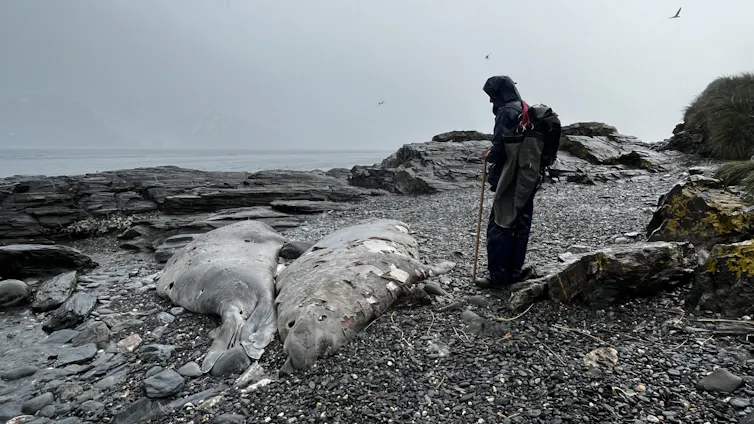
A dead elephant seal in South Georgia, seen in early 2025 during the bird flu outbreak on the island.

Dead elephant seals in South Georgia, seen in early 2025 during the bird flu outbreak on the island. Jane Younger

Then, at Australia’s Heard Island (about 1,700 km north of Antarctica), an estimated 13,359 elephant seal pups are believed to have died during the 2025 outbreak.

Antarctic fur seals have also been hit extremely hard. Field observations suggest they may have suffered the greatest number of deaths of any species, although the scale of the outbreaks makes a reliable total impossible.

These are not isolated animal deaths. For already threatened species – such as the Australian sea lion, the Antarctic fur seal and the southern elephant seal – losses on this scale can push species closer to extinction.

What is a long-nosed fur seal – and what happens next?​

Long-nosed fur seals, formerly known as New Zealand fur seals, occur in Western Australia, South Australia, Tasmania and New Zealand. The South Australian population is estimated at around 100,000 individuals.

We do not know exactly how the Beachport seal became infected, but infection could occur through direct contact with infected birds or other seals, or exposure to contaminated beaches or water.

Australia is also home to Australian fur seals and the endangered Australian sea lion, a species found nowhere else on Earth. Its entire population is estimated at fewer than 12,000 animals, around 85% of them in South Australia.

H5N1-infected birds have already been found at Seal Bay on Kangaroo Island, while mass bird deaths are occurring at the South Australian island group The Pages – both important Australian sea lion breeding locations.

Australia’s Macquarie Island (about 1,500 km southeast of Tasmania) is also home to southern elephant seals and endangered Antarctic fur seals – both species that have faced huge losses from H5N1 in other parts of the world.

Seal populations now need urgent surveillance. We can’t stop H5N1 spreading through a colony, but we need to know where it is, how quickly it is spreading and which populations are being hardest hit.

Why are seals so vulnerable?​

Seals gather on the coast in dense colonies, in close contact with each other and in contaminated ground and water, creating opportunities for rapid transmission.

But the biology of the virus matters too.

H5N1 is fundamentally a bird virus, but the lineage that spread through marine mammals in South America acquired mutations that improve its ability to replicate in the cells of mammals.

Our recent research (yet to have been peer reviewed) found that H5N1 continued to evolve as it spread through seals, including more changes that help it replicate in mammals. But severe outbreaks in seals also occurred without these changes, suggesting seals may be particularly vulnerable to the virus.

We do not yet know which viral lineage infected the Beachport seal. Rapid genome sequencing will be important to determine whether it carries the mammalian-adaptive mutations seen overseas.

Australia needs a seal plan now​

There are currently no commercially available H5 vaccines suitable for mammals available in Australia.

But there is promising overseas work.

In the United States, researchers tested a vaccine – originally developed for dairy cattle – in northern elephant seals. The vaccine was well tolerated and produced a clear, measurable antibody response. Researchers then extended the trial to endangered Hawaiian monk seals in rehabilitation.

This does not yet amount to a vaccination program for free-ranging seals, and the vaccine does not have regulatory approval for use in Australia.

Vaccinating every seal colony would also be impossible. Fur seals typically enter the water as soon as people approach, making vaccination infeasible for this species.

But Australia should urgently investigate whether targeted vaccination could protect select populations where intervention is both feasible and worthwhile – particularly endangered Australian sea lions, and southern elephant seals on Macquarie Island, which remains an enormously important Australian breeding population.

Vaccination will never stop H5N1 spreading through wildlife. But it may help prevent catastrophic losses in the species we can reach.

The Beachport seal is one animal – for now.

But this virus has already shown us what can happen next. Australia should use that warning while we still have time.

Please do not touch sick or dead birds or marine mammals. Record the location, take photographs from a safe distance, keep pets away, and report the sighting to the Emergency Animal Disease Hotline on 1800 675 888.
...


1787687196547.webp

Castaways Beach Queensland Australia

Google Map

------------------------------------------------------------------

1787686807727.webp

Queensland detects second H5 bird flu in migratory seabird​

The Department of Primary Industries is responding to its second detection of H5 bird flu in Queensland.

Samples from a single deceased shearwater found on Castaways Beach (Sunshine Coast) tested positive for H5 bird flu last night, during initial testing at the Queensland Government’s Biosecurity Sciences Laboratory (BSL).

Samples have been sent to CSIRO’s Australian Centre for Disease Preparedness for confirmatory testing.

There remains no detection in poultry, nor evidence of large-scale deaths in any animals in Queensland.

H5 bird flu is not able to be eradicated in wild birds and is expected to remain an ongoing wildlife disease that will require continued monitoring and management.

Department of Primary Industries Chief Veterinary Officer Dr Allison Crook said the bird was found as part of Queensland’s enhanced H5 bird flu surveillance program.

“A member of the public saw this dead bird and immediately reported it. This is 1 of more than 3,000 reports in Queensland to the Emergency Animal Disease (EAD) Hotline and I thank the public for their support,” Dr Crook said.

“If you find sick or dead wild birds or wildlife, avoid contact, keep children and pets away, record what you see, and report immediately to the EAD Hotline on 1800 675 888.”

Dr Crook said Queensland is well prepared to respond to this latest event and the Department of Primary Industries has an Incident Management Team that is responding swiftly, prioritising heightened surveillance, stakeholder engagement and regular public communication.

“We are continuing our enhanced passive surveillance program throughout the state and would encourage the community and industry to continue to be vigilant,” Dr Crook said.

Australia now has confirmed detections of H5 avian bird flu in wildlife across most states.

South Australia has also had mass mortality events in wild birds and for the first time in Australia, a confirmed detection in a marine mammal this week.

The community is being urged to continue to report sick or dead wild birds.
...
Last updated: 25 Aug 2026


1787688453510.webp

Interview with Rachel Mealey, ABC AM​

24 August 2026

E&OE TRANSCRIPT
RADIO INTERVIEW
ABC AM
MONDAY, 24 AUGUST 2026

SUBJECTS:
H5 bird flu

RACHEL MEALEY, HOST: Minister, thanks for speaking to AM.

JULIE COLLINS, MINISTER FOR AGRICULTURE, FISHERIES AND FORESTRY: Good morning and good morning to your listeners, Rachel.

MEALEY: How concerning is this development?

COLLINS: Well, obviously it can be distressing for many Australians, particularly those with a close connection to our land or our wildlife. But for us it's not unexpected and we should expect to see more infection in other wildlife, particularly marine mammals, in areas where there are high levels of infection in those wild birds.

MEALEY: Do scientists know how the fur seal contracted this strain of bird flu?

COLLINS
: Well, I'm advised that at the moment the detection doesn't appear to be associated with any other sick or dead marine mammals. And the infection of this individual animal is likely to have occurred due to exposure to infected wild birds or the environment that they share. So, it was found in an area where there were a lot of other sick or dead birds.

MEALEY
: What happens from here? Will more fur seals be tested to find out the extent of infection in the herd, or can any of the herd be quarantined to prevent further spread?

COLLINS: What we do know, sadly, is that once the H5 bird flu is spreading in the natural environment, it's not possible to avoid significant losses. And we've been very upfront with the Australian people about that. But that's why we've worked so hard to prepare. We've invested over $113 million in preparation, and $47 million of that has gone into protecting threatened species and improving habitat for them so that they will be able to get through this H5 bird flu.

MEALEY. So, what you're saying is that the spread to the fur seals was expected by scientists who've been monitoring the outbreak? It's part of the modelling.

COLLINS: It's certainly what we have seen and experienced overseas. Once it's in those wild birds, it does tend to go into marine mammals who are more susceptible and obviously it can go into any mammal.

MEALEY
: The Invasive Species Council says that this virus, if it spreads to Australia's sea lion population, it could be an extinction level event. Can anything be done there to prevent that?

COLLINS
: We have invested early in terms of our threatened species, and we've also obviously procured a vaccine in terms of wild birds, and we've been working with the states and territories who are prioritising their threatened species of wild birds in terms of vaccinations.

MEALEY: Will the government commit to more funding for biodiversity programs?

COLLINS: Well, obviously these types of biosecurity incursions that we have in Australia. There is a funding model and we have been working with the states and territories. We've also released since that first incursion, over $24.8 million now with the states and territories that we're investing with them, on top of the $113 million. But we have said we're doing everything we can do as a government.

MEALEY: What's the news on a bird flu vaccine for mammals? How far away might that be?

COLLINS: Well, we've been obviously monitoring that very closely. There are trials underway in North America, in California and Hawaii. And this is using a vaccine that's been developed for cattle, but there certainly is nothing commercially available. But we do continue to look at that research.

MEALEY: And what about house pets? Should owners, maybe particularly in South Australia, be taking any special precautions?

COLLINS: Well, what we do say is if you see sick or dead birds, don't touch them and certainly keep your pets away from any dead birds. So, our advice would be to keep an eye on your pets and keep them away from any dead birds or dead animals. I would just say we could also go to birdflu.gov.au where there is a lot of information for members of the public.

MEALEY: Minister, thanks very much for joining AM.

COLLINS: Thanks very much for having me.


Back
Top Bottom