

Giuseppe
Emeritus
Impact of the 2009 influenza A(H1N1) pandemic wave on the pattern of hibernal respiratory virus epidemics, France, 2009 (Euro Surveill., edited)
Eurosurveillance, Volume 15, Issue 6, 11 February 2010
Rapid communications
Impact of the 2009 influenza A(H1N1) pandemic wave on the pattern of hibernal respiratory virus epidemics, France, 2009
J S Casalegno ( )<sup>1</sup><sup>,2</sup>, M Ottmann<sup>2</sup>, M Bouscambert-Duchamp<sup>1</sup><sup>,2</sup>, M Valette<sup>1</sup>, F Morfin<sup>1</sup><sup>,2</sup>, B Lina<sup>1</sup><sup>,2</sup>
Citation style for this article: Casalegno JS, Ottmann M, Bouscambert-Duchamp M, Valette M, Morfin F, Lina B. Impact of the 2009 influenza A(H1N1) pandemic wave on the pattern of hibernal respiratory virus epidemics, France, 2009. Euro Surveill. 2010;15(6) ii=19485. Available online: http://www.eurosurveillance.org/ViewArticle.aspx?ArticleId=19485
Date of submission: 04 February 2010
<hr>
This short report based on clinical surveillance and laboratory data describes the circulation of rhinoviruses, influenza viruses and respiratory syncytial viruses (RSV) in France during the 2009-10 season compared with the previous winter season. The delayed circulation of RSV observed in 2009-10 compared with 2008-09 suggests that the early circulation of the 2009 pandemic influenza A(H1N1) viruses had an impact on the RSV epidemic.
<hr>
The emergence and spread of the 2009 pandemic influenza A(H1N1) virus during summer 2009 in northern and central America and in parts of Europe suggested that the epidemic wave would occur in Europe in September, according to weather conditions and social habits (start of the new school year). However, in early September 2009 while cases of clinical influenza-like illness (ILI) were increasing in France, Sweden and other European countries, the detection of 2009 pandemic influenza A(H1N1) remained sporadic.
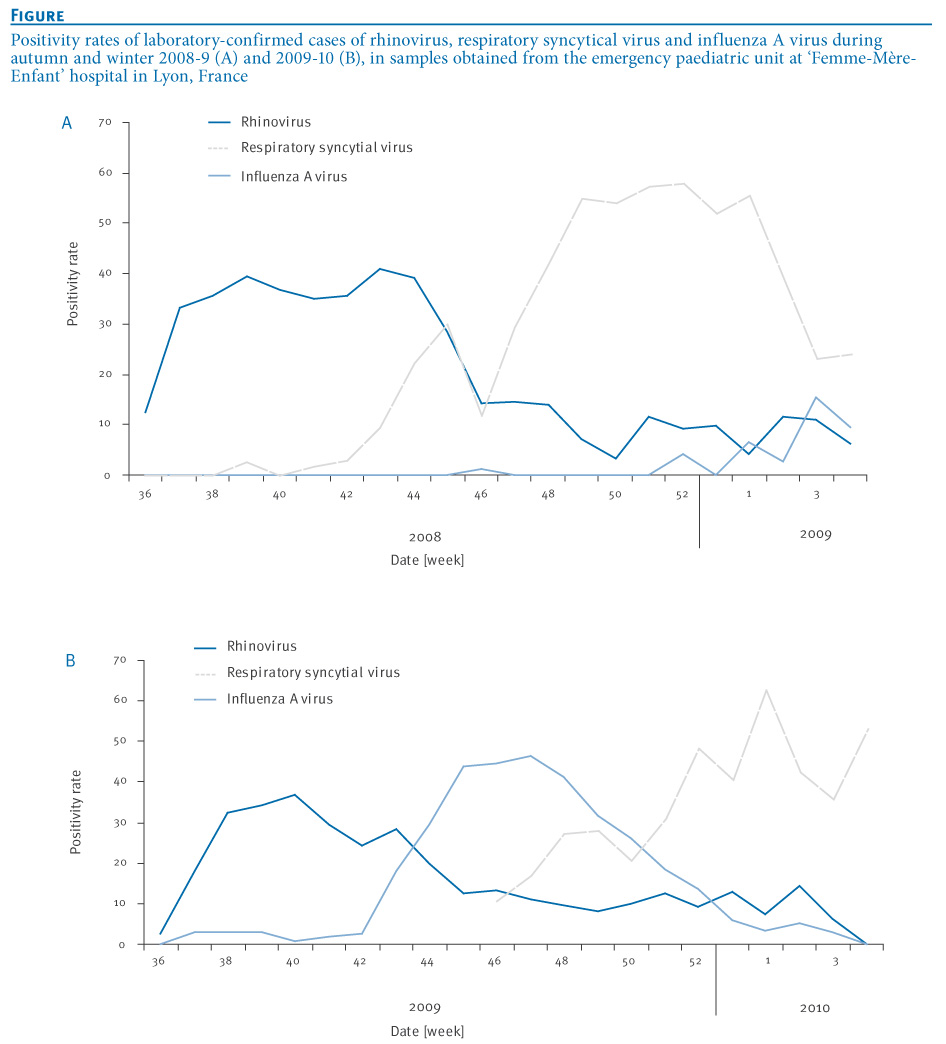
It was first suggested by Linde et al. that rhinovirus epidemics may have interfered with the spread of pandemic influenza A(H1N1) and caused this delay.[1]. Recently, we reported that the rhinovirus infections observed from early September to mid-October (Figure, panel B) appeared to reduce the statistical likelihood of pandemic influenza in the paediatric population [2]. These data support the hypothesis that the spread of the 2009 pandemic influenza A(H1N1) in France was delayed due to interaction between respiratory viruses at the beginning of autumn.
Analysis of respiratory viruses circulating in 2008-9 and 2009-10
Recently, we wondered whether the first epidemic wave of 2009 pandemic influenza could have had an impact on the respiratory syncytial virus (RSV) epidemic [3]. As the winter epidemics 2009-10 have almost ended, a first analysis can be performed. The French Institut de Veille Sanitaire (InVS) manages the national surveillance data provided by two independent monitoring systems. Firstly, the sentinel networks (?r?seau sentinelles?), collecting reports of clinical syndromes sent by volunteering general practitioners, and secondly, the Groupes R?gionaux d?Observation de la Grippe (GROG), analysing samples collected from patients by a network of volunteering general practitioners.
The first cases of pandemic influenza were detected in France from early May 2009, but the pandemic wave began only in mid-October, in week 42, and peaked in mid-November 2009 in week 49, according to GROG data [4]. Seasonal influenza viruses were isolated sporadically and overall were entirely overshadowed by the pandemic virus: overall, only six influenza A(H3N2) isolates were detected between 1 September 2009 and the end of January 2010 compared with more than 12,800 isolates of 2009 pandemic influenza A(H1N1) virus (GROG unpublished data). At the end of December 2009, in week 52, when the influenza activity started to decline, the number of RSV cases peaked.
This late emergence of RSV is an unusual pattern compared with previous years. In the past four years, the RSV epidemics started in weeks 44-45 and peaked in weeks 48-49, whereas the seasonal influenza epidemics started later (GROG unpublished data). Moreover, InVS reports show that the 2009-10 RSV epidemic started more gradually with a delayed peak in the south of France and with a lower impact compared with the previous winter season [5,6]. The evolution of this pattern is supported by laboratory analyses of samples obtained from the emergency paediatric unit at ?Femme-M?re-Enfant? hospital in Lyon during the two last consecutive seasons (see Figure, panels A and B). The virological diagnosis was based on specific RT-PCR methods for the detection of influenza virus, rhinovirus and RSV as previously described [2].
Figure. Positivity rates of laboratory-confirmed cases of rhinovirus, respiratory syncytical virus and influenza A virus during autumn and winter 2008-9 (A) and 2009-10 (B), in samples obtained from the emergency paediatric unit at ?Femme-M?re-Enfant? hospital in Lyon, France
That the pandemic influenza in 2009 spread earlier than seasonal influenza in previous years was not unexpected, given the lack of immunity against the pandemic influenza virus in the majority of population. What is surprising, however, it the observation that the influenza pandemic wave of 2009 seems to have partially overcome the RSV epidemic. Which factors could have had this impact on the RSV epidemic? Several hypotheses can be suggested: weather conditions, increased hygiene measures implemented following the pandemic plan and viral interference.
Conclusions
For the first time ever, the emergence and the spread of a pandemic wave were monitored using molecular techniques and modern surveillance schemes. This provided real-time information on the impact of the winter respiratory viruses, and was the source of changes in hygiene behaviour as a result of adopting mitigation measures. However, the pattern observed this winter 2009-10, with the almost complete disappearance of seasonal influenza viruses and the delayed and reduced RSV epidemic as opposed to an unchanged rhinovirus epidemic, emphasises how interactions between respiratory viruses can lead to changes in the circulation patterns and impact of different winter respiratory viruses. In addition, the implementation of mitigation measures and the changes in social behaviour in the context of the pandemic may also have played a role in this unusual pattern of hibernal respiratory virus epidemics.
<hr>
References
------
Eurosurveillance, Volume 15, Issue 6, 11 February 2010
Rapid communications
Impact of the 2009 influenza A(H1N1) pandemic wave on the pattern of hibernal respiratory virus epidemics, France, 2009
J S Casalegno (
- Hospices Civils de Lyon, National Influenza Centre, Laboratory of Virology, Lyon, France
- University of Lyon 1, Department of Virology, Lyon, France
Citation style for this article: Casalegno JS, Ottmann M, Bouscambert-Duchamp M, Valette M, Morfin F, Lina B. Impact of the 2009 influenza A(H1N1) pandemic wave on the pattern of hibernal respiratory virus epidemics, France, 2009. Euro Surveill. 2010;15(6)
ii=19485. Available online: http://www.eurosurveillance.org/ViewArticle.aspx?ArticleId=19485 Date of submission: 04 February 2010
<hr>
This short report based on clinical surveillance and laboratory data describes the circulation of rhinoviruses, influenza viruses and respiratory syncytial viruses (RSV) in France during the 2009-10 season compared with the previous winter season. The delayed circulation of RSV observed in 2009-10 compared with 2008-09 suggests that the early circulation of the 2009 pandemic influenza A(H1N1) viruses had an impact on the RSV epidemic.
<hr>
The emergence and spread of the 2009 pandemic influenza A(H1N1) virus during summer 2009 in northern and central America and in parts of Europe suggested that the epidemic wave would occur in Europe in September, according to weather conditions and social habits (start of the new school year). However, in early September 2009 while cases of clinical influenza-like illness (ILI) were increasing in France, Sweden and other European countries, the detection of 2009 pandemic influenza A(H1N1) remained sporadic.
It was first suggested by Linde et al. that rhinovirus epidemics may have interfered with the spread of pandemic influenza A(H1N1) and caused this delay.[1]. Recently, we reported that the rhinovirus infections observed from early September to mid-October (Figure, panel B) appeared to reduce the statistical likelihood of pandemic influenza in the paediatric population [2]. These data support the hypothesis that the spread of the 2009 pandemic influenza A(H1N1) in France was delayed due to interaction between respiratory viruses at the beginning of autumn.
Analysis of respiratory viruses circulating in 2008-9 and 2009-10
Recently, we wondered whether the first epidemic wave of 2009 pandemic influenza could have had an impact on the respiratory syncytial virus (RSV) epidemic [3]. As the winter epidemics 2009-10 have almost ended, a first analysis can be performed. The French Institut de Veille Sanitaire (InVS) manages the national surveillance data provided by two independent monitoring systems. Firstly, the sentinel networks (?r?seau sentinelles?), collecting reports of clinical syndromes sent by volunteering general practitioners, and secondly, the Groupes R?gionaux d?Observation de la Grippe (GROG), analysing samples collected from patients by a network of volunteering general practitioners.
The first cases of pandemic influenza were detected in France from early May 2009, but the pandemic wave began only in mid-October, in week 42, and peaked in mid-November 2009 in week 49, according to GROG data [4]. Seasonal influenza viruses were isolated sporadically and overall were entirely overshadowed by the pandemic virus: overall, only six influenza A(H3N2) isolates were detected between 1 September 2009 and the end of January 2010 compared with more than 12,800 isolates of 2009 pandemic influenza A(H1N1) virus (GROG unpublished data). At the end of December 2009, in week 52, when the influenza activity started to decline, the number of RSV cases peaked.
This late emergence of RSV is an unusual pattern compared with previous years. In the past four years, the RSV epidemics started in weeks 44-45 and peaked in weeks 48-49, whereas the seasonal influenza epidemics started later (GROG unpublished data). Moreover, InVS reports show that the 2009-10 RSV epidemic started more gradually with a delayed peak in the south of France and with a lower impact compared with the previous winter season [5,6]. The evolution of this pattern is supported by laboratory analyses of samples obtained from the emergency paediatric unit at ?Femme-M?re-Enfant? hospital in Lyon during the two last consecutive seasons (see Figure, panels A and B). The virological diagnosis was based on specific RT-PCR methods for the detection of influenza virus, rhinovirus and RSV as previously described [2].
Figure. Positivity rates of laboratory-confirmed cases of rhinovirus, respiratory syncytical virus and influenza A virus during autumn and winter 2008-9 (A) and 2009-10 (B), in samples obtained from the emergency paediatric unit at ?Femme-M?re-Enfant? hospital in Lyon, France
That the pandemic influenza in 2009 spread earlier than seasonal influenza in previous years was not unexpected, given the lack of immunity against the pandemic influenza virus in the majority of population. What is surprising, however, it the observation that the influenza pandemic wave of 2009 seems to have partially overcome the RSV epidemic. Which factors could have had this impact on the RSV epidemic? Several hypotheses can be suggested: weather conditions, increased hygiene measures implemented following the pandemic plan and viral interference.
Conclusions
For the first time ever, the emergence and the spread of a pandemic wave were monitored using molecular techniques and modern surveillance schemes. This provided real-time information on the impact of the winter respiratory viruses, and was the source of changes in hygiene behaviour as a result of adopting mitigation measures. However, the pattern observed this winter 2009-10, with the almost complete disappearance of seasonal influenza viruses and the delayed and reduced RSV epidemic as opposed to an unchanged rhinovirus epidemic, emphasises how interactions between respiratory viruses can lead to changes in the circulation patterns and impact of different winter respiratory viruses. In addition, the implementation of mitigation measures and the changes in social behaviour in the context of the pandemic may also have played a role in this unusual pattern of hibernal respiratory virus epidemics.
<hr>
References
- Linde A, Rotz?n-?stlund M, Zweygberg-Wirgart B, Rubinova S, Brytting M. Does viral interference affect spread of influenza? Euro Surveill. 2009;14(40)ii=19354. Available from: http://www.eurosurveillance.org/ViewArticle.aspx?ArticleId=19354
- Casalegno JS, Ottmann M, Bouscambert Duchamp M, Escuret V, Billaud G, Frobert E, et al. Rhinoviruses delayed the circulation the circulation of H1N1(2009) viruses in France. Clin Microbiol Infec. 2010;Jan 28. [Epub ahead of print]
- Casalegno JS, Bouscambert-Duchamp M, Morfin F, Lina B, Escuret V. Rhinoviruses, A(H1N1)v, RVS: the race for hivernal pandemics, France 2009-2010. Euro Surveill 2009;14(44)ii=19390. Available from: http://www.eurosurveillance.org/ViewArticle.aspx?ArticleId=19390
- Institut de Veille Sanitaire. Point de situation au 2 f?vrier 2010. [Situation report 2 February 2010]. Bulletin grippe A (H1N1) 2009 n?82. 2 February 2010. French. Available from: http://www.invs.sante.fr/surveillan...pe_A_h1n1_020210/Bulletin_grippe_02_02_10.pdf
- Groupes R?gionaux d?Observation de la Grippe. Bulletin VRS: 2010/5 du 01/02/2010 au 07/02/2010. 11 February 2010. French. Available from: http://www.grog.org/cgi-files/db.cgi?action=bulletin_vrs
- Institut de Veille Sanitaire. Situation ?pid?miologique de la bronchiolite en France. [Epidemiological situation of bronchiolitis in France]. 20 January 2010. French. Available from: http://www.invs.sante.fr/surveillance/bronchiolite/2009_2010/situation_200110.htm
------
