Re: Japan: outbreak of antibiotic-resistant mycoplasma bacteria due to ?mutation?, especially in Fukushima, Gunma, and Tochigi prefectures
Those are good questions, Alert. I can't even verify an expert is saying that a resistant mutant has been found. A Twitter tweet is the source of that statement and they refer to this video. :
<object width="560" height="315"><param name="movie" value="http://www.youtube.com/v/oDrKzc-j7NI?version=3&hl=en_US"></param><param name="allowFullScreen" value="true"></param><param name="allowscriptaccess" value="always"></param><embed src="http://www.youtube.com/v/oDrKzc-j7NI?version=3&hl=en_US" type="application/x-shockwave-flash" width="560" height="315" allowscriptaccess="always" allowfullscreen="true"></embed></object>
The text at the
youtube page translates to:
Mainly in children, an infection of "mycoplasma pneumonia" has been increasing at a pace of worst. Treatment does not work and so far, the danger is growing further.
Unfortunately I can't translate the video.
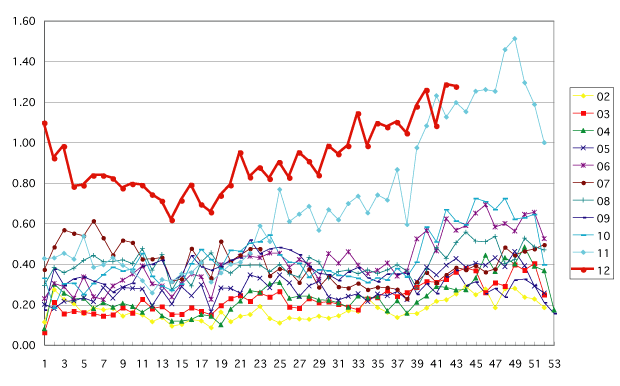
This article is also referenced and there is a mycoplasma surge, just as the graph shows, but I didn't see anything about a mutation there, (per a Google translation).
http://www3.nhk.or.jp/news/html/20120918/k10015102041000.html
Fukushima Diary has a post
here about the outbreak and he does not mention a specific mutation being found. (He had actually already reported the mycoplasma case increase in July.) He reports that Chlamydial pneumonia cases are also at a 10 yr high and has a link to an IDSC graph on that.
Regarding the Guma and Tochigi, they are close to Fukushima and did receive fallout, whether that is relevant to the mycoplasma outbreak, I don't know.
From a Google search:
Import Alert 99-33
www.accessdata.fda.gov › ... › Import Alerts › Imports Alerts by Number
Jul 25, 2012 – The following prefectures are in the closest proximity to the Fukushima Daiichi nuclear plant: Fukushima, Gunma Ibaraki, and Tochigi
There was food contamination in both areas:
http://www.japanfocus.org/-Martin_J_-Frid/3722
I looked at the date discrepancy issue and I think that's just due to a typo in a ENENEWS post. When you go to the article referenced as from 1/9/2011, it actually is an article published on 1/9/2012. However it discusses research that did
not suggest that the bacteria studied, (only 4 non-mycoplasma strains were studied and the experiment couldn't totally simulate real-life exposures),would mutate into a more resistant form. Actually they got the opposite result:
http://www.huffingtonpost.com/dr-douglas-fields/antibiotic-resistant-bact_b_1176687.html
Antibiotic Resistant Bacteria From the Fukushima Nuclear Accident?
Posted: 01/09/12 11:44 AM ET
Dr. Douglas Fields
Neurobiologist; Author, The Other Brain
[snip]
Shigeyuki Nakanishi and colleagues examined the potential effect of gamma radiation equivalent to levels in the environment surrounding the Fukushima plant to determine if doses equivalent to exposure for 1, 10, and 100 years could alter antibiotic resistance of several types of bacteria. The results showed that none of these doses of gamma radiation increased resistance to 14 different antibiotics. In fact, two bacteria, E. coli and Pseudomonas aeruginosa, became slightly more susceptible to antibiotics after gamma ray exposure.
The researchers conclude that there is no evidence to support concern that the Fukushima disaster may have bred antibiotic resistant bacteria. But, the scientists point out in their article; they were forced to treat the bacteria with a one-time exposure of radiation. How bacteria might respond to the actual situation of sub-lethal exposure to radiation surrounding the power plant for years on end is not known. Time will tell.
I don't think there is much comfort, though, in bacteria mutating into a less fit form of life after that one dose radiation exposure. If humans become less fit and easier to kill, too, then maybe their immune systems are finding it harder to fight off infections.
Whatever the reason, they do seem to be having a problem so I hope a way of treating the children's infections is found soon.