• FluTrackers.com Inc. does not provide medical advice. Information on this web site is collected from various internet resources, and the FluTrackers board of directors makes no warranty to the safety, efficacy, correctness or completeness of the information posted on this site by any author or poster. The information collated here is for instructional and/or discussion purposes only and is NOT intended to diagnose or treat any disease, illness, or other medical condition. Every individual reader or poster should seek advice from their personal physician/healthcare practitioner before considering or using any interventions that are discussed on this website. By continuing to access this website you agree to consult your personal physican before using any interventions posted on this website, and you agree to hold harmless FluTrackers.com Inc., the board of directors, the members, and all authors and posters for any effects from use of any medication, supplement, vitamin or other substance, device, intervention, etc. mentioned in posts on this website, or other internet venues referenced in posts on this website.
  • We are not asking for any donations. Do not donate to any entity who says they are raising funds for us.

North America's Indians gather in Mexico in bid to save planet

Snowy Owl

Retired in 2010, In Memoriam
North America's Indians gather in Mexico in bid to save planet

By Mark Stevenson --Associated Press

PALENQUE, Mexico (AP) - Indians from Mexico, the United States and Canada gathered before dawn March 10 to light incense, pray and sing in the shadow of ancient Mayan pyramids, asking the contaminated earth for forgiveness.

More than 200 leaders from 71 American Indian nations were joining in this jungle town at a conference to offer indigenous wisdom about ways to save the polluted planet.

''Our Mother Earth is being polluted at an alarming rate, and our elders say that she is dying,'' said Raymond Sensmeier, a Tlingit leader from Yakutat, Alaska. ''The way the weather is around the world ... a cleansing is needed.''

The pre-dawn ceremony that launched the conference included fire, copal incense, chants in Lacandon Maya and blasts from a conch shell to the four cardinal points.

Mexico's environment secretary, Juan Elvira Quesada, said the gathering is meant ''to present the teachings of the original peoples of North America.''

''In this way, the indigenous communities can become the natural guides to restoring balance and harmony in the world,'' he said.

The lessons they have to teach are simple - based on reviving Indian notions about ownership, use, compensation and respect.

''I sometimes talk to scientists,'' Sensmeier said, ''and they compartmentalize things, put things in boxes and disconnect them, and doing so promotes disharmony and imbalance.''

Kuetlachtli Texotik, a Nahuatl healer from Mexico whose name means ''Blue Wolf,'' agreed.

''Our grandfathers taught us to have an integrated vision,'' he said. ''The important thing is to look for balance. We should take care of what does not belong to us, for the future, because it is only ours temporarily.''

Indian cultures also have concrete examples to share.

Kayum Garcia's Lacandon people plant small, dense, rotating fields of jungle-friendly crops in southern Mexico and avoid pasture-hungry cattle, helping preserve the jungle without cutting it down.

''Cutting down a tree just because you want to, I just can't understand that,'' said Garcia, 31.

The Nahuatl-speaking Aztecs were able to use Mexico City's extensive lake system as both a source of food and a flood-control mechanism. The lakes were drained after the Spanish arrived, and now the metropolis suffers a constant threat of floods.

Some of the lessons are even simpler, reminiscent of advice grandparents often use.

''You'd catch one fish, just one, and you never played with your food, never wasted it,'' said Sensmeier. ''We used everything.''

http://www.indiancountry.com/content.cfm?id=1096416857
 
Re: North America's Indians gather in Mexico in bid to save planet

Did you know that at one time, the American Plains Natives were among the tallest humans in the world? European Americans were considered tall...

But not until they had about a hundred years of descendants living in North America. That is a remarkably short time to affect changes in phenotype for so large an organism. When did white-bread Americans start to slide towards 'average' height again? About the mid-1800s; during the boom of Western settlement, a push of people out of the over-crowded east.
~~~~~~~

If First Nations peoples in North America want to shed the acquired burdens of alcoholism, drug-abuse, chronic tobacco dependency, depression, and markedly low resistance to infectious and chronic disease, they will need to remember the ways of their ancestors, the first major migrants to the New World. Their culture of diet, lifestyle, and belief system.

And they must also think long and hard on the peoples of the ancestor's ancestors: the nomads of Siberia and the Far Russian taiga. Like the Evenk, Nenet and paleoarctic Nivkh peoples.

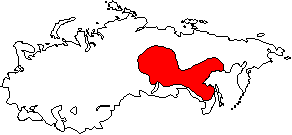
Map of Evenk tribal range:
068.gif


You will recognize them by their skin, their dress, and their homes; they are familiar to the northern First Peoples who came in the Second Wave, about 20 thousand years ago.

Background information on the Evenks
http://www.hunmagyar.org/turan/evenk/index.html

The Khanty:
http://www.hunmagyar.org/turan/khaman/index.html

The Nenets:
http://www.hunmagyar.org/turan/nenets/index.html

Hide-covered Nenet winter-camp dwellings:
ry0075-29m.jpg


ry0602-05m.jpg


ry0230-32m.jpg


It is nice when large science groups publish papers to confirm the origins of North American First Nations peoples by gene SNPs, but it was hardly necessary to be "startled" when the genetic maps locate the Ancient Elders to the paleoactic drylands.

These peoples understood and practiced the concept of 'connectedness'.
 
Re: North America's Indians gather in Mexico in bid to save planet

Thank you Oracle for these references.

We have a lot of catch up to do.

About 12 to 8 thousand years ago most of us became Snowbirds, we went south. The glaciation made us do it.

Many communities with limited financial means are gathering informations about our past.

Our past is our future we say.

Please forward more informations it helps us.
 
Re: North America's Indians gather in Mexico in bid to save planet

Increased Knowledge About Global Warming Leads To Apathy, Study Shows

ScienceDaily (Mar. 28, 2008) ? The more you know the less you care -- at least that seems to be the case with global warming. A telephone survey of 1,093 Americans by two Texas A&M University political scientists and a former colleague indicates that trend, as explained in their recent article in the peer-reviewed journal Risk Analysis.

"More informed respondents both feel less personally responsible for global warming, and also show less concern for global warming," states the article, titled "Personal Efficacy, the Information Environment, and Attitudes toward Global Warming and Climate Change in the USA."

The study showed high levels of confidence in scientists among Americans led to a decreased sense of responsibility for global warming.
The diminished concern and sense of responsibility flies in the face of awareness campaigns about climate change, such as in the movies An Inconvenient Truth and Ice Age: The Meltdown and in the mainstream media's escalating emphasis on the trend.

The research was conducted by Paul M. Kellstedt, a political science associate professor at Texas A&M; Arnold Vedlitz, Bob Bullock Chair in Government and Public Policy at Texas A&M's George Bush School of Government and Public Service; and Sammy Zahran, formerly of Texas A&M and now an assistant professor of sociology at Colorado State University.

Kellstedt says the findings were a bit unexpected. The focus of the study, he says, was not to measure how informed or how uninformed Americans are about global warming, but to understand why some individuals who are more or less informed about it showed more or less concern.
"In that sense, we didn't really have expectations about how aware or unaware people were of global warming," he says.

But, he adds, "The findings that the more informed respondents were less concerned about global warming, and that they felt less personally responsible for it, did surprise us. We expected just the opposite.

"The findings, while rather modest in magnitude -- there are other variables we measured which had much larger effects on concern for global warming -- were statistically quite robust, which is to say that they continued to appear regardless of how we modeled the data."

Measuring knowledge about global warming is a tricky business, Kellstedt adds.

"That's true of many other things we would like to measure in surveys, of course, especially things that might embarrass people (like ignorance) or that they might feel social pressure to avoid revealing (like prejudice)," he says.

"There are no industry standards, so to speak, for measuring knowledge about global warming. We opted for this straightforward measure and realize that other measures might produce different results."

Now, for better or worse, scientists have to deal with the public's abundant confidence in them. "But it cannot be comforting to the researchers in the scientific community that the more trust people have in them as scientists, the less concerned they are about their findings," the researchers conclude in their study.

Adapted from materials provided by Texas A&M University, via EurekAlert!, a service of AAAS.
 
Re: North America's Indians gather in Mexico in bid to save planet

The debate between scientists is not over whether global warming is occurring or not. Rather over the cause. Is warming within historical parameters and therefore a natural fluctuation or is it outside those parameters and therefore man made.


Personal Efficacy, the Information Environment, and Attitudes Toward Global Warming and Climate Change in the United States

Full text available here http://www.blackwell-synergy.com/ac...=10.1111/j.1539-6924.2008.01010.x&cookieSet=1

Abstract
Despite the growing scientific consensus about the risks of global warming and climate change, the mass media frequently portray the subject as one of great scientific controversy and debate. And yet previous studies of the mass public's subjective assessments of the risks of global warming and climate change have not sufficiently examined public informedness, public confidence in climate scientists, and the role of personal efficacy in affecting global warming outcomes. By examining the results of a survey on an original and representative sample of Americans, we find that these three forces?informedness, confidence in scientists, and personal efficacy?are related in interesting and unexpected ways, and exert significant influence on risk assessments of global warming and climate change. In particular, more informed respondents both feel less personally responsible for global warming, and also show less concern for global warming. We also find that confidence in scientists has unexpected effects: respondents with high confidence in scientists feel less responsible for global warming, and also show less concern for global warming. These results have substantial implications for the interaction between scientists and the public in general, and for the public discussion of global warming and climate change in particular.
 
Re: North America's Indians gather in Mexico in bid to save planet

This abstract caught me by surprise. One would expect that rational individuals, confronted with putative cause and fully visible physical effects, would be able to connect personal action with contribution to said cause.

I think the problem is this: inundation of bad news results in apathy.

You are shown nothing but bad news, day after day. War, crime, growing povery, government and most consumers bearing heavy debt load..blah, blah, blah. You turn it off, mentally, disconnect yourself from culpability. This is basic denial of fact - and it's easy to do, if you are told that scientists themselves are uncertain if global warming really exists.

This is largely due to the very small fraction of scientists who firmly believe that we are on the cusp of a major solar minimum, resulting in a magical reversal of about a hundred years of warming. In truth, we are still working to understand solar dynamics and its influence on Earth's climate. The preponderance of elegant, weighty science that demonstrates CLEAR ties between climate response and recent historical warming trend tips the scales towards broad acceptance of anthrogenic climate change among scientists of many disciplines.

As this report suggests, the mass media have provided the 'informed' but apathetic individual with an 'out' - why take personal action and responsibility, if the science jury is still debating whether cliamte change is real or not?

Confidence in science = they will find a way to 'fix' it, if global warming is real.

Also, there is a parallel between voter apathy and 'informed public' apathy towards global warming: the perception that larger, impersonal entities (industry, other nations) are primarily responsible for climate change and its environmental costs. Hence, if the prominent players don't make changes, what difference will a single person's action's make, in the larger scale of cause and effect? This is the same game played by those who presume that special interests dictate policy in Washington - a vote 'won't mean anything', etc.

The media have had their hand in decoupling personal responsibility and culpability - for physical and mental health, for fiscal health, for environmental health.

Consider who owns the media.
 
Re: North America's Indians gather in Mexico in bid to save planet

There is no longer any argument over whether climate change is occurring.
Only over why it is occurring.
Most agree humans are a very significant contributer.
The majority of changes that need to be made are in industry.
How can these changes be made with out harming the economy?
What degree of change is needed?


Climate change progress too slow - Rudd

<!--articleDetails--> <!--articleExtras-wrap--> <bod></bod>International progress on fighting climate change was too slow, Prime Minister Kevin Rudd and United Nations Secretary-General Ban Ki-Moon have agreed.
Mr Rudd emerged from a half-hour meeting with the UN head in New York promising to support Mr Ban's moves to speed up work ahead of next year's Copenhagen climate change conference.
The Copenhagen conference, to be held in November 2009, is expected to develop long-term greenhouse gas emissions targets for beyond 2012 when the Kyoto protocol expires.
But international negotiations have stalled since last December's Bali talks, prompting Mr Ban to consider appointing special envoys to speed up the process, Mr Rudd said.
"Progress so far is too slow but we've still got time to turn the corner," Mr Rudd told reporters.
"But let me tell you, we've got to get cracking and I think the secretary-general's been realistic in his concerns."
Mr Rudd said Mr Ban was concerned about delays in the negotiating process.
"He himself has decided to convene a number of representatives of the critical host states, namely Indonesia, Poland and Denmark, to assist in facilitating this process of bringing it to a more rapid conclusion and to achieve more substantial progress on the way through," he said.
"He's also considering the appointment of key special envoys to accelerate the climate change negotiating process."
Mr Rudd said Australia was fully committed to supporting Mr Ban's activities.
"The global community has a responsibility on climate change, there must be a global response to climate change with all states participating, both developed and developing states," he said.
"Therefore, I indicated to the secretary-general that we would be, as Australia, be fully supportive of the efforts of the United Nations to bring about a successful conclusion. The planet's interests depend on that
http://news.smh.com.au/climate-change-progress-too-slow--rudd/20080330-22f8.html
 
Back
Top Bottom