• FluTrackers.com Inc. does not provide medical advice. Information on this web site is collected from various internet resources, and the FluTrackers board of directors makes no warranty to the safety, efficacy, correctness or completeness of the information posted on this site by any author or poster. The information collated here is for instructional and/or discussion purposes only and is NOT intended to diagnose or treat any disease, illness, or other medical condition. Every individual reader or poster should seek advice from their personal physician/healthcare practitioner before considering or using any interventions that are discussed on this website. By continuing to access this website you agree to consult your personal physican before using any interventions posted on this website, and you agree to hold harmless FluTrackers.com Inc., the board of directors, the members, and all authors and posters for any effects from use of any medication, supplement, vitamin or other substance, device, intervention, etc. mentioned in posts on this website, or other internet venues referenced in posts on this website.
  • We are not asking for any donations. Do not donate to any entity who says they are raising funds for us.

Powerful 7.8 magnitude earthquake hits Ecuador's central coast, kills 654 and injures around 16,600 people

Emily

Editor, Senior Moderator
http://www.chicagotribune.com/news/n...416-story.html
Powerful earthquake hits Ecuador's central coast, kills at least 41

Tribune news services Contact Reporter
April 17, 2016


A powerful, 7.8-magnitude earthquake shook Ecuador's central coast on Saturday, killing at least 41 people and spreading panic hundreds of kilometers (miles) away as it collapsed homes and buckled a major overpass.
The U.S. Geological Survey said the shallow quake, the strongest since 1979 to hit Ecuador, was centered 27 kilometers (16 miles) south-southeast of Muisne, a sparsely populated area of fishing ports that's popular with tourists.
...
"We're trying to do the most we can but there's almost nothing we can do," said Gabriel Alcivar, mayor of Pedernales, a town of 40,000 near the epicenter. He pleaded for rescuers as dozens of buildings in the town were flattened, people trapped and looting broke out amid the chaos. "This wasn't just a house that collapsed, it was an entire town."...
 
UN supporting authorities in Ecuador following strongest earthquake in decades


A 7.8 magnitude earthquake which hit Ecuador on 16 April 2016 caused death and destruction. Photo: UNICEF Ecuador


18 April 2016 – While the Government of Ecuador is leading the response to continue helping people and communities affected by Saturday’s 7.8 magnitude earthquake, the United Nations announced it has deployed relief teams to provide additional support.

“The Secretary-General commends the Ecuadorean authorities for their leadership in the rescue effort and in providing relief to affected communities,” said a statement issued by Ban Ki-moon’s spokesperson.

It further indicated that Emergency Relief Coordinator Stephen O’Brien, who leads the UN Office for the Coordination of Humanitarian Affairs (OCHA), has deployed a Disaster and Assessment Coordination (UNDAC) team, which stands ready to provide additional support.

According to the latest assessment, more than 230 people died in central Ecuador and thousands were injured in the earthquake, reportedly the strongest in decades.

“The authorities continue to assess the impact and damage, but so far we know that across Manabi and Esmeralda provinces, the earthquake has damaged or destroyed homes, hospitals, roads and businesses, power lines have been cut and tens of thousands of people are currently sheltering in evacuation centres,” Mr. O’Brien said.
He noted that a state of emergency has been declared in six regions, and the Government has asked for international assistance.

Source: UN Department of Peacekeeping Operations Cartographic Section (The boundaries and names shown and the designations used on this map do not imply official endorsement or acceptance by the United Nations)
“The United Nations and our humanitarian partners stand ready to support the people and the authorities with any expertise and support they may need,” he stressed, adding that World Health Organization (WHO) has deployed a mobile medical emergency team.

The UN Children’s Fund (UNICEF) also announced it has delivered 20,000 water purification tablets to Pedernales, the worst affected area, while the UN refugee agency (UNHCR) is readying preparations for a major aid airlift, expected in the next 48 hours, to help people who have been displaced. Operational planning has been underway today in Copenhagen – UNHCR’s global logistics hub – for a first plane bound for Quito carrying core relief items including some 900 tents, plastic sheets, 15,000 sleeping mats, kitchen sets and, in view of the Zika virus risk, 18,000 much-needed repellant-impregnated mosquito nets.

Meanwhile, the United Nations Secretary-General today said the world body stands ready to provide assistance to Japan following powerful earthquakes that struck Kumamoto province last Thursday and Saturday, killing over 40 people and displacing some 110,000 from their homes.

“The Secretary-General sends his deepest condolences to the people and Government of Japan and to all affected communities, wishing a speedy recovery to those injured. He commends the Government, emergency responders and other civil society organizations who are sparing no efforts to help people in need and to restore essential services,” said a statement issued by Mr. Ban’s spokesperson.

http://www.un.org/apps/news/story.as...4#.VxTrMfkrKUk
 
Ecuador earthquake: At least 413 people confirmed dead

1 hour ago
From the section Latin America & Caribbean

At least 413 people are now known to have died in the earthquake that struck Ecuador, the country's government says.

The 7.8-magnitude quake struck Ecuador's Pacific coast on Saturday, and the search for survivors continues.

The cost of rebuilding is likely to be in the billions of dollars, President Rafael Correa said during a visit to the worst-affected region.

He said it was the biggest tragedy to hit Ecuador in the past seven decades. Some 2,500 people were injured.
...

http://www.bbc.com/news/world-latin-america-36079014
 
CgwLxE4WIAAOtUI.jpg:large

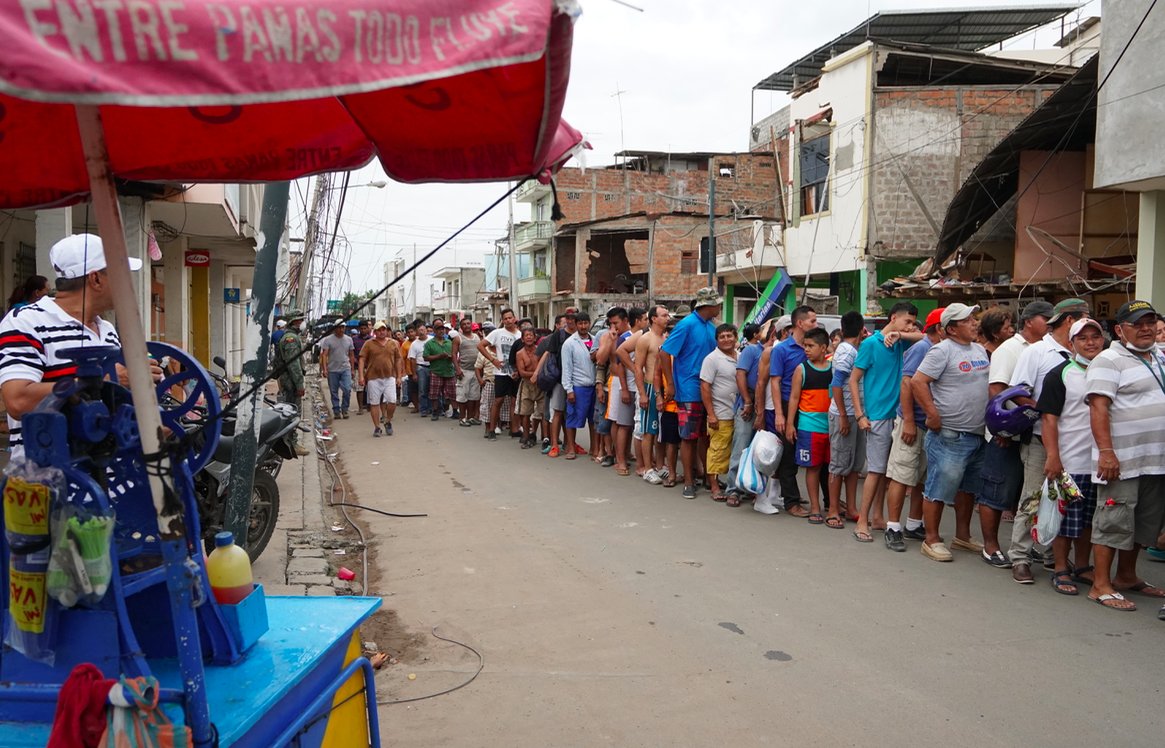
Greta Van Susteren@greta 22h22 hours agoWashington, DC
people lined up hoping to get water #EcuadorEarthquake @Franklin_Graham @GriffJenkins @johnpcoale

---------------------------------------------------------------------------------------------------------------


Ecuador Death Toll Rises to 654, Over 100 Rescued

by THE ASSOCIATED PRESS

QUITO ? The death toll from Ecuador's devastating 7.8 magnitude earthquake last week has risen to 654 people, the country's emergency management authority said on Saturday.

Last Saturday's quake, the worst in nearly seven decades, injured around 16,600 people and left 58 missing along the country's ravaged Pacific coast. One hundred and thirteen people were rescued from damaged buildings.

"These have been sad days for the homeland," President Rafael Correa said during his weekly television broadcast earlier on Saturday. "The country is in crisis."
...

http://www.nbcnews.com/news/world/ecuador-death-toll-rises-654-over-100-rescued-n561131


Crisis in Wake of 7.8 Magnitude Earthquake, Greta Reports

Monica Sanchez | 56 minutes ago
...
Amid scant international media attention, Fox News? Greta Van Susteren traveled to the South American nation over the weekend to cover what has become a true humanitarian crisis.

"I am shocked how little international help has arrived (that I saw) and even more shocked that I did not see any international media," writes Greta in her blog. "When the media puts a spotlight on a crisis, more people know to help. You can help by just sharing this post and getting the word out."

Watch the report below and check out her blog for more photos.
...
http://www.mrctv.org/blog/ecuador-s...is-wake-78-magnitude-earthquake-greta-reports
 
ecuador-earthquake.jpg


[h=1]Canada's response to the Earthquake in Ecuador[/h]

[h=3]Emergency contact info[/h] Canadians in Ecuador:
593 (2) 245-5499
613-996-8885 (call collect where available)
Canadians in Canada:
613-996-8885
1-800-387-3124
sos@international.gc.ca


On April 17, 2016, a 7.8 magnitude earthquake shook Ecuador and was followed by a series of aftershocks. With millions of people affected, the impact of the earthquake prompted international response.
In close collaboration with the Government of Ecuador, Canada took swift action and provided multi-faceted support which resulted in critical assistance delivered to the affected population. This included consular and humanitarian assistance, as well as the deployment of the Canadian Disaster Assessment Team.
[h=2]Humanitarian response ?$1.1 million[/h] Following the earthquake in Ecuador, Canada responded immediately to the needs of affected people by providing a $1.1 million funding commitment. The funding will be disbursed in fiscal year 2016/17 and will support immediate efforts to help humanitarian partners on the ground provide shelter, clean water, health, sanitation and other basic services:
International Federation of the Red Cross and Red Crescent Societies (IFRC) - $500,000: The IFRC will help provide trauma care, first aid, psychosocial support, clean drinking water, hygiene kits and temporary shelter to those injured and/or affected by the earthquake. The funding will be channeled to the Ecuador Red Cross, which has been the backbone of the civilian response to the earthquake to date.
CARE Canada via Canadian Humanitarian Assistance Fund (CHAF) - $300,000: Via CHAF, CARE Canada will provide clean drinking water and sanitation facilities, temporary shelter, including tarps, and other non-food items to up to 8,000 affected families in the provinces of Esmeraldas and Manab?.
Pan American Health Organization (PAHO) - $200,000: PAHO, the regional branch of the World Health Organization for the Americas, will provide support to restore local health services, ensure epidemiological surveillance and vector control, and promote coordination efforts in the emergency response across the health sector.
Canada Fund for Local Initiatives (CFLI) - $100,000: Under Canada?s Stabilization and Reconstruction Task Force's CFLI, funding was provided to two local organizations to provide support to distribute basic items, such as medicine, non-perishable food, insect repellent, mattresses, blankets, to the most affected communities in the provinces of Esmeraldas and Manabi.
[h=2]Deployment of Canadian Red Cross Field Hospital[/h] With support of the Government of Canada, the Canadian Red Cross deployed a field hospital on April 24 to support relief efforts in Ecuador. In coordination with the Ecuadorian Red Cross, the field hospital is supporting Ecuador?s Ministry of Health?s ongoing care and provision of mobile health outreach activities. The infrastructure being deployed includes a 20-bed, self-sustained tented hospital and base camp to provide health services, including:
  • Basic emergency obstetric care and transfer for complications;
  • Reproductive health services for men and women;
  • Outpatient care for adults and children with special attention to chronic illnesses;
  • Water treatment capacity for the clinic; and
  • Basic first aid and medical care through mobile clinics to hard-to-reach communities.
Once the mission is complete, the field hospital and associated equipment will be donated to the Ecuadorian Red Cross for their use in future disaster responses.
[h=2]Canadian Disaster Assistance Team (CDAT)[/h] In response to a request from the Ecuadorian Government, Canada deployed the CDAT on April 19, 2016. Its mandate is to undertake a full and rapid assessment of the situation on the ground, as well as the humanitarian needs of those most affected. Thereafter, it will make early recommendations on an appropriate Canadian response, in addition to the humanitarian assistance funding already committed. The assessment team includes six experts from Global Affairs Canada and the Department of National Defence.
[h=2]Assistance for Canadians in Ecuador[/h] [h=3]Standing Rapid Deployment Team (SRDT)[/h] Six members of the Standing Rapid Deployment Team (SRDT) were deployed to Ecuador to provide support to the Embassy of Canada in Quito, the Consulate in Guayaquil and the on-going Canadian consular efforts near the epicentre on the coast. The SRDT is a unit of specialized officials deployed to work alongside Canada?s embassies and consulates personnel to provide critical services to Canadians in distress during emergencies.
[h=3]Emergency assistance[/h] Consular officers in Quito and members of the SRDT, assisted by the Emergency Watch and Response Centre in Ottawa, worked around the clock to locate and ascertain the well-being of Canadians on the ground. Canadian officials also worked closely with our allies and local authorities to coordinate and share information to aid in the response efforts.
In addition, capacity in the Emergency Watch and Response Centre in Ottawa was increased to respond to more than 800 calls and emails from Canadians in Ecuador and their families in Canada, and to make over 1000 calls to Canadians believed to be in the affected areas. This service remains available 24 hours a day.
We were in contact with our warden network in Ecuador to obtain information on the situation on the ground, which contributed to the humanitarian assessment. These wardens were also very helpful in disseminating emergency messaging to Canadians in their area. Wardens are volunteer members of the Canadian community who play a vital role in the Government of Canada?s response to emergencies abroad. Under the direction of the Canadian Embassy, the warden?s role in an emergency is to relay messages to Canadians and report on events in the areas they reside.
[h=3]Contact information[/h] Canadian citizens in Ecuador requiring emergency consular assistance should contact the Embassy of Canada in Quito at 593 (2) 245-5499 or call Global Affairs Canada?s 24/7 Emergency Watch and Response Centre collect at +1 613 996 8885‎. An email can also be sent to sos@international.gc.ca.
Friends and relatives of Canadian citizens known to be in Ecuador should contact Global Affairs Canada?s 24/7 Emergency Watch and Response Centre by calling +1 613 996 8885 or +1 800 387 3124, or by sending an email to sos@international.gc.ca.

http://www.international.gc.ca/world-monde/crisis-crises/ecuador-equateur.aspx?lang=eng

 
Samaritan's Purse Rushing to Help Ecuador Quake Survivors

April 25, 2016 ? Ecuador

Samaritan's Purse staff are on the ground and finishing the set up of an emergency field hospital. The first of three airlifts arrived in Ecuador on Wednesday.

A 7.8-magnitude quake rocked Ecuador?s coast late on April 16, killing hundreds and injuring thousands more. Well more than 600 individuals are confirmed dead and the toll continues to rise. This was the deadliest earthquake to strike the South American country since 1987.

?The earthquake in Ecuador has caused incredible death, injury, destruction, and loss,? said Samaritan?s Purse President Franklin Graham. ?We?re responding as quickly as possible to help with emergency needs such as water, shelter, and medical care...
...

http://www.samaritanspurse.org/article/samaritans-purse-rushing-to-help-ecuador-quake-survivors/
 
Ecuador: ?The most important thing is health?

Published: 27 April 2016 23:06 CET
...

Dr Leber warns that mental illnesses and psychosocial problems will increase following the earthquake, as people have lost everything and are experiencing high levels of anxiety arising from fear of aftershocks and also from uncertainty about their futures.

Vector-borne diseases such as the Zika virus, dengue and chikungunya ? all transmitted by the mosquito Aedes aegypti - will also pose a great risk to the areas affected by the earthquake, due to an increase in stagnant water and a lack of vector control activities in the aftermath of the disaster. Dr Leber stresses the need of strengthening water and sanitation activities and raising community awareness to keep implement vector control measures in order to reduce the risks.

The population affected by the earthquake also faces the risk of water-related diseases caused by drinking contaminated water.

?We have reported an increase in diarrhea episodes, particularly among people living in temporary shelters,? says Dr Leber. ?The water supply is just beginning to be restored, people are not washing their hands before cooking and they are not drinking safe water. We need to make great efforts to improve primary health care, in addition to water, sanitation and hygiene conditions, and strengthen excreta and solid waste disposal capacity.?

http://www.ifrc.org/en/news-and-med...dor-the-most-important-thing-is-health-72170/
 
Back
Top Bottom