

Gert van der Hoek
In Memoriam - Editor, Senior Moderator
Mounting a Good Offense against Measles
N Engl J Med 2014; 371:1661-1663
October 30, 2014
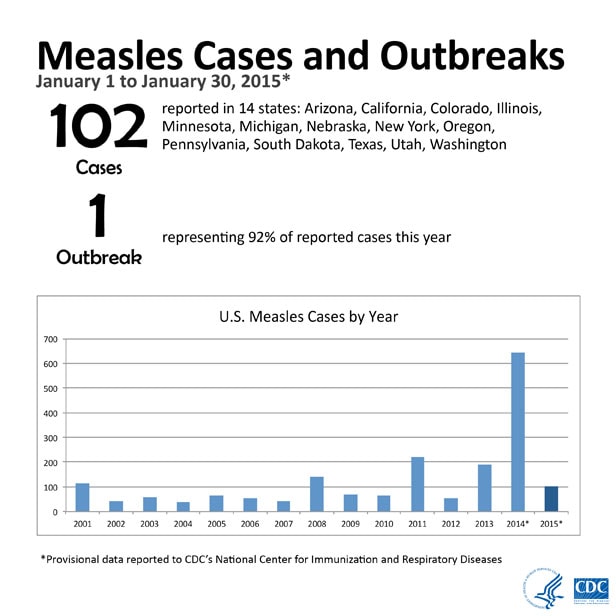
More measles cases have been reported in the United States so far in 2014 ? 592 cases from January 1 to August 29 ? than during any year in the past two decades (see graph Measles Cases in the United States, 1994?2014.)
(www.cdc.gov/measles/cases-outbreaks.html). The high incidence has occurred despite the fact that indigenous circulation of measles virus was declared eliminated in the United States in 2000 and in the Americas in 2002.
There are two major reasons for this resurgence. First, though significant progress has been made in reducing global measles incidence, there is still substantial circulation of the virus in other countries. Susceptible U.S. residents who travel to countries where measles is endemic or epidemic and susceptible residents of those countries who travel to the United States are bringing the virus here. Second, an increasing number of parents in this country are hesitant to have their children vaccinated, and such hesitancy has resulted in an accumulation of unvaccinated populations who can become infected and maintain transmission.
More: NEJM
N Engl J Med 2014; 371:1661-1663
October 30, 2014
More measles cases have been reported in the United States so far in 2014 ? 592 cases from January 1 to August 29 ? than during any year in the past two decades (see graph Measles Cases in the United States, 1994?2014.)
(www.cdc.gov/measles/cases-outbreaks.html). The high incidence has occurred despite the fact that indigenous circulation of measles virus was declared eliminated in the United States in 2000 and in the Americas in 2002.
There are two major reasons for this resurgence. First, though significant progress has been made in reducing global measles incidence, there is still substantial circulation of the virus in other countries. Susceptible U.S. residents who travel to countries where measles is endemic or epidemic and susceptible residents of those countries who travel to the United States are bringing the virus here. Second, an increasing number of parents in this country are hesitant to have their children vaccinated, and such hesitancy has resulted in an accumulation of unvaccinated populations who can become infected and maintain transmission.
More: NEJM