

Michael Coston
Editor, Senior Moderator
Masking Our COVID-19 Concerns
#15,169
In late January, in The Man In The Ironed Mask (Revisited), I wrote about the all-but inevitable shortages of PPEs (personal protective equipment) from the looming coronavirus pandemic, and discussed in some depth the research that had been done on homemade, cloth face masks and even provided a link to how to make one.
While studies (see A cluster randomised trial of cloth masks compared with medical masks in healthcare workers) have shown them to be a poor substitute for disposable PPEs, they are - quite literally - better than nothing.
Even the CDC agrees - at least for Heath Care workers without access to proper PPEs, as their March 17th Strategies for Optimizing the Supply of Facemasks even allows:
HCP use of homemade masks:
In settings where facemasks are not available, HCP might use homemade masks (e.g., bandana, scarf) for care of patients with COVID-19 as a last resort. However, homemade masks are not considered PPE, since their capability to protect HCP is unknown. Caution should be exercised when considering this option. Homemade masks should ideally be used in combination with a face shield that covers the entire front (that extends to the chin or below) and sides of the face.
The debate over the public wearing of masks continues, and has not yet officially been recommended by the WHO, or the CDC. Frankly, the mixed, and convoluted messaging over why the public shouldn't wear masks (they don't protect against the virus, and should be reserved for HCWs who need them) has diminished their credibility.
The `right' message should have been, we don't have enough disposable PPEs for HCWs, so please make your own masks, and wear them in public, along with washing your hands, social distancing, and the rest of the the standard advice.
Simple, honest, and most people would have accepted the reality.
Although I don't understand why it has taken two months, in recent days the opinion and advice appears to be changing, as yesterday and overnight we've seen headlines such as:
Those Asian countries (Singapore, Taiwan, Japan, etc.) that encourage the wearing of masks in public are seeing far fewer community cases of COVID-19 than countries that have discouraged the practice. Whether this is due to some degree of protection for the wearer, or to a reduction of virus transmission by infected individuals, the end result is the same.
Masks can help reduce the transmission of the virus. They are far from perfect, but as part of a layered NPI approach (hand washing, social distancing, avoiding touching your face, etc.) they can help reduce the spread of the disease.
I previously wrote:
While cloth masks from places like Amazon are on backorder, anyone who is handy with a sewing machine can find dozens of tutorials on YouTube on how to make cloth face masks, and I've even seen some `glue gun specials', which don't require sewing skills.
With so many people stuck at home, unable to work, this could be a terrific local cottage industry for a lot of people. To either sell (or better yet) to donate to friends and neighbors.
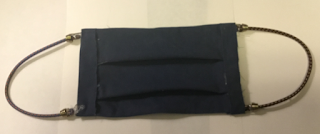
Although I possess zero sewing skills, and don't own a sewing machine, I managed to cobble together a serviceable face mask yesterday at home, using an old pillow case, some thin elastic bands, and a glue gun in about 20 minutes.
The photo at the top is the front of the mask, you can see the reverse below:
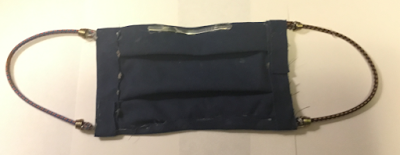
I even glued a metallic nose strip using a piece from an old, used N95. A stiff piece of wire would probably have worked as well. It admittedly isn't pretty, but I expect version 2.0 will be slightly better.
The point is, if I can make one, you can make one.
And since COVID-19 is likely to be with us for some time to come, and the public wearing of masks may soon become de rigueur, you might want to try your hand at making some yourself.

#15,169
In late January, in The Man In The Ironed Mask (Revisited), I wrote about the all-but inevitable shortages of PPEs (personal protective equipment) from the looming coronavirus pandemic, and discussed in some depth the research that had been done on homemade, cloth face masks and even provided a link to how to make one.
While studies (see A cluster randomised trial of cloth masks compared with medical masks in healthcare workers) have shown them to be a poor substitute for disposable PPEs, they are - quite literally - better than nothing.
Even the CDC agrees - at least for Heath Care workers without access to proper PPEs, as their March 17th Strategies for Optimizing the Supply of Facemasks even allows:
HCP use of homemade masks:
In settings where facemasks are not available, HCP might use homemade masks (e.g., bandana, scarf) for care of patients with COVID-19 as a last resort. However, homemade masks are not considered PPE, since their capability to protect HCP is unknown. Caution should be exercised when considering this option. Homemade masks should ideally be used in combination with a face shield that covers the entire front (that extends to the chin or below) and sides of the face.
The debate over the public wearing of masks continues, and has not yet officially been recommended by the WHO, or the CDC. Frankly, the mixed, and convoluted messaging over why the public shouldn't wear masks (they don't protect against the virus, and should be reserved for HCWs who need them) has diminished their credibility.
The `right' message should have been, we don't have enough disposable PPEs for HCWs, so please make your own masks, and wear them in public, along with washing your hands, social distancing, and the rest of the the standard advice.
Simple, honest, and most people would have accepted the reality.
Although I don't understand why it has taken two months, in recent days the opinion and advice appears to be changing, as yesterday and overnight we've seen headlines such as:
Those Asian countries (Singapore, Taiwan, Japan, etc.) that encourage the wearing of masks in public are seeing far fewer community cases of COVID-19 than countries that have discouraged the practice. Whether this is due to some degree of protection for the wearer, or to a reduction of virus transmission by infected individuals, the end result is the same.
Masks can help reduce the transmission of the virus. They are far from perfect, but as part of a layered NPI approach (hand washing, social distancing, avoiding touching your face, etc.) they can help reduce the spread of the disease.
I previously wrote:
While cloth masks from places like Amazon are on backorder, anyone who is handy with a sewing machine can find dozens of tutorials on YouTube on how to make cloth face masks, and I've even seen some `glue gun specials', which don't require sewing skills.
With so many people stuck at home, unable to work, this could be a terrific local cottage industry for a lot of people. To either sell (or better yet) to donate to friends and neighbors.
Although I possess zero sewing skills, and don't own a sewing machine, I managed to cobble together a serviceable face mask yesterday at home, using an old pillow case, some thin elastic bands, and a glue gun in about 20 minutes.
The photo at the top is the front of the mask, you can see the reverse below:

I even glued a metallic nose strip using a piece from an old, used N95. A stiff piece of wire would probably have worked as well. It admittedly isn't pretty, but I expect version 2.0 will be slightly better.
The point is, if I can make one, you can make one.
And since COVID-19 is likely to be with us for some time to come, and the public wearing of masks may soon become de rigueur, you might want to try your hand at making some yourself.

