Re: 6.9-magnitude earthquake strikes China
Re: 6.9-magnitude earthquake strikes China
China earthquake kills hundreds in Qinghai (BBC, edited)
[Source: BBC, <cite cite="http://news.bbc.co.uk/1/hi/world/asia-pacific/8619135.stm">
BBC News - China earthquake kills hundreds in Qinghai</cite>. Edited. April 14, 2010.]
China earthquake kills hundreds in Qinghai
At least 300 people have died and thousands are feared injured after a magnitude-6.9 earthquake struck China's Qinghai province, officials say.
The powerful tremor hit remote Yushu county, 800km (500 miles) south-west of the provincial capital Xining, at 0749 (2349 GMT), at a shallow depth of 10km.
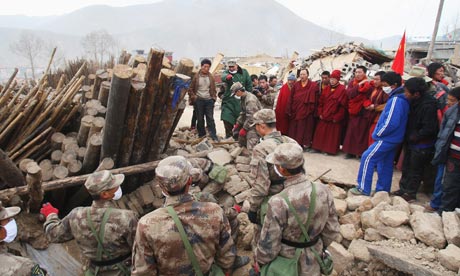
Most of the buildings in the worst-hit town of Jiegu were wrecked, and landslides have cut off roads.
Rescue crews were travelling to Yushu, hundreds of miles from a major airport.
The earthquake struck just before 0800 local time - when many people were still at home. It was followed by three aftershocks.
Some media reports say most buildings in the town near the epicentre fell down. Grainy pictures on Chinese television showed rescuers pulling at the rubble of one collapsed structure. Soldiers have been sent to the area to help with the rescue.
The earthquake happened in a remote and sparsely populated area on the Tibetan plateau. The area is regularly hit by earthquakes.
About 5,000 specialist quake rescuers have been dispatched from neighbouring provinces, with the first teams expected to reach Yushu within hours.
A local official in Jiegu told the BBC that the loss from the quake was huge, and that almost all of the buildings in the town had been destroyed.
"The death toll will definitely go up," he said.
Many people have fled the town to nearby mountains, amid fears that a nearby dam could burst.
State media reported that officials are trying to drain a reservoir after a crack appeared in the dam.
A spokesman for the local government told China's state news agency Xinhua that the area was in urgent need of help.
"The streets in Jiegu are thronged with panic - injured people, with many bleeding in the head," Zhuo Huaxia told Xinhua.
"Many students are buried under the debris due to building collapse at a vocational school.
"I can see injured people everywhere. The biggest problem now is that we lack tents, we lack medical equipment, medicine and medical workers."
Many of the buildings in Yushu, a county with a largely Tibetan population of about 250,000, were thought to be made from wood.
In 2008, a huge quake struck in neighbouring Sichuan province, about 1,000km from Yushu, which left 87,000 people dead or missing.
Karsum Nyima, from Yushu county's TV station, told China's state-run CCTV that school students had been assembled in outside playgrounds, although school buildings had not collapsed.
"In a flash, the houses went down. It was a terrible earthquake. In a small park, there is a Buddhist tower and the top of the tower fell off," he said.
"Everybody is out on the streets, standing in front of their houses, trying to find their family members."
Earthquake survivors are struggling to stay warm in temperatures of about 6C.
Power and water have been cut off, and the road to the local airport is reported to have been blocked by landslides.
The remote high-altitude region is prone to earthquakes, but officials from the US Geological Survey said this was the strongest quake within 100km of the area since 1976.
The region, which is home to Tibetan farmers and herdsmen, is dotted with coal, tin, lead and copper mines.
Yushu is roughly half-way between Xining and Lhasa, about 200km from the Qinghai-Tibet railway line.
After the Sichuan quake, five million people were left homeless, and officials estimated rebuilding work would take at least three years.
The government later punished people who had compiled lists of the victims and had suggested shoddy school-building was partly to blame for the high death toll.
-
------



 ffice
ffice ></o
></o