

Rwilmer
New member
When The `Flu? Isn?t The Flu
# 3997
A very interesting report this morning out of Philadelphia, where tests showed that as many as 40% of the people reporting to the ED (Emergency Department) of a local hospital in early fall with `the flu? actually had a Rhinovirus instead.
With more than 100 different Rhinovira identified, these viruses ? often referred to as `the common cold? ? produce the majority of respiratory illness in the world.
They normally take residence in our upper respiratory tract and can make us miserable for a week or more.
But according to doctors at Children's Hospital of Philadelphia, the strain of Rhinovirus circulating in Philadelphia this fall produced unusually severe symptoms:
First, since many of these milder ILI?s are commonly perceived by the public as being the `flu?, many people have a false perception of what having real influenza can be like.
And second, it is entirely possible that some of the people who suspect that they?ve already had the pandemic virus over the summer or last spring ? and would therefore be immune ? really had one of the other commonly circulating respiratory viruses.
The article, of which I?ve just posted an excerpt, is well worth reading in its entirety.
# 3997
A very interesting report this morning out of Philadelphia, where tests showed that as many as 40% of the people reporting to the ED (Emergency Department) of a local hospital in early fall with `the flu? actually had a Rhinovirus instead.
With more than 100 different Rhinovira identified, these viruses ? often referred to as `the common cold? ? produce the majority of respiratory illness in the world.
They normally take residence in our upper respiratory tract and can make us miserable for a week or more.
But according to doctors at Children's Hospital of Philadelphia, the strain of Rhinovirus circulating in Philadelphia this fall produced unusually severe symptoms:
Besides the sheer numbers of rhinovirus, Coffin was surprised that it was causing more problems - wheezing, pneumonia, fever, and lower-respiratory-tract infections - than are normally associated with the common cold, which typically infects the upper respiratory tract.
That has led her to suspect that a strain not seen here before may be responsible. The CDC's lab will attempt to identify the strain.
If all of this sounds vaguely familiar, it is because we recently discussed this very issue; the idea that not everyone who thinks they?ve had swine flu over the past 6 months really did. That has led her to suspect that a strain not seen here before may be responsible. The CDC's lab will attempt to identify the strain.
Even during the height of flu season, at least half of all ILI?s (influenza-like-illnesses) are probably caused by something other than influenza. Perhaps metapneumovirus, parainfluenzavirus, respiratory syncytial virus (RSV), one of the myriad Rhinoviruses (Common cold), or adenovirus.
This chart (see ILI?s Aren?t Always The Flu) from early October show more than 70% of samples tested by the CDC came back negative for influenza.
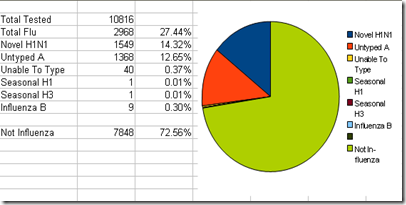
As I pointed out in October, the reason for bringing all of this up ? besides the fact that it is interesting ? is really two-fold.This chart (see ILI?s Aren?t Always The Flu) from early October show more than 70% of samples tested by the CDC came back negative for influenza.

First, since many of these milder ILI?s are commonly perceived by the public as being the `flu?, many people have a false perception of what having real influenza can be like.
That `mild swine flu? infection last September, that convinced your family that this pandemic is much to do about nothing, may not have been swine flu after all.
And second, it is entirely possible that some of the people who suspect that they?ve already had the pandemic virus over the summer or last spring ? and would therefore be immune ? really had one of the other commonly circulating respiratory viruses.
Which means that they may not have acquired the protective antibodies they think they have.
Two things to consider, now that the H1N1 vaccine is becoming more widely available.
The article, of which I?ve just posted an excerpt, is well worth reading in its entirety.
Posted on Thu, Nov. 12, 2009
Tests show fall outbreak is rhinovirus, not swine flu
By Don Sapatkin
Inquirer Staff Writer
I had swine flu. It is almost a badge of honor, suggesting that the speaker survived the first pandemic of the 21st century and is immune to the next wave.
It also may be wrong.
Tests at Children's Hospital of Philadelphia suggest that large numbers of people who got sick this fall actually fell victim to a sudden, unusually severe - and continuing - outbreak of rhinovirus, better known as a key cause of the common cold.
Experts say it is logistically and financially impossible to test everyone with flulike symptoms. And signs, treatment, and prognoses for a bad cold and a mild flu are virtually identical, so the response hardly differs.
But the finding may send an important message to parents who (despite doctors' recommendations) are questioning the need to immunize their children against swine flu because they seemed to have already had the disease, said Susan Coffin, director of infection prevention and control at Children's Hospital.
"Maybe their child is still susceptible to H1N1 and should still get the vaccine," Coffin said.
For years, rhinoviruses have been the Rodney Dangerfields of microbes. Even major institutions have found plenty of reasons not to pay them much mind. They are exceedingly common, they cause mere colds, they come in hundreds of hard-to-identify strains that make testing a challenge, and there is no effective treatment anyway.
Neither the federal government nor the states track rhinoviruses in the way they do "surveillance" for influenza, based on samplings of doctor diagnoses, emergency-room visits, and lab reports. Children's Hospital of Philadelphia is one of the few institutions that routinely checks for them whenever it tests for influenza and other viruses.
(Continue . . . )
Tests show fall outbreak is rhinovirus, not swine flu
By Don Sapatkin
Inquirer Staff Writer
I had swine flu. It is almost a badge of honor, suggesting that the speaker survived the first pandemic of the 21st century and is immune to the next wave.
It also may be wrong.
Tests at Children's Hospital of Philadelphia suggest that large numbers of people who got sick this fall actually fell victim to a sudden, unusually severe - and continuing - outbreak of rhinovirus, better known as a key cause of the common cold.
Experts say it is logistically and financially impossible to test everyone with flulike symptoms. And signs, treatment, and prognoses for a bad cold and a mild flu are virtually identical, so the response hardly differs.
But the finding may send an important message to parents who (despite doctors' recommendations) are questioning the need to immunize their children against swine flu because they seemed to have already had the disease, said Susan Coffin, director of infection prevention and control at Children's Hospital.
"Maybe their child is still susceptible to H1N1 and should still get the vaccine," Coffin said.
For years, rhinoviruses have been the Rodney Dangerfields of microbes. Even major institutions have found plenty of reasons not to pay them much mind. They are exceedingly common, they cause mere colds, they come in hundreds of hard-to-identify strains that make testing a challenge, and there is no effective treatment anyway.
Neither the federal government nor the states track rhinoviruses in the way they do "surveillance" for influenza, based on samplings of doctor diagnoses, emergency-room visits, and lab reports. Children's Hospital of Philadelphia is one of the few institutions that routinely checks for them whenever it tests for influenza and other viruses.
(Continue . . . )