

Michael Coston
Editor, Senior Moderator
Another Convalescent Plasma Study Fails To Find Benefit For Severe COVID-19
#15,702
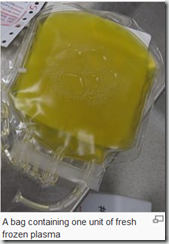
While hailed as a potential `breakthrough' treatment for COVID-19 last summer - and still in wide use by many hospitals today - the results from clinical trials using convalescent plasma to treat severe COVID-19 have been less than impressive.
Convalescent plasma therapy, using blood products collected from recovered cases, is not a new idea, and was used extensively during the first half of the 20th century to treat a variety of infectious diseases.
While its use gradually faded with the advent of powerful antibiotics and other drugs in the 20th century, the rise of new, mostly zoonotic viral diseases - for which few drug therapies are available - has sparked a revival in interest in convalescent plasma therapy in recent years.
And over the past decade we've seen some promising results (see 2011's CID Journal: Convalescent Plasma Therapy For Severe H1N1, 2015's Int J Infect Dis: Convalescent Plasma Treatment Of An H7N9 Patient In China), and even some early media reports on Convalescent Plasma treatment of COVID-19 in China.
But we've also seen some high profile failures, such as 2019's Lancet: Clinical Trial On Use of Convalescent Plasma To Treat Severe Influenza, which disappointingly found that `High-titre anti-influenza plasma conferred no significant benefit over non-immune plasma' and 2016's NEJM: Evaluation of Convalescent Plasma for Ebola Virus Disease in Guinea, which reported no statistically significant improvement in survival over the control group.
With few pharmacological options available for treating COVID-19, clinical trials on convalescent plasma were started around the world.
The first high-profile stumbling block came last July (see Dutch Convalescent Plasma Study For COVID-19 Halted For Redesign) when a clinical trial (see NCT04342182) in the Netherlands was abruptly halted.
Marion Koopmans, a world renown virologist and head of the Erasmus MC Department of Viroscience - who was part of the research team on this study - posted the following on her twitter account.
 Last October, in BMJ: Clinical Trial On Convalescent Plasma Showed Little Benefit For COVID-19, we looked at another major clinical trial which cast further doubt on the effectiveness of this treatment for COVID-19 patients, finding that it ` . . . was not associated with a reduction in progression to severe covid-19 or all cause mortality.'
Yesterday, another large clinical trial (REMAP-CAP) announced a halt to enrollment after an analysis of unpublished data on more than 900 severely ill trial participants showed that treatment with convalescent plasma did not improve outcomes.
We have some details available in this press release from Imperial College London. I've only posted the link and some excerpts, so click the link to read it in its entirety.
Blood plasma treatment has limited effect for sickest COVID-19 patients
by Ryan O'Hare
11 January 2021
Treating critically ill COVID-19 patients with blood plasma from people who have fought off the disease has limited impact on patient outcomes.
The early findings, which are yet to be published, come from the REMAP-CAP study and show that treatment with convalescent plasma did not improve outcomes among patients requiring intensive care unit (ICU) support.
There was no evidence of harm associated with the administration of convalescent plasma, but investigators have paused enrollment of severely ill COVID-19 patients in ICU to this arm of REMAP-CAP study.
They explain the trial will continue to recruit hospitalised COVID-19 patients who are moderately unwell and are not requiring intensive care, to assess if less severely ill patients benefit from the treatment.
Professor Anthony Gordon, Professor of anesthesia and critical care at Imperial College London and an NIHR research professor, said: “I am glad REMAP-CAP has been able to provide important evidence about which patients might benefit from convalescent plasma.
“Although it is disappointing that all critically ill patients don’t appear to gain any benefit, this is still vitally important to know. Convalescent plasma is a precious resource, and we can now continue to focus on identifying exactly which patients might benefit the most from treatment – maybe people earlier in their illness or those with weak immune systems.”
While convalescent plasma hasn't turned out to be the COVID-slayer that some had hoped for, there are still hopes it might still have some benefit for less severely ill patients, and so studies on those cohorts continue.
https://afludiary.blogspot.com/2021/01/another-convalescent-plasma-study-fails.html
#15,702
While hailed as a potential `breakthrough' treatment for COVID-19 last summer - and still in wide use by many hospitals today - the results from clinical trials using convalescent plasma to treat severe COVID-19 have been less than impressive.
Convalescent plasma therapy, using blood products collected from recovered cases, is not a new idea, and was used extensively during the first half of the 20th century to treat a variety of infectious diseases.
While its use gradually faded with the advent of powerful antibiotics and other drugs in the 20th century, the rise of new, mostly zoonotic viral diseases - for which few drug therapies are available - has sparked a revival in interest in convalescent plasma therapy in recent years.
And over the past decade we've seen some promising results (see 2011's CID Journal: Convalescent Plasma Therapy For Severe H1N1, 2015's Int J Infect Dis: Convalescent Plasma Treatment Of An H7N9 Patient In China), and even some early media reports on Convalescent Plasma treatment of COVID-19 in China.
But we've also seen some high profile failures, such as 2019's Lancet: Clinical Trial On Use of Convalescent Plasma To Treat Severe Influenza, which disappointingly found that `High-titre anti-influenza plasma conferred no significant benefit over non-immune plasma' and 2016's NEJM: Evaluation of Convalescent Plasma for Ebola Virus Disease in Guinea, which reported no statistically significant improvement in survival over the control group.
With few pharmacological options available for treating COVID-19, clinical trials on convalescent plasma were started around the world.
The first high-profile stumbling block came last July (see Dutch Convalescent Plasma Study For COVID-19 Halted For Redesign) when a clinical trial (see NCT04342182) in the Netherlands was abruptly halted.
Marion Koopmans, a world renown virologist and head of the Erasmus MC Department of Viroscience - who was part of the research team on this study - posted the following on her twitter account.
Yesterday, another large clinical trial (REMAP-CAP) announced a halt to enrollment after an analysis of unpublished data on more than 900 severely ill trial participants showed that treatment with convalescent plasma did not improve outcomes.
We have some details available in this press release from Imperial College London. I've only posted the link and some excerpts, so click the link to read it in its entirety.
Blood plasma treatment has limited effect for sickest COVID-19 patients
by Ryan O'Hare
11 January 2021
Treating critically ill COVID-19 patients with blood plasma from people who have fought off the disease has limited impact on patient outcomes.
The early findings, which are yet to be published, come from the REMAP-CAP study and show that treatment with convalescent plasma did not improve outcomes among patients requiring intensive care unit (ICU) support.
There was no evidence of harm associated with the administration of convalescent plasma, but investigators have paused enrollment of severely ill COVID-19 patients in ICU to this arm of REMAP-CAP study.
They explain the trial will continue to recruit hospitalised COVID-19 patients who are moderately unwell and are not requiring intensive care, to assess if less severely ill patients benefit from the treatment.
Professor Anthony Gordon, Professor of anesthesia and critical care at Imperial College London and an NIHR research professor, said: “I am glad REMAP-CAP has been able to provide important evidence about which patients might benefit from convalescent plasma.
“Although it is disappointing that all critically ill patients don’t appear to gain any benefit, this is still vitally important to know. Convalescent plasma is a precious resource, and we can now continue to focus on identifying exactly which patients might benefit the most from treatment – maybe people earlier in their illness or those with weak immune systems.”
While convalescent plasma hasn't turned out to be the COVID-slayer that some had hoped for, there are still hopes it might still have some benefit for less severely ill patients, and so studies on those cohorts continue.
https://afludiary.blogspot.com/2021/01/another-convalescent-plasma-study-fails.html