sharon sanders
Editor-in-Chief & President
link from a friend of FluTrackers
[FONT="]A Mysterious Infection, Spanning the Globe in a Climate of Secrecy[/FONT]
The rise of Candida auris embodies a serious and growing public health threat: drug-resistant germs.
https://www.nytimes.com/2019/04/06/h...gtype=Homepage
-----------------------------------------------------------------
CDC information:
General Information about Candida auris
[FONT="]Healthcare facilities in several countries have reported that a type of yeast called Candida auris has been causing severe illness in hospitalized patients. In some patients, this yeast can enter the bloodstream and spread throughout the body, causing serious invasive infections. This yeast often does not respond to commonly used antifungal drugs, making infections difficult to treat. Patients who have been hospitalized in a healthcare facility a long time, have a central venous catheter, or other lines or tubes entering their body, or have previously received antibiotics or antifungal medications, appear to be at highest risk of infection with this yeast.[/FONT]
[FONT="]Specialized laboratory methods are needed to accurately identify C. auris. Conventional laboratory techniques could lead to misidentification and inappropriate management, making it difficult to control the spread of C. auris in healthcare settings.[/FONT]
[FONT="]Because of these factors, CDC is alerting U.S. healthcare facilities to be on the lookout for C. auris in their patients.[/FONT]
[FONT="]CDC and partners continue to work closely; click here for the latest information on Candida auris. To learn more about Candida auris, read the Q&A below and:[/FONT]
Why is CDC concerned about C. auris infections?
[FONT="]CDC is concerned about C. auris for three main reasons:[/FONT]
[FONT="]C. auris has caused bloodstream infections, wound infections, and ear infections. It also has been isolated from respiratory and urine specimens, but it is unclear if it causes infections in the lung or bladder.[/FONT]
How is C. auris infection diagnosed?
[FONT="]Like other Candida infections, C. auris infections are usually diagnosed by culture of blood or other body fluids. However, C. auris is harder to identify from cultures than other, more common types of Candida. For example, it can be confused with other types of yeasts, particularly Candida haemulonii. Special laboratory tests are needed to identify C. auris. For more information, please see the Recommendations for Laboratorians and Health Professionals.[/FONT]
Who is at risk for infection from C. auris?
[FONT="]Limited data suggest that the risk factors for Candida auris infections are generally similar to risk factors for other types of Candida infections. These risk factors include recent surgery, diabetes, broad-spectrum antibiotic and antifungal use. People who have recently spent time in nursing homes and have lines and tubes that go into their body (such as breathing tubes, feeding tubes and central venous catheters), seem to be at highest risk for C. auris infection. Infections have been found in patients of all ages, from preterm infants to the elderly. Further study is needed to learn more about risk factors for C. auris infection.[/FONT]
When was C. auris first reported?
[FONT="]C. auris was first identified in 2009 in Japan. Retrospective review of Candida strain collections found that the earliest known strain of C. auris dates to 1996 in South Korea. CDC considers C. auris an emerging pathogen because increasing numbers of infections have been identified in multiple countries since it was recognized.[/FONT]
How did C. auris get its name?
[FONT="]Auris is the Latin word for ear. Despite its name, C. auris can also affect many other regions of the body and can cause invasive infections, including bloodstream infections and wound infections.[/FONT]
Where have C. auris infections occurred globally?
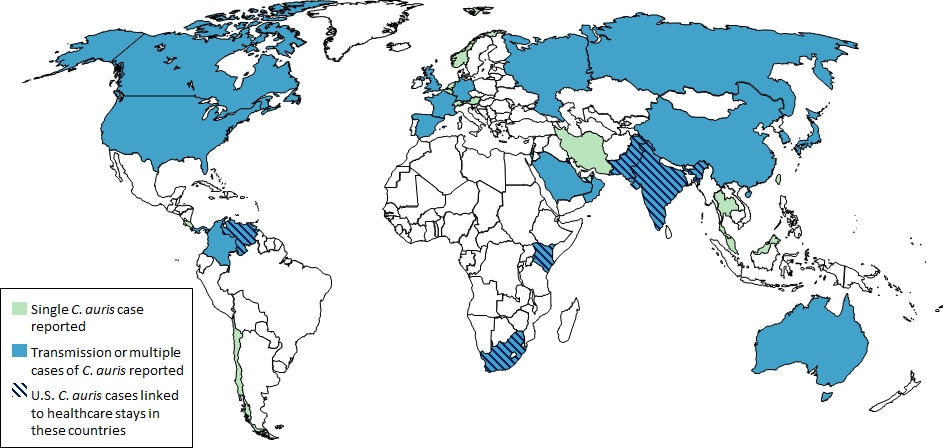
[FONT="]C. auris infections have been reported from over 20 countries, including the United States. Because identification of C. auris requires specialized laboratory methods, infections likely have occurred in other countries but have not been identified or reported. Click here for a map of countries with reported cases.[/FONT]
How did C. auris infection spread globally?
[FONT="]CDC conducted whole genome sequencing of C. auris specimens from countries in the regions of eastern Asia, southern Asia, southern Africa, and South America. Whole genome sequencing produces detailed DNA fingerprints of organisms. CDC found that isolates within each region are quite similar to one another, but are relatively different across regions. These differences suggest that C. auris has emerged independently in multiple regions at roughly the same time.[/FONT]
Would someone be likely to get a C. auris infection if they travel to any of these countries?
[FONT="]It is unlikely that routine travel to countries with documented C. auris infections would increase the chance of someone getting sick from C. auris. Infections have occurred primarily in patients who were already in the hospital for other reasons. People who travel to these countries to seek medical care or who are hospitalized there for a long time may have an increased risk for C. auris infection. [/FONT]
Have C. auris infections occurred in the United States?
[FONT="]Cases of C. auris infections have been reported in the United States. As laboratories continue to look for this fungus, it is likely that more cases will be reported. Click here for a map of cases in the United States.[/FONT]
What should someone do if they suspect they have a C. auris infection?
[FONT="]CDC recommends that anyone who believes they have any fungal infection or healthcare-associated infection see a healthcare provider.[/FONT]
Are C. auris infections treatable?
[FONT="]Most C. auris infections are treatable with a class of antifungal drugs called echinocandins. However, some C. auris infections have been resistant to all three main classes of antifungal medications, making them more difficult to treat. In this situation, multiple classes of antifungals at high doses may be required to treat the infection. Treatment decisions should be made in consultation with a healthcare provider experienced in treating patients with fungal infections.[/FONT]
Can a person die from infection with C. auris?
[FONT="]Yes. Invasive infections with any Candida species can be fatal. We don’t know if patients with invasive C. auris infection are more likely to die than patients with other invasive Candida infections. Based on information from a limited number of patients, 30–60% of people with C. auris infections have died. However, many of these people had other serious illnesses that also increased their risk of death.[/FONT]
How does C. auris spread?
[FONT="]C. auris can spread in healthcare settings through contact with contaminated environmental surfaces or equipment, or from person to person. More work is needed to further understand how it spreads.[/FONT]
How can the spread of C. auris be prevented?
[FONT="]Please see the Recommendations for Laboratorians and Health Professionals.[/FONT]
What is CDC doing to address C. auris?
[FONT="]CDC is providing guidance for clinicians and infection control personnel. For more information, please see the Recommendations for Laboratorians and Health Professionals. CDC also is working with state and local health agencies, healthcare facilities, and clinical microbiology laboratories to ensure that laboratories are using proper methods to detect C. auris and know the limitations of certain tests for detecting C. auris.[/FONT]
https://www.cdc.gov/fungal/candida-a...ris-qanda.html
[FONT="]A Mysterious Infection, Spanning the Globe in a Climate of Secrecy[/FONT]
The rise of Candida auris embodies a serious and growing public health threat: drug-resistant germs.
https://www.nytimes.com/2019/04/06/h...gtype=Homepage
-----------------------------------------------------------------
CDC information:
General Information about Candida auris
[FONT="]Healthcare facilities in several countries have reported that a type of yeast called Candida auris has been causing severe illness in hospitalized patients. In some patients, this yeast can enter the bloodstream and spread throughout the body, causing serious invasive infections. This yeast often does not respond to commonly used antifungal drugs, making infections difficult to treat. Patients who have been hospitalized in a healthcare facility a long time, have a central venous catheter, or other lines or tubes entering their body, or have previously received antibiotics or antifungal medications, appear to be at highest risk of infection with this yeast.[/FONT]
[FONT="]Specialized laboratory methods are needed to accurately identify C. auris. Conventional laboratory techniques could lead to misidentification and inappropriate management, making it difficult to control the spread of C. auris in healthcare settings.[/FONT]
[FONT="]Because of these factors, CDC is alerting U.S. healthcare facilities to be on the lookout for C. auris in their patients.[/FONT]
[FONT="]CDC and partners continue to work closely; click here for the latest information on Candida auris. To learn more about Candida auris, read the Q&A below and:[/FONT]
- [FONT="]Fact sheet on Candida auris – Download Cdc-pdf
[PDF – 2 Pages][/FONT] - [FONT="]Recommendations for Laboratorians and Health Professionals[/FONT]
- [FONT="]Information for Patients and Family Members[/FONT]
- [FONT="]Questions and Answers for Healthcare Personnel[/FONT]
Why is CDC concerned about C. auris infections?
[FONT="]CDC is concerned about C. auris for three main reasons:[/FONT]
- It is often multidrug-resistant, meaning that it is resistant to multiple antifungal drugs commonly used to treat Candida infections.
- It is difficult to identify with standard laboratory methods, and it can be misidentified in labs without specific technology. Misidentification may lead to inappropriate management.
- It has caused outbreaks in healthcare settings. For this reason, it is important to quickly identify C. auris in a hospitalized patient so that healthcare facilities can take special precautions to stop its spread.
[FONT="]C. auris has caused bloodstream infections, wound infections, and ear infections. It also has been isolated from respiratory and urine specimens, but it is unclear if it causes infections in the lung or bladder.[/FONT]
How is C. auris infection diagnosed?
[FONT="]Like other Candida infections, C. auris infections are usually diagnosed by culture of blood or other body fluids. However, C. auris is harder to identify from cultures than other, more common types of Candida. For example, it can be confused with other types of yeasts, particularly Candida haemulonii. Special laboratory tests are needed to identify C. auris. For more information, please see the Recommendations for Laboratorians and Health Professionals.[/FONT]
Who is at risk for infection from C. auris?
[FONT="]Limited data suggest that the risk factors for Candida auris infections are generally similar to risk factors for other types of Candida infections. These risk factors include recent surgery, diabetes, broad-spectrum antibiotic and antifungal use. People who have recently spent time in nursing homes and have lines and tubes that go into their body (such as breathing tubes, feeding tubes and central venous catheters), seem to be at highest risk for C. auris infection. Infections have been found in patients of all ages, from preterm infants to the elderly. Further study is needed to learn more about risk factors for C. auris infection.[/FONT]
When was C. auris first reported?
[FONT="]C. auris was first identified in 2009 in Japan. Retrospective review of Candida strain collections found that the earliest known strain of C. auris dates to 1996 in South Korea. CDC considers C. auris an emerging pathogen because increasing numbers of infections have been identified in multiple countries since it was recognized.[/FONT]
How did C. auris get its name?
[FONT="]Auris is the Latin word for ear. Despite its name, C. auris can also affect many other regions of the body and can cause invasive infections, including bloodstream infections and wound infections.[/FONT]
Where have C. auris infections occurred globally?
[FONT="]C. auris infections have been reported from over 20 countries, including the United States. Because identification of C. auris requires specialized laboratory methods, infections likely have occurred in other countries but have not been identified or reported. Click here for a map of countries with reported cases.[/FONT]
How did C. auris infection spread globally?
[FONT="]CDC conducted whole genome sequencing of C. auris specimens from countries in the regions of eastern Asia, southern Asia, southern Africa, and South America. Whole genome sequencing produces detailed DNA fingerprints of organisms. CDC found that isolates within each region are quite similar to one another, but are relatively different across regions. These differences suggest that C. auris has emerged independently in multiple regions at roughly the same time.[/FONT]
Would someone be likely to get a C. auris infection if they travel to any of these countries?
[FONT="]It is unlikely that routine travel to countries with documented C. auris infections would increase the chance of someone getting sick from C. auris. Infections have occurred primarily in patients who were already in the hospital for other reasons. People who travel to these countries to seek medical care or who are hospitalized there for a long time may have an increased risk for C. auris infection. [/FONT]
Have C. auris infections occurred in the United States?
[FONT="]Cases of C. auris infections have been reported in the United States. As laboratories continue to look for this fungus, it is likely that more cases will be reported. Click here for a map of cases in the United States.[/FONT]
What should someone do if they suspect they have a C. auris infection?
[FONT="]CDC recommends that anyone who believes they have any fungal infection or healthcare-associated infection see a healthcare provider.[/FONT]
Are C. auris infections treatable?
[FONT="]Most C. auris infections are treatable with a class of antifungal drugs called echinocandins. However, some C. auris infections have been resistant to all three main classes of antifungal medications, making them more difficult to treat. In this situation, multiple classes of antifungals at high doses may be required to treat the infection. Treatment decisions should be made in consultation with a healthcare provider experienced in treating patients with fungal infections.[/FONT]
Can a person die from infection with C. auris?
[FONT="]Yes. Invasive infections with any Candida species can be fatal. We don’t know if patients with invasive C. auris infection are more likely to die than patients with other invasive Candida infections. Based on information from a limited number of patients, 30–60% of people with C. auris infections have died. However, many of these people had other serious illnesses that also increased their risk of death.[/FONT]
How does C. auris spread?
[FONT="]C. auris can spread in healthcare settings through contact with contaminated environmental surfaces or equipment, or from person to person. More work is needed to further understand how it spreads.[/FONT]
How can the spread of C. auris be prevented?
[FONT="]Please see the Recommendations for Laboratorians and Health Professionals.[/FONT]
What is CDC doing to address C. auris?
[FONT="]CDC is providing guidance for clinicians and infection control personnel. For more information, please see the Recommendations for Laboratorians and Health Professionals. CDC also is working with state and local health agencies, healthcare facilities, and clinical microbiology laboratories to ensure that laboratories are using proper methods to detect C. auris and know the limitations of certain tests for detecting C. auris.[/FONT]
[FONT="]Page last reviewed: [/FONT]
[FONT="]December 21, 2018[/FONT]
https://www.cdc.gov/fungal/candida-a...ris-qanda.html