Michael Coston
Editor, Senior Moderator
CDC EID Journal: Clade I–Associated Mpox Cases Associated with Sexual Contact, the Democratic Republic of the Congo

Credit WHO
#17,788
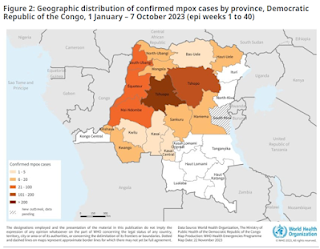
Last week, in WHO Reports 1st Confirmed Cluster Of Sexually Transmitted MPXV Clade 1 in the DRC, we looked at the first confirmed clusters of MPXV Clade 1 spread by sexual transmission in the DRC.
Compared to the milder Clade IIb MPXV - which was recognized as spreading internationally in early 2022 - Clade I infections are far more severe, more disfiguring, and can have a significant (≅ 10%) fatality rate.
Over the past decade we've seen a number of cautionary reports warning of Clade I's evolution and growing transmissibility, including:
This newly discovered ability to transmit sexually could open the door for Clade I MPXV to follow in Clade IIb's footsteps, and begin spreading outside of the endemic regions of central Africa.
This decidedly unwelcome news comes on the heels of reports of growing (antiviral) Tecovirimat Resistance in Mpox Patients, and some uncertainties over the effectiveness of the JANNEOS Mpox vaccine against the more virulent Clade I virus.
This morning the CDC's EID Journal has published dispatch from the team in the DRC that discovered these clusters. I've only posted some excerpts, so follow the link to read it in its entirety. I'll have a bit more after the break.
Dispatch
Clade I–Associated Mpox Cases Associated with Sexual Contact, the Democratic Republic of the Congo
Emile M. Kibungu, Emmanuel H. Vakaniaki, Eddy Kinganda-Lusamaki, Thierry Kalonji-Mukendi, Elisabeth Pukuta, Nicole A. Hoff, Isaac I. Bogoch, Muge Cevik, Gregg S. Gonsalves, Lisa E. Hensley, Nicola Low, Souradet Y. Shaw, Erin Schillberg, Mikayla Hunter, Lygie Lunyanga, Sylvie Linsuke, Joule Madinga, Martine Peeters, Jean-Claude Makangara Cigolo, Steve Ahuka-Mundeke, Jean-Jacques Muyembe, Anne W. Rimoin1, Jason Kindrachuk1 , Placide Mbala-Kingebeni1 , Robert S. Lushima1, and International Mpox Research Consortium
Abstract
We report a cluster of clade I monkeypox virus infections linked to sexual contact in the Democratic Republic of the Congo. Case investigations resulted in 5 reverse transcription PCR–confirmed infections; genome sequencing suggest they belonged to the same transmission chain. This finding demonstrates that mpox transmission through sexual contact extends beyond clade IIb.
Human mpox, caused by monkeypox virus (MPXV), is an emerging zoonotic viral disease first identified in the Democratic Republic of the Congo (DRC) (1). MPXV is endemic in multiple regions of Central and West Africa (2,3). The virus is subclassified into 2 clades: clade I, formerly Congo Basin (Central Africa) clade, and clade II, formerly West African clade. Clade II is further subdivided into 2 subclades, IIa and IIb; subclade IIb was responsible for the 2022 global epidemic (4; https://www.who.int/news/item/12-08-2022-monkeypox--experts-give-virus-variants-new-namesExternal Link).
Conclusions
We describe a cluster of clade I MPXV–associated infections in DRC related to sexual contact, which has previously only been described for clade II MPXV. Of note, MPXV transmission through sexual contact is not exclusive to clade IIb and can occur during heterosexual and same-sex contact.
This study demonstrates that MPXV infections can occur through additional exposure routes in MPXV-endemic regions and that the current understanding of mpox burden in clade I–endemic regions is based on classical transmission exclusively; recognizing those factors is critical. Our findings highlight additional considerations for MPXV circulation and transmission containment in endemic areas. Thus, increased MPXV surveillance, diagnostic testing access, and equitable access to both vaccines and therapeutics for persons at increased risk for infection are needed for ongoing mitigation strategies.
Given the increased disease severity associated with clade I MPXV, the potential implications of sexual transmission on broadening geographic distribution for MPXV across clades I and II must be considered. In addition, long-term immunity to mpox inferred by vaccination is unknown, including the role of mucosal immunity against clade I MPXV infections. This report highlights multiple critical global health considerations that must be addressed. Ongoing support for community engagement and educational efforts focusing on mpox recognition and reporting, including within sexual networks and for specific groups who might suffer from lack of care or experience stigma when seeking care.
Our findings highlight historically unrecognized MPXV transmission through sexual contact and indicate the need for increased routine screening in sexual health clinics in mpox-endemic and nonendemic regions. Population movement and previously unreported routes of transmission could exacerbate global distribution of MPXV, which could be compounded by the lack of routine diagnostic testing or inadequate access to rapid point-of-care testing. In view of this investigation, epidemiologic and genomic surveillance for MPXV, in both endemic and nonendemic regions, should be improved and strengthened.
Dr. Kibungu is a senior expert epidemiologist with a primary research interest in emerging infectious diseases, including response and containment efforts from the Ministry of Public Health, Hygiene and Prevention, Democratic Republic of the Congo. His primary research interests are emerging infectious diseases, including response and containment efforts.
Last year's emergence and global spread of the Mpox virus had been long predicted, but we arguably got lucky when it turned out to be the milder Clade II virus that began its world tour.
Although international spread of Clade I has not been reported, the Clade IIb virus had probably been spreading globally for quite some time before it was finally detected in the UK in May of 2022.
Another reason why we should be strengthening our global surveillance and reporting systems, not dismantling them, as we've seen over the past couple of years.
https://afludiary.blogspot.com/2023/11/cdc-eid-journal-clade-iassociated-mpox.html
Credit WHO
#17,788
Last week, in WHO Reports 1st Confirmed Cluster Of Sexually Transmitted MPXV Clade 1 in the DRC, we looked at the first confirmed clusters of MPXV Clade 1 spread by sexual transmission in the DRC.
Compared to the milder Clade IIb MPXV - which was recognized as spreading internationally in early 2022 - Clade I infections are far more severe, more disfiguring, and can have a significant (≅ 10%) fatality rate.
Over the past decade we've seen a number of cautionary reports warning of Clade I's evolution and growing transmissibility, including:
This newly discovered ability to transmit sexually could open the door for Clade I MPXV to follow in Clade IIb's footsteps, and begin spreading outside of the endemic regions of central Africa.
This decidedly unwelcome news comes on the heels of reports of growing (antiviral) Tecovirimat Resistance in Mpox Patients, and some uncertainties over the effectiveness of the JANNEOS Mpox vaccine against the more virulent Clade I virus.
This morning the CDC's EID Journal has published dispatch from the team in the DRC that discovered these clusters. I've only posted some excerpts, so follow the link to read it in its entirety. I'll have a bit more after the break.
Dispatch
Clade I–Associated Mpox Cases Associated with Sexual Contact, the Democratic Republic of the Congo
Emile M. Kibungu, Emmanuel H. Vakaniaki, Eddy Kinganda-Lusamaki, Thierry Kalonji-Mukendi, Elisabeth Pukuta, Nicole A. Hoff, Isaac I. Bogoch, Muge Cevik, Gregg S. Gonsalves, Lisa E. Hensley, Nicola Low, Souradet Y. Shaw, Erin Schillberg, Mikayla Hunter, Lygie Lunyanga, Sylvie Linsuke, Joule Madinga, Martine Peeters, Jean-Claude Makangara Cigolo, Steve Ahuka-Mundeke, Jean-Jacques Muyembe, Anne W. Rimoin1, Jason Kindrachuk1
, Placide Mbala-Kingebeni1 , Robert S. Lushima1, and International Mpox Research ConsortiumAbstract
We report a cluster of clade I monkeypox virus infections linked to sexual contact in the Democratic Republic of the Congo. Case investigations resulted in 5 reverse transcription PCR–confirmed infections; genome sequencing suggest they belonged to the same transmission chain. This finding demonstrates that mpox transmission through sexual contact extends beyond clade IIb.
Human mpox, caused by monkeypox virus (MPXV), is an emerging zoonotic viral disease first identified in the Democratic Republic of the Congo (DRC) (1). MPXV is endemic in multiple regions of Central and West Africa (2,3). The virus is subclassified into 2 clades: clade I, formerly Congo Basin (Central Africa) clade, and clade II, formerly West African clade. Clade II is further subdivided into 2 subclades, IIa and IIb; subclade IIb was responsible for the 2022 global epidemic (4; https://www.who.int/news/item/12-08-2022-monkeypox--experts-give-virus-variants-new-namesExternal Link).
Clade I infections are associated with greater disease severity and more pronounced rash and had demonstrated increased human-to-human transmission compared with
clade II before the global emergence of clade IIb (5). Those difference are likely influenced by factors such as clade-specific genomic differences in host response modifier proteins, exposure type and dose, and vaccination status (https://www.who.int/news/item/12-08-2022-monkeypox--experts-give-virus-variants-new-namesExternal Link). Travel-related and animal importation–related cases have been reported in nonendemic regions (6). In 2022, rapid spread of MPXV to new geographic regions resulted in >86,000 confirmed infections in nonendemic regions and declaration of a public health emergency of international concern by the World Health Organization (7).
(SNIP)
clade II before the global emergence of clade IIb (5). Those difference are likely influenced by factors such as clade-specific genomic differences in host response modifier proteins, exposure type and dose, and vaccination status (https://www.who.int/news/item/12-08-2022-monkeypox--experts-give-virus-variants-new-namesExternal Link). Travel-related and animal importation–related cases have been reported in nonendemic regions (6). In 2022, rapid spread of MPXV to new geographic regions resulted in >86,000 confirmed infections in nonendemic regions and declaration of a public health emergency of international concern by the World Health Organization (7).
(SNIP)
Conclusions
We describe a cluster of clade I MPXV–associated infections in DRC related to sexual contact, which has previously only been described for clade II MPXV. Of note, MPXV transmission through sexual contact is not exclusive to clade IIb and can occur during heterosexual and same-sex contact.
This study demonstrates that MPXV infections can occur through additional exposure routes in MPXV-endemic regions and that the current understanding of mpox burden in clade I–endemic regions is based on classical transmission exclusively; recognizing those factors is critical. Our findings highlight additional considerations for MPXV circulation and transmission containment in endemic areas. Thus, increased MPXV surveillance, diagnostic testing access, and equitable access to both vaccines and therapeutics for persons at increased risk for infection are needed for ongoing mitigation strategies.
Given the increased disease severity associated with clade I MPXV, the potential implications of sexual transmission on broadening geographic distribution for MPXV across clades I and II must be considered. In addition, long-term immunity to mpox inferred by vaccination is unknown, including the role of mucosal immunity against clade I MPXV infections. This report highlights multiple critical global health considerations that must be addressed. Ongoing support for community engagement and educational efforts focusing on mpox recognition and reporting, including within sexual networks and for specific groups who might suffer from lack of care or experience stigma when seeking care.
Our findings highlight historically unrecognized MPXV transmission through sexual contact and indicate the need for increased routine screening in sexual health clinics in mpox-endemic and nonendemic regions. Population movement and previously unreported routes of transmission could exacerbate global distribution of MPXV, which could be compounded by the lack of routine diagnostic testing or inadequate access to rapid point-of-care testing. In view of this investigation, epidemiologic and genomic surveillance for MPXV, in both endemic and nonendemic regions, should be improved and strengthened.
Dr. Kibungu is a senior expert epidemiologist with a primary research interest in emerging infectious diseases, including response and containment efforts from the Ministry of Public Health, Hygiene and Prevention, Democratic Republic of the Congo. His primary research interests are emerging infectious diseases, including response and containment efforts.
Last year's emergence and global spread of the Mpox virus had been long predicted, but we arguably got lucky when it turned out to be the milder Clade II virus that began its world tour.
Although international spread of Clade I has not been reported, the Clade IIb virus had probably been spreading globally for quite some time before it was finally detected in the UK in May of 2022.
Another reason why we should be strengthening our global surveillance and reporting systems, not dismantling them, as we've seen over the past couple of years.
https://afludiary.blogspot.com/2023/11/cdc-eid-journal-clade-iassociated-mpox.html
Last edited: