

Michael Coston
Editor, Senior Moderator
CDC IRAT Updated Statement On HPAI H5N1
17,296
The CDC maintains a (growing) list of novel influenza viruses with zoonotic potential on their IRAT (Influenza Risk Assessment Tool) website - that, using a variety of parameters - attempts to quantify their threat in two broad categories.
This list has expanded rapidly since 2011, with 20 of 23 current flu subtypes added since then.
The most recent - H5N1: clade 2.3.4.4b: [A/American wigeon/South Carolina/AH0195145/2021]- was added last May, a few months after H5N1 arrived in the United States.
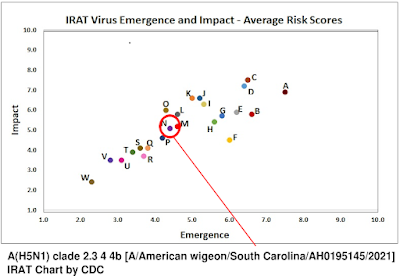
The original CDC Assessment (see Influenza Risk Assessment Tool (IRAT) Virus Report H5N1 clade 2.3.4.4b pdf icon[462 KB, 6 pages]) placed this threat squarely in the middle of the pack, with a threat score of 5.1 and an emergence score of 4.4.
The summary read:
Summary: A risk assessment of highly pathogenic avian influenza A(H5N1) virus clade 2.3.4.4b, using A/American wigeon/South Carolina/AH0195145/2021 as the prototype strain, was conducted in March 2022. The overall estimated IRAT scores placed this virus in the moderate risk category, which ranges from 4.0 to 7.9.
Since then, we've seen increasing reports of spillover of H5N1 into mammals (see below) along with a small number of human infections, 3 of which have been serious (see WHO Update & Risk Assessment On Human H5N1 Infection - Ecuador).
First Mass Mortality of Marine Mammals Caused by Highly Pathogenic Influenza Virus (H5N1) in South America
Eurosurveillance: HPAI A(H5N1) Virus Infection in Farmed Minks, Spain, October 2022
All of which has visibly raised the level of concern among virologists and public health officials (see WOAH: Statement on Avian Influenza and Mammals and WHO Director-General Statement on Risk From H5N1 Avian Flu).
So far, we've not seen any evidence of efficient transmission of H5N1 between humans, and without that, the virus likely only poses a low risk to those in direct contact with infected birds or mammals.
The concern is, over time, that could change.
Addressing those concerns, the CDC added a brief statement to their IRAT page this week (see below).
The H5N1 viruses that are causing ongoing outbreaks in wild birds and poultry, occasional infections in mammals, and rare sporadic human infections are H5N1 clade 2.3.4.4b viruses [A/American wigeon/South Carolina/AH0195145/2021]. While the potential pandemic risk assessment for ‘emergence’ and ‘public health impact’ for those viruses was conducted in March 2022, the assessment is still current as no changes in recent contemporary H5N1 viruses have been seen that would enhance the capacity of these viruses to infect people, nor has there been epidemiologic evidence to suggest that the risk has increased. The current risk to the general public from contemporary H5N1 viruses at this time is still considered low.
While reassuring, this can only tell us what the CDC has observed with these viruses so far. Still, it is an important reminder that H5N1 isn't ready for prime time (yet), and may never evolve into a pandemic threat.
For more from the CDC on the risks from H5N1, you may wish to revisit CDC `Ask The Expert' On HPAI H5N1,
But regardless of the future trajectory of H5N1, another pandemic will come. Which is why we need to be preparing now, for whatever nature throws at us next.
https://afludiary.blogspot.com/2023/02/cdc-irat-updated-statement-on-hpai-h5n1.html
17,296
The CDC maintains a (growing) list of novel influenza viruses with zoonotic potential on their IRAT (Influenza Risk Assessment Tool) website - that, using a variety of parameters - attempts to quantify their threat in two broad categories.
- Potential Emergence Risk: The likelihood that a particular virus will become transmissible among humans
- Potential Impact Risk: And its impact (based on virulence, population immunity, etc.), should it become a pandemic strain
This list has expanded rapidly since 2011, with 20 of 23 current flu subtypes added since then.
The most recent - H5N1: clade 2.3.4.4b: [A/American wigeon/South Carolina/AH0195145/2021]- was added last May, a few months after H5N1 arrived in the United States.
The original CDC Assessment (see Influenza Risk Assessment Tool (IRAT) Virus Report H5N1 clade 2.3.4.4b pdf icon[462 KB, 6 pages]) placed this threat squarely in the middle of the pack, with a threat score of 5.1 and an emergence score of 4.4.
The summary read:
Summary: A risk assessment of highly pathogenic avian influenza A(H5N1) virus clade 2.3.4.4b, using A/American wigeon/South Carolina/AH0195145/2021 as the prototype strain, was conducted in March 2022. The overall estimated IRAT scores placed this virus in the moderate risk category, which ranges from 4.0 to 7.9.
The average risk score for the estimated potential emergence of the virus was 4.4, in the lower range of the moderate risk category. The average risk score for the virus to potentially impact public health was 5.1, also in the lower range of the moderate risk category. The average confidence level in the available data of all 10 risk elements was 2.4 (range: 1.0-3.0).
Since then, we've seen increasing reports of spillover of H5N1 into mammals (see below) along with a small number of human infections, 3 of which have been serious (see WHO Update & Risk Assessment On Human H5N1 Infection - Ecuador).
First Mass Mortality of Marine Mammals Caused by Highly Pathogenic Influenza Virus (H5N1) in South America
Eurosurveillance: HPAI A(H5N1) Virus Infection in Farmed Minks, Spain, October 2022
All of which has visibly raised the level of concern among virologists and public health officials (see WOAH: Statement on Avian Influenza and Mammals and WHO Director-General Statement on Risk From H5N1 Avian Flu).
So far, we've not seen any evidence of efficient transmission of H5N1 between humans, and without that, the virus likely only poses a low risk to those in direct contact with infected birds or mammals.
The concern is, over time, that could change.
Addressing those concerns, the CDC added a brief statement to their IRAT page this week (see below).
The H5N1 viruses that are causing ongoing outbreaks in wild birds and poultry, occasional infections in mammals, and rare sporadic human infections are H5N1 clade 2.3.4.4b viruses [A/American wigeon/South Carolina/AH0195145/2021]. While the potential pandemic risk assessment for ‘emergence’ and ‘public health impact’ for those viruses was conducted in March 2022, the assessment is still current as no changes in recent contemporary H5N1 viruses have been seen that would enhance the capacity of these viruses to infect people, nor has there been epidemiologic evidence to suggest that the risk has increased. The current risk to the general public from contemporary H5N1 viruses at this time is still considered low.
While reassuring, this can only tell us what the CDC has observed with these viruses so far. Still, it is an important reminder that H5N1 isn't ready for prime time (yet), and may never evolve into a pandemic threat.
For more from the CDC on the risks from H5N1, you may wish to revisit CDC `Ask The Expert' On HPAI H5N1,
But regardless of the future trajectory of H5N1, another pandemic will come. Which is why we need to be preparing now, for whatever nature throws at us next.
https://afludiary.blogspot.com/2023/02/cdc-irat-updated-statement-on-hpai-h5n1.html