
https://www.cidrap.umn.edu/news-perspective/2022/11/who-details-4-more-mers-cases-saudi-arabia
WHO details 4 more MERS cases in Saudi Arabia
Filed Under:
MERS-CoV
The World Health Organization (WHO) yesterday posted an update on Middle East respiratory syndrome coronavirus (MERS-CoV) in Saudi Arabia that covers four cases reported by the country since the WHO's last update in April. Three of the patients had recent contact with camels. No secondary cases were reported, and none were fatal.
The WHO said the four MERS-CoV cases were reported between Dec 29, 2021, and Oct 31, 2022. Symptom onsets ranged from Dec 27 through Jun 9. All patients—three men and a woman—are aged 23 to 68 years and weren't healthcare workers. All had underlying conditions and were
 hospitalized. The men had contact with camels and had consumed camel milk. The agriculture ministry's related investigations identified the virus in camels in those three instances. So far, the 23-year-old woman's exposure source isn't known.
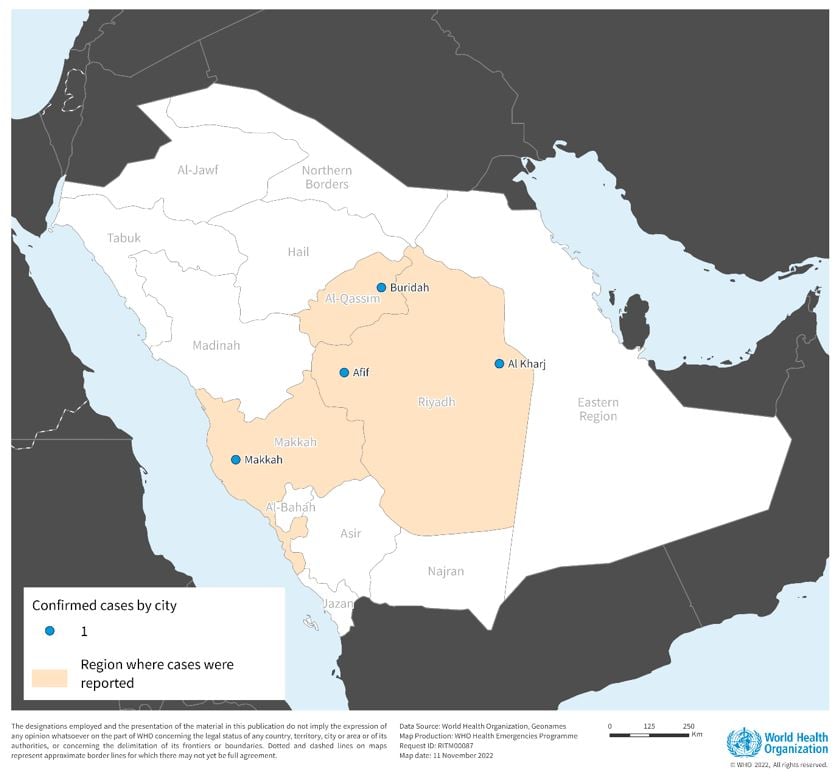
Two patients are from Riyadh province, from the cities of Afif and Al-Kharj. The others are from Mecca in Mecca province and Buraydah in Al Qassim province (see WHO map above).
The WHO noted that the number of MERS-CoV cases has declined since the start of the COVID-19 pandemic, likely due to health officials prioritizing COVID-19 activities. Also, the WHO said COVID-19 protective measures may have reduced MERS-CoV transmission. However, the WHO said MERS-CoV circulation continued in dromedary camels and that the zoonotic threat remains.
The WHO said the latest cases from Saudi Arabia lift the global total since September 2012 to 2,600 cases, 935 of them fatal.
WHO details 4 more MERS cases in Saudi Arabia
Filed Under:
MERS-CoV
The World Health Organization (WHO) yesterday posted an update on Middle East respiratory syndrome coronavirus (MERS-CoV) in Saudi Arabia that covers four cases reported by the country since the WHO's last update in April. Three of the patients had recent contact with camels. No secondary cases were reported, and none were fatal.
The WHO said the four MERS-CoV cases were reported between Dec 29, 2021, and Oct 31, 2022. Symptom onsets ranged from Dec 27 through Jun 9. All patients—three men and a woman—are aged 23 to 68 years and weren't healthcare workers. All had underlying conditions and were
Two patients are from Riyadh province, from the cities of Afif and Al-Kharj. The others are from Mecca in Mecca province and Buraydah in Al Qassim province (see WHO map above).
The WHO noted that the number of MERS-CoV cases has declined since the start of the COVID-19 pandemic, likely due to health officials prioritizing COVID-19 activities. Also, the WHO said COVID-19 protective measures may have reduced MERS-CoV transmission. However, the WHO said MERS-CoV circulation continued in dromedary camels and that the zoonotic threat remains.
The WHO said the latest cases from Saudi Arabia lift the global total since September 2012 to 2,600 cases, 935 of them fatal.
