• FluTrackers.com Inc. does not provide medical advice. Information on this web site is collected from various internet resources, and the FluTrackers board of directors makes no warranty to the safety, efficacy, correctness or completeness of the information posted on this site by any author or poster. The information collated here is for instructional and/or discussion purposes only and is NOT intended to diagnose or treat any disease, illness, or other medical condition. Every individual reader or poster should seek advice from their personal physician/healthcare practitioner before considering or using any interventions that are discussed on this website. By continuing to access this website you agree to consult your personal physican before using any interventions posted on this website, and you agree to hold harmless FluTrackers.com Inc., the board of directors, the members, and all authors and posters for any effects from use of any medication, supplement, vitamin or other substance, device, intervention, etc. mentioned in posts on this website, or other internet venues referenced in posts on this website.
  • We are not asking for any donations. Do not donate to any entity who says they are raising funds for us.

Discussion thread: H5N1 avian flu in US dairy cows including human cases (poultry, dairy workers) - March 24, 2024 +

Canada -
...
Milk sampling and testing results

CFIA laboratories tested 303 retail milk samples from across Canada. All samples have tested negative for HPAI fragments, with no evidence of disease in dairy cattle detected in milk.

Results of the Canada-wide testing of retail milk samples are listed below. Next steps on testing will be decided as part of further discussions with partners.

Date testing completed Area Samples tested HPAI detections (positive or negative)

May 16, 2024 Atlantic provinces 77 All negative
May 16, 2024 Ontario 75 All negative
May 16, 2024 Quebec 76 All negative
May 16, 2024 Western provinces 75 All negative​
​...
https://inspection.canada.ca/en/ani...ommercial-milk-sampling-and-testing-hpai-vira
 
Cows Have Almost Certainly Infected More Than Two People With Bird Flu

Protecting dairy workers from further spread will be crucial to containing the outbreak.
By Katherine J. Wu
MAY 23, 2024, 10:06 AM ET

​​​​​​It was bound to happen again. For the second time in two months, the United States has confirmed a case of bird flu in a dairy worker employed by a farm with H5N1-infected cows. “The only thing I’m surprised about is that it’s taken this long to get another confirmed case,” Steve Valeika, a veterinarian and an epidemiologist based in North Carolina, told me.


The true case count is almost certainly higher. For weeks, anecdotal reports of sick farmworkers have been trickling in from around the nation, where H5N1 has been detected in dozens of herds in nine states, according to federal counts. Testing among humans and animals remains limited, and buy-in from farms is still spotty. The gap between reality and what the government can measure is hindering the world from realizing the full scope of the outbreak. And it may hamper experts’ ability to detect human-to-human spread, should that someday occur. “I wouldn’t be surprised if there have been dozens of cases at this point,” Valeika said.

The risk to most of the public is still low, as federal guidelines continue to emphasize. But that assurance feels tenuous when “the threat to farmworkers remains high,” Jennifer Nuzzo, the director of the pandemic center at the Brown University School of Public Health, told me. Too often, infectious disease most affects a society’s most vulnerable people; now the future of this virus depends on America’s ability to protect a community whose health and safety are routinely discounted....

....People who work on dairy farms, though, have reason to worry, Lakdawala added. In the so-called parlors where dairy cows are milked, animals are strapped into machines that latch on to their udders, pump until the rate of flow slows, then release, swinging “off the animal at eye height,” Lakdawala told me, and blasting bystanders with frothy liquid. The machines aren’t necessarily sanitized between each animal—and what cleaning does occur often involves a high-pressure hose-down that also mists up milk. The entire process involves a lot of direct maneuvering of udders, as workers load machinery onto each cow and prime their initial milk flow manually. If workers aren’t directly getting milk on their hands—which will, at some point, touch their face—they’re “constantly being bombarded with aerosols, droplets, and spray,” Lakdawala said.​....

:tiphat:
https://www.theatlantic.com/science...source=twitter&utm_medium=social&utm_campaign =social​
 
This is very disturbing. Firstly, the child was much more sick than we were led to believe. Secondly, no contact with birds, animals, sick human contacts. Did not eat undercooked poultry. No contact with animals at all. That leaves humans. Or water.

From: https://flutrackers.com/forum/forum...ia-from-india-may-22-2024?p=991054#post991054

Published Date: 2024-05-22 21:08:04 EDT
Subject: PRO/AH/EDR> Avian influenza, human - Australia: ex India, H5N1​

The child who became unwell whilst in India was hospitalised upon return to Australia in March 2024. Influenza A was detected by PCR during admission, and the child was treated with oseltamivir during a prolonged stay in intensive care with severe lower respiratory tract infection and hypoxia with respiratory failure. The child has since been discharged home and has made a complete recovery.

...
Interview with the child's family has been unable to identify a clear acquisition source, with the child having no interaction with birds, animals or sick human contacts either in India or Australia, and no geographic or epidemiological links to any of the previously isolated homologous cases. There was also no known consumption of undercooked poultry or meat products during the acquisition period.

Contact tracing did not identify any contact with animals whilst ill on return to Australia, and there were no ill human contacts identified and no evidence of any onwards transmission to humans or animals.
 
UW-Madison: UW finds raw milk with H5N1 flu poses infection risk
Home » Press Releases » UW-Madison: UW finds raw milk with H5N1 flu poses infection risk

MADISON — Consuming raw cow’s milk that contains H5N1 avian influenza virus poses an infection risk, but a laboratory process that simulates high-temperature pasteurization reduces the virus in infected milk by more than 99.99%. That’s according to a team led by University of Wisconsin–Madison scientists, who reported their findings May 24 in a letter published in the New England Journal of Medicine.

The group, which also included researchers from Texas A&M University, found that mice that consumed untreated milk infected with H5N1 subsequently became ill with influenza and that small amounts of virus persist in untreated milk for weeks when kept at standard refrigeration temperatures. The research took place as the H5N1 avian influenza virus continued its spread from birds into mammals, with infections reported in dairy herds across the United States this spring.

......This method inactivated more than 99.99% of the virus within the samples, though it did not completely inactivate the virus.

“We must emphasize that the conditions used in our laboratory study are not identical to the large-scale industrial treatment of raw milk,” says Kawaoka. “It’s important to remember that our heat-treatment findings may not perfectly translate to real-world conditions.”

Meanwhile, the team orally inoculated mice with untreated milk samples to gauge the possible risk posed by consuming raw milk that contains H5N1 virus. The mice began showing symptoms of illness after one day.

While no mice died as a result of infection with....
​:tiphat:

​​​​​​https://www.wispolitics.com/2024/uw-madison-uw-finds-raw-milk-with-h5n1-flu-poses-infection-risk/
 
In Experiments, Mice Got Ill From Raw Milk Carrying Bird Flu Virus

​By:
Ernie Mundell
Published on:
May 24, 2024, 11:35 am
Updated on:
May 24, 2024, 11:35 am​
  • H5N1 bird flu is currently infecting U.S. dairy cows, and the virus is showing up in milk
  • New experiments in mice fed unpasteurized "raw" milk tainted with H5N1 show that consumption quickly made the rodents very ill
  • Refrigerating raw milk did little to lower levels of the virus, while pasteurization brought levels down dramatically
FRIDAY, May 24, 2024 (HealthDay News) -- Confirming the dangers of drinking raw cow's milk when the H5N1 avian flu virus is circulating in U.S. dairy herds, researchers found that mice fed the milk quickly got ill.

"Our data indicate that HPAI A[H5N1] virus in untreated milk can infect susceptible animals that consume it," concluded a team led by virologist Yoshihiro Kawaoka, of the University of Wisconsin–Madison. His team published the findings Friday in the New England Journal of Medicine....

:tiphat:
https://www.healthday.com/health-ne...ot-ill-from-raw-milk-carrying-bird-flu-virus​
 
Updates on H5N1 Beef Safety Studies


Last Modified: May 24, 2024

What's New


May 24, 2024

USDA’s Food Safety and Inspection Service (FSIS), as part of its ongoing efforts to ensure the safety of the food supply, has conducted tests on beef tissue from 96 cull dairy cows condemned at select FSIS-inspected facilities. Meat from condemned cows is prohibited from entering the food supply. On May 22, 2024, viral particles were detected in tissue samples, including muscle, from one cow. To date, samples from 95 cows have tested negative for viral particles. No meat from these dairy cattle entered the food supply.

...
https://www.aphis.usda.gov/livestoc...detections/livestock/h5n1-beef-safety-studies
 
HPAI dairy herd infection case report


Phil Durst, Michigan State University Extension - May 24, 2024

What happens in a dairy herd with HPAI? What should I expect if my herd became infected? This case report describes what one farmer has faced since herd infection began.
Please note: This story and publish date have been updated to reflect additional information. The original version was posted on May 17, 2024.

May 1, 2024 marked day one of the onset of an outbreak of Highly Pathogenic Avian Influenza (HPAI) on one dairy farm in Michigan. The farmer, recognizing the potential benefit to other farmers, willingly shared this information and agreed to have official testing of his herd. This report is what was known and reported on day 15 of the HPAI infection in a herd of approximately 500 lactating cows. Prior to infection, the average cow production on this farm ranged from 95 to 100 lbs. per day.

Initial symptoms were detected with the SmaXtec monitoring boluses that they currently have in about 90% of lactating cows. The onset was manifested by a spike in body temperature of 4 to 5 degrees above normal, followed by a decrease in rumination 6 hours later. The decrease of rumination in infected cows was severe with almost no activity occurring.

The temperature elevation lasted about two days, and there was a sharp drop in water intake by infected cows from 40-50 gallons to 5–10 gallons. per day. These conditions resulted in severe dehydration in cows. The farm took an aggressive approach to supportive therapy, administering aspirin boluses twice a day to reduce temperature and inflammation. Additionally they provided Vitamin B and a rumen yeast capsule for a minimum of three days. For cows that refused to drink, they administered hypertonic saline IV. They tried IV Banamine on a limited number of cows but did not see any positive impact. Their goal is to make the cows as comfortable as possible.

It began in a barn with two pens of cattle that had three water fountains, the center one being shared. They wanted to try to confine the disease to a single group or at least a single barn. They changed their wash cycle in milking so that it washed after this group of cows. Regardless of their efforts, HPAI spread to all groups of lactating cattle on the farm.


The number of cows the farm employees needed to handle in some way had increased sixfold, making the work very labor intensive. Breeding stopped during this time because of the demands of just working with sick cattle.

While pregnancy checks have not at this point shown a reduction in conception, multiple late-lactation (150-220-day) cows have aborted their calves, and the farm believes this is due to high body temperatures. The disease primarily affected high-producing, multi-lactation cows and the low group. Transition cows seem to be performing normally at this point. Waste milk is pasteurized before feeding it to calves, and to date, the calves seem to be doing fine.

Employees have stayed healthy to date. The farmer encouraged them to wash their hands frequently and avoid touching their face and eyes. All employees were offered safety eyewear or face shields.

By day 15, the full impact of the disease has not yet been felt. However, the farmer did some cost estimations. He has spent $5,000 – $7,500 in extra medical supplies. Even though the costs of these common medications are low, the volume needed has been quite high. There has been the loss of milk, loss of quality premium, increased labor and loss of a few pregnancies resulting in culling animals. He estimates the cost for this herd of approximately 500 cows at $30,000 – $40,000.

By day 24, the farmer said that some cows—approximately 10% that became infected—have not recovered rumen activity. It is likely that these cows will be culled because they are not regaining weight and health. It appears that there are some individual cows that have a “long” form of the disease.

The owner of the farm in this case report understands that this does not include the potential longer-term costs. Another farmer said that some herds are seeing symptoms for four to six weeks. Additional negative impacts include increased culls of animals that do not recover significantly and increased weight gain of late lactation cows that recover feed intake but not milk output.

“It has been a lot of work, stressful on the cows and frankly overwhelming,” the farmer said. He shared that the monitoring system they have in place has enabled them to get a head start on supporting the health of infected cattle that show milk loss which begins two days after temperature elevation is detected. Therefore, they initiated therapy before milk loss occurred. The monitoring has also enabled him to evaluate the impact of supportive therapy and recovery by animals.

This farmer reported the disease to the Michigan Department of Agriculture and Rural Development (MDARD). He believes it is important for the industry to understand the disease. He knows that his is not the only farm to get HPAI and hopes that the more we can learn from his experience, the better we can prevent more herd infections, reduce the impact and potentially be better prepared against other diseases.

Michigan State University Extension is a leader in working with this and other farms regarding HPAI for the benefit of the dairy industry and provides resources at our animal agriculture and avian influenza websites.

This article was published by Michigan State University Extension. For more information, visit https://extension.msu.edu. To have a digest of information delivered straight to your email inbox, visit https://extension.msu.edu/newsletters. To contact an expert in your area, visit https://extension.msu.edu/experts, or call 888-MSUE4MI (888-678-3464).
​:tiphat:
​​​​​​https://www.canr.msu.edu/news/hpai-dairy-herd-infection-case-report

 
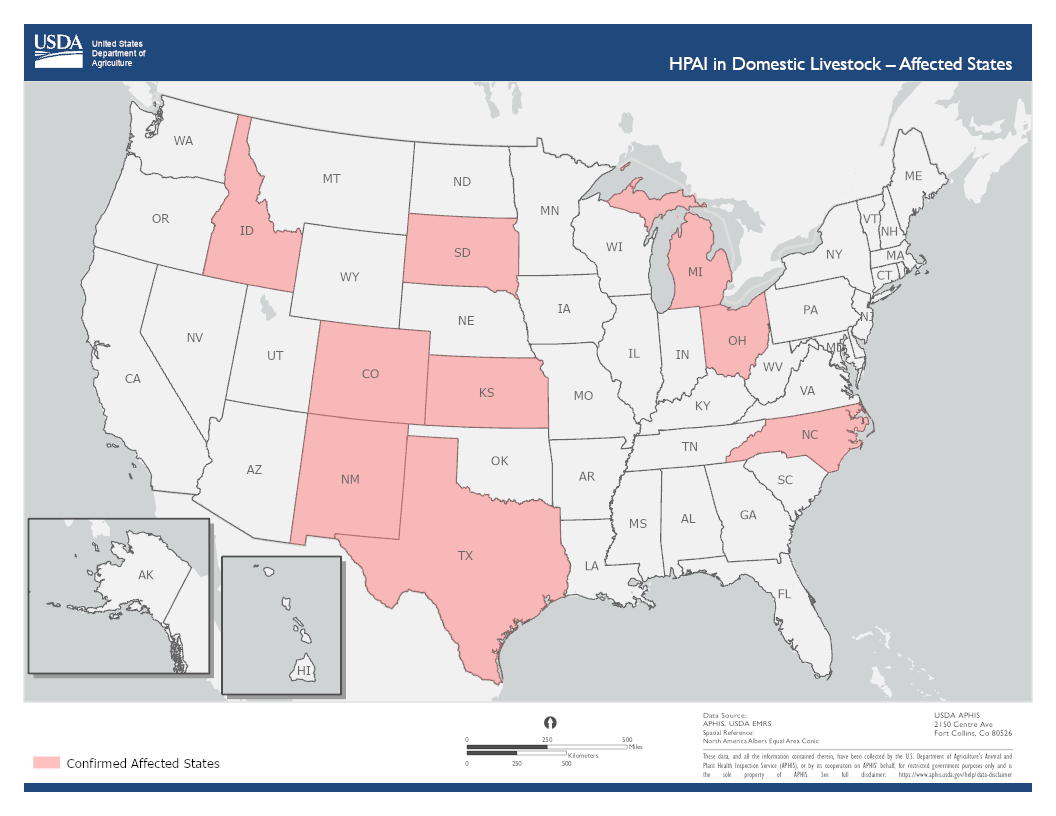
63 Confirmed Cases of HPAI in Domestic Livestock


*Data updated weekdays by 4 pm ET.
hpai-livestock-map.png
CSV Print
Search:
South DakotaDairy Milking Cattle5/23/2024
South DakotaDairy Milking Cattle5/22/2024
ColoradoDairy Milking Cattle5/22/2024
ColoradoDairy Milking Cattle5/20/2024
South DakotaDairy Milking Cattle5/17/2024
MichiganDairy Milking Cattle5/22/2024
IdahoDairy Milking Cattle5/21/2024
Showing 1 to 10 of 63 entries
Previous1234567Next Latest News :tiphat:

https://www.aphis.usda.gov/livestoc...an/avian-influenza/hpai-detections/livestock​
 
@HelenBranswell
·
23s


The number of #H5N1 #birdflu infected dairy herds continues to rise.
@USDA
added 5 today, 3 in SD & 2 in Colorado. Michigan announced +3 which USDA hasn't yet put on its list but I've added here because Michigan's doing a bang-up job finding/reporting herds. Total = 66.​
 
Expert explainer: Ethical approaches to mitigate H5N1 bird flu
...
By Justin Zadorsky,
May 27, 2024
...
Maxwell Smith is a health studies professor and Western’s first Canadian Institutes of Health Research Chair in Applied Public Health. He studies the ethical dimensions of responding to infectious diseases and spoke with Western News about some of the ethical concerns around mitigating the impact of H5N1.
...
What are you watching in efforts to prevent the spread of H5N1/HPAI?

MS: Most concerning right now are reports that some farmers, the broader agriculture industry, and even states are pushing back against attempts to track and mitigate the spread of H5N1 in livestock. Their concerns are important: testing livestock can have economic implications if there are positive tests. Without government assistance, reluctance to collaborate with health authorities is understandable.

An important ethical challenge we’re facing is navigating when it is justified for government authorities to require testing or restrict the sale or transport of livestock, what the penalties should be for noncompliance and how to mitigate the unintended consequences of such measures on the livelihoods of farmers and the agriculture industry. Success is dependent on getting these ethical questions right.

Are there ethical concerns around virus surveillance efforts?

MS: There’s a clear ethical concern with lack of surveillance. We expect governments to protect us from threats, but they can’t do that effectively if they don’t have any information about those threats. Inadequate surveillance can lead to illness and death that could otherwise have been prevented.

However, increased surveillance also presents ethical issues, including interference with our privacy. The question is how much intrusion of our privacy is justified to protect one another from harm? Surveillance can also generate information that may lead to interventions being taken and those actions can have negative impacts on people.
...

https://news.westernu.ca/2024/05/et...H5N1 or,concern for public health authorities.
 
Highly Pathogenic Avian Influenza Detected in Clinton County Dairy Herd

May 28, 2024​

Today, Michigan Department of Agriculture and Rural Development (MDARD) Director Tim Boring announced the detection of highly pathogenic avian influenza (HPAI) in an additional dairy herd from Clinton County. Testing through the Michigan State University Veterinary Diagnostic Laboratory initially detected this case. Samples have been sent to the U.S. Department of Agriculture's (USDA) National Veterinary Services Laboratories for additional confirmatory testing.​

...https://www.michigan.gov/mdard/abou...fluenza-detected-in-clinton-county-dairy-herd
 
  1. Alpacas
Highly Pathogenic Avian Influenza (HPAI) H5N1 Detections in Alpacas


Last Modified: May 28, 2024

The National Veterinary Services Laboratories (NVSL) confirmed the detection of Highly Pathogenic Avian Influenza (HPAI) H5N1 in alpacas from a premises where HPAI-affected poultry were depopulated in May 2024. While this HPAI confirmation is not unexpected due to the previous HPAI detection on the premises, the high amount of virus in the environment, and co-mingling of multiple livestock species on-farm, it is the first HPAI detection in alpacas.

NVSL has confirmed that the viral genome sequence for these samples is the same sequence currently circulating in dairy cattle (B3.13), which
is consistent with sequences from the depopulated poultry on this premises. (NVSL PCR confirmation was completed on May 16. APHIS reported the confirmation to the World Organisation for Animal Health and on the HPAI livestock website upon completion of additional gene sequencing, per APHIS policy for disease detections in new species.):tiphat:


Highly Pathogenic Avian Influenza (HPAI) H5N1 Detections in Alpacas | Animal and Plant Health Inspection Service
https://www.aphis.usda.gov/livestoc...ai-detections/mammals/highly-pathogenic-avian
 
H5N1 virus in latest human case has mutated, officials say


The slight evolution in the virus is associated with ‘adaptation to mammalian hosts’, according to the Centre for Disease Control
Maeve Cullinan, GLOBAL HEALTH SECURITY REPORTER​
28 May 2024 • 5:21pm

Testing of the latest human case of bird flu has revealed a “notable” mutation in the virus, officials have said.

The case, which was identified this month in a dairy worker in Michigan, marks the second human infection linked to the multi-state H5N1 outbreak among US cattle.

Genomic sequencing has now found a change in the virus compared to an earlier infection in a dairy worker in Texas, raising concerns that the virus is evolving to better infect humans…..

The slight change in the virus’s genetic makeup is “associated with viral adaptation to mammalian hosts,” the Centre for Disease Control said in a statement published on Friday.

This change has also been identified as resulting in enhancement of virus replication and disease severity in mice during studies with avian influenza viruses, the agency added.

“This is exactly why I’ve been trying to call attention to deep sequencing of each virus from cows, cats, and people infected with H5N1, which is needed for a rapid and effective global response on vaccine and antiviral development,” said Dr Rick Bright, an immunologist and influenza expert, on X (formerly Twitter)….

There are currently at least 350 people under surveillance who have been exposed to bird flu-infected cattle, which have now been identified in at least 68 herds across nine states.​…

:tiphat:
https://www.telegraph.co.uk/global-...-latest-human-case-has-mutated-officials-say/
 
Idaho Update
Six Idaho dairy farms have the avian flu. Here’s what you need to know

​Boise State Public Radio News | By Mónica Esquivel
Published May 20, 2024 at 4:20 PM MDT​

The Idaho State Department of Agriculture confirmed on Friday avian flu had been detected in a dairy operation for the first time in Minidoka County.

Last week, two farms in Jerome County also tested positive. The first three cases were detected in early April in Cassia County after a farm there received cows from an affected dairy in Texas.

State Veterinarian Dr. Scott Leibsle said about 10 to 20% of cows in affected facilities have tested positive and the economic impact to farmers has been significant.

​...https://www.boisestatepublicradio.org/environment/2024-05-20/idaho-dairy-avian-bird-flu
 
Idaho Update
Six Idaho dairy farms have the avian flu. Here’s what you need to know

​Boise State Public Radio News | By Mónica Esquivel
Published May 20, 2024 at 4:20 PM MDT​

The Idaho State Department of Agriculture confirmed on Friday avian flu had been detected in a dairy operation for the first time in Minidoka County.

Last week, two farms in Jerome County also tested positive. The first three cases were detected in early April in Cassia County after a farm there received cows from an affected dairy in Texas.

State Veterinarian Dr. Scott Leibsle said about 10 to 20% of cows in affected facilities have tested positive and the economic impact to farmers has been significant.

​...https://www.boisestatepublicradio.org/environment/2024-05-20/idaho-dairy-avian-bird-flu


Idaho confirmed H5N1 in a Minidoka​ dairy operation on Tuesday, May 21. The news writer is a bit late. link

There are a lot of media who are reporting on H5N1 that are inexperienced. This is why we always recommend people use at least two sources for their news.
 
Gov. Reynolds Announces Disaster Proclamation for Highly Pathogenic Avian Influenza in Sioux County
Today Gov. Kim Reynolds announced the signing of a disaster proclamation for Sioux County, Iowa effective immediately through June 27, 2024. The USDA has confirmed a positive case of highly pathogenic avian influenza (HPAI) in commercial layer chickens.

This proclamation allows state resources from Iowa Homeland Security, the Iowa Department of Agriculture and Land Stewardship, and other agencies to assist with tracking and monitoring, rapid detection, containment, disposal, and disinfection. The proclamation also waives regulatory provisions related to commercial vehicles responding to affected sites.

The recent HPAI detections in birds do not present an immediate public health concern, and it remains safe to eat poultry products. If producers suspect signs of HPAI in their flocks, they should contact their veterinarian immediately.​ :tiphat:
https://governor.iowa.gov/press-rel...ighly-pathogenic-avian-influenza-sioux-county
 
:magnify: So what type of symptoms are alpacas having? Does h5 kill them? Conjunctivitis? Lung involvement? Are they spitting it at each other? Are tha alpaca farmers taking precautions now? Is it in alpaca meat at $79$ a pound ?..
:tiphat: Chop, Chop, I need answers!
 
Last edited:
It is beyond ridiculous that we have to wait for WOAH reports to be published before we get general location information. On top of this WOAH publishes new information on reports with previous dates. So for instance, if you are looking at the latest WOAH United States report...you have to keep track of what outbreaks are updated with the old date because they might have a new outbreak, as of today, with new details.

:oops:

I suggest new reports, like today's alpaca report in Idaho, are dated for the day that the information becomes public. This way people can follow and distinguish between known data and new data.
 
Back
Top Bottom