Translation Google
Educational response to Ebola: the MINEDU-NC is implementing a graduated system to ensure continuity of learning.
News
August 29, 2026
In response to the Ebola epidemic, the Ministry of National Education and New Citizenship (MINEDU-NC) is deploying a graduated educational response system, designed to protect students and staff while ensuring the continuity of learning in the affected and exposed areas.
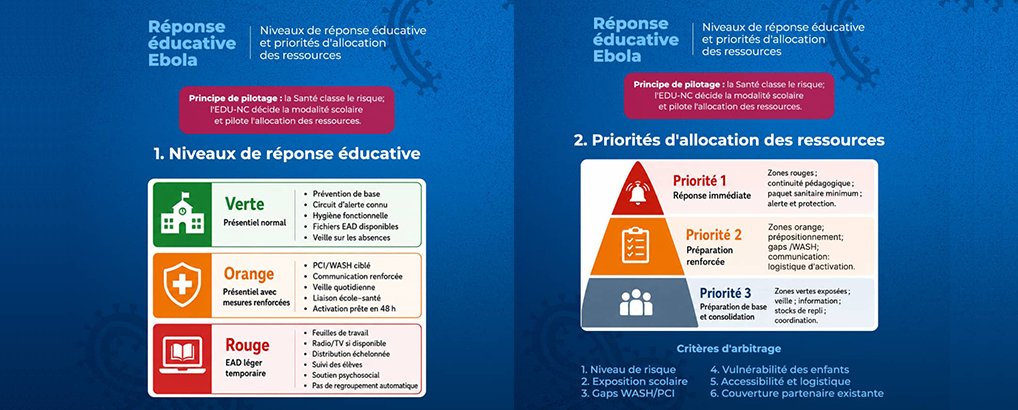
This system is based on a clear governance principle: the Health Department classifies the risk level; the Ministry of Education in New Caledonia (MINEDU-NC) decides on the appropriate schooling method and manages resource allocation. This coordination allows the educational response to be adapted to the evolving health situation and the specific realities of each area.
1. Three levels of educational response
The response from MINEDU-NC is organized around three levels: green, orange and red, corresponding to school arrangements and protection measures adapted to the level of risk.
In
green zones , the risk level allows for the continuation of normal in-person learning. However, basic preventative measures remain in place, including a known alert system, functional hygiene practices, the availability of distance learning (e-learning) materials, and careful monitoring of absences.
In
orange zones , in-person schooling continues with enhanced measures. These measures include targeted actions for infection prevention and control (IPC) and water, hygiene, and sanitation (WASH), improved communication, daily monitoring, and close collaboration between schools and health services. The system can also be activated within 48 hours should the situation change.
In
red zones , the Ministry of Education in New Caledonia (MINEDU-NC) plans to temporarily implement a reduced distance learning approach when health requirements necessitate it, in order to maintain learning while minimizing the risks associated with gatherings. Students may benefit from worksheets, radio or television broadcasts when available, and a staggered distribution of learning materials. The program also includes student monitoring and psychosocial support. No automatic regrouping of students is planned in these zones.
This gradation makes it possible not to apply a uniform response to the whole territory, but to favour an approach proportionate to the level of risk.
2. Risk-appropriate resource allocation priorities
In addition to school arrangements, the MINEDU-NC plans a differentiated allocation of resources in order to concentrate resources where the needs are most urgent.
Red zones constitute Priority 1 – Immediate Response. Resources there are primarily directed towards educational continuity, the implementation of a minimum health package, and alert and protection mechanisms.
The orange zones correspond to Priority 2
Enhanced preparation. Emphasis is placed on pre-positioning resources, identifying and reducing WASH gaps, communication, and logistical preparation necessary for a rapid activation of the response.
The exposed green areas fall under Priority 3
Basic preparation and consolidation. They benefit from monitoring and information actions, fallback stocks and enhanced coordination, in order to allow a rapid reaction in the event of a change in risk.
Resource allocation is guided by several arbitration criteria, including the level of risk, school exposure, gaps in IPC/WASH, child vulnerability, accessibility and logistical constraints, as well as the coverage of interventions already provided by partners.
Through this system, the Ministry of Education in New Caledonia (MINEDU-NC) intends to ensure an early, proportionate, and responsive approach, balancing health imperatives with the right to education. The objective is to enable every child to continue their learning in a way that is adapted to the situation in their area.
In the face of Ebola, the principle remains clear: the educational response adapts to the level of risk, resources are prioritized according to needs, but the continuity of learning remains a priority. No child will be left behind.
Jean Jeef Mwanza
https://edu-nc.gouv.cd/actualites/reponse-educative-a-ebola-le-minedu-nc-met-en-place-un-dispositif-gradue-pour-garantir-la-continuite-des-apprentissages

edu-nc.gouv.cd
-----------------------------------------------------------------------------
Translation Google
A risky return to school
DRC: Facing Ebola, a school year under high surveillance
Despite the spread of Ebola and calls for postponement, schools are reopening this September 1st in the DRC. In Ituri, however, authorities and teachers remain concerned.
by Merveille Assani
From our correspondent in Kinshasa (Democratic Republic of Congo)
Published on September 1, 2026 at 1:00 PM
Amid the escalating Ebola epidemic , the DRC is sending millions of students back to school. From Kinshasa to Bunia, the government has decided to maintain the 2026-2027 school year throughout the country. Authorities are now focusing on prevention and surveillance to ensure that schools do not become new hotspots for infection.
As of August 31, the country had recorded 2,911 deaths and just over 6,000 infected people in six provinces and 60 health zones, according to the latest situation report from the Ministry of Communication and Media.
In Ituri, the province at the epicenter of the epidemic, this decision comes amid a climate of concern. Teachers' organizations had called for the suspension of classes, arguing that the health conditions did not yet sufficiently guarantee the safety of students and educational staff. The government, however, chose to maintain the school calendar.
In Bunia, a return to school under surveillance
In Bunia, this position was reaffirmed on Thursday, August 27, following a workshop on Ebola prevention and protection in schools . Inspectors, educational staff, and representatives from schools were trained to prepare schools for the resumption of classes.
In total, 150 trainers will be tasked with passing on this knowledge to school principals, teachers, and parent committees. Handwashing and disease prevention facilities should be installed in the schools.
This confirmation comes just days after the government had considered a staggered return to school depending on the level of risk in areas affected by Ebola.
A turn of events
On August 18, during a briefing in Kinshasa, the Minister of State for National Education, Raïssa Malu, presented a system based on three levels of risk. In green zones, classes were to continue as normal.
In orange zones, where cases have been reported but transmission remains under control, in-person classes were to be maintained with enhanced health measures. In red zones, considered high-risk, regular classes were to be temporarily replaced by distance learning.
Of the 138 educational subdivisions identified in the affected provinces, 40 were considered to be affected by Ebola , including 18 classified as high risk. The ministry estimated that these latter 18 represented approximately 13% of all identified subdivisions.
The distance learning plan envisioned by the government was not intended to take the form of online courses. In the most affected areas, workbooks and educational materials covering essential knowledge were to be distributed to students. Radio broadcasts were also planned to supplement the program.
The minister's stated objective was to keep children in the school system while avoiding gatherings that could promote the transmission of the virus.
But on August 27, just days before the start of the school year, Ituri chose not to close its schools. "The start of the school year is set for Tuesday, September 1, 2026 ," confirmed Jean-Baptiste Ngona, acting provincial director of National Education in Ituri 1.
This development is occurring in a province where community resistance is complicating the response . Currently, Ituri remains the most affected province, with 28 out of 36 health zones impacted. Several sources report that some people continue to deny the existence of the disease. According to the WHO, the spread remains rapid and the risk of national and international expansion remains high.
"This is the fastest growing epidemic ever recorded ," United Nations Secretary-General Antonio Guterres reminded reporters at a press conference in New York.
The Ituri 1 inter-union group called on August 24th for the suspension of the 2026-2027 school year in Bunia until the Ebola virus disease outbreak is declared over throughout the province. For teachers, the issue is not only the continuity of classes, but also their own safety.
Teachers' fears
Patrick Girinegi, spokesperson for teachers in Ituri, states that, just days before the start of the school year, professionals in the sector had not yet received detailed information on the measures decided in Kinshasa. "We are still unaware of what Kinshasa has planned for the start of the school year. So far, we have not received any documents or official instructions ," he explains.
Discussions are nevertheless underway at the provincial level with the governor, non-governmental organizations and other partners to determine the protective measures to be put in place in the establishments.
For Patrick Girinegi, distance learning should not be considered the only possible solution. He specifically mentions the markets of Bunia, where gatherings continue despite the epidemic. "Distance learning should not be the last resort ," he argues, advocating instead for the implementation of a monitoring system in schools, with individuals capable of quickly identifying at-risk situations and alerting the relevant authorities.
In some public schools, free education has led to a sharp increase in student numbers. "Some classes have more than 90 students ," the teachers' representative points out. According to him, the province is working with the governor and several partners on a mechanism to reduce class sizes.
For the authorities, the challenge is immense. How can they keep children in school without turning the schools into new transmission sites ? "They promised to put measures in place to ensure our protection and indicated that these would be deployed in schools before or after the start of the school year. So we're waiting to see how this plays out on the ground ," says Girinegi.
For his part, he recommends regular hand washing, the provision of sanitary equipment, raising awareness among students, teachers and parents, as well as the rapid referral to health facilities of any person presenting symptoms, in order to limit the transmission of the epidemic.
----------------------------------------------------------------------------
Ebola: an isolation room for suspected cases set up in a school in Bunia
September 1, 2026
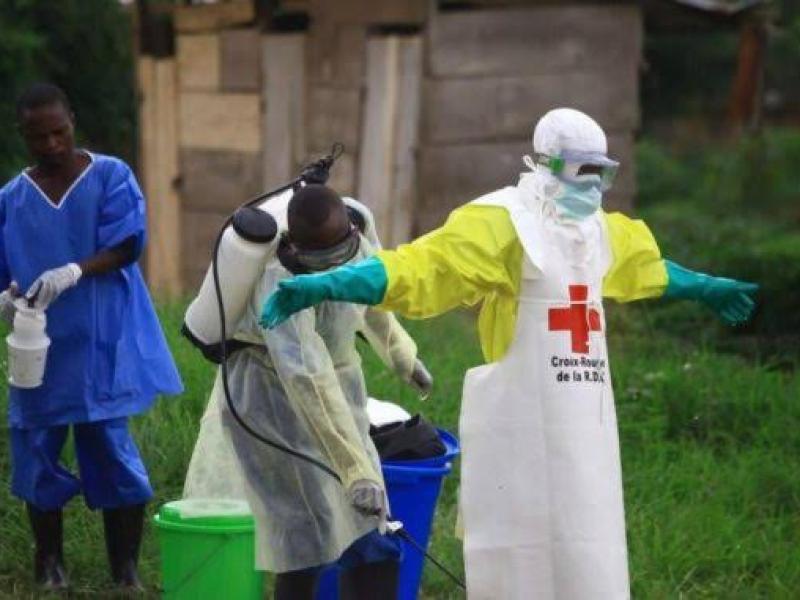
Bunia, September 1, 2026 (ACP).- A room reserved for the isolation of suspected cases has been set up at the Fabia school complex in Bunia, the provincial capital of Ituri, (Northeast) of the Democratic Republic of Congo, as part of the prevention plan against Ebola in schools, one of the school's officials indicated on Monday.
“ As soon as a student, a person from the school or a visitor has a high temperature, the procedure would be to put them in isolation in order to possibly call the relevant teams or even the student’s parents ,” explained Patrick Katsuva, deputy director of the primary school at the “Fabia” school complex.
He explained that this procedure should allow for the rapid separation of any person showing a warning sign, pending their evaluation and referral to a specialized health facility.
Mr. Katsuva stressed that school staff have been trained in alert management by the response teams, which facilitates the implementation of planned measures in case of suspicion.
" The system also includes handwashing stations installed at the entrances to the school and in front of classrooms, as well as temperature checks upon arrival of students, staff and visitors, " he reassured.
The 2026-2027 school year officially began on Tuesday, September 1st, in the Democratic Republic of Congo in general and in Bunia in particular, but within a challenging health context in Ituri, where the Ebola virus disease is prevalent. Several schools have reinforced hygiene measures. ACP/
Bunia, 1er septembre 2026 (ACP).- Une salle réservée à l’isolement des cas suspects a été aménagée au Complexe scolaire Fabia à Bunia, capitale provinciale de l'Ituri, (Nord-est) de la République démocratique du Congo, dans le cadre du dispositif de prévention contre Ebola en milieu scolaire, a...

acp.cd


 www.radiomoto.net