Follow along with the video below to see how to install our site as a web app on your home screen.
Note: This feature may not be available in some browsers.
FluTrackers.com Inc. does not provide medical advice. Information on this web site is collected from various internet resources, and the FluTrackers board of directors makes no warranty to the safety, efficacy, correctness or completeness of the information posted on this site by any author or poster.
The information collated here is for instructional and/or discussion purposes only and is NOT intended to diagnose or treat any disease, illness, or other medical condition. Every individual reader or poster should seek advice from their personal physician/healthcare practitioner before considering or using any interventions that are discussed on this website.
By continuing to access this website you agree to consult your personal physican before using any interventions posted on this website, and you agree to hold harmless FluTrackers.com Inc., the board of directors, the members, and all authors and posters for any effects from use of any medication, supplement, vitamin or other substance, device, intervention, etc. mentioned in posts on this website, or other internet venues referenced in posts on this website.
We are not asking for any donations. Do not donate to any entity who says they are raising funds for us.
Influenza at the human-animal interface Summary and assessment as of 3 March 2015 Human infection with avian influenza A(H5) viruses From 2003 through 3 March 2015,
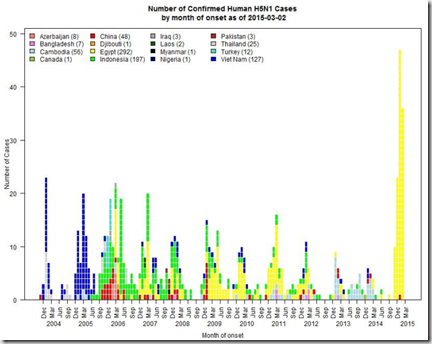
784 laboratory-confirmed human cases of avian influenza A(H5N1) virus infection have been officially reported to WHO from 16 countries. Of these cases, 429 have died. Since the last WHO Influenza update on 26 January 2015, 66 new laboratory-confirmed human cases of avian influenza A(H5N1) virus infection, including 13 fatal cases, were reported to WHO from Egypt (65) and China (one).
In the last update WHO announced 24 cases YTD 2015, now they are adding 65 which totals 89. I have 82 on my list, plus I take a conservative approach. I think not all cases were mentioned in the media. I will add the 7 new cases as a line item until I can review the entire chart to find those 7 cases:
This matches very closely to FluTrackers independently curated 2015 Egypt H5N1 Case List, which showed (as of this morning) 82 cases and 23 deaths for the year.
Summary and assessment as of 3 March 2015 Human infection with avian influenza A(H5) viruses From 2003 through 3 March 2015, 784 laboratory-confirmed human cases of avian influenza A(H5N1) virus infection have been officially reported to WHO from 16 countries. Of these cases, 429 have died.
Since the last WHO Influenza update on 26 January 2015, 66 new laboratory-confirmed human cases of avian influenza A(H5N1) virus infection, including 13 fatal cases, were reported to WHO from Egypt (65) and China (one).
Of the 65 human cases of influenza A(H5N1) virus infection reported from Egypt, 29 had onset of disease in January and the rest had onset of disease in February. The cases were reported from 18 different governorates of Egypt (see table 1 in the annex). The age range of the 65 cases is from one to 75 years, with a median of 26 years, and 23% of the cases are under 10 years of age. All cases had exposure to poultry or poultry markets, were hospitalized and all but one reportedly received treatment with antiviral medication.
Of the newly-reported cases, there was one cluster which included two confirmed cases in a mother and daughter from Fayoum governorate. The mother had an onset of illness two days prior to the daughter?s onset of illness and both had exposure to backyard poultry.
Currently, there are reports of an increased number of outbreaks and detections of influenza A(H5N1) viruses in poultry in Egypt compared to previous months and compared to this month in previous years. The number of laboratory-confirmed human cases of avian influenza A(H5N1) virus infection in Egypt with onsets of illness in the months of December 2014, January and February 2015 are the highest numbers reported by any country in a single month. Although all influenza viruses evolve over time, preliminary laboratory investigation has not detected major genetic changes in the viruses isolated from the patients or animals compared to previously circulating isolates , but further in depth analysis is ongoing. A new candidate vaccine virus was proposed to better protect against the current circulating H5 clade 2.2.1. viruses (a group which all the recent influenza A( H5N1) virus isolates from Egypt belong to). 1 The increase in the number of human cases is likely attributed to a mixture of factors, including increased circulation of influenza A(H5N1) viruses in poultry, lower public health awareness of risks in middle and upper Egypt and seasonal factors such as closer proximity to poultry because of cold weather and possible longer survival of the viruses in the environment. A high-level joint WHO/FAO/OIE mission to Egypt to assess the risks associated with the influenza A(H5N1) viruses and to recommend control measures is planned for early March 2015. China reported a human infection with an avian influenza A(H5N1) virus in a 37-year-old woman from Jiangsu province. She developed symptoms on 14 January 2015, was admitted to hospital on 20 January.
The patient had a history of exposure to poultry. No further cases among contacts were reported. China reported a human infection with an avian influenza A(H5N6) virus in a 44-year-old man from Yunnan province. He developed symptoms on 27 January 2015, was admitted to hospital on 3 February, and passed away on 6 February. The patient had a history of exposure to dead wild birds. No further cases among contacts were reported. This is the third human case of influenza A(H5N6) reported from China.
Various influenza A(H5) subtypes, such as influenza A(H5N1), A(H5N2), A(H5N3), A(H5N6) and A(H5N8), have recently been detected in birds in Europe, North America, and Asia, according to reports received by OIE. Although these influenza A(H5) viruses might have the potential to cause disease in humans, so far no human cases of infection have been reported, with exception of the human infections with influenza A(H5N1) viruses and the three human infections with influenza A(H5N6) virus detected in China since 2014. Overall public health risk assessment for avian influenza A(H5) viruses: Whenever avian influenza viruses are circulating in poultry, sporadic infections and small clusters of human cases are possible in people exposed to infected poultry or contaminated environments. Although an increased number of animal-to-human infections have been reported by Egypt over the past few months, these influenza A(H5) viruses do not currently appear to transmit easily among people.
As such, the risk of community level spread of these viruses remains to be low
Note:there is a 1 case discrepancy between the Updated WHO chart of January 26th, and the last summary update, hence the `roughly? qualifier. When the new case count chart if posted, that will hopefully clarify matters.
Our case list now has 91 total H5N1 human cases for 2015 after a review of the above WHO update.
There are a few cases directly announced by the Ministry of Health on their website that are not included on the WHO list. As with Saudi Arabia (MERS) and China (H7N9) case lists, the FluTrackers policy is to include central ministries of health announcements since there is usually a time lag before those cases appear on the WHO website.