Volume 26, Number 9—September 2020
Research Letter
Effectiveness of N95 Respirator Decontamination and Reuse against SARS-CoV-2 Virus
Robert J. Fischer, Dylan H. Morris, Neeltje van Doremalen, Shanda Sarchette, M. Jeremiah Matson, Trenton Bushmaker, Claude Kwe Yinda, Stephanie N. Seifert, Amandine Gamble, Brandi N. Williamson, Seth D. Judson, Emmie de Wit, James O. Lloyd-Smith, and Vincent J. Munster

Author affiliations: National Institute of Allergy and Infectious Diseases, Hamilton, Montana, USA (R.J. Fischer, N. van Doremalen, S. Sarchette, M.J. Matson, T. Bushmaker, C.K. Yinda, S.N. Seifert. B.N. Williamson, E. de Wit, V.J. Munster); Princeton University, Princeton, New Jersey, USA (D.H. Morris); Marshall University, Huntington, West Virginia, USA (M.J. Matson); University of California, Los Angeles, Los Angeles, California, USA (A. Gamble, J.O. Lloyd-Smith); University of Washington, Seattle, Washington, USA (S.D. Judson)
Cite This Article
Abstract
The coronavirus pandemic has created worldwide shortages of N95 respirators. We analyzed 4 decontamination methods for effectiveness in deactivating severe acute respiratory syndrome coronavirus 2 virus and effect on respirator function. Our results indicate that N95 respirators can be decontaminated and reused, but the integrity of respirator fit and seal must be maintained.
The unprecedented pandemic of coronavirus disease has created worldwide shortages of personal protective equipment, in particular respiratory protection such as N95 respirators (
1). Transmission of severe acute respiratory syndrome coronavirus 2 (SARS-CoV-2) occurs frequently in hospital settings; numerous reported cases of nosocomial transmission highlight the vulnerability of healthcare workers (
2). The environmental stability of SARS-CoV-2 virus underscores the need for rapid and effective decontamination methods.
In general, N95 respirators are designed for one use before disposal. Extensive literature is available for decontaminating N95 respirators of either bacterial spores, bacteria, or respiratory viruses (e.g. influenza A virus) (
3–
6). Effective inactivation methods for these pathogens and surrogates include UV light, ethylene oxide, vaporized hydrogen peroxide (VHP), gamma irradiation, ozone, and dry heat (A. Cramer et al., unpub data,
https://doi.org/10.1101/2020.03.28.20043471External Link) (
3–
6). The filtration efficiency and fit of N95 respirators has been less well explored, but reports suggest that both filtration efficiency and N95 respirator fit can be affected by the decontamination method used (
7;
Appendix).
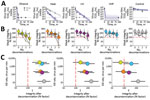
Figure. Results of decontamination of N95 respirators by 4 different methods. A) Inactivation of severe acute respiratory syndrome coronavirus 2 (SARS-CoV-2) virus (
Appendix). Points indicate estimated mean viable titer across...
We analyzed 4 different decontamination methods, UV light (260–285 nm), 70?C dry heat, 70% ethanol, and VHP, for their ability to reduce contamination with infectious SARS-CoV-2 and their effect on N95 respirator function. The starting inoculum of SARS-CoV-2 has cycle threshold values of 20–22, similar to those observed in samples obtained from the upper and lower respiratory tract in humans. For each of the decontamination methods, we compared the normal inactivation rate of SARS-CoV-2 virus on N95 filter fabric to that on stainless steel. Using quantitative fit testing, we measured the filtration performance of N95 respirators after each decontamination run and 2 hours of wear, for 3 consecutive decontamination and wear sessions (
Appendix). VHP and ethanol yielded extremely rapid inactivation both on N95 and on stainless steel (
Figure, panel A). UV light inactivated SARS-CoV-2 virus rapidly from steel but more slowly on N95 fabric, probable because of its porous nature. Heat caused more rapid inactivation on N95 than on steel; inactivation rates on N95 were comparable to UV.
Quantitative fit tests showed that the filtration performance of the N95 respirator was not markedly reduced after a single decontamination for any of the 4 decontamination methods (
Figure, panel B). Subsequent rounds of decontamination caused sharp drops in filtration performance of the ethanol-treated masks and, to a slightly lesser degree, the heat-treated masks. The VHP- and UV-treated masks retained comparable filtration performance to the control group after 2 rounds of decontamination and maintained acceptable performance after 3 rounds.
Our findings showed that VHP treatment had the best combination of rapid inactivation of SARS-CoV-2 virus and preservation of N95 respirator integrity under the experimental conditions (
Figure, panel C). UV light killed the virus more slowly and preserved respirator function almost as well. Dry heat at 70?C killed the virus with similar speed to UV and is likely to maintain acceptable fit scores for 1–2 rounds of decontamination but should not be used for 3 rounds. Consistent with earlier findings (
8), ethanol decontamination reduced N95 integrity and is not recommended.
All treatments, particularly UV light and dry heat, should be conducted for long enough to ensure sufficient reduction in virus concentration. The degree of required reduction depends upon the degree of initial virus contamination. Policymakers can use our estimated decay rates together with estimates of real-world contamination to choose appropriate treatment durations (
Appendix).
Our results indicate that, in times of shortage, N95 respirators can be decontaminated and reused up to 3 times by using UV light and HPV and 1–2 times by using dry heat. Following nationally established guidelines for fit testing, seal check, and respirator reuse is critical (
9,10). We recommend performing decontamination for sufficient time and ensuring proper function of the respirators after decontamination using readily available qualitative fit testing tools.
Dr. Fischer is a member of the Virus Ecology Section at the Rocky Mountain Laboratories Division of Intramural Research, National Institute of Allergy and Infectious Diseases, National Institutes of Health. His research interests include the ecology of emerging viruses in their natural and spillover hosts, including SARS-CoV-2.
Top
Acknowledgments
We thank Madison Hebner, Julia Port, Kimberly Meade-White, Irene Offei Owusu, Victoria Avanzato, and Lizzette Perez-Perez for excellent technical assistance.
This research was supported by the Intramural Research Program of the National Institute of Allergy and Infectious Diseases, National Institutes of Health. J.O.L.-S. and A.G. were supported by the Defense Advanced Research Projects Agency PREEMPT no. D18AC00031 and the UCLA AIDS Institute and Charity Treks, and J.O.L.-S. was supported by the US National Science Foundation (DEB-1557022), the Strategic Environmental Research and Development Program (RC‐2635) of the US Department of Defense.
Top
References
- Ranney ML, Griffeth V, Jha AK. Critical supply shortages—the need for ventilators and personal protective equipment during the Covid-19 pandemic. N Engl J Med. 2020;382:e41. DOIExternal LinkPubMedExternal Link
- McMichael TM, Currie DW, Clark S, Pogosjans S, Kay M, Schwartz NG, et al.; Public Health–Seattle and King County, EvergreenHealth, and CDC COVID-19 Investigation Team. Epidemiology of Covid-19 in a long-term care facility in King County, Washington. N Engl J Med. 2020;382:2005–11. DOIExternal LinkPubMedExternal Link
- Batelle. Final report for the Bioquell hydrogen peroxide vapor (HPV) decontamination for reuse of N95 respirators. 2016 [cited 2020 May 22]. https://www.fda.gov/media/136386/downloadExternal LinkExternal Link
- Fisher EM, Shaffer RE. A method to determine the available UV-C dose for the decontamination of filtering facepiece respirators. J Appl Microbiol. 2011;110:287–95. DOIExternal LinkPubMedExternal Link
- Heimbuch BK, Wallace WH, Kinney K, Lumley AE, Wu CY, Woo MH, et al. A pandemic influenza preparedness study: use of energetic methods to decontaminate filtering facepiece respirators contaminated with H1N1 aerosols and droplets. Am J Infect Control. 2011;39:e1–9. DOIExternal LinkPubMedExternal Link
- Lin TH, Tang FC, Hung PC, Hua ZC, Lai CY. Rel ative survival of Bacillus subtilis spores loaded on filtering facepiece respirators after five decontamination methods. Indoor Air. 2018;28:754–62. DOIExternal LinkPubMedExternal Link
- Lin TH, Chen CC, Huang SH, Kuo CW, Lai CY, Li n WY. Filter quality of electret masks in filtering 14.6-594 nm aerosol particles: Effects of five decontamination methods. PLoS One. 2017;12:e0186217. DOIExternal LinkPubMedExternal Link
- Viscusi DJ, Bergman MS, Eimer BC, Shaffer RE. Evaluation of five decontamination methods for filtering facepiece respirators. Ann Occup Hyg. 2009;53:815–27.PubMedExternal Link
- US Centers for Disease Control and Prevention. Decontamination and reuse of filtering facepiece respirators. 2020 [cited 2020 Apr 5]. https://www.cdc.gov/coronavirus/2019...spirators.html
- US National Institute for Occupational Safety and Health; US Centers for Disease Control and Prevention. Recommended guidance for extended use and limited reuse of N95 filtering facepiece respirators in healthcare settings. 2020 [cited 2020 May 22]. https://www.cdc.gov/niosh/topics/hcw...nceextuse.html
https://wwwnc.cdc.gov/eid/article/26/9/20-1524_article