
• FluTrackers.com Inc. does not provide medical advice. Information on this web site is collected from various internet resources, and the FluTrackers board of directors makes no warranty to the safety, efficacy, correctness or completeness of the information posted on this site by any author or poster. The information collated here is for instructional and/or discussion purposes only and is NOT intended to diagnose or treat any disease, illness, or other medical condition. Every individual reader or poster should seek advice from their personal physician/healthcare practitioner before considering or using any interventions that are discussed on this website. By continuing to access this website you agree to consult your personal physican before using any interventions posted on this website, and you agree to hold harmless FluTrackers.com Inc., the board of directors, the members, and all authors and posters for any effects from use of any medication, supplement, vitamin or other substance, device, intervention, etc. mentioned in posts on this website, or other internet venues referenced in posts on this website.
  • We are not asking for any donations. Do not donate to any entity who says they are raising funds for us.

Emergence of recombinant Mayaro virus strains from the Amazon basin

Gert van der Hoek

In Memoriam - Editor, Senior Moderator
[FONT=&quot]18 August 2017[/FONT]

Abstract

Mayaro virus (MAYV), causative agent of Mayaro Fever, is an arbovirus transmitted by Haemagogus mosquitoes. Despite recent attention due to the identification of several cases in South and Central America and the Caribbean, limited information on MAYV evolution and epidemiology exists and represents a barrier to prevention of further spread.

We present a thorough spatiotemporal evolutionary study of MAYV full-genome sequences collected over the last sixty years within South America and Haiti, revealing recent recombination events and adaptation to a broad host and vector range, including
Aedes mosquito species.

We employed a Bayesian phylogeography approach to characterize the emergence of recombinants in Brazil and Haiti and report evidence in favor of the putative role of human mobility in facilitating recombination among MAYV strains from geographically distinct regions.

Spatiotemporal characteristics of recombination events and the emergence of this previously neglected virus in Haiti, a known hub for pathogen spread to the Americas, warrants close monitoring of MAYV infection in the immediate future.
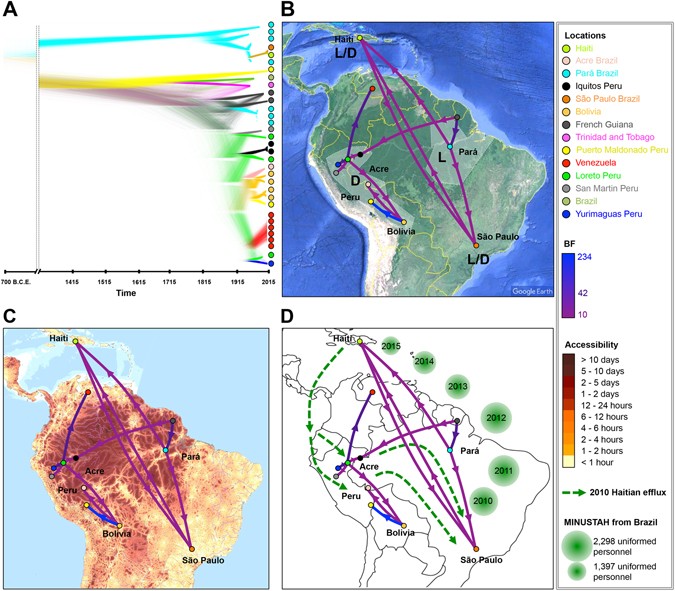

we propose that recent changes in human mobility patterns connecting ..... Brazilian regions may have facilitated recombination between the two MAYV genotypes, as well as their introduction to non-endemic areas such as S?o Paulo and Haiti

41598_2017_7152_Fig6_HTML.jpg


[FONT=&quot]Schematic representation of the relationship between MAYV spread and human population connectivity and migration patterns among central South American and Haiti following the 2010 Haiti earthquake.[/FONT]

[FONT=&quot]LINK TO FULL ARTICLE[/FONT]
 
Published Date: 2018-09-09 19:23:51
Subject: PRO/EDR> Undiagnosed febrile illness - Haiti: Mayaro virus susp. RFI
Archive Number: 20180909.6018117

UNDIAGNOSED ILLNESS - HAITI: MAYARO VIRUS SUSPECTED, REQUEST FOR INFORMATION
****************************************************************************

Date: 9 Sep 2018
Source: ProMED-mail <promed@promedmail.org>


[There has been significant chatter on social media from individuals working in Haiti and their colleagues, friends and family, suggesting there is a "new, as yet undiagnosed outbreak," possibly of a mosquito-borne disease, in the expat and local Haitian communities. Some of the content of this social media chatter is excerpted below [edited for clarity/readability - CopyEd.MSP]. - Mod.MPP]
 
Brazil - Mayaro, a relative of the chikungunya virus, is already circulating in the Southeast, points out UFRJ

16 05 2019

Researchers at the University of Rio de Janeiro (UFRJ) have discovered that the Mayaro virus, a relative of the chikungunya, is circulating in the state. The new virus causes disease with symptoms similar to those of other arboviruses such as chikungunya. Symptoms are high fever, muscle aches, headaches and joints.


"The mayaro is already here and it is transmitted by the mosquito Haemagogus, the same mosquito that transmits the virus of the yellow fever. The Mayaro virus that is here in Rio de Janeiro, as well as that of yellow fever, is still wild, that is, it is in the high forests, it has not yet become eminently urban, "explained Rodrigo Brindeiro, one of the authors of the study on the virus mayaro and coordinator of the Zika Network of UFRJ.


According to a recently reported study, in recent years the number of mayaro virus infections has increased in the central and northern regions of Brazil. Since the last chikungunya epidemic in 2016, researchers have already warned of the risk of the spread of the Mayaro virus in large cities in the southeast region and with potential to establish an epidemic scenario in Brazil.

The mayaro virus is an arbovirus of the Togaviridae family, genus Alphavirus, whose main vector is the Haemagogus mosquito, which lives in more wild areas, such as forests or closed forests.


According to Am?lcar Tanuri, coordinator of the Laboratory of Molecular Virology of UFRJ, where the study was conducted, in 2016, 279 samples had clinical indication of chikungunya. However, 57 gave inconclusive results.

"We became suspicious and decided to take a molecular test to test inconclusive samples. To our surprise, of these 57 samples, we found three containing RNA compatible with mayaro and coincidentally the samples were from residents of the city of Niteroi and autochthonous, "he explained.


The epidemiological history of mayaro infection began in 1954 in Trinidad and Tobago when the virus was isolated from blood samples from five rural workers who had a febrile illness. The virus was named in reference to the municipality of Mayaro, southeast of Trinidad, where cases were recorded.

The virus has been reported in some countries of Central and South America, usually in places with tropical forests such as French Guiana, Bolivia, Peru, Suriname, Costa Rica, Guatemala, Venezuela, Mexico, Ecuador, Guyana, Panama and Brazil.
 
Back
Top Bottom