• FluTrackers.com Inc. does not provide medical advice. Information on this web site is collected from various internet resources, and the FluTrackers board of directors makes no warranty to the safety, efficacy, correctness or completeness of the information posted on this site by any author or poster. The information collated here is for instructional and/or discussion purposes only and is NOT intended to diagnose or treat any disease, illness, or other medical condition. Every individual reader or poster should seek advice from their personal physician/healthcare practitioner before considering or using any interventions that are discussed on this website. By continuing to access this website you agree to consult your personal physican before using any interventions posted on this website, and you agree to hold harmless FluTrackers.com Inc., the board of directors, the members, and all authors and posters for any effects from use of any medication, supplement, vitamin or other substance, device, intervention, etc. mentioned in posts on this website, or other internet venues referenced in posts on this website.
  • We are not asking for any donations. Do not donate to any entity who says they are raising funds for us.

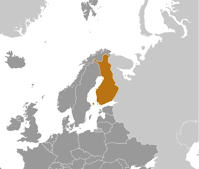
Finland - Outbreaks of highly pathogenic avian influenza H5N1 in raccoon dogs, Arctic foxes, American minks and red foxes in fur farms

Pathfinder

Editor, Senior Moderator
Finland - Influenza A viruses of high pathogenicity (Inf. with) (non-poultry including wild birds) (2017-) - Immediate notification

GENERAL INFORMATION
COUNTRY/TERRITORY OR ZONE
ZONE

ANIMAL TYPE
TERRESTRIAL

DISEASE CATEGORY
Listed disease

EVENT ID
5119

DISEASE
Influenza A viruses of high pathogenicity (Inf. with) (non-poultry including wild birds) (2017-)

CAUSAL AGENT
Highly pathogenic avian influenza virus

GENOTYPE / SEROTYPE / SUBTYPE
H5N1

START DATE
2023/07/06

REASON FOR NOTIFICATION
Unusual host species

DATE OF LAST OCCURRENCE
-

CONFIRMATION DATE
2023/07/13

EVENT STATUS
On-going

END DATE
-

SELF-DECLARATION
NO

REPORT INFORMATION
REPORT NUMBER
Immediate notification

REPORT ID
IN_161810

REPORT REFERENCE
-

REPORT DATE
2023/07/13

REPORT STATUS
Validated

NO EVOLUTION REPORT
-

EPIDEMIOLOGY
SOURCE OF EVENT OR ORIGIN OF INFECTION
Unknown or inconclusive

EPIDEMIOLOGICAL COMMENTS
A focal outbreak on a fur farm raising arctic foxes and raccoon dogs. Plenty of black-headed gulls have been observed around and at the fur farm. Currently no control measures are applied as HPAI is not "listed disease" in fur animals. Further sampling is planned on the fur farm. Veterinary authorities are working in tight collaboration with the public health authority. Improved biosecurity measures and use of personal protection equipment on fur farms are encouraged.
...

NEW OUTBREAKS

OB_121770 - KAUSTINEN

OUTBREAK REFERENCE
-

START DATE
2023/07/06

END DATE
-

DETAILED CHARACTERISATION
-

FIRST ADMINISTRATIVE DIVISION
Länsi- ja Sisä-Suomen aluehallintovirasto

SECOND ADMINISTRATIVE DIVISION
Keski-Pohjanmaa

THIRD ADMINISTRATIVE DIVISION
Kaustinen

EPIDEMIOLOGICAL UNIT
Farm

LOCATION
Kaustinen

Latitude, Longitude
63.549 , 23.692

(Approximate location)
OUTBREAKS IN CLUSTER
-

MEASURING UNIT
Animal

AFFECTED POPULATION DESCRIPTION
A focal outbreak in a fur farm. Increased mortality in litters, also some adult animals have died. Three pups were examined and found positive for HPAI H5N1.


SpeciesSusceptibleCasesDeathsKilled and Disposed ofSlaughtered/ Killed for commercial useVaccinated
Raccoon dog (WILD)
Captive
NEW 1500
- - - - -
TOTAL 1500 - - - - -
Arctic Fox (WILD)
Captive
NEW 3500
3 3 - - -
TOTAL 3500 3 3 - - -
All species
NEW 5000
3 3 - - -
TOTAL 5000 3 3 - - -​

...

https://wahis.woah.org/#/in-review/5119​
 
Bird flu detected on Finnish fur farms for the first time
The exact virus type is still being determined, but measures are being taken to protect workers and prevent transmission to humans.
Yle News
11:16

Avian influenza has been detected on a fur farm in Kaustinen, Western Finland, the Finnish Food Authority has stated. This marks the first known infection of avian influenza, also known as 'bird flu', in fur animals in Finland.

Infections have been detected at five fur farms in Ostrobothnia, although efforts to determine the exact virus type are still ongoing. The farms are located in the towns of Halsua, Kaustinen, and Kauhava.

The infections did not result in any restrictions being imposed on the fur farms by the animal health authorities. The Finnish Food Authority suggested that the infections likely originated from wild birds.

The authority further advised workers on the farms to take protective and hygiene measures and to prevent wild birds from coming into contact with farm animals. The virus has limited transmissibility to humans, as infection typically requires close contact with a sick animal or its secretions, the authority noted...​
 
Finnish Food Authority Update On H5N1 In Additional Fur Farms

AVvXsEgf08jUxPcMTzbYvsYOKaqv4P_d7JJMQaFXGRC3HjVdc3_0mcZbeg_l41PSBUZ038USnpGNbHSTEme4hAKNMIMbm-gcsjF5Ni06O1aNEiqE7n6RU-KN25oOOUwa0cbVmcweh6CV7FDNGdMUaq1GgLYdRz8nQxRZ01N7QF4Id6lxw_8KLr0GkogHIQ=w200-h169


#17,549


The Finnish Food Authority (Ruokavirasto) has posted an update on the 4 additional fur farms infected with H5N1 that were mentioned in yesterday's blog. The virus has now been reported from 5 different farms, and today we learn that mink were infected (along with foxes) at a farm in Kauhavala.

It is unclear what steps, if any, are being taken by these farms to prevent the spread of the virus. All we are told is that they do not fall under the jurisdiction of the `animal disease authority​'.


The translated statement follows

Bird flu also in the animals of four fur farms

July 14, 2023

Highly pathogenic bird flu of the H5N1 type has been confirmed in the animals of four fur farms in southern and central Pohlia that have been investigated by the Food Agency. It is the same strain of virus that was found yesterday Thursday in the blue foxes of the fur farm in Kaustinen, and which has caused several mass deaths of wild birds this year. The disease has now been found in a total of five fur farms.

Two of the new shelter cases are located in Kauhava, South Ostrobothnia, one in Kausti and one in Halsua, Central Ostrobothnia. Avian flu was also now found in blue foxes and in the mink of another shelter in Kauhavala. The breeders had sent samples to the Food Agency to be examined in order to find out the cause of illness or death of the animals.

Bird flu infection in fur animals does not cause the shelter to be subject to restrictions imposed by the animal disease authority. However, the Food Agency and the regional administrative agencies are monitoring the situation in cooperation with the Health and Welfare Institute (THL) and the health authorities of the welfare regions.

The Food Agency is currently examining samples from several mass deaths of seagulls from different parts of Finland. The website of the Food Agency is updated with information on confirmed bird flu cases.


https://afludiary.blogspot.com/2023/07/finnish-food-authority-update-on-h5n1.html

 
Finnish Food Agency Changes Disease Classification of Bird Flu on Fur Farms


AVvXsEhXxZXqxFwTpTeFrvS66hcZ6w3CYLwJMPNtYVEKuBYq8K2ic7CYpMIdq9ULQ4B0Qeuh9D-2Yx1aQ_hqPjwMgY7dZFw80PbJZ0aIVmOqoMCN4oGZ3F8W6t9aYeZLfQs1tD_yxNVFXJde5-2YKuwhzPYxUSh4VFo56gBZuFO_jCHLWHTPVGouvmhlJg

#17,557


Last Thursday and Friday (see here and here) the Finnish Food Authority (Ruokavirasto) announced outbreaks of H5N1 on 5 fur farms, infecting thousands of blue foxes, raccoon dogs, and mink.
Other than recommending the use of PPEs, and urging that employees contact health care for instructions if they fell ill, little was said about mitigation efforts (e.g. quarantine, culling, etc.).​


Somewhat surprisingly, the agency stated that fur farms in Finland did not fall under the jurisdiction of the `animal disease authority'.

Apparently this `gap' in governmental oversight is being addressed, according to the following statement from the the Finnish Food Authority.

(Translated)​
The Finnish Food Agency is preparing to combat bird flu on fur farms

July 18, 2023

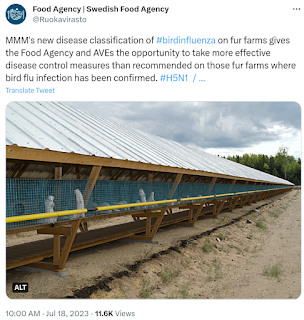
The Ministry of Agriculture and Forestry changed the disease classification of bird flu on fur farms on Tuesday 18 July 2023. This gives the Food Agency and regional administrative agencies the opportunity to take more effective disease control measures than the recommendations at those fur farms where bird flu infection has been confirmed. The first official actions will be initiated as soon as possible. Currently, the infection has been confirmed on five fur farms. Investigations are still ongoing.

As a first measure, the Regional Administration Office imposes site-specific activity restrictions to prevent the spread of infections through animals, feed, manure or other material. The Finnish Food Agency is currently preparing decisions to euthanize animals on infected fur farms and to organize euthanasia. The number of animals ordered to be euthanized is based on a farm-specific assessment of the spread of the infection on the farm. Animal owners have the right to seek compensation from state funds for animals euthanized by order of the Food Agency. The state is also responsible for the costs of other official actions to eradicate the infection.

Wild birds are the most significant source of avian influenza infection for fur animals. All fur farms must take care of the control of wild birds and rodents (e.g. bird nets, bird repellents and deterrents, protection of feed and feed storage, cleaning and proper storage of waste feed, rodent control baits) and biosecurity.

More information:

Head of Unit Sirpa Kiviruusu, tel. 0400 920503.
E-mail: firstname.surname@ruokavirasto.fi

https://afludiary.blogspot.com/2023/07/finnish-food-agency-changes-disease.html
 
Finland: Food Authority Orders More Measures To Combat Avian Flu


#17,559

After being caught powerless last week to regulate fur farms affected by avian flu, yesterday the Finnish Food Authority (Ruokavirasto) announced rule changes that would give them jurisdiction (see Finnish Food Agency Changes Disease Classification of Bird Flu on Fur Farms).

With 5 farms known to be affected, and thousands of animals exposed or infected, the losses for the fur industry are likely to be substantial. Investigations are reportedly underway in as many as 10 other fur farms.​

While the source of infection of these 5 farms remains unclear, authorities are looking at a variety of sources of contamination, including feed and feed storage facilities. Today the Food Safety Agency issued the following orders to the feed industry.

Measures by feed industry operators to combat bird flu

July 19, 2023

Bird flu has been found in large numbers in wild birds this summer, and bird flu has also been found in fur animals. The spread of the infection in poultry or further in fur animals causes large losses and regional activity restrictions. Bird flu can also infect humans. Due to the seriousness of the situation and to prevent the spread of the disease, feed industry operators should also pay special attention to protective measures.


The measures taken to combat bird flu are similar to the measures taken to combat other animal diseases - such as salmonella. Due to the bird flu situation, it is now necessary to observe special precision in these procedures. The cleanliness of the production and storage facilities as well as the transport equipment must be taken care of with sufficient cleaning measures and birds must be prevented from entering the premises. As far as possible, operators must ensure that there are no factors that attract birds, such as food that has fallen to the ground, in the facility area. The disease can also spread via transport equipment.

The Food Agency
The operating instructions for cargo mixers, feed transporters and farms to prevent the spread of salmonella also apply to the fight against avian flu, where applicable. Read more on the Food Agency's website: https://www.ruokavirasto.fi/elaimet/elainten-terveys-ja-elaintaudit/elaintaudit/siipikarja/lintuinfluenssa/ahkanohaista-lintuinfluenssasta/ .

While the fur trade has largely fallen out of favor in the United States, and fur farms have been recently banned in several EU nations, it is still a major industry in parts of Northern Europe, Russia, and China. In many places, particularly in Asia, there is little regulation (see China: Avian-Origin Canine H3N2 Prevalence In Farmed Dogs).

Many of the animals raised on these farms (e.g. mink, sable, foxes, raccoon dogs, etc.) have been shown to be highly susceptible to respiratory viruses - including influenza A and COVID - raising concerns over their potential role in generating a future pandemic virus.​


A few (of many) past blogs on these concerns include:

Of course, the next pandemic could certainly emerge from the wild without being aided and abetted by human actions.

But by putting thousands of these highly susceptible animals into close quarters (often with poor biosecurity), we are giving H5N1 and SARS-CoV-2 (and other emerging viruses) ample opportunities to adapt to mammals and begin a world tour.​

Over the past 3 years the amount of H5N1 in the environment has grown dramatically. Practices (like fur farming, letting your cat run free outdoors, or picking up a sick bird) that were presumably less dangerous prior to 2020 are arguably more dangerous now.
A bitter pill if you are in the fur business, or are a cat that likes its freedom, or work for a seabird rescue organization.​

But we either find ways to adapt to this `new normal', or we run the risk that the virus will adapt to us instead.


https://afludiary.blogspot.com/2023/07/finland-food-authority-orders-more.html
 
Finland: Finnish Food Authority Adds 5 More Fur Farms To H5N1 List


#17,560

Earlier today I mentioned that Finland's Food Safety Authority was investigating as many as 10 additional fur farms for possible HPAI H5N1 infection.

While we don't have any official announcement, the Finnish Ruokavirasto website has updated their list (see below), which added 5 new farms today (July 19th). My thanks to @thijskuiken for retweeting the link.​

With hundreds of fur farms still in operation in Finland, these numbers could easily go up from here. If we get another press statement from Finnish authorities today, I'll update this post.


https://afludiary.blogspot.com/2023/07/finland-finnish-food-authority-adds-5.html
 
Finland: Food Agency Establishes An Infection Zone Due to Bird Flu


AVvXsEhOQqlh3kn0RKiF5qcocgfx1qVMysceShiLm82HEuJB9vtwij7HaxKEVZeBD1UaFAdYr6JfoccbLB1JWhPaYGrH5ranemnOTdA85d1xn0UnjQYfDXrTqPZaafQabsDsu3jkqdfpHIOnGlDTUAWkrZx9CHZolqTYKgWCoorrTSYSjCT2N4XabqNO0g


#17,562

Yesterday, after saying they were powerless to regulate fur farms affected by avian flu, the Finnish Food Authority (Ruokavirasto) announced rule changes that would give them jurisdiction (see Finland: Food Authority Orders More Measures To Combat Avian Flu) over those facilities.

With the number of premises affected by avian flu growing, and the number of fur-bearing animals susceptible now reportedly having risen from 5,000 last week to nearly 120,000 today (see WAHIS report), we are seeing a much more proactive stance being taken by their food safety agency (Ruokavirasto).​

Today they announced the immediate imposition of a Bird Flu Infection Zone, covering 5 provinces.

(translation)

The Finnish Food Agency establishes an infection zone due to bird flu

July 20, 2023

In Finland, in June-July 2023, highly pathogenic bird flu of the H5N1 type has been detected in several localities. The disease has been found especially in seagulls. In addition, the disease caused by the virus has been found in farmed fur animals in Southern and Central Ostrobothnia. Currently, the infection has been confirmed on ten fur farms. Investigations are still ongoing.

Pursuant to the Animal Diseases Act, the Finnish Food Agency establishes an infection zone with the aim of preventing further spread of the disease. The infection zone covers the provinces of Varsinais-Suomen, Satakunta, South Ostrobothnia, Ostrobothnia and Central Ostrobothnia. The decision is effective immediately.

It is forbidden to keep poultry and captive birds outside in the infected zone. The ban also applies to venues engaged in organic production. Exceptions can be found in the decision.

Measures to be taken in the infection zone to prevent the spread of infection

  • Visits by persons to the animal shelter for poultry and captive birds are prohibited for reasons other than essential.
  • Persons visiting an animal shelter for poultry or captive birds must wear only the protective clothing used in that animal shelter, and change footwear when entering and exiting the animal shelter. In addition, hands must be washed and disinfected when entering the animal shelter. If it is not possible to wash your hands, you must still disinfect your hands.
  • Bird feeds and bedding must be stored so that wild birds cannot come into contact with them.
The infection zone is abolished when the Food Agency assesses that there is no longer a need for it to prevent the spread of bird flu. The Food Agency also informs separately about the termination of the zone.

The Food Agency recommends that poultry be carefully protected in other parts of the country as well. If symptoms suggestive of bird flu, abnormal mortality or changes in production are observed in poultry or other birds, the municipal or county veterinarian must be notified immediately. A decrease in water and feed consumption or egg production can be signs of bird flu infection.

Mass deaths of wild birds and individual dead birds of prey must also be reported to the municipal or county veterinarian. The municipal veterinarian takes care of sending the necessary samples to the Helsinki office of the Food Agency.

Avian flu viruses are poorly contagious to humans, and infection usually requires close contact with an infected wild bird, poultry or their secretions.

More information:

Head of Unit Sirpa Kiviruusu, tel. 0400 920503.
E-mail: firstname.surname@ruokavirasto.fi


https://afludiary.blogspot.com/2023/07/finland-food-agency-establishes.html
 
Finland - Influenza A viruses of high pathogenicity (Inf. with) (non-poultry including wild birds) (2017-) - Follow up report 1

GENERAL INFORMATION
COUNTRY/TERRITORY OR ZONE
ZONE

ANIMAL TYPE
TERRESTRIAL

DISEASE CATEGORY
Listed disease

EVENT ID
5119

DISEASE
Influenza A viruses of high pathogenicity (Inf. with) (non-poultry including wild birds) (2017-)

CAUSAL AGENT
Highly pathogenic avian influenza virus

GENOTYPE / SEROTYPE / SUBTYPE
H5N1

START DATE
2023/06/30

REASON FOR NOTIFICATION
Unusual host species

DATE OF LAST OCCURRENCE
-

CONFIRMATION DATE
2023/07/13

EVENT STATUS
On-going

END DATE
-

SELF-DECLARATION
NO

REPORT INFORMATION
REPORT NUMBER
Follow-up report 1

REPORT ID
FUR_161911

REPORT REFERENCE
-

REPORT DATE
2023/07/20

REPORT STATUS
Validated

NO EVOLUTION REPORT
-

EPIDEMIOLOGY
SOURCE OF EVENT OR ORIGIN OF INFECTION
Unknown or inconclusive

EPIDEMIOLOGICAL COMMENTS
A focal outbreak on a fur farm raising arctic foxes and raccoon dogs. Plenty of black-headed gulls have been observed around and at the fur farm. Currently no control measures are applied as HPAI is not "listed disease" in fur animals. Further sampling is planned on the fur farm. Veterinary authorities are working in tight collaboration with the public health authority. Improved biosecurity measures and use of personal protection equipment on fur farms are encouraged.


QUANTITATIVE DATA SUMMARY
MEASURING UNIT
Animal

SpeciesSusceptibleCasesDeathsKilled and Disposed ofSlaughtered/ Killed for commercial useVaccinated American
Mink (WILD)
NEW 15000
13 13 - - -
TOTAL 15000 13 13 - - -
Raccoon dog (WILD) NEW - - - - - -
TOTAL 1500 - - - - -
Arctic Fox (WILD)
NEW 99373
32 32 - - -
TOTAL 102873 35 35 - - -
All species
NEW 114373
45 45 - - -
TOTAL 119373 48 48 - - -​

DIAGNOSTIC DETAILS
CLINICAL SIGNS
YES

...

NEW OUTBREAKS

OB_122146 - KAUSTINEN
OB_122142 - KAUSTINEN
OB_122138 - KAUSTINEN
OB_122136 - KAUSTINEN
OB_122130 - KORTESJÄRVI
OB_122128 - HALSUA
OB_122110 - KAUHAVA
OB_122107 - KAUSTINEN

PREVIOUSLY REPORTED OUTBREAKS

OB_121770 - KAUSTINEN

...
https://wahis.woah.org/#/in-review/5119​
 
Finland Food Authority: Preliminary Sequencing Of H5N1 In Fur Farms


AVvXsEgcnSIEdD0wWFdVBV-wG23Xjm5UMv7sbpp1ojviWPvIPjwnDCGq8xeEcU9ueLe-RXGd6fwjV_3yiDyzMFR-KT2uAkum5NsUIdoAXPq4EcN6o40GrqE2FQCTFLngAGcuWKxF6CURuALbreWHgCqamhIQasd2TXnmU0Gh8wSyZIL-89C_6n2Hyx80Rw=w200-h148


#17,564

We've a brief update from the Finnish Food Authority (Ruokavirasto) providing a few additional details regarding the H5N1 virus that has spread - at last report - to at least 10 fur farms in that country.
Although the report hints at other possible amino acid changes, the one specifically mentioned is PB2-E627K; the swapping out of Glutamic acid (E) for Lysine (K) at position 627 in the PB2 protein, which allows the virus to replicate at a lower temperature.​

The virus is reportedly most closely related to one detected recently in seagulls in Finland, leading the agency to suspect the virus is being spread by these birds.

(translated)

The virus line that circulates especially among seagulls has been confirmed as the cause of bird flu infections in fur animals

July 21, 2023

The preliminary sequencing results of H5N1 subtype bird flu viruses detected in fur farms in Western Finland have been completed. Based on the results, the virus line circulating especially among seagulls has been confirmed as the causative agent of fur animals. The results point to the involvement of wild birds in the spread of the virus to fur farms.

In some of the samples collected from the fur farms, there were indications that a mutation has taken place in the virus that contributes to the multiplication of the virus in mammalian cells, including the previously known PB2-E627K mutation. However, this adaptation is not known to increase the ability of the virus to infect humans.

Sequencing, i.e. the study of the virus's genome and the changes that occur in it, can be used to support epidemic investigations in the investigation of the source of infection and chains of infection, and in the implementation of timely and extensive control measures.

The Food Agency and the Institute of Health and Welfare continue to investigate the epidemic in cooperation with the Regional Administration and international actors.


The Finnish Food Agency also published the following statement regarding enhanced biosecurity measures that those raising birds should be following due to the elevated level of H5N1 in wild birds.

(translated)

The Food Agency also recommends keeping hobby chickens indoors throughout Finland - wild birds have a lot of bird flu

July 21, 2023

The Food Agency recommends keeping birds indoors or otherwise ensuring that wild birds do not come into contact with poultry and captive birds or the feed and water offered to them. Bird flu is easily spread from wild birds to poultry and other birds, if the birds come into contact with each other directly or, for example, through feed contaminated with feces.

Feeds and bedding intended for birds should be stored in such a way that wild birds cannot come into contact with them. Bird flu can also spread over longer distances, e.g. with people or equipment contaminated with the virus.

If symptoms suggestive of bird flu or abnormal mortality are observed in poultry or other birds, the municipal or county veterinarian must be notified immediately. A decrease in water and feed consumption or egg production can be signs of bird flu infection.

Mass deaths of wild birds and individual dead birds of prey must also be reported to the municipal or county veterinarian. The municipal veterinarian takes care of sending the necessary samples to the Helsinki office of the Food Agency.

Avian flu viruses are poorly contagious to humans, and infection usually requires close contact with an infected wild bird, poultry or their secretions.

Read more about bird flu
on the Food Agency's website (ruokavirasto.fi) .
.

https://afludiary.blogspot.com/2023/07/finland-food-authority-preliminary.html

 
Finland Adds 2 More Fur Farms To H5N1 Affected List (n=14)


#17,575

While we haven't seen any official press releases since last week (see Finland Food Authority: Preliminary Sequencing Of H5N1 In Fur Farms) the Finnish Ruokavirasto website has updated their H5N1 infected fur farm list again (see below) - adding an additional 2 farms today (July 26th), on top of the 2 that were added on Friday - bringing the total number of farms testing positive to 14.


The last WAHIS report filed was on July 20th, before the addition of the last 4 farms. At that time > 119,000 animals were listed as susceptible. The size of these latest farms has not been announced, but they are listed as having both blue fox, and mixed breed foxes.

While the number of new farms being added to the list appears to have slowed, local media reports indicated that the Food Safety Authority's testing labs are struggling to deal with the load (see Mass bird flu deaths causing test backlog), and that may be a factor.​

This level of avian flu activity during the middle of summer - a time when bird flu is generally at its low point of the year - doesn't bode well for what we may see this fall.

Stay tuned.

https://afludiary.blogspot.com/2023/07/finland-adds-2-more-fur-farms-to-h5n1_26.html
 
Finland Adds 5 More Fur Farms To H5N1 Affected List (n=19)

AVvXsEicwN3cEBRG28xsgjyxPLIiSJ4jL39Qqpy6i4LqcDqDRqNjwWkSlzMguNvVIQ4AOeKuLiCLp8L9-1u-exnTX6lg5vUYy7fGXCYGqOXeZNMta_-BWr74KvVTbummeLECEYa-wRjIHsl9ynKMRc5PfUmRKdsJBy-txXzM-kop4kGP34m-SeKRQBt67A


#17,577

For the second time today, and relatively late (after 8 pm Local time), Finland's Food Safety Authority has increased the number of fur farms listed on their H5N1 outbreak page.
Earlier today, we saw the number increase from 12 to 14, and in the past couple of hours they've added 5 more farms.​

The newly identified farms raise a mixture of Blue Fox, Raccoon dogs, mixed breed fox, and mink.


So far, there still is no update posted on the WAHIS website, and no press released have been published on these 9 farms identified since last Friday, meaning that we don't have a good handle on the number of animals infected, or susceptible to infection.


Stay tuned.


https://afludiary.blogspot.com/2023/07/finland-adds-5-more-fur-farms-to-h5n1.html
 
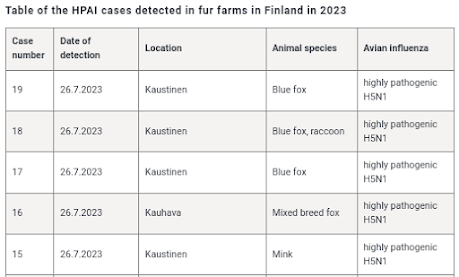
Cases of avian influenza (HPAI) detected by the Food Agency in fur farms in 2023
[TABLE="width: 715, height: 1047"]
[TR]
[TD="bgcolor: #ffffff"]Case number[/TD]
[TD="bgcolor: #ffffff"]Date of determination[/TD]
[TD="bgcolor: #ffffff"]Venue[/TD]
[TD="bgcolor: #ffffff"]Animal species[/TD]
[TD="bgcolor: #ffffff"]Bird flu[/TD]
[/TR]
[TR]
[TD="bgcolor: #ffffff"]20[/TD]
[TD="bgcolor: #ffffff"]26/07/2023[/TD]
[TD="bgcolor: #ffffff"]Caustic[/TD]
[TD="bgcolor: #ffffff"]Blue fox[/TD]
[TD="bgcolor: #ffffff"]highly pathogenic H5N1[/TD]
[/TR]
[TR]
[TD="bgcolor: #ffffff"]19[/TD]
[TD="bgcolor: #ffffff"]26/07/2023[/TD]
[TD="bgcolor: #ffffff"]Caustic[/TD]
[TD="bgcolor: #ffffff"]Sup dog[/TD]
[TD="bgcolor: #ffffff"]highly pathogenic H5N1[/TD]
[/TR]
[TR]
[TD="bgcolor: #ffffff"]18[/TD]
[TD="bgcolor: #ffffff"]26/07/2023[/TD]
[TD="bgcolor: #ffffff"]Caustic[/TD]
[TD="bgcolor: #ffffff"]Blue fox[/TD]
[TD="bgcolor: #ffffff"]highly pathogenic H5N1[/TD]
[/TR]
[TR]
[TD="bgcolor: #ffffff"]17[/TD]
[TD="bgcolor: #ffffff"]26/07/2023[/TD]
[TD="bgcolor: #ffffff"]Caustic[/TD]
[TD="bgcolor: #ffffff"]Blue fox[/TD]
[TD="bgcolor: #ffffff"]highly pathogenic H5N1[/TD]
[/TR]
[TR]
[TD="bgcolor: #ffffff"]16[/TD]
[TD="bgcolor: #ffffff"]26/07/2023[/TD]
[TD="bgcolor: #ffffff"]Kauhava[/TD]
[TD="bgcolor: #ffffff"]Crossbreed (fox, blue silver)[/TD]
[TD="bgcolor: #ffffff"]highly pathogenic H5N1[/TD]
[/TR]
[TR]
[TD="bgcolor: #ffffff"]15[/TD]
[TD="bgcolor: #ffffff"]26/07/2023[/TD]
[TD="bgcolor: #ffffff"]Caustic[/TD]
[TD="bgcolor: #ffffff"]Mink[/TD]
[TD="bgcolor: #ffffff"]highly pathogenic H5N1[/TD]
[/TR]
[TR]
[TD="bgcolor: #ffffff"]14[/TD]
[TD="bgcolor: #ffffff"]26/07/2023[/TD]
[TD="bgcolor: #ffffff"]Caustic[/TD]
[TD="bgcolor: #ffffff"]Blue fox, hybrid (fox, blue silver)[/TD]
[TD="bgcolor: #ffffff"]highly pathogenic H5N1[/TD]
[/TR]
[TR]
[TD="bgcolor: #ffffff"]13[/TD]
[TD="bgcolor: #ffffff"]26/07/2023[/TD]
[TD="bgcolor: #ffffff"]Kauhava[/TD]
[TD="bgcolor: #ffffff"]Blue fox[/TD]
[TD="bgcolor: #ffffff"]highly pathogenic H5N1[/TD]
[/TR]
[TR]
[TD="bgcolor: #ffffff"]12[/TD]
[TD="bgcolor: #ffffff"]21/07/2023[/TD]
[TD="bgcolor: #ffffff"]Caustic[/TD]
[TD="bgcolor: #ffffff"]Blue fox[/TD]
[TD="bgcolor: #ffffff"]highly pathogenic H5N1[/TD]
[/TR]
[TR]
[TD="bgcolor: #ffffff"]11[/TD]
[TD="bgcolor: #ffffff"]21/07/2023[/TD]
[TD="bgcolor: #ffffff"]Caustic[/TD]
[TD="bgcolor: #ffffff"]Blue fox[/TD]
[TD="bgcolor: #ffffff"]highly pathogenic H5N1[/TD]
[/TR]
[TR]
[TD="bgcolor: #ffffff"]10[/TD]
[TD="bgcolor: #ffffff"]19.7.2023[/TD]
[TD="bgcolor: #ffffff"]Evijärvi[/TD]
[TD="bgcolor: #ffffff"]Silver fox, raccoon[/TD]
[TD="bgcolor: #ffffff"]highly pathogenic H5N1[/TD]
[/TR]
[TR]
[TD="bgcolor: #ffffff"]9[/TD]
[TD="bgcolor: #ffffff"]19.7.2023[/TD]
[TD="bgcolor: #ffffff"]Caustic[/TD]
[TD="bgcolor: #ffffff"]Blue fox[/TD]
[TD="bgcolor: #ffffff"]highly pathogenic H5N1[/TD]
[/TR]
[TR]
[TD="bgcolor: #ffffff"]8[/TD]
[TD="bgcolor: #ffffff"]19.7.2023[/TD]
[TD="bgcolor: #ffffff"]Caustic[/TD]
[TD="bgcolor: #ffffff"]Blue fox[/TD]
[TD="bgcolor: #ffffff"]highly pathogenic H5N1[/TD]
[/TR]
[TR]
[TD="bgcolor: #ffffff"]7[/TD]
[TD="bgcolor: #ffffff"]19.7.2023[/TD]
[TD="bgcolor: #ffffff"]Caustic[/TD]
[TD="bgcolor: #ffffff"]Blue fox[/TD]
[TD="bgcolor: #ffffff"]highly pathogenic H5N1[/TD]
[/TR]
[TR]
[TD="bgcolor: #ffffff"]6[/TD]
[TD="bgcolor: #ffffff"]19.7.2023[/TD]
[TD="bgcolor: #ffffff"]Caustic[/TD]
[TD="bgcolor: #ffffff"]Blue fox[/TD]
[TD="bgcolor: #ffffff"]highly pathogenic H5N1[/TD]
[/TR]
[TR]
[TD="bgcolor: #ffffff"]5[/TD]
[TD="bgcolor: #ffffff"]14.7.2023[/TD]
[TD="bgcolor: #ffffff"]Kauhava[/TD]
[TD="bgcolor: #ffffff"]Blue fox and mink[/TD]
[TD="bgcolor: #ffffff"]highly pathogenic H5N1[/TD]
[/TR]
[TR]
[TD="bgcolor: #ffffff"]4[/TD]
[TD="bgcolor: #ffffff"]14.7.2023[/TD]
[TD="bgcolor: #ffffff"]Kauhava[/TD]
[TD="bgcolor: #ffffff"]Blue fox[/TD]
[TD="bgcolor: #ffffff"]highly pathogenic H5N1[/TD]
[/TR]
[TR]
[TD="bgcolor: #ffffff"]3[/TD]
[TD="bgcolor: #ffffff"]14.7.2023[/TD]
[TD="bgcolor: #ffffff"]Baldness[/TD]
[TD="bgcolor: #ffffff"]Blue fox[/TD]
[TD="bgcolor: #ffffff"]highly pathogenic H5N1[/TD]
[/TR]
[TR]
[TD="bgcolor: #ffffff"]2.[/TD]
[TD="bgcolor: #ffffff"]14.7.2023[/TD]
[TD="bgcolor: #ffffff"]Caustic[/TD]
[TD="bgcolor: #ffffff"]Blue fox[/TD]
[TD="bgcolor: #ffffff"]highly pathogenic H5N1[/TD]
[/TR]
[TR]
[TD="bgcolor: #ffffff"]1.[/TD]
[TD="bgcolor: #ffffff"]13/07/2023[/TD]
[TD="bgcolor: #ffffff"]Caustic[/TD]
[TD="bgcolor: #ffffff"]Blue fox[/TD]
[TD="bgcolor: #ffffff"]highly pathogenic H5N1[/TD]
[/TR]
[/TABLE]
​:tiphat:https://www.ruokavirasto.fi/elaimet...ntuinfluenssa/lintuinfluenssa-suomessa/​​​​​​
 
The Food Agency orders animals to be euthanized at three fur farms - more decisions to come

In connection with the mass deaths of birds, bird flu has been observed in several localities. The virus has also infected fur animals in South Ostrobothnia and Central Ostrobothnia. AUTHORS


27.7. 12:12•Updated on 27.7. 18:18

Ice


Yle followed the Food Agency's information session
  • The Food Agency orders animals to be killed at three fur farms.
  • The Food Agency does not reveal which fur farms are in question.
  • People exposed to influenza are tested. People working on poultry farms are under special scrutiny. So far, the test results have been negative.
  • There were experts from the Food Agency, the Ministry of Social Affairs and Health, the Ministry of Agriculture and Forestry and the Institute of Health and Welfare.
15:49 Yesterday

Kari Ikävalko Food Agency: There will be more termination decisions

The Food Agency is currently investigating whether there is a need to make new decisions on euthanizing farm animals.
According to Terhi Laaksonen, head of the Food Agency's department , there will be more termination decisions next week, as long as the investigations progress.
Decisions to euthanize animals have already been given to three fur farms. At least for the time being, two of the facilities that have already been investigated have not been given closure decisions.
H5N1 bird flu, which spreads easily, has been found in at least 20 fur farms in Finland, of which the investigation into the decision to close three farms has progressed the furthest. The discoveries were made in fur farms in Southern and Central Ostrobothnia.
Disease discoveries have been made on farms whose size varies from a few hundred to thousands of animals. The agency does not yet have information on the number of dead animals on farms.

​​​​​​
14:05 Yesterday

Clarissa Aries Food Agency: In fur farms, the virus has spread between foxes

Avian flu has spread from one sheltered in the same fur farm to another.
Terhi Laaksonen, director of the Food Agency , told a press conference that the virus may have been transmitted from one mammal to another. No indications of breeding between species have been observed.
The disease has affected all fur animals that are bred in Finland, such as blue foxes, silver foxes, crossbred foxes, minks and raccoons.

The Food Agency continues to examine samples taken from fur farms. According to the current information, the virus has spread to the nurseries from wild birds.
The Food Agency's information session has ended.
27.7.-23 Story corrected and changed so that the suspicion does not concern spread between species.

14:05 Yesterday

Clarissa Aries Prepared for human infections

Even people exposed to bird flu are currently being tested for infection.
According to STM's Tuula Helander, the virus has circulated a lot in birds, so exposure to humans has also occurred.
Helander says that different agencies are coordinating the situation together.
- So far, all those exposed have received a negative test result. We are prepared for all scenarios. Since we learned a lot because of the interest rate, it is a good idea to prepare, he says.
Helander says that the doctors have been instructed in case of operation and testing.
- Those working on poultry farms are under special scrutiny. Special attention if the person develops a respiratory infection.
Helander says that cooperation has been intensified with, for example, laboratories.

13:49 Yesterday

Anne Elheimer Stopping the virus is now essential for fur farms - this is how to prevent the development of a pandemic

At this stage, it is not possible to predict at which point the bird flu virus H5N1 would turn into a pandemic among people, says Anna Katz, head of the THL unit .
According to the Institute of Health and Welfare, the most important thing now is to stop the virus in nurseries in order to prevent the virus from developing into a pandemic among people.
Not even the world's experts have an answer to why the bird flu started spreading so strongly right now, says Terhi Laaksonen, head of the Department of the Food Agency.


​...:tiphat:https://yle.fi/a/74-20042735​​​​​​
 
Finland - Influenza A viruses of high pathogenicity (Inf. with) (non-poultry including wild birds) (2017-) - Follow up report 2

GENERAL INFORMATION
COUNTRY/TERRITORY OR ZONE
ZONE

ANIMAL TYPE
TERRESTRIAL

DISEASE CATEGORY
Listed disease

EVENT ID
5119

DISEASE
Influenza A viruses of high pathogenicity (Inf. with) (non-poultry including wild birds) (2017-)

CAUSAL AGENT
Highly pathogenic avian influenza virus

GENOTYPE / SEROTYPE / SUBTYPE
H5N1

START DATE
2023/06/30

REASON FOR NOTIFICATION
Unusual host species

DATE OF LAST OCCURRENCE
-

CONFIRMATION DATE
2023/07/13

EVENT STATUS
On-going

END DATE
-

SELF-DECLARATION
NO

REPORT INFORMATION
REPORT NUMBER
Follow-up report 2

REPORT ID
FUR_162033

REPORT REFERENCE
-

REPORT DATE
2023/07/27

REPORT STATUS
Validated

NO EVOLUTION REPORT
-

EPIDEMIOLOGY
SOURCE OF EVENT OR ORIGIN OF INFECTION
Unknown or inconclusive

EPIDEMIOLOGICAL COMMENTS
A focal outbreak on a fur farm raising arctic foxes and raccoon dogs. Plenty of black-headed gulls have been observed around and at the fur farm. Currently no control measures are applied as HPAI is not "listed disease" in fur animals. Further sampling is planned on the fur farm. Veterinary authorities are working in tight collaboration with the public health authority. Improved biosecurity measures and use of personal protection equipment on fur farms are encouraged.

QUANTITATIVE DATA SUMMARY
MEASURING UNIT
Animal

SpeciesSusceptibleCasesDeathsKilled and Disposed ofSlaughtered/ Killed for commercial useVaccinated
American Mink (WILD)
NEW 3900
4 4 - - -
TOTAL 18900 17 17 - - -
Raccoon dog (WILD)
NEW 2700
2 2 - - -
TOTAL 4200 2 2 - - -
Arctic Fox (WILD)
NEW 19770
13 13 - - -
TOTAL 122643 48 48 - - -
Red Fox (WILD) NEW 39940 19 19 - - -
TOTAL 39940
19 19 - - -
All species
NEW 66310
38 38 - - -
TOTAL 185683 86 86 - - -​


DIAGNOSTIC DETAILS
CLINICAL SIGNS
YES

...

NEW OUTBREAKS

OB_122644 - KAUSTINEN
OB_122642 - KAUSTINEN
OB_122640 - KAUSTINEN
OB_122638 - KAUSTINEN
OB_122636 - KAUHAVA
OB_122632 - KAUHAVA
OB_122631 - KAUSTINEN
OB_122630 - KAUSTINEN
OB_122629 - KAUSTINEN
OB_122628 - EVIJÄRVI

PREVIOUSLY REPORTED OUTBREAKS

OB_122146 - KAUSTINEN
OB_122142 - KAUSTINEN
OB_122138 - KAUSTINEN
OB_122136 - KAUSTINEN
OB_122130 - KORTESJÄRVI
OB_122128 - HALSUA
OB_122110 - KAUHAVA
OB_122107 - KAUSTINEN
OB_121770 - KAUSTINEN

...

https://wahis.woah.org/#/in-review/5119​
 
Finnish Food Agency Orders All Mink On H5N1 Affected Farms To Be Culled


#17,589


Not quite 3 weeks ago the Finnish Food Authority (Ruokavirasto) announced the detection of HPAI H5N1 in animals at multiple (n=5) fur farms across Southern and Central Ostrobothnia affecting blue foxes and raccoon dogs.

Over time the number of affected farms has grown to 20, with 3 of those farms raising mink as well.​

As we've discussed numerous times over the years (see last January's That Touch of Mink Flu (2023 Edition), mink are particularly susceptible to COVID and Influenza A infection, raising concerns that they could act as a mixing vessel (see graphic below), possibly leading to the creation of a more dangerous virus.

AVvXsEg7CKuboD9CMP8jrah4a7cY3_dkg26C-cMOAw25SBBAsJGOAogkeKUAaYZa2J5wyhT3qogL2-3KZjG0cc0yZnfog0T9H9TqgmELv3MEtWYAadFpOMhU__kylz6sTBjBjRBdmfD3Vc7OH86xXFNhXpoiQ0wwrzL_68y1IXtoreZoBu-BfdmhQ_d2Sw


This concern was well addressed 10 days ago by two well known UK virologists in an opinion piece published in the Journal PNAS :
This morning, after a couple of weeks of deliberation, the Finnish Food Authority announced the decision to cull all of the mink housed at 3 H5N1 affected farms. Decisions to cull other animals will be made on a case-by-case basis.

According to the Finnish Fur Breeders Association, there are `. . . 581 member farms operating in Finland in approximately 600 locations, and most of them are family businesses. 95% of Finnish fur farms are located in the Ostrobothnia region'.

The translated announcement follows.

The Food Agency orders all minks to be culled from fur farms that have been found to be infected with bird flu

1 August 2023

The Food Agency has specified the criteria for killing fur animals infected with bird flu. Based on the decision, all minks will be killed from fur farms that have been found to be infected with bird flu. The opinion of the Norwegian Institute of Health and Welfare (THL) has also been taken into account in the policy decision regarding minks made by the Food Agency. Termination decisions regarding foxes and raccoons are still made on a case-by-case basis.

Mink is a particularly problematic animal species when it comes to avian influenza virus infections. This is because the upper respiratory tract of the mink has receptors that bind both bird and human influenza viruses, so the mink is susceptible to infections caused by both types of influenza. The mink can thus function more effectively than other mammals as an intermediate host for bird flu, where the flu virus can better transform into a form that infects humans. To prevent such viral transformations, it is important to destroy all minks from infected fur farms.

The termination of foxes and raccoons is decided on a case-by-case basis

In termination decisions concerning foxes and raccoons, the Food Agency can order all or part of the fur farm's foxes and raccoons to be culled. This decision is influenced by how widely and with how strong the symptoms of bird flu infection occur in the shelter. It is also possible that the animals in the shelter are not ordered to be euthanized at all for the time being, if the symptoms and increased mortality have stopped at the shelter. However, the restrictions imposed by the regional administrative agency on fur farms and the measures to prevent the spread of the disease remain in force at all farms where bird flu has been confirmed. If not all the animals in the infected shelters have been ordered to be euthanized, additional samples are repeatedly taken from the animals in these shelters to monitor the infection situation.
An order to kill the animals was issued to three fur farms

The Food Agency has so far issued orders to kill animals at three fur farms. The preparation of new termination orders continues this week. The Food Agency does not publish information about fur farms that have been ordered to kill animals.

Animal owners have the right to seek compensation from state funds for animals euthanized by order of the Food Agency. The amount of compensation is not yet known.

By the end of July, bird flu has been detected in twenty fur farms. The samples of the four shelters are currently being supported.

Read more about bird flu
on the Food Agency's website (ruokavirasto.fi)


Following last October's large outbreak of avian flu at a European mink farm (Spain: Avian H5N1 Spillover Into Farmed Mink), new concerns have been raised over the risks of mink farming.

Last January a Eurosurveillance report on that outbreak reported evidence of a rare mammalian adaptation - (T271A), which `enhances the polymerase activity of influenza A viruses in mammalian host cells and mice' - in the virus.​

That report was followed by a report from Denmark (see SSI: Low to Moderate Risk of Human Infection With Bird Flu From Mink). While conceding that `There is limited knowledge about the occurrence and course of HPAI virus infections in mink', they wrote in their 19-page assessment:

SSI assesses that the risk of infection to humans from mink is low to moderate in the event of exposure to infected mink. This assessment is in line with assessments from ECDC and WHO.

The risk of humans becoming infected is greatest if the virus spreads between mink. Early detection of viruses in mink and humans is essential to reduce the overall health risk.


And just a month ago, in the CDC: New IRAT Risk Assessment On Mink Variant of Avian H5N1, we saw this `mink flu' officially added to the CDC's list of zoonotic influenza viruses of greatest concern.

While still classified as a `moderate' threat, it's scores have risen in 6 of the 10 parameters used to evaluate their zoonotic potential (see chart below).


While it is true that other animals (see H5N1 in Swine. H5N1 in cats, and H5N1 in Marine Mammals) may pose similar threats, their susceptibility to H5N1 - and their current ability to transmit it - pales in comparison to farmed mink.

Making hard choices regarding the culling of animals sometimes a grim necessity.


https://afludiary.blogspot.com/2023/08/finnish-food-agency-orders-all-mink-on.html
 
All minks to be culled at bird flu sites, at least 50K fur animals already ordered killed


So far, fur farms have been ordered to cull some 50,000 minks and foxes, but that number is likely to rise.

The Finnish Food Authority has ordered that all minks on farms where avian influenza (bird flu) has been detected must be killed. Cases have been found at at least 20 fur farms in the country since mid-July.

So far, fur farms have been ordered to cull some 50,000 minks and foxes, but that number is likely to rise. The agency said on Tuesday that more fur farms will be closed this week due to avian influenza infections. The disease, officially known as H5N1, can spread from birds to some mammals.

The World Health Organisation said in July that "the increasing number of H5N1 avian influenza detections among mammals—which are biologically closer to humans than birds are—raises concern that the virus might adapt to infect humans more easily".

....
Termination decisions concerning foxes and raccoon dogs at fur farms are still being made on a case-by-case basis, the Food Authority said, noting that minks pose a higher risk of transforming the flu virus into a form that could infect humans.

..... The 50,000 total therefore includes minks and foxes," said Terhi Laaksonen, director of the agency's Animal Health and Welfare Department.

Most of the infected fur farms are located in Kaustinen, Central Ostrobothnia and Kauhava in Southern Ostrobothnia, both in western Finland. The Food Agency has not specified which farms have been shut down.

On Tuesday, the agency was examining samples from another farm in Ostrobothnia.

Sequencing data has bee...​:tiphat:https://yle.fi/a/74-20043331
 
The Food Agency's updated assessment: the termination decision concerns about 70,000 mink and fox

Of the animals to be killed, 30,000 are minks and the remaining 40,000 are foxes. The number has increased from the previous estimate by about twenty thousand animals.
ALIISA UUSITALO

1.8. 18:55Updated 1.8. 19:00


Ice
A total of around 70,000 animals have now been ordered to be euthanized on fur farms, says Terhi Laaksonen , head of the Department of the Food Agency .
Previously, the number of fur animals to be killed was estimated at around 50,000 animals .
On Tuesday, the Food Agency ordered all minks to be killed in fur farms where bird flu has been detected.

This is because, according to the Food Agency, mink are more susceptible to infections caused by both types of influenza. Minks also have a higher risk that the influenza virus can transform into a form that infects humans.
In the case of foxes and raccoons, termination decisions are made on a case-by-case basis.
Terhi Laaksonen, head of the animal health and welfare department of the Food Agency, now estimates that a total of around 70,000 lives will be ended on three fur farms. 30,000 of them are minks and the remaining 40,000 are foxes.
- However, the exact amount is not yet known, as we have only made the decision to close three fur farms, says Laaksonen....
According to Laaksonen, the fur farms that have now been subject to closure decisions are larger than average.

- This is why these first figures are so large. At the moment, there are also a lot of puppies on farms, which increases the number of animals to be euthanized, says Terhi Laaksonen...According to the Food Agency's estimate, there will be around 550 fur farms in Finland in 2023.
.:tiphat:https://yle.fi/a/74-20043413​
 
Finland - Influenza A viruses of high pathogenicity (Inf. with) (non-poultry including wild birds) (2017-) - Follow up report 3

GENERAL INFORMATION
COUNTRY/TERRITORY OR ZONE
ZONE

ANIMAL TYPE
TERRESTRIAL

DISEASE CATEGORY
Listed disease

EVENT ID
5119

DISEASE
Influenza A viruses of high pathogenicity (Inf. with) (non-poultry including wild birds) (2017-)

CAUSAL AGENT
Highly pathogenic avian influenza virus

GENOTYPE / SEROTYPE / SUBTYPE
H5N1

START DATE
2023/06/30

REASON FOR NOTIFICATION
Unusual host species

DATE OF LAST OCCURRENCE
-

CONFIRMATION DATE
2023/07/13

EVENT STATUS
On-going

END DATE
-

SELF-DECLARATION
NO

REPORT INFORMATION
REPORT NUMBER
Follow-up report 3

REPORT ID
FUR_162158

REPORT REFERENCE
-

REPORT DATE
2023/08/03

REPORT STATUS
Validated

NO EVOLUTION REPORT
-

EPIDEMIOLOGY
SOURCE OF EVENT OR ORIGIN OF INFECTION
Unknown or inconclusive

EPIDEMIOLOGICAL COMMENTS
A focal outbreak on a fur farm raising arctic foxes and raccoon dogs. Plenty of black-headed gulls have been observed around and at the fur farm. Currently no control measures are applied as HPAI is not "listed disease" in fur animals. Further sampling is planned on the fur farm. Veterinary authorities are working in tight collaboration with the public health authority. Improved biosecurity measures and use of personal protection equipment on fur farms are encouraged.

QUANTITATIVE DATA SUMMARY
MEASURING UNIT
Animal

SpeciesSusceptibleCasesDeathsKilled and Disposed ofSlaughtered/ Killed for commercial useVaccinated
American Mink (WILD)
NEW - - - - - -
TOTAL 18900 17 17 - - -
Raccoon dog (WILD)
NEW - - - - - -
TOTAL 4200 2 2 - - -
Arctic Fox (WILD)
NEW 25000
6 6 - - -
TOTAL 147643 54 54 - - -
Red Fox (WILD)
NEW - - - - - -
TOTAL 39940 19 19 - - -
All species
NEW 25000
6 6 - - -
TOTAL 210683 92 92 - - -

DIAGNOSTIC DETAILS
CLINICAL SIGNS
YES
...

NEW OUTBREAKS

OB_123093 - VÖYRI
OUTBREAK REFERENCE
-

START DATE
2023/07/21

END DATE
-

DETAILED CHARACTERISATION
-

FIRST ADMINISTRATIVE DIVISION
Länsi- ja Sisä-Suomen aluehallintovirasto

SECOND ADMINISTRATIVE DIVISION
Pohjanmaa

THIRD ADMINISTRATIVE DIVISION
Vöyri

EPIDEMIOLOGICAL UNIT
Farm

LOCATION
Vöyri

Latitude, Longitude
63.24112 , 22.47643

OUTBREAKS IN CLUSTER
-

MEASURING UNIT
Animal

AFFECTED POPULATION DESCRIPTION
-

SpeciesSusceptibleCasesDeathsKilled and Disposed ofSlaughtered/ Killed for commercial useVaccinated
Arctic Fox (WILD)
Captive
NEW 25000 6
6 - - -
TOTAL 25000 6 6 - - -

...

PREVIOUSLY REPORTED OUTBREAKS

OB_122644 - KAUSTINEN
OB_122642 - KAUSTINEN
OB_122640 - KAUSTINEN
OB_122638 - KAUSTINEN
OB_122636 - KAUHAVA
OB_122632 - KAUHAVA
OB_122631 - KAUSTINEN
OB_122630 - KAUSTINEN
OB_122629 - KAUSTINEN
OB_122628 - EVIJÄRVI
OB_122146 - KAUSTINEN
OB_122142 - KAUSTINEN
OB_122138 - KAUSTINEN
OB_122136 - KAUSTINEN
OB_122130 - KORTESJÄRVI
OB_122128 - HALSUA
OB_122110 - KAUHAVA
OB_122107 - KAUSTINEN
OB_121770 - KAUSTINEN

...
https://wahis.woah.org/#/in-review/5119

 
Finland: THL Statement On Avian Flu In Fur Farms


AVvXsEhIQZ4QzkthNUKmdBoA-VQXRccZdzBDfUPD6XExe3XcrWVAeufWswTy69pPX_NdMnjtyGgwViDr9D189RV8CJBWZ6V4rH0Aj82F44SHr_YDMDwCYNEDF33b5q9MWBm8phRRYpzogdDMKyTI1iV1a2q02VGGjhtxIYgJboMRz7EzjPSzWqYmFRhFDQ=w200-h176


#17,606

Although the number of fur farms reportedly affected by H5N1 in Finland remains at 21, there are more than 600 farms at risk, and media reports suggest that testing may be backlogged.

After a slow start - the Finnish Food Safety Authority (Ruokavirasto) - appears to have taken the lead in the investigation and has ordered the culling of > 50,000 mink.
But what to do about 150,000+ exposed foxes and raccoon dogs has apparently not been determined. The concerns with high density fur farms is that it provides the virus with an ideal environment to spread from mammal to mammal.


Long chains of infection (see graphic below) can provide the virus with additional opportunities to adapt to a new host species, furthering its evolution. This is a topic we looked at in some depth 3 weeks ago in PNAS: Mink Farming Poses Risks for Future Viral Pandemics.

Today, Finland's Institute for Health and Welfare (THL) released their second press release in just 4 days on the continued risk from these infected fur farms. Last week's announcementwas released in connection to a Eurosurveillance Rapid communication, and called for better biosecurity on fur farms.​

Today's announcement is even more strongly worded, and appears (at least based on the translation) to be directed towards the Finnish Food Safety Agency.
8.8.2023
The Finnish Institute of Health and Welfare (THL) states in its statement to the Food Agency that the circulation of the bird flu virus in farmed fur animals must be stopped in order to prevent the virus from adapting to mammals.

THL considers minks, whose respiratory receptors have similarities with human respiratory receptors, to be particularly problematic. Because of this, the mink is able to act as an intermediate host that adapts the bird flu virus to mammals and thus also to humans.

Another concern is related to humans' own influenza viruses, which can infect minks as well. If human and bird influenza viruses infect the mink at the same time, there is a chance for the genes of the viruses to mix. The occurrence of this situation at the mink farm must be prevented, as it enables the creation of a new virus strain for humans, increasing the risk of a new influenza pandemic.

Protection of mink farms from the corona virus was successful, so protecting farms from influenza is also possible. However, this requires significant improvements to improve the biosecurity of the shelters, such as bird protection and strict hygiene measures to prevent infections from humans to fur animals.

Although mink is considered to be the most problematic animal species in terms of avian influenza virus infections, there are also risks associated with bird flu epidemics in dense, large animal populations of foxes and other fur-bearing animals, that the virus becomes more adaptable to mammals.

The A(H5N1) bird flu virus is poorly contagious to humans. However, it can also cause serious, even fatal, infections in infected people. For this reason, fur farms must pay special attention to the protection of people working there or otherwise dealing with animals.

In the summer of 2023, exceptionally large mass deaths of wild birds as a result of A(H5N1) virus infection have been found in Finland. The virus has spread to fur farms in Finland, causing high morbidity and mortality in animals (foxes, blue foxes, minks and raccoons).

More information


Statement on risk management measures to protect human health in fur farm epidemics caused by highly pathogenic avian influenza
(Continue . . . )


The full PDF report is in Finnish, but I've provided a translated excerpt below:

At the beginning of the respiratory infection season, the risk of human influenza A virus infections increases. This also applies to people in contact with minks at the shelter. If the highly pathogenic A(H5N1) 2.3.4.4b development line avian influenza virus that caused the epidemic now persists in the mink population of fur farms, the fall influenza season will cause a new risk situation. Human influenza A virus can be transmitted to kennels and minks. If human and bird influenza viruses infect the mink at the same time, there is a possibility of virus reassortment.

As stated above, in laboratory conditions, such reassortment has resulted in a new combination of viruses, which is transmitted through the air as a droplet infection from one ferret to another. The occurrence of this situation at the mink farm must be prevented, as it enables the creation of a new,airborne virus strain for people, which increases the risk of an influenza pandemic significantly.

To combat this situation, all minks infected with avian influenza must be euthanized, the carcasses disposed of and the shelters cleaned. THL also considers that the biosecurity of fur farms must be significantly improved so that the risk of mink infections caused by influenza viruses (and other viruses such as SARS-CoV-2) is minimized. This requires actions, e.g. to improve bird protection and strict hygiene measures to prevent infections from humans to minks.

In addition to the mink, the most important fur animals bred in Finland are the fox (Vulpes vulpes), the mink (Vulpes lagopus) and the raccoon (Nyctereutes procyonoides). Highly pathogenic A(H5) 2.3.4.4b - infections caused by the virus have been found in different parts of the world in foxes (15, 16) and raccoons (14, 17). During the current bird flu epidemic, infections have been found in domesticated foxes and raccoons in Finland (15).

Regarding other fur animals, THL states the following. Although mink is considered to be the most problematic animal species in terms of avian influenza virus infections among fur-bearing animals, the bird flu epidemic in dense, large animal populations of foxes and other fur-bearing animals is also associated with risks of the virus changing to one better adapted to mammals.

During the current epidemic, both PB2-E627K and PB2-T271A mutations have been found in viruses isolated from foxes, both of which are important for the ability of the virus to reproduce in mammalian cells.

Just like with mink, it is not yet known for sure whether infections occur in shelters directly from one animal to another, and if there are direct infections, whether they occur through contact or through the air. THL believes that the circulation of the virus must also be stopped in the case of other fur animals and the biosecurity of the shelters must be improved in order to prevent the creation of new virus variants adapted to mammals.

Finally, THL reminds us that although the highly pathogenic A(H5N1) bird flu virus is weakly contagious to humans, it can still cause serious, even fatal, infections in infected people. For this reason, special attention must be paid to the proper protection of persons who work with infected animals and have to deal with other animals, as well as those who participate in the cleaning of fur farms.


Without reading too much into these translated statements, it does appear that THL is taking a far-harder stance on the eradication of H5N1 than has the Food Safety Agency.

Stay tuned.

https://afludiary.blogspot.com/2023/08/finland-thl-statement-on-avian-flu-in.html

 
More than 400 birds were shot in the fur farms on the basis of exemptions to prevent bird flu from spreading
8.8. 16:57

Riistakeskus says that only a small part of the nearly 10,000 exemption permits were used.

Among other things, crows were shot under an exception permit.

More than 400 exemption permits for BIRD HUNTING WERE USED TO CURB THE BIRD FLU SITUATION, SAYS Ohto Salo, game manager of the Finnish Game Center . At the end of July, the Finnish Game Agency granted an exceptional number of exemptions, almost 10,000, to the vicinity of fur zoos to prevent damage caused by bird flu.

According to the game manager, the hunting season, which lasted just under a week, went as expected, and the catch numbers per reserve were small. According to Salo, birds were shot at twenty fur farms under the exception permit.

Riistakeskus' exemption permit specifically concerned non-tranquilized birds. Salo says that the most killed were jackdaws, crows and gray gulls. Seagulls, homing pigeons and wood thrushes were not shot at all.

more... https://www.hs.fi/kotimaa/art-2000009771417.html

​​
 
Back
Top Bottom