• FluTrackers.com Inc. does not provide medical advice. Information on this web site is collected from various internet resources, and the FluTrackers board of directors makes no warranty to the safety, efficacy, correctness or completeness of the information posted on this site by any author or poster. The information collated here is for instructional and/or discussion purposes only and is NOT intended to diagnose or treat any disease, illness, or other medical condition. Every individual reader or poster should seek advice from their personal physician/healthcare practitioner before considering or using any interventions that are discussed on this website. By continuing to access this website you agree to consult your personal physican before using any interventions posted on this website, and you agree to hold harmless FluTrackers.com Inc., the board of directors, the members, and all authors and posters for any effects from use of any medication, supplement, vitamin or other substance, device, intervention, etc. mentioned in posts on this website, or other internet venues referenced in posts on this website.
  • We are not asking for any donations. Do not donate to any entity who says they are raising funds for us.

Florida - Zika tracking

Most countries can learn a lot from the approach of Singapore: they do a great job there. With Zika and other outbreaks. They are on top of it. They have to, because Singapore is so small.
 

Hattip Tetano
...
On Sept. 7, the state health department, in response to questions from the Miami Herald, said eight out-of-state residents have contracted Zika in Florida but are not included in the total count.

Mara Gambineri, a spokeswoman, said the health department tracks those cases ?as they are still important for us to be aware of, but the cases are not reported in our case counts. The department reports cases of Florida residents.?

That means there have been at least 64 local Zika infections in Florida this year, not the 56 cases reported so far by the health department.
...
http://www.miamiherald.com/news/health-care/article100939277.html
...
 
800px-Bromeliad3.jpg


https://en.wikipedia.org/wiki/Bromeliaceae

--------------------------------------------------------------------

Florida finds Zika in local mosquitoes, Miami Beach Botanical Garden removing plants where they breed

Aerial spraying takes place in Miami Beach, to start in Broward County
WPLG - Miami, FL

THE ASSOCIATED PRESS
Monday, September 12, 2016, 12:24 AM
...
One of the traps that tested positive was at the Miami Beach Botanical Gardens, where bromeliads bloom. The plants trap standing water in their cylindrical centers, providing excellent breeding areas for mosquitoes amid their colorful flowers and pointy leaves.

"Everyone should know by now that bromeliads are really problematic for us. These are probably the number one breeding area for mosquitoes," said Miami-Dade County Mayor Carlos Gimenez.

He said Miami Beach is removing all bromeliads from its landscaping, and urged residents across the county to either pull them out or rinse them after every rain. Earlier this week, officials removed two truckloads of bromeliads from the botanical gardens, which remains closed.
...

http://www.nydailynews.com/news/nat...osquitoes-bromeliads-blamed-article-1.2787891
 
FluTrackers.com@FluTrackers Sep 10
What's going on with #Florida #ZIka stats? @HealthyFla See this and pls respond http://www.miamiherald.com/news/health-care/article100939277.html… #publichealth


-------------------------------------------------------------------------------------------------


From: DOH COMMUNICATIONS OFFICE <DOHCOMMUNICATIONSOFFICE@flheal...
To:
Subject: SETTING THE RECORD STRAIGHT: FLORIDA PROVIDES ACCURATE AND TIMELY INFORMATION RELATED TO ZIKA
Date: Sep 12, 2016 11:21 AM
[TABLE="border: 0, cellpadding: 0, cellspacing: 0"]
[TR]
[TD] [TABLE="border: 0, cellpadding: 0, width: 923"]
[TR]
[TD]Sept. 12, 2016[/TD]
[TD] [/TD]
[/TR]
[TR]
[TD] [/TD]
[/TR]
[TR]
[TD]SETTING THE RECORD STRAIGHT: FLORIDA PROVIDES ACCURATE AND TIMELY INFORMATION RELATED TO ZIKA[/TD]
[/TR]
[TR]
[TD] [/TD]
[/TR]
[TR]
[TD] [/TD]
[/TR]
[TR]
[TD="colspan: 2"]Contact:
Communications Office
NewsMedia@flhealth.gov
850-245-4111[/TD]
[/TR]
[TR]
[TD="colspan: 2"] [/TD]
[/TR]
[TR]
[TD="colspan: 2"]Tallahassee, Fla. &#151;On Saturday, August 10[SUP]th[/SUP], the Miami Herald published &#147;Florida&#146;s Zika undercount hides extent of virus&#146; spread, experts say,&#148; a story suggesting that Florida is not being forthcoming regarding the burden of Zika in our state. This story is misleading and the claims made in it are inaccurate.
The Zika virus is new to the United States and the Florida Department of Health (DOH) is working daily with our partners and the Centers for Disease Control and Prevention (CDC) to learn more about this virus and take every action to protect the public, especially expectant mothers. Since February, in an effort to keep Florida residents and visitors safe and aware about the status of the Zika virus, DOH has issued daily updates each weekday regarding the Zika virus, even prior to having local mosquito-borne transmission. No other state is sharing information on the Zika virus with the public as frequently as Florida.
CLAIM: &#147;But the information issued by the governor and state agencies has not been timely or accurate &#151; cases announced as &#147;new&#148; are often several weeks old, due to a time lag in diagnosis &#151; and excludes details that public health experts say would allow people to make informed decisions and provide a complete picture of Zika&#146;s foothold in Florida.&#148;
FACTS:
  • The department is absolutely committed to transparency as our state continues to combat the Zika virus.
  • On a daily basis, our staff work with the public to provide up-to-date information on all of the agency&#146;s Zika response, prevention and education efforts.
  • As directed by Governor Scott, the department has operated a Zika Virus Information Hotline since February 12, 2016 to answer questions on the Zika virus and the state&#146;s preparedness efforts. The number for the Zika Virus Information Hotline is 855-622-6735.
  • DOH alerts the public to all cases of travel and non-travel related Zika in Florida residents when a case is confirmed through laboratory testing. Sometimes more than one test is required to differentiate between Zika and other mosquito-borne illnesses such as dengue and chikungunya.
  • Zika symptoms are mild, including fever, rash, joint pain and red eyes, and could be mistaken for a common virus or different mosquito borne illness like dengue or chikungunya. When a person has Zika symptoms, health care providers must rule out other illnesses and confirm Zika virus through laboratory testing before the department can alert the public.
  • Ruling out other modes of transmission is important for accuracy, and sometimes takes a week or two to reach individuals and verify facts. In some instances, consistent and thorough questioning has resulted in identifying a case as travel-related.
  • For information on the department&#146;s investigation and testing process, please click HERE.
CLAIM : &#147;And under-reported the number of local Zika infections in Florida by excluding anyone who is not a state resident.&#148;
FACTS:
  • The Florida Department of Health follows guidelines set by CDC.
  • CDC guidelines state that a Zika case, like ALL other reportable diseases, is reported by state of residence, not by the location of where the virus was acquired. That is why the department did not include eight cases of non-Florida residents in our case counts, per CDC reporting guidelines.
  • Information on the number of out of state residents with Zika is available, however, the department, like the CDC, defers to the home state or country on whether they will announce the location of residency. Texas, Taiwan and New York all shared publicly that they had residents who had acquired Zika in Florida, other jurisdictions have not yet shared this information. Governor Scott also announced this on August 19[SUP]th[/SUP].
  • The out of state residents acquired Zika in an area where the department has already identified ongoing active transmission is occurring so the public is already aware of the risks associated with that area.
  • Also, the department identifies more infections than is required by CDC. Florida is identifying and sharing information on all people who have laboratory evidence of Zika but do not have symptoms, whereas CDC cases of Zika are people who have laboratory evidence andsymptoms.
CLAIM : &#147;The health department has refused to say how many local infections involve pregnant women.&#148;
FACTS:
  • Patient privacy is a priority of the department.
  • The department strives to strike a balance between protecting patient privacy while providing the media and the public with information that is critical to protecting public health.
  • Knowing the pregnancy status of locally transmitted cases is not necessary information to protect public health.
CLAIM : &#147;The agency also has stopped issuing details of active investigations into local Zika cases. On Sept. 1, the health department began reporting only a summary of the total number of investigations in each county. Previously, the agency had listed each investigation by county, with the number of people tested for Zika and the results of those tests.&#148;
FACTS :
  • The department has not stopped providing this information. Information on active investigations, such as the number of people tested, is available to any interested media or member of the public who would like the information and we provide this information to interested parties on a daily basis.
  • We&#146;ve adjusted and improved our communication vehicles over the past several months and will likely do so again to ensure we&#146;re achieving our mission of sharing accurate and timely information.
  • The department received feedback that the way information was presented on our website was difficult to understand, so we are re-working how the information is displayed in order to make it easier for the any member of the public to easily understand.
For a detailed timeline on Zika preparedness actions taken by Governor Rick Scott, please click HERE.
For information on the department&#146;s investigation and testing process, please click HERE.
For more information on DOH action and federal guidance, please click HERE.
For resources and information on Zika virus, click HERE.
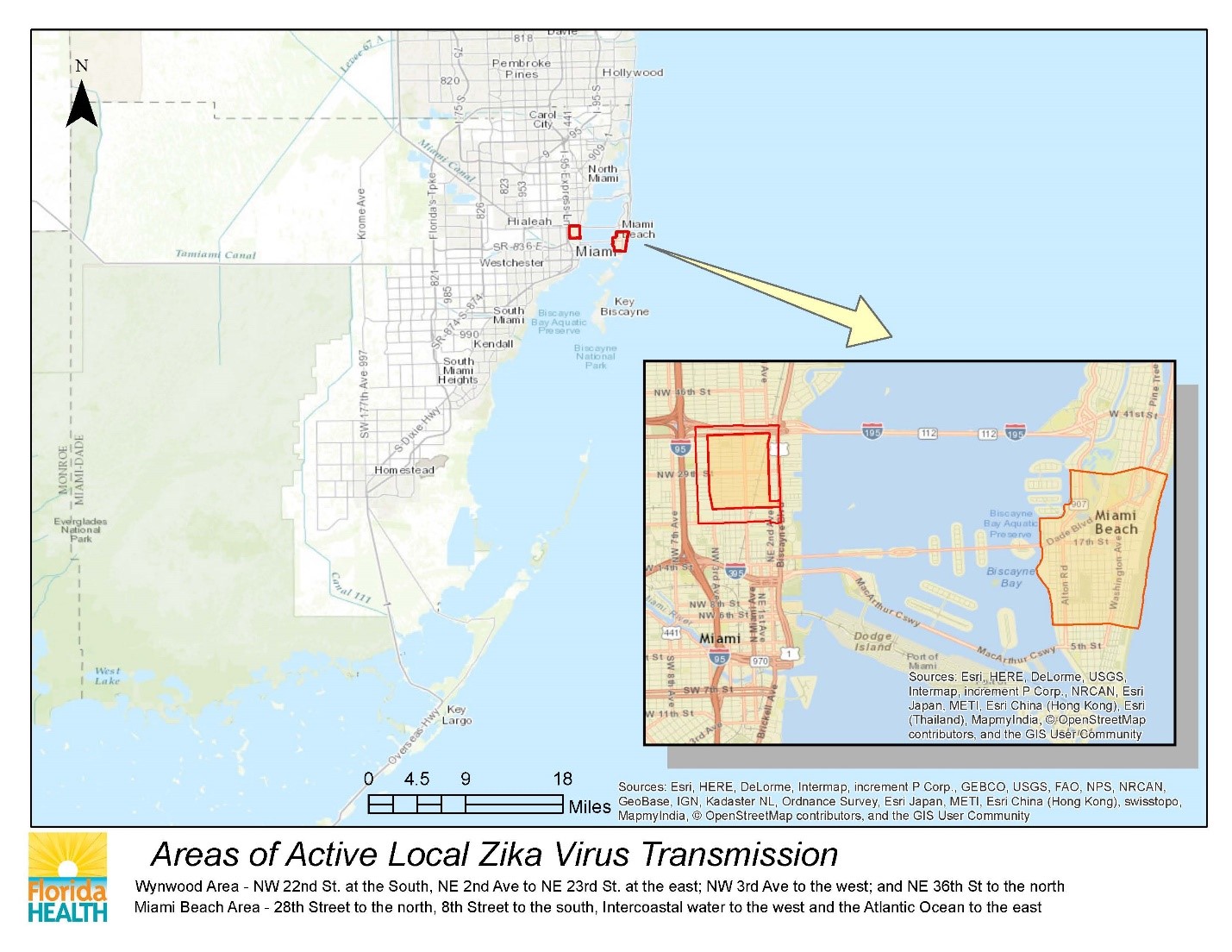
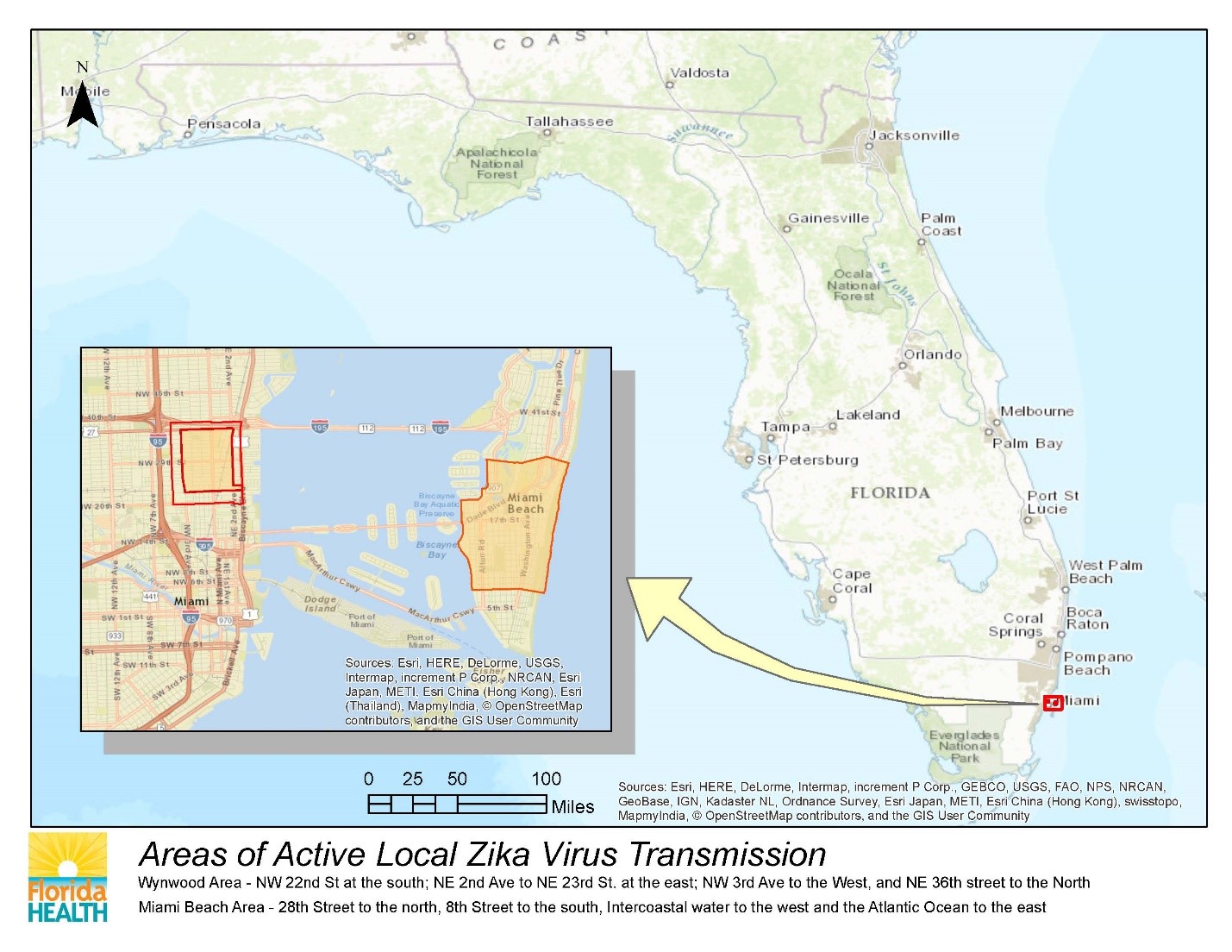
STATE OF FLORIDA
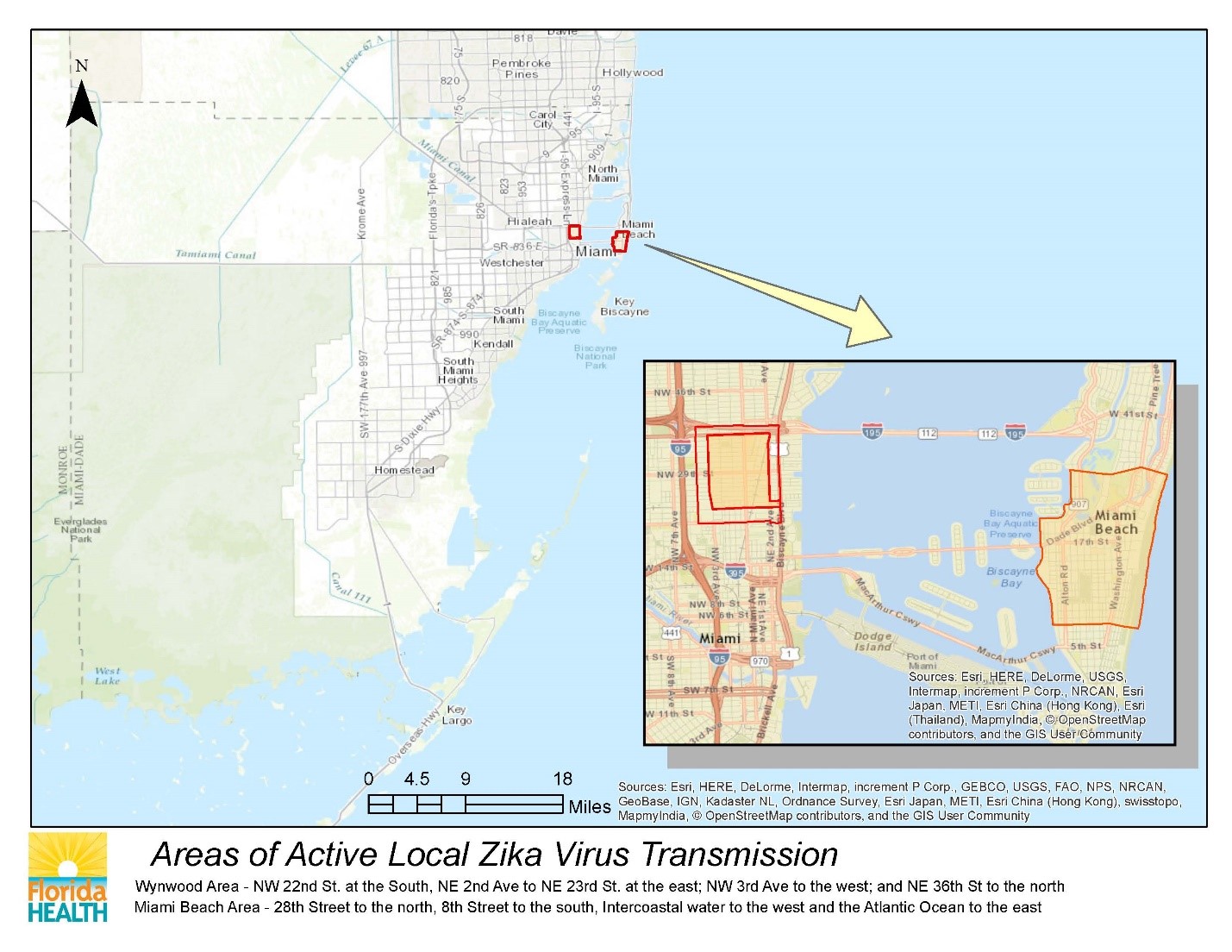
3717731473692885519.jpg

MIAMI-DADE COUNTY
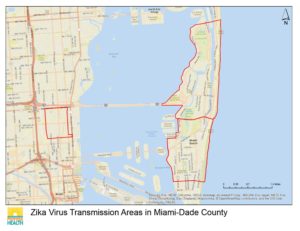
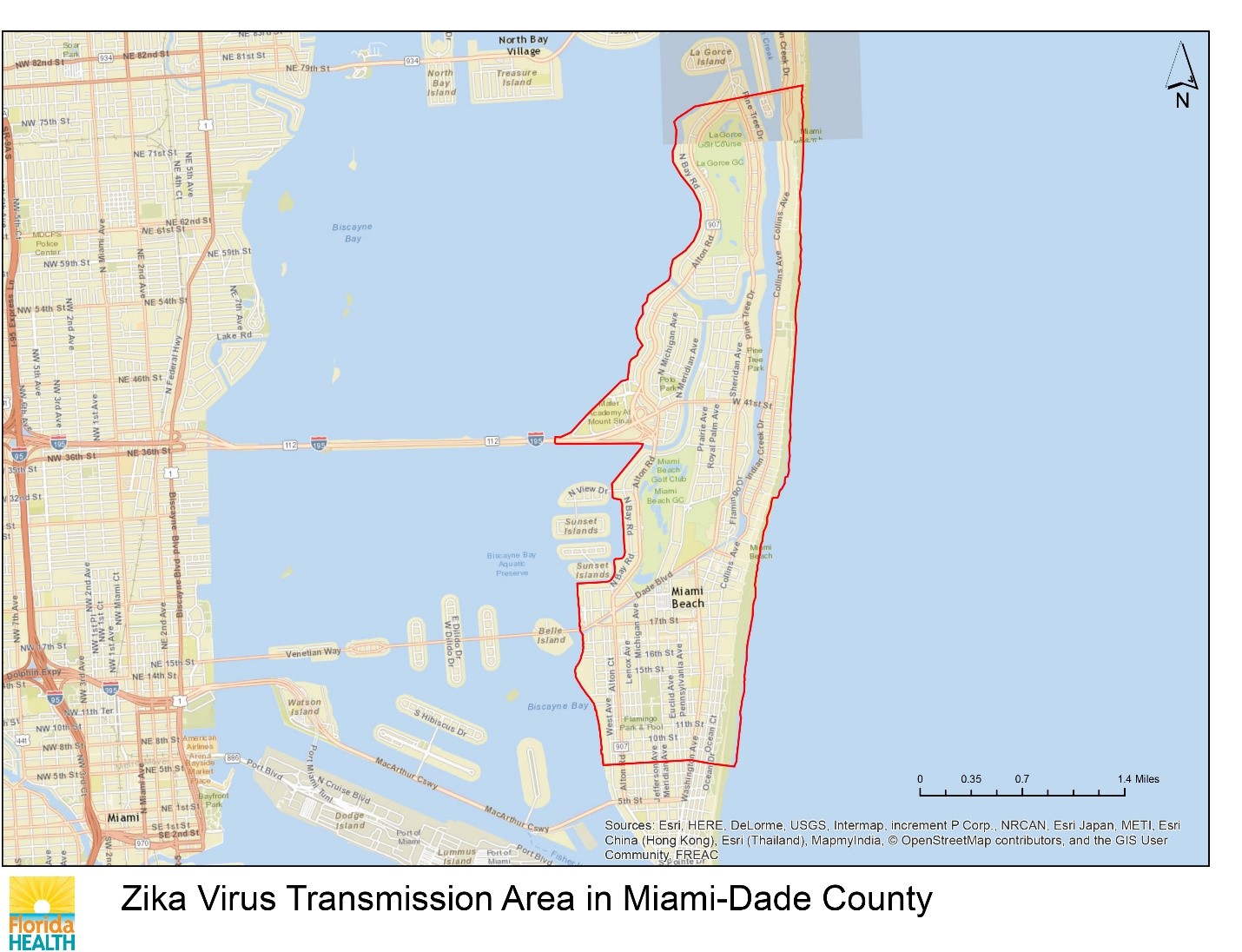
3717731473692962925.jpg


About the Florida Department of Health

The department, nationally accredited by the Public Health Accreditation Board, works to protect, promote and improve the health of all people in Florida through integrated state, county and community efforts.

Follow us on Twitter at @HealthyFla and on Facebook. For more information about the Florida Department of Health please visitwww.FloridaHealth.gov.[/TD]
[/TR]
[/TABLE]
[/TD]
[/TR]
[/TABLE]
 
[FONT=&quot]September 12, 2016[/FONT]
[h=2]Department of Health Daily Zika Update[/h] [FONT=&quot]Contact:
Communications Office
NewsMedia@flhealth.gov
(850) 245-4111
[/FONT]

[FONT=&quot]Tallahassee, Fla.?In an effort to keep Florida residents and visitors safe and aware about the status of the Zika virus, the department will issue a Zika virus update each week day. Updates will include a Zika case count by county and information to keep Floridians informed and prepared. In order to keep the public informed, the department has posted our investigation process here.[/FONT]
[FONT=&quot]There are seven new travel-related cases today including two in Miami-Dade, two in Palm Beach, one in Nassau and two involving pregnant women. This is Nassau County?s first travel-related case and the Declaration of Public Health Emergency has been amended to include the county. Please visit our website to see the full list of travel-related cases.[/FONT]
[FONT=&quot]There are eight new non-travel related cases today:[/FONT]
  • Two individuals were identified within the Wynwood area and experienced symptoms of Zika in late July. These cases are being announced today following confirmatory antibody testing to rule out other mosquito-borne illness such as Dengue and Chikungunya.
  • Two individuals are associated with ongoing active transmission in Miami Beach.
  • One individual is a Palm Beach resident, however, we are investigating to determine where exposure occurred.
  • The other three individuals are Miami-Dade residents, however, we are investigating to determine where exposure occurred.
[FONT=&quot]
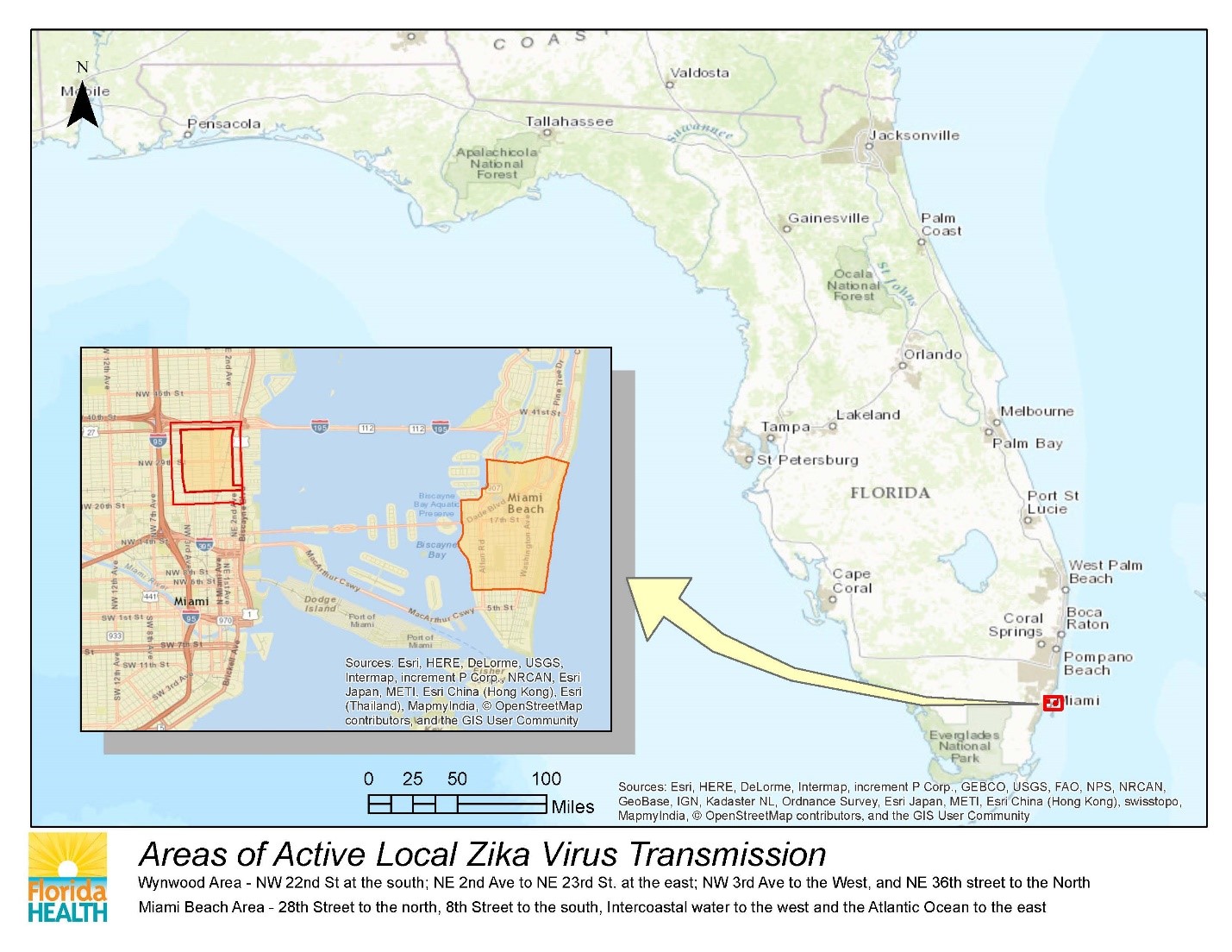
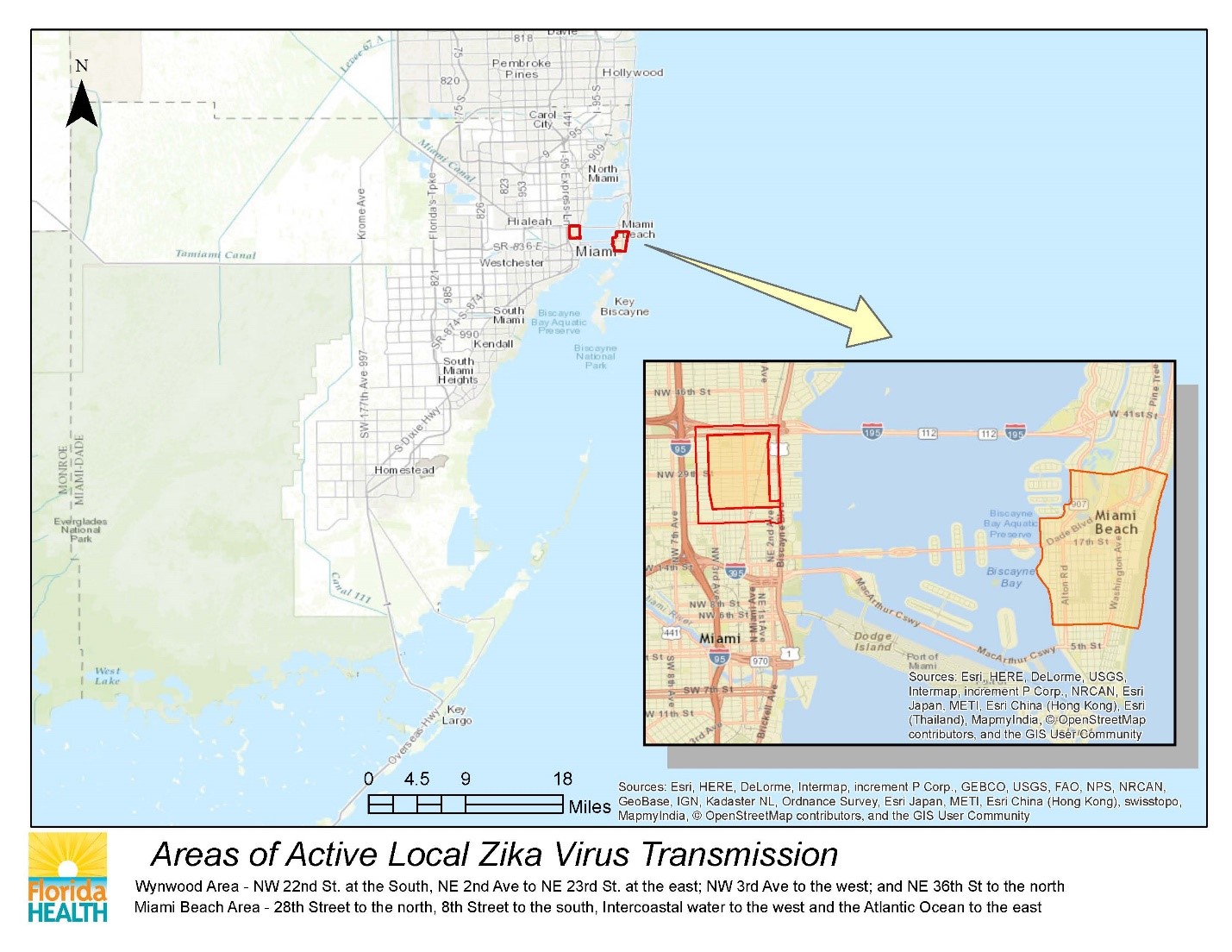
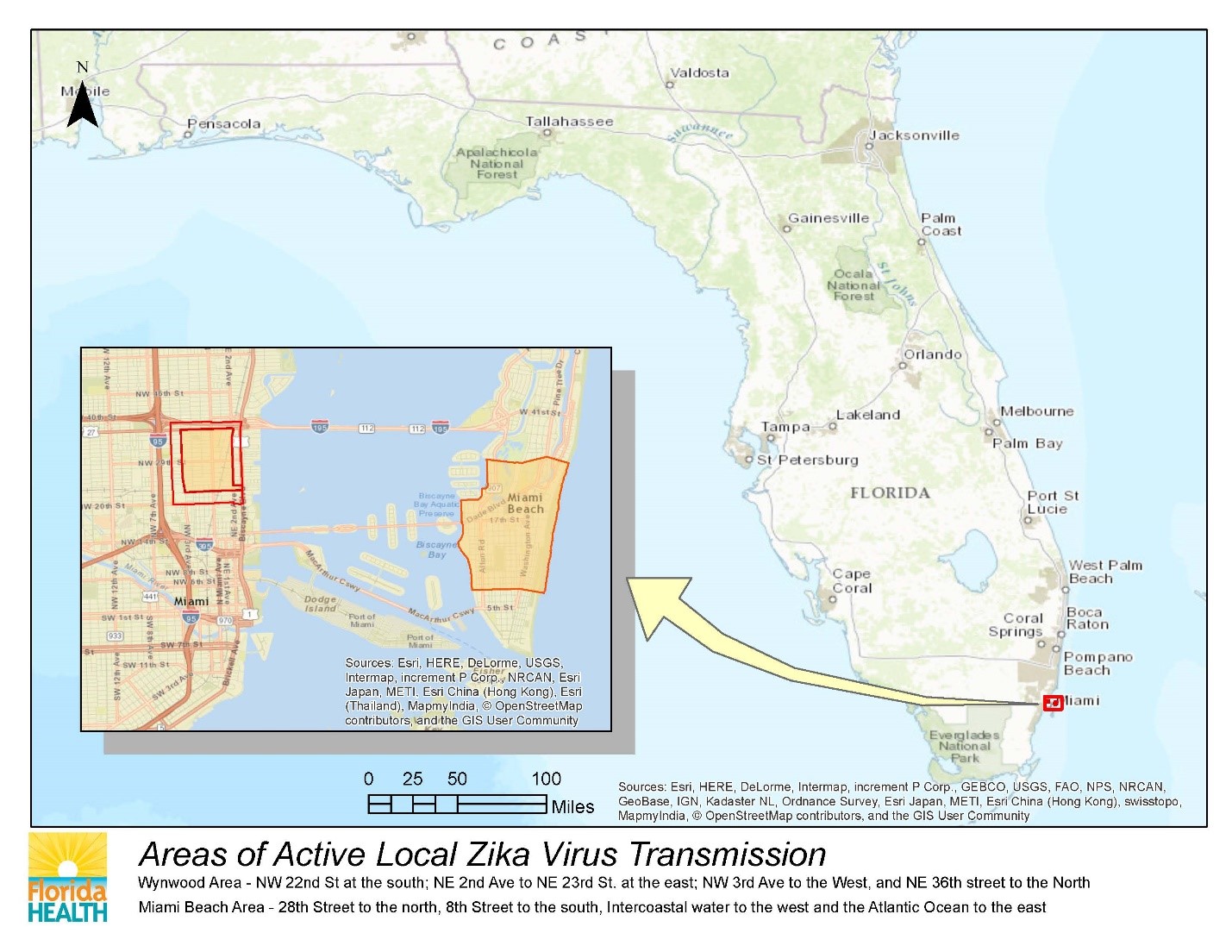
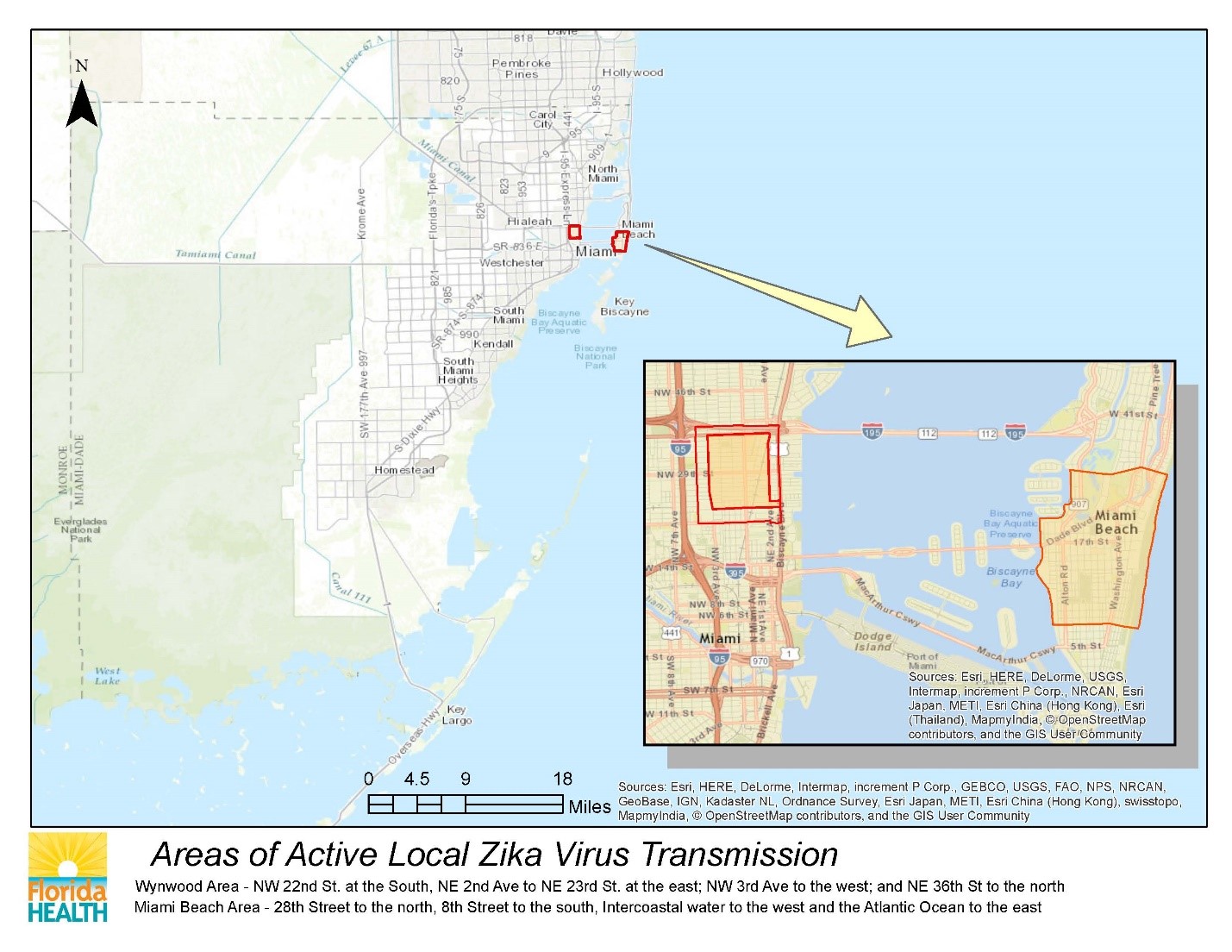
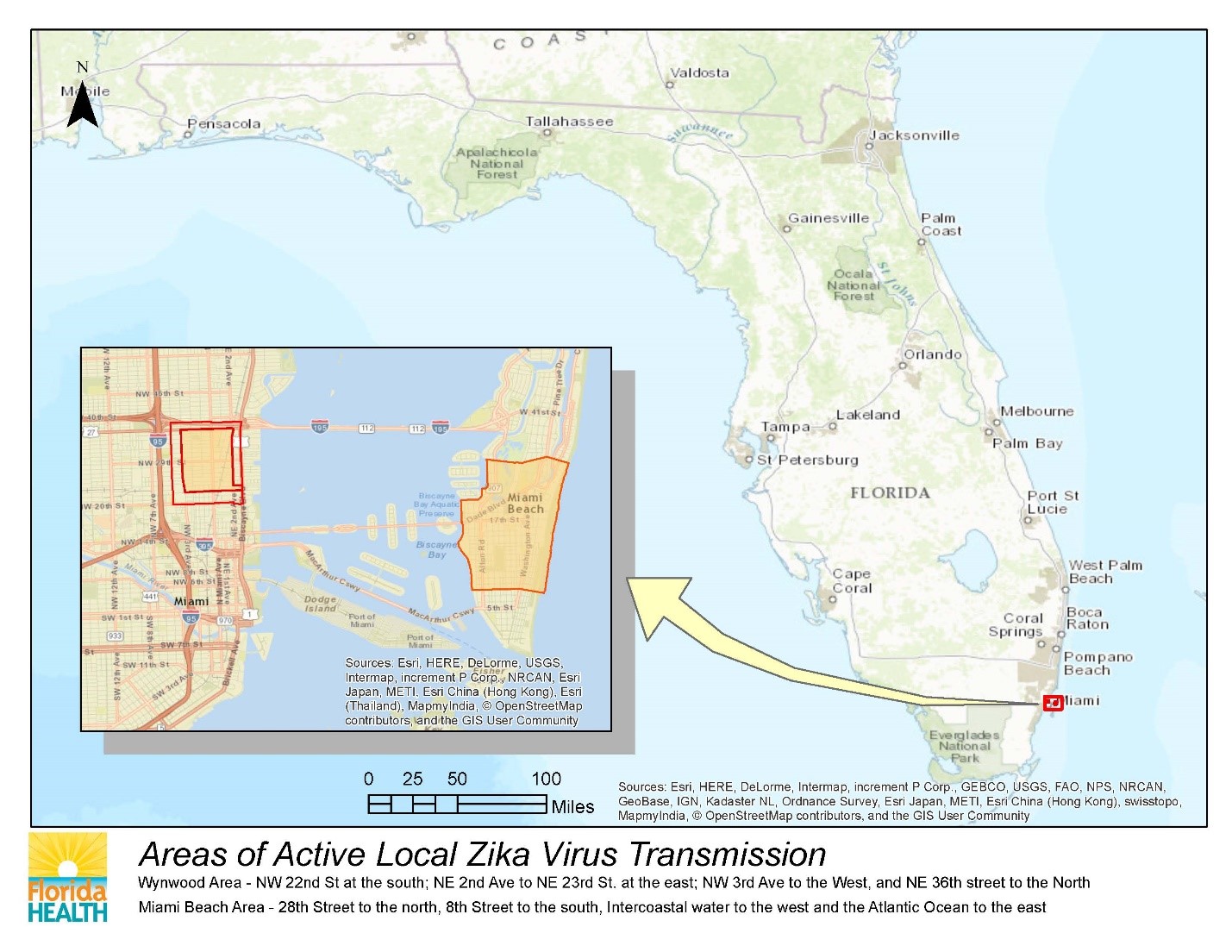
DOH continues door-to-door outreach and targeted testing in Pinellas, Palm Beach and Miami-Dade counties and mosquito abatement and reduction activities are also taking place around the locations that are being investigated. DOH believes ongoing transmission is only taking place within the small identified areas in Wynwood and Miami Beach in Miami-Dade County, see maps below.
[/FONT]

[FONT=&quot]One case does not mean ongoing active transmission is taking place. DOH conducts a thorough investigation by sampling close contacts and community members around each case to determine if additional people are infected. If DOH finds evidence that active transmission is occurring in an area, the media and the public will be notified.[/FONT]
[FONT=&quot]For a complete breakdown of non-travel and travel-related Zika infections to-date, please see below.[/FONT]
[FONT=&quot] [/FONT]
[TABLE="border: 1, cellpadding: 0, cellspacing: 0, height: 19"]
[TR]
[TD="width: 312"] Infection Type
[/TD]
[TD="width: 312"] Infection Count
[/TD]
[/TR]
[TR]
[TD="width: 312"] Travel-Related Infections of Zika
[/TD]
[TD="width: 312"] 621
[/TD]
[/TR]
[TR]
[TD="width: 312"] Non-Travel Related Infections of Zika
[/TD]
[TD="width: 312"] 64
[/TD]
[/TR]
[TR]
[TD="width: 312"] Infections Involving Pregnant Women
[/TD]
[TD="width: 312"] 86
[/TD]
[/TR]
[TR]
[TD="width: 312"] Total
[/TD]
[TD="width: 312"] 771
[/TD]
[/TR]
[/TABLE]
[FONT=&quot] [/FONT]
[FONT=&quot]The department is currently conducting 17 investigations. Information regarding the investigations can be found here. If investigations reveal additional areas of active transmission, the department will announce a defined area of concern. [/FONT]
[FONT=&quot]The department has conducted Zika virus testing for more than 6,649 people statewide. Florida currently has the capacity to test 5,306 people for active Zika virus and 8,801 for Zika antibodies. At Governor Scott?s direction, all county health departments now offer free Zika risk assessment and testing to pregnant women.[/FONT]
[FONT=&quot]Florida?s small case cluster is not considered widespread transmission, however, pregnant women are advised to avoid non-essential travel to the impacted area in Miami-Dade County (see map below). If you are pregnant and must travel or if you live or work in the impacted area, protect yourself from mosquito bites by wearing insect repellent, long clothing and limiting your time outdoors. [/FONT]
[FONT=&quot]According to CDC guidance, providers should consider testing all pregnant women with a history of travel to a Zika affected area for the virus. It is also recommended that all pregnant women who reside in or travel frequently to the area where active transmission is likely occurring be tested for Zika in the first and second trimester. Pregnant women in the identified area can contact their medical provider or their local county health department to be tested and receive a Zika prevention kit. CDC recommends that a pregnant woman with a history of Zika virus and her provider should consider additional ultrasounds. Additionally, the department is working closely with the Healthy Start Coalition of Miami-Dade County to identify pregnant women in the impacted areas to ensure they have access to resources and information to protect themselves. CDC recommends that a pregnant woman with a history of Zika virus and her provider should consider additional ultrasounds. [/FONT]
[FONT=&quot]Pregnant women can contact their local county health department for Zika risk assessment and testing hours and information. A Zika risk assessment will be conducted by county health department staff and blood and/or urine samples may be collected and sent to labs for testing. It may take one to two weeks to receive results.[/FONT]
[FONT=&quot]Florida has been monitoring pregnant women with evidence of Zika regardless of symptoms. The total number of pregnant women who have been or are being monitored is 86.[/FONT]
[FONT=&quot]On Feb. 12, Governor Scott directed the State Surgeon General to activate a Zika Virus Information Hotline for current Florida residents and visitors, as well as anyone planning on traveling to Florida in the near future. The hotline, managed by the Department of Health, has assisted 5,941 callers since it launched. The number for the Zika Virus Information Hotline is 1-855-622-6735.[/FONT]
[FONT=&quot]The department urges Floridians to drain standing water weekly, no matter how seemingly small. A couple drops of water in a bottle cap can be a breeding location for mosquitoes. Residents and visitors also need to use repellents when enjoying the Florida outdoors.[/FONT]
[FONT=&quot]For more information on DOH action and federal guidance, please click here.[/FONT]
[FONT=&quot]For resources and information on Zika virus, click here.[/FONT]
[FONT=&quot]State of Florida[/FONT]
[FONT=&quot]
090916-state-map.jpg
[/FONT]

[FONT=&quot]Miami-Dade County[/FONT]
[FONT=&quot]
090916-county-map.jpg
[/FONT]

[FONT=&quot]About the Florida Department of Health[/FONT]
[FONT=&quot]The department, nationally accredited by the Public Health Accreditation Board, works to protect, promote, and improve the health of all people in Florida through integrated state, county and community efforts.[/FONT]
[FONT=&quot]Follow us on Twitter at @HealthyFla and on Facebook. For more information about the Florida Department of Health, please visit www.FloridaHealth.gov.

http://www.floridahealth.gov/newsroom/2016/09/091216-zika-update.html
[/FONT]
 
Last edited:
[FONT=&quot] [h=1]Department of Health Daily Zika Update[/h] By Florida Department of Health, Office of Communications
September 13, 2016
[/FONT]

[FONT=&quot] Press Release[/FONT]
[FONT=&quot]
DOH_logo.png

September 13, 2016
[h=2]Department of Health Daily Zika Update[/h] Contact:
Communications Office
NewsMedia@flhealth.gov
(850) 245-4111

Tallahassee, Fla.?In an effort to keep Florida residents and visitors safe and aware about the status of the Zika virus, the department will issue a Zika virus update each week day. Updates will include a Zika case count by county and information to keep Floridians informed and prepared. In order to keep the public informed, the department has posted our investigation process here.
There are 13 new travel-related cases today including eight in Miami-Dade, one in Escambia, one in Hillsborough, one in Manatee, one in Monroe and one in Seminole. Please visit our website to see the full list of travel-related cases.
There are six new non-travel related cases today:
  • Four individuals are associated with ongoing active transmission in Miami Beach.
  • One individual was identified within the Wynwood area and experienced symptoms of Zika in early August. This case is being announced today following confirmatory lab results.
  • One individual is a Miami-Dade resident and the department is investigating to determine where exposure occurred.

DOH continues door-to-door outreach and targeted testing in Pinellas, Palm Beach and Miami-Dade counties and mosquito abatement and reduction activities are also taking place around the locations that are being investigated. DOH believes ongoing transmission is only taking place within the small identified areas in Wynwood and Miami Beach in Miami-Dade County, see maps below.

One case does not mean ongoing active transmission is taking place. DOH conducts a thorough investigation by sampling close contacts and community members around each case to determine if additional people are infected. If DOH finds evidence that active transmission is occurring in an area, the media and the public will be notified.
For a complete breakdown of non-travel and travel-related Zika infections to-date, please see below.
[TABLE="border: 1, cellpadding: 0, cellspacing: 0"]
[TR]
[TD="width: 390"] Infection Type
[/TD]
[TD="width: 390"] Infection Count
[/TD]
[/TR]
[TR]
[TD="width: 390"] Travel-Related Infections of Zika
[/TD]
[TD="width: 390"] 634
[/TD]
[/TR]
[TR]
[TD="width: 390"] Non-Travel Related Infections of Zika
[/TD]
[TD="width: 390"] 70
[/TD]
[/TR]
[TR]
[TD="width: 390"] Infections Involving Pregnant Women
[/TD]
[TD="width: 390"] 86
[/TD]
[/TR]
[TR]
[TD="width: 390"] Out of State Cases (not Florida Residents)
[/TD]
[TD="width: 390"] 9
[/TD]
[/TR]
[TR]
[TD="width: 390"] Total
[/TD]
[TD="width: 390"] 799
[/TD]
[/TR]
[/TABLE]
The department is currently conducting 17 investigations. Information regarding the investigations can be found here. If investigations reveal additional areas of active transmission, the department will announce a defined area of concern.
The department has conducted Zika virus testing for more than 6,895 people statewide. Florida currently has the capacity to test 5,251 people for active Zika virus and 8,737 for Zika antibodies. At Governor Scott?s direction, all county health departments now offer free Zika risk assessment and testing to pregnant women.
Florida?s small case cluster is not considered widespread transmission, however, pregnant women are advised to avoid non-essential travel to the impacted area in Miami-Dade County (see map below). If you are pregnant and must travel or if you live or work in the impacted area, protect yourself from mosquito bites by wearing insect repellent, long clothing and limiting your time outdoors.
According to CDC guidance, providers should consider testing all pregnant women with a history of travel to a Zika affected area for the virus. It is also recommended that all pregnant women who reside in or travel frequently to the area where active transmission is likely occurring be tested for Zika in the first and second trimester. Pregnant women in the identified area can contact their medical provider or their local county health department to be tested and receive a Zika prevention kit. CDC recommends that a pregnant woman with a history of Zika virus and her provider should consider additional ultrasounds. Additionally, the department is working closely with the Healthy Start Coalition of Miami-Dade County to identify pregnant women in the impacted areas to ensure they have access to resources and information to protect themselves. CDC recommends that a pregnant woman with a history of Zika virus and her provider should consider additional ultrasounds.
Pregnant women can contact their local county health department for Zika risk assessment and testing hours and information. A Zika risk assessment will be conducted by county health department staff and blood and/or urine samples may be collected and sent to labs for testing. It may take one to two weeks to receive results.
Florida has been monitoring pregnant women with evidence of Zika regardless of symptoms. The total number of pregnant women who have been or are being monitored is 86.
On Feb. 12, Governor Scott directed the State Surgeon General to activate a Zika Virus Information Hotline for current Florida residents and visitors, as well as anyone planning on traveling to Florida in the near future. The hotline, managed by the Department of Health, has assisted 6,020 callers since it launched. The number for the Zika Virus Information Hotline is 1-855-622-6735.
The department urges Floridians to drain standing water weekly, no matter how seemingly small. A couple drops of water in a bottle cap can be a breeding location for mosquitoes. Residents and visitors also need to use repellents when enjoying the Florida outdoors.
For more information on DOH action and federal guidance, please click here.
For resources and information on Zika virus, click here.
State of Florida
091316-state-map.jpg

Miami-Dade County
091316-county-map.jpg

About the Florida Department of Health
The department, nationally accredited by the Public Health Accreditation Board, works to protect, promote, and improve the health of all people in Florida through integrated state, county and community efforts.
Follow us on Twitter at @HealthyFla and on Facebook. For more information about the Florida Department of Health, please visit www.FloridaHealth.gov.

http://www.floridahealth.gov/newsroom/2016/09/091316-zika-update.html

[/FONT]
 
...
Region of travel for Zika cases diagnosed in UK travellers since 2015
[TABLE="class: text_table, width: 720, height: 25"]
[TR]
[/TR]
[TR]
[TD]Caribbean[/TD]
[TD]128[/TD]
[/TR]
[TR]
[TD]South America[/TD]
[TD]33[/TD]
[/TR]
[TR]
[TD]Central America[/TD]
[TD]21[/TD]
[/TR]
[TR]
[TD]North America*[/TD]
[TD]2[/TD]
[/TR]
[TR]
[TD]Oceania[/TD]
[TD]1[/TD]
[/TR]
[TR]
[TD]More than one region[/TD]
[TD]4[/TD]
[/TR]
[TR]
[TD]Total[/TD]
[TD]189[/TD]
[/TR]
[/TABLE]

*The case acquired in North America had travelled to the high risk area of Miami-Dade County in Florida
...

https://www.gov.uk/government/publi...us-epidemiology-and-cases-diagnosed-in-the-uk
 
[FONT=&quot] [h=1]Department of Health Daily Zika Update[/h] By Florida Department of Health, Office of Communications
September 14, 2016
[/FONT]

[FONT=&quot] Press Release[/FONT]
[FONT=&quot]
DOH_logo.png

September 14, 2016
[h=2]Department of Health Daily Zika Update[/h] Contact:
Communications Office
NewsMedia@flhealth.gov
(850) 245-4111

Tallahassee, Fla.?In an effort to keep Florida residents and visitors safe and aware about the status of the Zika virus, the department will issue a Zika virus update each week day. Updates will include a Zika case count by county and information to keep Floridians informed and prepared. In order to keep the public informed, the department has posted our investigation process here.
There are five new travel-related cases today including two in Broward, one in Miami-Dade, one in Hillsborough and one in Polk. Please visit our website to see the full list of travel-related cases.
There is one new non-travel related case today associated with the Miami Beach investigation.

DOH continues door-to-door outreach and targeted testing in Pinellas, Palm Beach and Miami-Dade counties and mosquito abatement and reduction activities are also taking place around the locations that are being investigated. DOH believes ongoing transmission is only taking place within the small identified areas in Wynwood and Miami Beach in Miami-Dade County, see maps below.

One case does not mean ongoing active transmission is taking place. DOH conducts a thorough investigation by sampling close contacts and community members around each case to determine if additional people are infected. If DOH finds evidence that active transmission is occurring in an area, the media and the public will be notified.
For a complete breakdown of non-travel and travel-related Zika infections to-date, please see below.
[TABLE="border: 1, cellpadding: 0, cellspacing: 0"]
[TR]
[TD="width: 390"] Infection Type
[/TD]
[TD="width: 390"] Infection Count
[/TD]
[/TR]
[TR]
[TD="width: 390"] Travel-Related Infections of Zika
[/TD]
[TD="width: 390"] 639
[/TD]
[/TR]
[TR]
[TD="width: 390"] Non-Travel Related Infections of Zika
[/TD]
[TD="width: 390"] 71
[/TD]
[/TR]
[TR]
[TD="width: 390"] Infections Involving Pregnant Women
[/TD]
[TD="width: 390"] 86
[/TD]
[/TR]
[TR]
[TD="width: 390"] Out of State Cases (not Florida Residents)
[/TD]
[TD="width: 390"] 9
[/TD]
[/TR]
[TR]
[TD="width: 390"] Total
[/TD]
[TD="width: 390"] 805
[/TD]
[/TR]
[/TABLE]
The department is currently conducting 16 active investigations. The department has closed seven investigations. Information regarding the investigations can be found here. If investigations reveal additional areas of active transmission, the department will announce a defined area of concern.
The department has conducted Zika virus testing for more than 7,000 people statewide. Florida currently has the capacity to test 5,176 people for active Zika virus and 8,612 for Zika antibodies. At Governor Scott?s direction, all county health departments now offer free Zika risk assessment and testing to pregnant women.
Florida?s small case cluster is not considered widespread transmission, however, pregnant women are advised to avoid non-essential travel to the impacted area in Miami-Dade County (see map below). If you are pregnant and must travel or if you live or work in the impacted area, protect yourself from mosquito bites by wearing insect repellent, long clothing and limiting your time outdoors.
According to CDC guidance, providers should consider testing all pregnant women with a history of travel to a Zika affected area for the virus. It is also recommended that all pregnant women who reside in or travel frequently to the area where active transmission is likely occurring be tested for Zika in the first and second trimester. Pregnant women in the identified area can contact their medical provider or their local county health department to be tested and receive a Zika prevention kit. CDC recommends that a pregnant woman with a history of Zika virus and her provider should consider additional ultrasounds. Additionally, the department is working closely with the Healthy Start Coalition of Miami-Dade County to identify pregnant women in the impacted areas to ensure they have access to resources and information to protect themselves. CDC recommends that a pregnant woman with a history of Zika virus and her provider should consider additional ultrasounds.
Pregnant women can contact their local county health department for Zika risk assessment and testing hours and information. A Zika risk assessment will be conducted by county health department staff and blood and/or urine samples may be collected and sent to labs for testing. It may take one to two weeks to receive results.
Florida has been monitoring pregnant women with evidence of Zika regardless of symptoms. The total number of pregnant women who have been or are being monitored is 86.
On Feb. 12, Governor Scott directed the State Surgeon General to activate a Zika Virus Information Hotline for current Florida residents and visitors, as well as anyone planning on traveling to Florida in the near future. The hotline, managed by the Department of Health, has assisted 6,086 callers since it launched. The number for the Zika Virus Information Hotline is 1-855-622-6735.
The department urges Floridians to drain standing water weekly, no matter how seemingly small. A couple drops of water in a bottle cap can be a breeding location for mosquitoes. Residents and visitors also need to use repellents when enjoying the Florida outdoors.
For more information on DOH action and federal guidance, please click here.
For resources and information on Zika virus, click here.
State of Florida
091416-state-map.jpg

Miami-Dade County
091416-county-map.jpg

About the Florida Department of Health
The department, nationally accredited by the Public Health Accreditation Board, works to protect, promote, and improve the health of all people in Florida through integrated state, county and community efforts.
Follow us on Twitter at @HealthyFla and on Facebook. For more information about the Florida Department of Health, please visit www.FloridaHealth.gov.

http://www.floridahealth.gov/newsroom/2016/09/091416-zika-update.html

[/FONT]
 
[FONT=&quot] [h=1]Department of Health Daily Zika Update[/h] By Florida Department of Health, Office of Communications
September 15, 2016
[/FONT]

[FONT=&quot] Press Release[/FONT]
[FONT=&quot]
DOH_logo.png

September 15, 2016
[h=2]Department of Health Daily Zika Update[/h] Contact:
Communications Office
NewsMedia@flhealth.gov
(850) 245-4111

Tallahassee, Fla.?In an effort to keep Florida residents and visitors safe and aware about the status of the Zika virus, the department will issue a Zika virus update each week day. Updates will include a Zika case count by county and information to keep Floridians informed and prepared. In order to keep the public informed, the department has posted our investigation process here.
There are 11 new travel-related cases today including eight in Miami-Dade, two in Flagler and one in Lee. This is Flagler County?s first case and the Declaration of Public Health Emergency has been amended to include the county. Please visit our website to see the full list of travel-related cases.
There are seven new non-travel related cases today including six in Miami-Dade and one in Palm Beach County.
  • Three individuals are associated with the Miami Beach investigation.
  • Two individuals are in Miami-Dade County and the department is investigating to determine where exposure occurred.
  • One case is a Palm Beach resident, however the individual was likely infected in Miami-Dade County. The department is investigating the case.
  • One individual is an out-of-state visitor who was likely infected in Miami-Dade County and the department is investigating to determine where exposure occurred.

DOH continues door-to-door outreach and targeted testing in Pinellas, Palm Beach and Miami-Dade counties and mosquito abatement and reduction activities are also taking place around the locations that are being investigated. DOH believes ongoing transmission is only taking place within the small identified areas in Wynwood and Miami Beach in Miami-Dade County, see maps below.

One case does not mean ongoing active transmission is taking place. DOH conducts a thorough investigation by sampling close contacts and community members around each case to determine if additional people are infected. If DOH finds evidence that active transmission is occurring in an area, the media and the public will be notified.
For a complete breakdown of non-travel and travel-related Zika infections to-date, please see below.
[TABLE="border: 1, cellpadding: 0, cellspacing: 0"]
[TR]
[TD="width: 390"] Infection Type
[/TD]
[TD="width: 390"] Infection Count
[/TD]
[/TR]
[TR]
[TD="width: 390"] Travel-Related Infections of Zika
[/TD]
[TD="width: 390"] 650
[/TD]
[/TR]
[TR]
[TD="width: 390"] Non-Travel Related Infections of Zika
[/TD]
[TD="width: 390"] 77
[/TD]
[/TR]
[TR]
[TD="width: 390"] Infections Involving Pregnant Women
[/TD]
[TD="width: 390"] 86
[/TD]
[/TR]
[TR]
[TD="width: 390"] Out of State Cases (not Florida Residents)
[/TD]
[TD="width: 390"] 10
[/TD]
[/TR]
[TR]
[TD="width: 390"] Total
[/TD]
[TD="width: 390"] 823
[/TD]
[/TR]
[/TABLE]
The department is currently conducting 20 active investigations. The department has closed seven investigations. Information regarding the investigations can be found here. If investigations reveal additional areas of active transmission, the department will announce a defined area of concern.
The department has conducted Zika virus testing for more than 7,117 people statewide. Florida currently has the capacity to test 5,094 people for active Zika virus and 8,516 for Zika antibodies. At Governor Scott?s direction, all county health departments now offer free Zika risk assessment and testing to pregnant women.
Florida?s small case cluster is not considered widespread transmission, however, pregnant women are advised to avoid non-essential travel to the impacted area in Miami-Dade County (see map below). If you are pregnant and must travel or if you live or work in the impacted area, protect yourself from mosquito bites by wearing insect repellent, long clothing and limiting your time outdoors.
According to CDC guidance, providers should consider testing all pregnant women with a history of travel to a Zika affected area for the virus. It is also recommended that all pregnant women who reside in or travel frequently to the area where active transmission is likely occurring be tested for Zika in the first and second trimester. Pregnant women in the identified area can contact their medical provider or their local county health department to be tested and receive a Zika prevention kit. CDC recommends that a pregnant woman with a history of Zika virus and her provider should consider additional ultrasounds. Additionally, the department is working closely with the Healthy Start Coalition of Miami-Dade County to identify pregnant women in the impacted areas to ensure they have access to resources and information to protect themselves. CDC recommends that a pregnant woman with a history of Zika virus and her provider should consider additional ultrasounds.
Pregnant women can contact their local county health department for Zika risk assessment and testing hours and information. A Zika risk assessment will be conducted by county health department staff and blood and/or urine samples may be collected and sent to labs for testing. It may take one to two weeks to receive results.
Florida has been monitoring pregnant women with evidence of Zika regardless of symptoms. The total number of pregnant women who have been or are being monitored is 86.
On Feb. 12, Governor Scott directed the State Surgeon General to activate a Zika Virus Information Hotline for current Florida residents and visitors, as well as anyone planning on traveling to Florida in the near future. The hotline, managed by the Department of Health, has assisted 6,141 callers since it launched. The number for the Zika Virus Information Hotline is 1-855-622-6735.
The department urges Floridians to drain standing water weekly, no matter how seemingly small. A couple drops of water in a bottle cap can be a breeding location for mosquitoes. Residents and visitors also need to use repellents when enjoying the Florida outdoors.
For more information on DOH action and federal guidance, please click here.
For resources and information on Zika virus, click here.
State of Florida
091516-state-map.jpg

Miami-Dade County
091516-county-map.jpg

About the Florida Department of Health
The department, nationally accredited by the Public Health Accreditation Board, works to protect, promote, and improve the health of all people in Florida through integrated state, county and community efforts.
Follow us on Twitter at @HealthyFla and on Facebook. For more information about the Florida Department of Health, please visit www.FloridaHealth.gov.

http://www.floridahealth.gov/newsroom/2016/09/091516-zika-update.html

[/FONT]
 
Gov. Scott: DOH expands area of local transmission in Miami Beach; expects to lift Wynwood zone Monday

GOV. SCOTT: DOH EXPANDS AREA OF LOCAL TRANSMISSION IN MIAMI BEACH; EXPECTS TO LIFT WYNWOOD ZONE MONDAY

On September 16, 2016, in News Releases, by Staff


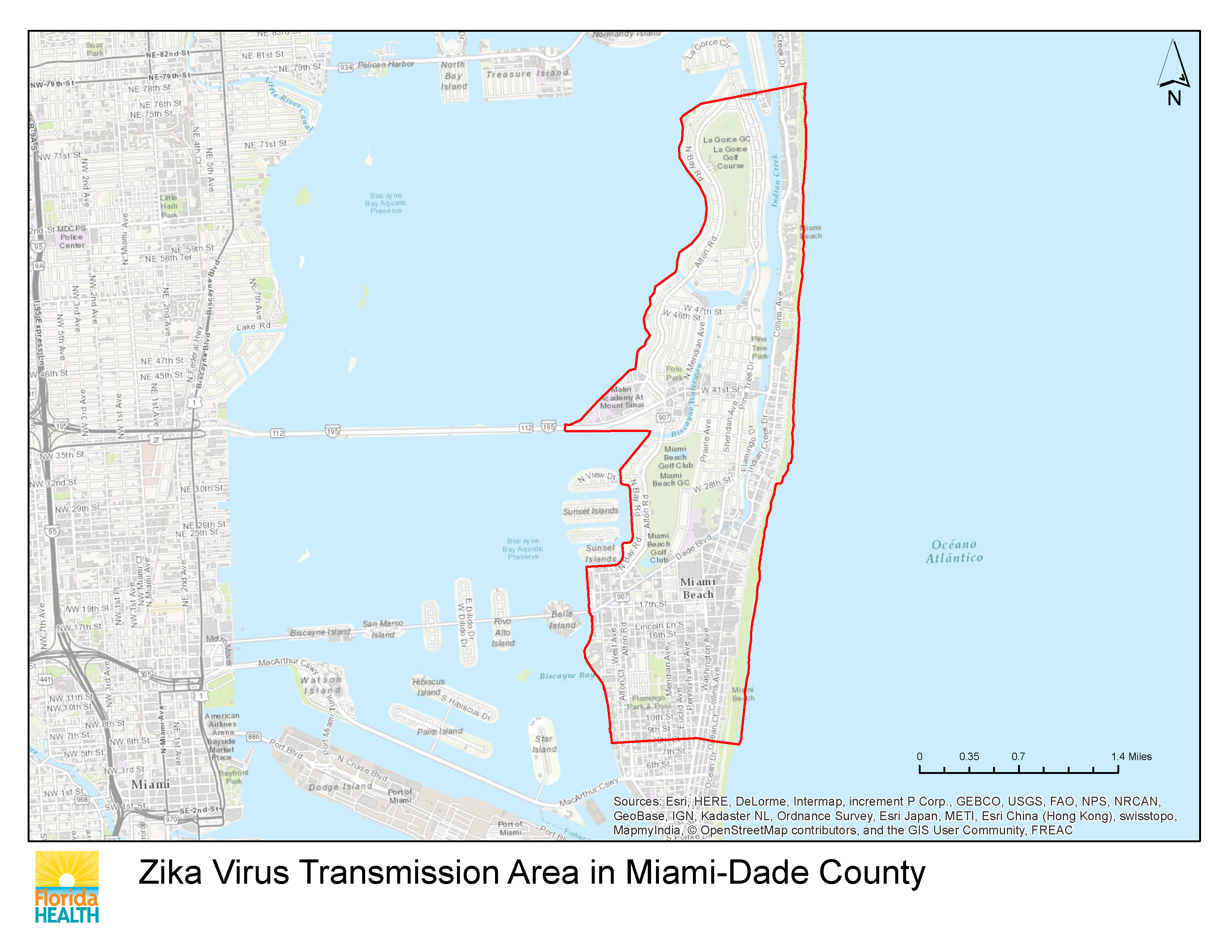
TALLAHASSEE, Fla. &#150; Tonight, Governor Rick Scott announced that the Florida Department of Health (DOH) has confirmed through its on-going investigation that local transmission of Zika is occurring in an expanded area of Miami Beach. DOH is expanding the area of local transmission in Miami Beach from 8th Street to 63rd Street. The total area where DOH believes active transmission of the Zika virus is occurring is around 4.5 square miles (see map below). DOH has identified five people, two males and three females, in the expanded area who all experienced symptoms within one month of each other. One of these cases has already been announced by DOH earlier this week and was under a normal investigation process. The investigations of the other four were completed today. All five individuals are non-travel related cases. Aggressive mosquito control efforts, including larviciding, have already taken place in this area and these efforts will continue by the Miami-Dade Mosquito Control District. The total number of non-travel related cases associated with this expanded impacted area on Miami Beach is 35 and the total number of non-travel related cases in Florida is 93 (this includes people who live outside of Florida and contracted Zika in our state).

Governor Rick Scott said, &#147;While we&#146;ve learned that we&#146;re expanding the impacted area in Miami Beach, the good news is that we expect to lift the zone in Wynwood on Monday because of our aggressive mosquito control measures, outreach to the community, education efforts and the vigilant actions of the residents and businesses in Wynwood.The expansion of the Miami Beach area where local transmission is occurring highlights the need for continued aggressive mosquito control measures and for Congress to immediately approve federal funding to combat Zika. I went to Washington this week to meet with Congressional leaders and urge them to immediately provide funding for this national crisis. Every minute that passes that Congress doesn&#146;t approve funding means more time is lost from researching this virus to find a vaccine to help pregnant women and their developing babies.

&#147;Due to the inaction by Congress, I authorized an additional $10 million in state funds today to continue fighting Zika. I am also continuing to call on Congress to hold a field hearing in Miami on Zika preparedness and prevention by October 1. I know many members of Florida&#146;s Congressional Delegation are fighting for Zika funding and it is critically important that members come to Miami and hear directly from those who are on the frontlines of batting this virus.

&#147;Following today&#146;s news, I am asking the CDC to provide Florida with an additional epidemiologist to support DOH&#146;s efforts to combat and contain Zika and host a call with community leaders and clinicians in Miami Beach to answer questions and provide the latest guidance on Zika. In August, I asked the CDC to send additional lab support to Florida and while they have provided some resources, we need much more. That is why earlier this week I asked the CDC for more lab support. Additionally, I am renewing my call to the Obama Administration to provide 10,000 Zika Prevention Kits to protect pregnant women and a detailed plan on how they would like us to work with FEMA now that Zika is mosquito-borne in our state. We have continued to call on the CDC to quickly respond to these requests, and pregnant women who are most at-risk for the Zika virus deserve to have these requests immediately fulfilled.&#148;

&#147;Everything we are doing to combat this virus is to protect pregnant women. As a father and a grandfather, I cannot imagine the challenges a child would have being born with microcephaly. Everyone has to take precautions by dumping standing water and wearing bug spray so we can protect pregnant women and their growing babies. It is up to all of us to urgently work to combat Zika.&#148;

Following today&#146;s news, the Governor made the following new requests to the CDC:

  • Provide Florida with an additional epidemiologist to support DOH&#146;s efforts to combat and contain Zika; and
  • Host a call with community leaders and clinicians in Miami Beach to answer questions and provide the latest information and guidance on Zika.
The Governor also renewed the following requests, which have yet to be fulfilled by the federal government:
  • Additional lab support staff (Governor Scott requested September 14, 2016).
  • 10,000 Zika Prevention Kits, which are essential to protecting pregnant women (Governor Scott requested August 19, 2016).
  • A detailed plan from the Obama Administration on how they would like Florida to work with FEMA on how federal resources will be allocated to states now that this has become mosquito-borne in Florida. (Initially requested June 1; Requested again August 19, 2016).
9.16.16_miamidade-300x231.jpg
 
Florida - Fifth mosquito sample tests positive for Zika in Miami-Dade

[h=1]Miami-Dade Mosquitoes Test Positive for Zika[/h] [FONT=pt_sansregular]Sep 16, 2016
[/FONT]

[FONT=pt_sansregular][FONT=pt_sansbold]TALLAHASSEE, Fla. ? The Florida Department of Agriculture and Consumer Services announced today that it has detected Zika in one mosquito sample from the same small area in Miami Beach, where four other samples had previously tested positive for Zika. All samples have consisted of Aedes aeqypti mosquitoes and are from an area where increased trapping and intensified mosquito control measures have already been underway since the Florida Department of Health determined local transmission had occurred.[/FONT]
[FONT=pt_sansregular]The Florida Department of Agriculture and Consumer Services has tested more than 3,200 mosquito samples, consisting of more than 52,000 mosquitoes, since May, and these five samples are the only ones to test positive.[/FONT]
[FONT=pt_sansregular]Miami-Dade County has submitted 375 additional mosquito samples subsequent to the collection date of the first positive mosquito pool finds, and those 375 mosquito samples have tested negative for Zika.[/FONT]
[FONT=pt_sansregular]The positive mosquito pool announced today was collected in Miami Beach within the current zone that has been treated for local transmission. Scientists with the Florida Department of Agriculture and Consumer Services tested the sample at the Bronson Animal Disease Diagnostic Laboratory in Kissimmee.[/FONT]
[FONT=pt_sansregular]A summary of the five total positive mosquito samples to date is as follows:[/FONT]
  • Sept. 16, 2016: One mosquito sample from a small area in Miami Beach tested positive for Zika.
  • Sept. 9, 2016: One mosquito sample from a small area in Miami Beach tested positive for Zika.
  • Sept. 1, 2016: Three mosquito samples from a small area in Miami Beach tested positive for Zika.
[FONT=pt_sansregular]Florida's proactive efforts, which are conducted by local mosquito control programs and supported by the expertise provided by the Florida Department of Agriculture and Consumer Services, include: eliminating larval habitats by emptying standing water, treating water-holding containers with long-lasting larvicide, providing outdoor residual and spatial insecticide treatments to reduce adult vectors, and conducting adult mosquito surveillance to evaluate the effectiveness of treatments.[/FONT]
[FONT=pt_sansregular]Miami-Dade County's Mosquito Control team will continue to conduct inspections to reduce mosquito breeding and perform spray treatments as necessary in a 200-yard radius around the trap location.[/FONT]
[FONT=pt_sansregular]Floridians can help prevent the spread of Zika by eliminating mosquito breeding grounds by draining standing water around their homes, businesses and communities.[/FONT]
[FONT=pt_sansregular]On February 2, 2016, the Florida Surgeon General declared a public health emergency in regards to the Zika virus. Floridians can assist in Zika-related response efforts by draining standing water and allowing officials who are conducting mosquito control efforts to access their property.[/FONT]
[FONT=pt_sansregular]Commissioner Adam H. Putnam issued a mosquito declaration on July 29 when local transmission first occurred in Florida and has since extended the declaration. Access a copy of the mosquito declaration [
pdf.png
819.05 KB ].[/FONT]

[FONT=pt_sansregular]For more information on the Zika virus, visit the Florida Department of Health's website at FloridaHealth.gov.[/FONT]
[/FONT]
 
DEPARTMENT OF HEALTH DAILY ZIKA
UPDATE

Contact:
Communications Office
NewsMedia@flhealth.gov
850-245-4111
TALLAHASSEE, Fla. ? In an effort to keep Florida residents and visitors safe and aware about the status of the Zika virus, the department will issue a Zika virus update each week day. Updates will include a Zika case count by county and information to keep Floridians informed and prepared. In order to keep the public informed, the department has posted our investigation processhere .


There are 10 new travel-related cases today including six in Miami-Dade, two in Lee and two in Orange. Please visit our website to see the full list of travel-related cases.


There are two new non-travel related cases today associated with the Miami Beach investigation.

DOH continues door-to-door outreach and targeted testing in Pinellas, Palm Beach and Miami-Dade counties and mosquito abatement and reduction activities are also taking place around the locations that are being investigated. DOH believes ongoing transmission is only taking place within the small identified areas in Wynwood and Miami Beach in Miami-Dade County, see maps below.

One case does not mean ongoing active transmission is taking place. DOH conducts a thorough investigation by sampling close contacts and community members around each case to determine if additional people are infected. If DOH finds evidence that active transmission is occurring in an area, the media and the public will be notified.

For a complete breakdown of non-travel and travel-related Zika infections to-date, please see below.
[TABLE="border: 1, cellpadding: 0, cellspacing: 0"]
[TR]
[TD]Infection Type[/TD]
[TD]Infection Count[/TD]
[/TR]
[TR]
[TD]Travel-Related Infections of Zika[/TD]
[TD]660[/TD]
[/TR]
[TR]
[TD]Non-Travel Related Infections of Zika[/TD]
[TD]79[/TD]
[/TR]
[TR]
[TD]Infections Involving Pregnant Women[/TD]
[TD]86[/TD]
[/TR]
[TR]
[TD]Out of State Cases (not Florida Residents)[/TD]
[TD]10[/TD]
[/TR]
[TR]
[TD]Total[/TD]
[TD]835[/TD]
[/TR]
[/TABLE]

The department is currently conducting 17 active investigations. The department has closed eight investigations. The department has combined two previously reported investigations with an existing investigation. Information regarding the investigations can be found here . If investigations reveal additional areas of active transmission, the department will announce a defined area of concern.

The department has conducted Zika virus testing for more than 7,192 people statewide. Florida currently has the capacity to test 5,022 people for active Zika virus and 8,452 for Zika antibodies. At Governor Scott?s direction, all county health departments now offer free Zika risk assessment and testing to pregnant women.

Florida?s small case cluster is not considered widespread transmission, however, pregnant women are advised to avoid non-essential travel to the impacted area in Miami-Dade County (see map below). If you are pregnant and must travel or if you live or work in the impacted area, protect yourself from mosquito bites by wearing insect repellent, long clothing and limiting your time outdoors.

According to CDC guidance, providers should consider testing all pregnant women with a history of travel to a Zika affected area for the virus. It is also recommended that all pregnant women who reside in or travel frequently to the area where active transmission is likely occurring be tested for Zika in the first and second trimester. Pregnant women in the identified area can contact their medical provider or their local county health department to be tested and receive a Zika prevention kit. CDC recommends that a pregnant woman with a history of Zika virus and her provider should consider additional ultrasounds. Additionally, the department is working closely with the Healthy Start Coalition of Miami-DadeCounty to identify pregnant women in the impacted areas to ensure they have access to resources and information to protect themselves. CDC recommends that a pregnant woman with a history of Zika virus and her provider should consider additional ultrasounds.

Pregnant women can contact their local county health department for Zika risk assessment and testing hours and information. A Zika risk assessment will be conducted by county health department staff and blood and/or urine samples may be collected and sent to labs for testing. It may take one to two weeks to receive results.

Florida has been monitoring pregnant women with evidence of Zika regardless of symptoms. The total number of pregnant women who have been or are being monitored is 86.

On Feb. 12, Governor Scott directed the State Surgeon General to activate a Zika Virus Information Hotline for current Florida residents and visitors, as well as anyone planning on traveling to Florida in the near future. The hotline, managed by the Department of Health, has assisted 6,214 callers since it launched. The number for the Zika Virus Information Hotline is 1-855-622-6735.

The department urges Floridians to drain standing water weekly, no matter how seemingly small. A couple drops of water in a bottle cap can be a breeding location for mosquitoes. Residents and visitors also need to use repellents when enjoying the Florida outdoors.

For more information on DOH action and federal guidance, please click here .

For resources and information on Zika virus, click here .

State of Florida
MsgAttachment


Miami-Dade County

MsgAttachment


About the Florida Department of Health

The department, nationally accredited by the Public Health Accreditation Board , works to protect, promote and improve the health of all people in Florida through integrated state, county and community efforts.
Follow us on Twitter at @HealthyFla and on Facebook . For more information about the Florida Department of Health please visitwww.FloridaHealth.gov


http://www.floridahealth.gov/_documents/newsroom/press-releases/2016/09/091616-zika-update.pdf

 
Florida - ​State, local official declare Wynwood Zika free and safe - await CDC lifting of travel advisory - don't hold your breath

State, Local Official Declare Wynwood Zika Free and Safe, Await Federal Lifting of Travel Advisory
...
During a Monday morning press conference where he was joined by City of Miami Mayor Tomas Regalado and Miami-Dade County Mayor Carlos Gimenez, Florida Gov. Rick Scott declared that the area north of Downtown Miami has not had a new case of the virus detected.

While Scott and both Mayors are willing to silence the alarms, the Centers for Disease Control and Prevention still have travel advisories in place for the area - something leaders hope will get lifted in the near future.
...
http://www.nbcmiami.com/news/local/...ika-Zone-Expected-to-be-Lifted-393878691.html
 
...
Updated guidance for Wynwood area


The guidance below applies to the identified area in Wynwood, FL.

  • Pregnant women and partners of pregnant women who are worried about potential exposure to Zika may consider postponing nonessential travel to all parts of Miami-Dade County, including the Wynwood area.
  • Pregnant women and partners of pregnant women living in or traveling to the area should strictly follow steps to prevent mosquito bites.
  • Women and men living in or who traveled to the area should be aware that the location was considered to have active Zika virus transmission from June 15 to September 18, 2016. Pregnant women should talk to their doctor or other healthcare provider about getting tested for Zika. Partners of pregnant women should consistently and correctly use condoms to prevent passing Zika during sex, or they should not have sex during the pregnancy.
  • Women and men who do not have signs or symptoms of Zika and who traveled to the area from June 15 to September 18 should wait at least 8 weeks before trying to get pregnant.
  • Men who had signs or symptoms of Zika or were diagnosed with Zika and who traveled to the area from June 15 to September 18 should wait at least 6 months before trying to get their partner pregnant.
  • ...
  • http://www.cdc.gov/zika/intheus/florida-update.html
 
Mon Sep 19, 2016 | 11:18am EDT

Florida declares neighborhood Zika free; CDC remains cautious

By Julie Steenhuysen and Ransdell Pierson

U.S. health officials on Monday continued to advise pregnant women and their partners to consider postponing non-essential travel to Miami to avoid the risk of exposure to Zika, even as Florida Governor Rick Scott declared the city's Wynwood neighborhood Zika-free and invited visitors to return.

The U.S. Centers for Disease Control and Prevention said in a statement that the Wynwood neighborhood of Miami had been considered an area of active Zika virus transmission from June 15 to Sept. 18, 2016. It urged pregnant women who lived in or traveled to the neighborhood to consider getting tested for Zika.

"We want to continue to emphasize to pregnant women that they still should consider postponing non-essential travel for all of Miami-Dade (County). That is still in effect," said CDC spokesman Tom Skinner.
...
http://www.reuters.com/article/us-health-zika-florida-idUSKCN11P1A9
 
I would love to hope that Florida is rid of the Zika threat, but this is not the case. As long as we have the a.e. mosquito as a permanent resident we are all at risk. Please follow the CDC advice. To be on the cautious side, consult your medical practitioner if you are pregnant or planning to become pregnant. Discuss Zika with them. Discuss the threat where you live and where you want to travel.

CDC Zika page link


I edited the title to add a bit at the end.
 
[FONT=&quot]September 19,2016[/FONT]
[h=2]Department of Health Daily Zika Update[/h] [FONT=&quot]Contact:
Communications Office
NewsMedia@flhealth.gov
(850) 245-4111
[/FONT]

[FONT=&quot]Tallahassee, Fla.?In an effort to keep Florida residents and visitors safe and aware about the status of the Zika virus, the department will issue a Zika virus update each week day. Updates will include a Zika case count by county and information to keep Floridians informed and prepared. In order to keep the public informed, the department has posted our investigation process here.[/FONT]
[FONT=&quot]
There is one new travel-related case today in Polk County. Please visit our website to see the full list of travel-related cases.
[/FONT]

[FONT=&quot]There are two new non-travel related cases today in Miami-Dade County. One case is associated with the Miami Beach investigation. The department is investigating the other case to determine where exposure occurred in Miami-Dade.[/FONT]
[FONT=&quot]On Friday evening, Governor Scott announced the area of active transmission in Miami Beach expanded to approximately 4.5 square miles from 8th Street to 63rdStreet as four new non-travel related cases were identified in the expanded area.[/FONT]
[FONT=&quot]Today, Governor Rick Scott announced that following 45 days with no evidence of active Zika transmission, the entire Wynwood zone, which was originally about one square mile, has been lifted. The department advises residents and visitors in Wynwood to remain vigilant about mosquito bite protection by draining all sources of standing water to keep mosquitoes from breeding and wearing bug repellent to help keep Wynwood Zika free.[/FONT]
[FONT=&quot]
DOH continues door-to-door outreach and targeted testing in Pinellas, Palm Beach and Miami-Dade counties and mosquito abatement and reduction activities are also taking place around the locations that are being investigated. DOH believes ongoing transmission is only taking place within the identified area in Miami Beach in Miami-Dade County, see map below.
[/FONT]

[FONT=&quot]One case does not mean ongoing active transmission is taking place. DOH conducts a thorough investigation by sampling close contacts and community members around each case to determine if additional people are infected. If DOH finds evidence that active transmission is occurring in an area, the media and the public will be notified.[/FONT]
[FONT=&quot]For a complete breakdown of non-travel and travel-related Zika infections to-date, please see below.[/FONT]
[TABLE="border: 1, cellpadding: 0, cellspacing: 0, height: 19"]
[TR]
[TD="width: 390"] Infection Type
[/TD]
[TD="width: 390"] Infection Count
[/TD]
[/TR]
[TR]
[TD="width: 390"] Travel-Related Infections of Zika
[/TD]
[TD="width: 390"] 661
[/TD]
[/TR]
[TR]
[TD="width: 390"] Non-Travel Related Infections of Zika
[/TD]
[TD="width: 390"] 85
[/TD]
[/TR]
[TR]
[TD="width: 390"] Infections Involving Pregnant Women
[/TD]
[TD="width: 390"] 86
[/TD]
[/TR]
[TR]
[TD="width: 390"] Out of State Cases (not Florida Residents)
[/TD]
[TD="width: 390"] 10
[/TD]
[/TR]
[TR]
[TD="width: 390"] Total
[/TD]
[TD="width: 390"] 842
[/TD]
[/TR]
[/TABLE]
[FONT=&quot]The department is currently conducting 10 active investigations. The department has closed 15 investigations. Information regarding the investigations can be found here. If investigations reveal additional areas of active transmission, the department will announce a defined area of concern. [/FONT]
[FONT=&quot]The department has conducted Zika virus testing for more than 7,734 people statewide. Florida currently has the capacity to test 4,944 people for active Zika virus and 8,452 for Zika antibodies. At Governor Scott?s direction, all county health departments now offer free Zika risk assessment and testing to pregnant women.[/FONT]
[FONT=&quot]Florida?s small case cluster is not considered widespread transmission, however, pregnant women are advised to avoid non-essential travel to the impacted area in Miami-Dade County (see map below). If you are pregnant and must travel or if you live or work in the impacted area, protect yourself from mosquito bites by wearing insect repellent, long clothing and limiting your time outdoors. [/FONT]
[FONT=&quot]According to CDC guidance, providers should consider testing all pregnant women with a history of travel to a Zika affected area for the virus. It is also recommended that all pregnant women who reside in or travel frequently to the area where active transmission is likely occurring be tested for Zika in the first and second trimester. Pregnant women in the identified area can contact their medical provider or their local county health department to be tested and receive a Zika prevention kit. CDC recommends that a pregnant woman with a history of Zika virus and her provider should consider additional ultrasounds. Additionally, the department is working closely with the Healthy Start Coalition of Miami-Dade County to identify pregnant women in the impacted areas to ensure they have access to resources and information to protect themselves. CDC recommends that a pregnant woman with a history of Zika virus and her provider should consider additional ultrasounds. [/FONT]
[FONT=&quot]Pregnant women can contact their local county health department for Zika risk assessment and testing hours and information. A Zika risk assessment will be conducted by county health department staff and blood and/or urine samples may be collected and sent to labs for testing. It may take one to two weeks to receive results.[/FONT]
[FONT=&quot]Florida has been monitoring pregnant women with evidence of Zika regardless of symptoms. The total number of pregnant women who have been or are being monitored is 86.[/FONT]
[FONT=&quot]On Feb. 12, Governor Scott directed the State Surgeon General to activate a Zika Virus Information Hotline for current Florida residents and visitors, as well as anyone planning on traveling to Florida in the near future. The hotline, managed by the Department of Health, has assisted 6,314 callers since it launched. The number for the Zika Virus Information Hotline is 1-855-622-6735.[/FONT]
[FONT=&quot]The department urges Floridians to drain standing water weekly, no matter how seemingly small. A couple drops of water in a bottle cap can be a breeding location for mosquitoes. Residents and visitors also need to use repellents when enjoying the Florida outdoors.[/FONT]
[FONT=&quot]For more information on DOH action and federal guidance, please click here.[/FONT]
[FONT=&quot]For resources and information on Zika virus, click here.[/FONT]
[FONT=&quot]Miami Beach Map[/FONT]
[FONT=&quot]
091916-county-map.jpg
[/FONT]

[FONT=&quot]About the Florida Department of Health[/FONT]
[FONT=&quot]The department, nationally accredited by the Public Health Accreditation Board, works to protect, promote, and improve the health of all people in Florida through integrated state, county and community efforts.[/FONT]
[FONT=&quot]Follow us on Twitter at @HealthyFla and on Facebook. For more information about the Florida Department of Health, please visit www.FloridaHealth.gov.[/FONT]

http://www.floridahealth.gov/newsroom/2016/09/091916-zika-update.html
 
[FONT=&quot]September 20, 2016[/FONT]
[h=2]Department of Health Daily Zika Update[/h] [FONT=&quot]Contact:
Communications Office
NewsMedia@flhealth.gov
(850) 245-4111
[/FONT]

[FONT=&quot]Tallahassee, Fla.?In an effort to keep Florida residents and visitors safe and aware about the status of the Zika virus, the department will issue a Zika virus update each week day. Updates will include a Zika case count by county and information to keep Floridians informed and prepared. In order to keep the public informed, the department has posted our investigation process here.[/FONT]
[FONT=&quot]
There are 11 new travel-related cases today with four in Orange, three in Hillsborough, two in Osceola, one in Seminole and one involving a pregnant women. Please visit our website to see the full list of travel-related cases.
[/FONT]

[FONT=&quot]There are four new non-travel related cases today in Miami-Dade County. Three of the four are associated with the Miami Beach investigation. The department is investigating the other case to determine where exposure occurred in Miami-Dade.[/FONT]
[FONT=&quot]DOH continues door-to-door outreach and targeted testing in Pinellas, Palm Beach and Miami-Dade counties and mosquito abatement and reduction activities are also taking place around the locations that are being investigated. DOH believes ongoing transmission is only taking place within the identified area in Miami Beach in Miami-Dade County, see map below.[/FONT]
[FONT=&quot]One case does not mean ongoing active transmission is taking place. DOH conducts a thorough investigation by sampling close contacts and community members around each case to determine if additional people are infected. If DOH finds evidence that active transmission is occurring in an area, the media and the public will be notified.[/FONT]
[FONT=&quot]For a complete breakdown of non-travel and travel-related Zika infections to-date, please see below.[/FONT]
[TABLE="border: 1, cellpadding: 0, cellspacing: 0, height: 19"]
[TR]
[TD="width: 390"] Infection Type
[/TD]
[TD="width: 390"] Infection Count
[/TD]
[/TR]
[TR]
[TD="width: 390"] Travel-Related Infections of Zika
[/TD]
[TD="width: 390"] 671
[/TD]
[/TR]
[TR]
[TD="width: 390"] Non-Travel Related Infections of Zika
[/TD]
[TD="width: 390"] 89
[/TD]
[/TR]
[TR]
[TD="width: 390"] Infections Involving Pregnant Women
[/TD]
[TD="width: 390"] 87
[/TD]
[/TR]
[TR]
[TD="width: 390"] Out of State Cases (not Florida Residents)
[/TD]
[TD="width: 390"] 10
[/TD]
[/TR]
[TR]
[TD="width: 390"] Total
[/TD]
[TD="width: 390"] 857
[/TD]
[/TR]
[/TABLE]
[FONT=&quot]The department is currently conducting 10 active investigations. The department has closed 16 investigations. Information regarding the investigations can be found here. If investigations reveal additional areas of active transmission, the department will announce a defined area of concern. [/FONT]
[FONT=&quot]The department has conducted Zika virus testing for more than 7,815 people statewide. Florida currently has the capacity to test 4,930 people for active Zika virus and 8,364 for Zika antibodies. At Governor Scott?s direction, all county health departments now offer free Zika risk assessment and testing to pregnant women.[/FONT]
[FONT=&quot]Florida?s small case cluster is not considered widespread transmission, however, pregnant women are advised to avoid non-essential travel to the impacted area in Miami-Dade County (see map below). If you are pregnant and must travel or if you live or work in the impacted area, protect yourself from mosquito bites by wearing insect repellent, long clothing and limiting your time outdoors. [/FONT]
[FONT=&quot]According to CDC guidance, providers should consider testing all pregnant women with a history of travel to a Zika affected area for the virus. It is also recommended that all pregnant women who reside in or travel frequently to the area where active transmission is likely occurring be tested for Zika in the first and second trimester. Pregnant women in the identified area can contact their medical provider or their local county health department to be tested and receive a Zika prevention kit. CDC recommends that a pregnant woman with a history of Zika virus and her provider should consider additional ultrasounds. Additionally, the department is working closely with the Healthy Start Coalition of Miami-Dade County to identify pregnant women in the impacted areas to ensure they have access to resources and information to protect themselves. CDC recommends that a pregnant woman with a history of Zika virus and her provider should consider additional ultrasounds. [/FONT]
[FONT=&quot]Pregnant women can contact their local county health department for Zika risk assessment and testing hours and information. A Zika risk assessment will be conducted by county health department staff and blood and/or urine samples may be collected and sent to labs for testing. It may take one to two weeks to receive results.[/FONT]
[FONT=&quot]Florida has been monitoring pregnant women with evidence of Zika regardless of symptoms. The total number of pregnant women who have been or are being monitored is 87.[/FONT]
[FONT=&quot]On Feb. 12, Governor Scott directed the State Surgeon General to activate a Zika Virus Information Hotline for current Florida residents and visitors, as well as anyone planning on traveling to Florida in the near future. The hotline, managed by the Department of Health, has assisted 6,371 callers since it launched. The number for the Zika Virus Information Hotline is 1-855-622-6735.[/FONT]
[FONT=&quot]The department urges Floridians to drain standing water weekly, no matter how seemingly small. A couple drops of water in a bottle cap can be a breeding location for mosquitoes. Residents and visitors also need to use repellents when enjoying the Florida outdoors.[/FONT]
[FONT=&quot]For more information on DOH action and federal guidance, please click here.[/FONT]
[FONT=&quot]For resources and information on Zika virus, click here.[/FONT]
[FONT=&quot]Miami Beach Map[/FONT]
[FONT=&quot]
092016-county-zika-map.png
[/FONT]

[FONT=&quot]About the Florida Department of Health[/FONT]
[FONT=&quot]The department, nationally accredited by the Public Health Accreditation Board, works to protect, promote, and improve the health of all people in Florida through integrated state, county and community efforts.[/FONT]
[FONT=&quot]Follow us on Twitter at @HealthyFla and on Facebook. For more information about the Florida Department of Health, please visit www.FloridaHealth.gov.


http://www.floridahealth.gov/newsroom/2016/09/092016-zika-update.html
[/FONT]
 
Back
Top Bottom