
• FluTrackers.com Inc. does not provide medical advice. Information on this web site is collected from various internet resources, and the FluTrackers board of directors makes no warranty to the safety, efficacy, correctness or completeness of the information posted on this site by any author or poster. The information collated here is for instructional and/or discussion purposes only and is NOT intended to diagnose or treat any disease, illness, or other medical condition. Every individual reader or poster should seek advice from their personal physician/healthcare practitioner before considering or using any interventions that are discussed on this website. By continuing to access this website you agree to consult your personal physican before using any interventions posted on this website, and you agree to hold harmless FluTrackers.com Inc., the board of directors, the members, and all authors and posters for any effects from use of any medication, supplement, vitamin or other substance, device, intervention, etc. mentioned in posts on this website, or other internet venues referenced in posts on this website.
  • We are not asking for any donations. Do not donate to any entity who says they are raising funds for us.

France - Avian influenza: the situation in France ​​​​​​​ (August 28, 2023)

Pathfinder

Editor, Senior Moderator
03 August 2022

Avian influenza: the situation in France

The national health situation with regard to avian influenza had improved in France since the beginning of May, with the return to a level of risk classified as “negligible”. However, since mid-May, a sharp increase in cases has been observed in “indigenous” wildlife on the Channel coast. And two outbreaks in breeding were confirmed on July 29 and 30 in the Manche and the Somme.

Location on the northern coast of France

Since mid-May, grouped mortalities of coastal birds have been observed first in the coastal departments of Hauts de France (Nord, Pas-de-Calais, Somme) mainly among gulls (gulls, gulls and terns) then these mortalities appeared during June on the Normandy coasts (Seine-maritime, Calvados, Manche) to be observed in July on the Brittany coasts (Côtes d'Armor). Since then, these observations have been regular on these 7 departments on the coasts but also sometimes inland.

These mortalities are monitored as part of the SAGIR network (national system for monitoring the health of wildlife) which carries out analyses. ANSES's National Reference Laboratory (NRL) has confirmed the presence of the highly pathogenic avian influenza virus in more than sixty events in wildlife on the Channel coast.

Note that the term "event" does not give the number of animals found dead (this number can vary from 1 to ten).

Temporary wildlife control zones (ZCT-FS) have been established, in consultation with the DDecPPs concerned, around confirmed cases of HPAI. In these areas, various measures have been introduced, the objective of which is to strengthen surveillance of wildlife and poultry farms and to raise awareness among professionals of compliance with biosecurity measures.

This increase in cases of HPAI in wildlife extends to other countries of the European Union, cases essentially grouped together at coastal level.

The situation is exceptional (never encountered in France before) due to its scale and the period when the detections are taking place.
Although the regulatory level of risk has returned to the negligible level (see below), environmental contamination remains high in the regions where wild bird mortality and the spread of this contamination are observed (and the risk of introduction of the virus into poultry farms) can occur as a result of movements to settle populations of wild birds.


Strict compliance with biosecurity rules and bird monitoring are more important than ever.

More information on the ESA platform

Number of outbreaks and cases since May 17, 2022

...

Protection measures in the event of outbreaks and cases in wildlife

Health policy measures are taken each time an outbreak is detected in order to limit the spread of the virus:

  • Slaughter of outbreaks and, if necessary, preventive slaughter of animals within a perimeter defined by prefectural order to limit the spread of the disease;
  • Cleaning and disinfection of homes;
  • Prohibition of poultry movements in the protection (ZP) and surveillance (ZS) zones defined around the outbreaks.
When it comes to confirmed cases in wildlife, temporary control zones (ZCT) are set up.

REMINDER : The consumption of meat, foie gras and eggs – and more generally of any poultry-based food product – does not present any risk for humans .

https://agriculture.gouv.fr/influenza-aviaire-la-situation-en-france
 
August 18, 2022 Info +

Avian influenza: the situation in France

The national health situation with regard to avian influenza had improved in France since the beginning of May, with the return to a level of risk classified as “negligible”. However, since mid-May, a sharp increase in cases has been observed in “indigenous” wildlife on the Channel coast. And two outbreaks in breeding were confirmed at the end of July in the Manche and the Somme, as well as a third on August 17 in the Morbihan.

Situation in France since mid-May 2022

Since mid-May, grouped mortalities of coastal birds have been observed first in the coastal departments of Hauts de France (Nord, Pas-de-Calais, Somme) mainly among gulls (gulls, gulls and terns) then these mortalities appeared during June on the Normandy coasts (Seine-maritime, Calvados, Manche) to be observed in July on the Brittany coasts (Côtes d'Armor). Since then, these observations are regular on these 7 departments on the coasts but also sometimes inland.

These mortalities are monitored as part of the SAGIR network (national system for monitoring the health of wildlife) which carries out analyses. ANSES's National Reference Laboratory (NRL) confirmed the presence of the highly pathogenic avian influenza virus in around a hundred events in wildlife on the Channel coast.

Note that the term "event" does not give the number of animals found dead (this number can vary from 1 to ten).

Temporary wildlife control zones (ZCT-FS) have been established, in consultation with the DDecPPs concerned, around confirmed cases of HPAI. In these areas, various measures have been introduced, the objective of which is to strengthen surveillance of wildlife and poultry farms and to raise awareness among professionals of compliance with biosecurity measures.

This increase in cases of HPAI in wildlife extends to other countries of the European Union, cases essentially grouped together at the coastal level.

The situation is exceptional (never encountered in France before) due to its scale and the period when the detections are taking place. Although the regulatory level of risk has returned to the negligible level (see below), environmental contamination remains high in the regions where wild bird mortality and the spread of this contamination are observed (and the risk of introduction of the virus into poultry farms) can occur as a result of movements to settle populations of wild birds.

Strict compliance with biosecurity rules and bird monitoring are more important than ever.

More information on the ESA platform

Number of outbreaks and cases since May 17, 2022 pdf-672.49 Ko

Protection measures in the event of outbreaks and cases in wildlife

Health policy measures are taken each time an outbreak is detected in order to limit the spread of the virus:

Slaughter of outbreaks and, if necessary, preventive slaughter of animals within a perimeter defined by prefectural order to limit the spread of the disease;

Cleaning and disinfection of homes;

Prohibition of poultry movements in the protection (ZP) and surveillance (ZS) zones defined around the outbreaks.

When it comes to confirmed cases in wildlife, temporary control zones (ZCT) are set up.

REMINDER : The consumption of meat, foie gras and eggs – and more generally of any poultry-based food product – does not present any risk for humans .

Situation in France from August 2021 to May 2022

Since August 2021, numerous outbreaks of highly pathogenic avian influenza (HPAI) have been detected in wildlife or in farms in Europe. The health authorities of many Member States (the Netherlands, Germany, Italy, etc.) have notified outbreaks in poultry farms (turkeys and broiler chickens, laying hens). Thirty-six countries are today affected by the epizootic on the whole of the European continent.
...


https://agriculture.gouv.fr/influenza-aviaire-la-situation-en-france
 
10189_012_bd_rz.jpg

Xavier Remongin / agriculture.gouv.fr

September 15, 2022 Info +

Avian influenza: the situation in France
...

The national health situation with regard to avian influenza had improved in France since the beginning of May, with the return to a level of risk classified as “negligible”. However, since mid-May, a sharp increase in cases has been observed in “indigenous” wildlife on the Channel coast and more recently, on the Atlantic coast.

As of September 14, there are 11 outbreaks in breeding and 6 in backyards.


Situation in France since mid-May 2022

Since mid-May, grouped mortalities of coastal birds have been observed first in the coastal departments of Hauts-de-France (Nord, Pas-de-Calais, Somme) mainly in gulls (gulls, gulls and terns ) then these mortalities appeared during June on the Normandy coasts (Seine-Maritime, Calvados, Manche) to be observed in July on the Brittany coasts (Côtes d'Armor) and now in Loire-Atlantique and Charente-Maritime. Since then, these observations have been regular on the coasts of these departments but also sometimes inland.

These mortalities are monitored as part of the SAGIR network (national system for monitoring the health of wildlife) which carries out analyses. ANSES's National Reference Laboratory (NRL) confirmed the presence of the highly pathogenic avian influenza virus in around a hundred events in wildlife on the Channel coast.

Note that the term "event" does not give the number of animals found dead (this number can vary from 1 to ten).

Temporary wildlife control zones (ZCT-FS) have been established, in consultation with the DDETSPP or DDPP concerned, around confirmed cases of HPAI. In these areas, various measures have been introduced, the objective of which is to strengthen surveillance of wildlife and poultry farms and to raise awareness among professionals of compliance with biosecurity measures.

This increase in cases of HPAI in wildlife extends to other countries of the European Union, cases essentially grouped together at coastal level.

The situation is exceptional (never encountered in France before) due to its scale and the period when the detections are taking place. Although the regulatory level of risk has returned to the negligible level (see below), environmental contamination remains high in the regions where wild bird mortality and the spread of this contamination are observed (and the risk of introduction of the virus into poultry farms) can occur as a result of movements to settle populations of wild birds.

Strict compliance with biosecurity rules and bird monitoring are more important than ever.

More information on the ESA platform


Number of outbreaks and cases since May 17, 2022[COLOR=var(--text-mention-grey)]pdf - 675.87 KB

Protection measures in the event of outbreaks and cases in wildlife

Health policy measures are taken each time an outbreak is detected in order to limit the spread of the virus:
  • Slaughter of outbreaks and, if necessary, preventive slaughter of animals within a perimeter defined by prefectural order to limit the spread of the disease;
  • Cleaning and disinfection of homes;
  • Prohibition of poultry movements in the protection (ZP) and surveillance (ZS) zones defined around the outbreaks.
When it comes to confirmed cases in wildlife, temporary control zones (ZCT) are set up.

REMINDER : The consumption of meat, foie gras and eggs – and more generally of any poultry-based food product – does not present any risk for humans .


...
https://agriculture.gouv.fr/influenza-aviaire-la-situation-en-france
 
September 26, 2022 Info +

Avian influenza: the situation in France


The national health situation with regard to avian influenza had improved in France since the beginning of May, with the return to a level of risk classified as “negligible”. However, since mid-May, a sharp increase in cases has been observed in “indigenous” wildlife on the Channel coast and more recently, on the Atlantic coast.

As of September 23, there are 15 outbreaks in breeding and 7 in backyards, i.e. ten departments affected. Restriction zones have been lifted in certain departments in the West and in the Dordogne.


Situation in France since mid-May 2022

Since mid-May, grouped mortalities of coastal birds have been observed first in the coastal departments of Hauts-de-France (Nord, Pas-de-Calais, Somme) mainly in gulls (gulls, gulls and terns ) then these mortalities appeared during June on the Normandy coasts (Seine-Maritime, Calvados, Manche) to be observed in July on the Brittany coasts (Côtes d'Armor) and now in Loire-Atlantique and Charente-Maritime. Since then, these observations have been regular on the coasts of these departments but also sometimes inland.

These mortalities are monitored as part of the SAGIR network (national system for monitoring the health of wildlife) which carries out analyses. ANSES's National Reference Laboratory (NRL) confirmed the presence of the highly pathogenic avian influenza virus in around a hundred events in wildlife on the Channel coast.
Note that the term "event" does not give the number of animals found dead (this number can vary from 1 to ten).

Temporary wildlife control zones (ZCT-FS) have been established, in consultation with the DDETSPP or DDPP concerned, around confirmed cases of HPAI. In these areas, various measures have been introduced, the aim of which is to strengthen surveillance of wildlife and poultry farms and to make professionals aware of compliance with biosecurity measures.

This increase in cases of HPAI in wildlife extends to other countries of the European Union, cases essentially grouped together at the coastal level.

The situation is exceptional (never encountered in France before) due to its scale and the period when the detections are taking place. Although the regulatory level of risk has returned to the negligible level (see below), environmental contamination remains high in regions where wild bird mortality and the spread of this contamination are observed (and the risk of introduction of the virus into poultry farms) can occur as a result of movements to settle populations of wild birds.

Strict compliance with biosecurity rules and bird monitoring are more important than ever.

More information on the ESA platform


Number of outbreaks and cases since May 17, 2022
pdf - 684.63 KB


...
https://agriculture.gouv.fr/influenza-aviaire-la-situation-en-france
 
September 30, 2022 Info +

Avian influenza: the situation in France
...

The national health situation with regard to avian influenza had improved in France since the beginning of May, with the return to a level of risk classified as “negligible”.

However, since mid-May, a sharp increase in cases has been observed in “indigenous” wildlife on the Channel coast and more recently, on the Atlantic coast.

As of September 30, 18 breeding outbreaks have been confirmed since August 1.

Number of outbreaks and cases since August 1, 2022 pdf - 632 KB

Situation in France since mid-May 2022

Since mid-May, grouped mortalities of coastal birds have been observed first in the coastal departments of Hauts-de-France (Nord, Pas-de-Calais, Somme) mainly in gulls (gulls, gulls and terns ) then these mortalities appeared during June on the Normandy coasts (Seine-Maritime, Calvados, Manche) to be observed in July on the Brittany coasts (Côtes d'Armor) and now in Loire-Atlantique and Charente-Maritime. Since then, these observations have been regular on the coasts of these departments but also sometimes inland.

These mortalities are monitored as part of the SAGIR network (national system for monitoring the health of wildlife) which carries out analyses. ANSES's National Reference Laboratory (NRL) confirmed the presence of the highly pathogenic avian influenza virus in around a hundred events in wildlife on the Channel coast.

Note that the term "event" does not give the number of animals found dead (this number can vary from 1 to ten).

Temporary wildlife control zones (ZCT-FS) have been established, in consultation with the DDETSPP or DDPP concerned, around confirmed cases of HPAI. In these areas, various measures have been introduced, the aim of which is to strengthen surveillance of wildlife and poultry farms and to make professionals aware of compliance with biosecurity measures.

This increase in cases of HPAI in wildlife extends to other countries of the European Union, cases essentially grouped together at the coastal level.

The situation is exceptional (never encountered in France before) due to its scale and the period when the detections are taking place. Although the regulatory level of risk has returned to the negligible level (see below), environmental contamination remains high in regions where wild bird mortality and the spread of this contamination are observed (and the risk of introduction of the virus into poultry farms) can occur as a result of movements to settle populations of wild birds.

Strict compliance with biosecurity rules and bird monitoring are more important than ever.

More information on the ESA platform

...

https://agriculture.gouv.fr/influenza-aviaire-la-situation-en-france
 
07 October 2022 Info +

Avian influenza: the situation in France

The health situation with regard to highly pathogenic avian influenza (HPAI) has deteriorated in recent weeks. The number of cases of avian influenza in livestock and in wildlife is increasing sharply in metropolitan France. With the approach of autumn, a period of risk due to the drop in temperatures and the start of bird migrations, the level of risk has been raised from "negligible" to "moderate" throughout the national territory. . From October 2, this change will be accompanied by a strengthening of the surveillance of poultry farms and protective measures.

As of September 30, 18 breeding outbreaks have been confirmed since August 1.

Read the press release: https://agriculture.gouv.fr/influenza-aviaire-face-des-mortalites-croissants-en-elevage-et-dans-la-faune-sauvage-la-france
Ministerial decree of September 29, 2022 on raising the level of risk


...
Situation in France since mid-May 2022

Since mid-May, grouped mortalities of coastal birds have been observed first in the coastal departments of Hauts-de-France (Nord, Pas-de-Calais, Somme) mainly in gulls (gulls, gulls and terns ) then these mortalities appeared during June on the Normandy coasts (Seine-Maritime, Calvados, Manche) to be observed in July on the Brittany coasts (Côtes d'Armor) and now in Loire-Atlantique and Charente-Maritime. Since then, these observations have been regular on the coasts of these departments but also sometimes inland.

These mortalities are monitored as part of the SAGIR network (national system for monitoring the health of wildlife) which carries out analyses. ANSES's National Reference Laboratory (NRL) confirmed the presence of the highly pathogenic avian influenza virus in around a hundred events in wildlife on the Channel coast.
Note that the term "event" does not give the number of animals found dead (this number can vary from 1 to ten).

Temporary wildlife control zones (ZCT-FS) have been established, in consultation with the DDETSPP or DDPP concerned, around confirmed cases of HPAI. In these areas, various measures have been introduced, the objective of which is to strengthen surveillance of wildlife and poultry farms and to raise awareness among professionals of compliance with biosecurity measures.

This increase in cases of HPAI in wildlife extends to other countries of the European Union, cases essentially grouped together at coastal level.

The situation is exceptional (never encountered in France before) due to its scale and the period when the detections are taking place. Although the regulatory level of risk has returned to the negligible level (see below), environmental contamination remains high in the regions where wild bird mortality and the spread of this contamination are observed (and the risk of introduction of the virus into poultry farms) can occur as a result of movements to settle populations of wild birds.

Strict compliance with biosecurity rules and bird monitoring are more important than ever.

More information on the ESA platform

...
https://agriculture.gouv.fr/influenza-aviaire-la-situation-en-france
 
Source: https://www.canindia.com/bird-flu-detected-in-french-duck-farm/

Bird flu detected in French duck farm
11 hours ago

The highly pathogenic bird flu avian influenza has been detected in a duck farm in France’s southwestern department of Gironde, according to a media report.

According to French daily newspaper Le Figaro, the owner had bought, without knowing, infected animals in a barnyard in the Seine-et-Marne department located in eastern Paris, Xinhua news agency reported...
 
Translation Google


October 12, 2022 Info +

Avian influenza: the situation in France

The health situation with regard to highly pathogenic avian influenza (HPAI) has deteriorated in recent weeks. The number of cases of avian influenza in livestock and in wildlife is increasing sharply in metropolitan France. With the approach of autumn, a period of risk due to the drop in temperatures and the start of bird migrations, the level of risk has been raised from "negligible" to "moderate" throughout the national territory. . As of October 2, this change is accompanied by a strengthening of the surveillance of poultry farms and protective measures.

As of October 10, 20 breeding outbreaks have been confirmed since August 1.


Number of outbreaks and cases in France since August 1, 2022[COLOR=var(--text-mention-grey)]pdf - 651.55 KB[/COLOR]

Read the press release: https://agriculture.gouv.fr/influenza-aviaire-face-des-mortalites-croissants-en-elevage-et-dans-la-faune-sauvage-la-france

...

Situation in France since mid-May 2022

Since mid-May, grouped mortalities of coastal birds have been observed first in the coastal departments of Hauts-de-France (Nord, Pas-de-Calais, Somme) mainly in gulls (gulls, gulls and terns ) then these mortalities appeared during June on the Normandy coasts (Seine-Maritime, Calvados, Manche) to be observed in July on the Brittany coasts (Côtes d'Armor) and now in Loire-Atlantique and Charente-Maritime. Since then, these observations have been regular on the coasts of these departments but also sometimes inland.

These mortalities are monitored as part of the SAGIR network (national system for monitoring the health of wildlife) which carries out analyses. ANSES's National Reference Laboratory (NRL) confirmed the presence of the highly pathogenic avian influenza virus in around a hundred events in wildlife on the Channel coast.

Note that the term "event" does not give the number of animals found dead (this number can vary from 1 to ten).

Temporary wildlife control zones (ZCT-FS) have been established, in consultation with the DDETSPP or DDPP concerned, around confirmed cases of HPAI. In these areas, various measures have been introduced, the objective of which is to strengthen surveillance of wildlife and poultry farms and to raise awareness among professionals of compliance with biosecurity measures.

This increase in cases of HPAI in wildlife extends to other countries of the European Union, cases essentially grouped together at coastal level.

The situation is exceptional (never encountered in France before) due to its scale and the period when the detections are taking place. Although the regulatory level of risk has returned to the negligible level (see below), environmental contamination remains high in the regions where wild bird mortality and the spread of this contamination are observed (and the risk of introduction of the virus into poultry farms) can occur as a result of movements to settle populations of wild birds.

Strict compliance with biosecurity rules and bird monitoring are more important than ever.

More information on the ESA platform

...
https://agriculture.gouv.fr/influenza-aviaire-la-situation-en-france
 
October 18, 2022 Info +

Avian influenza: the situation in France


The health situation with regard to highly pathogenic avian influenza (HPAI) has deteriorated in recent weeks. The number of cases of avian influenza in livestock and in wildlife is increasing sharply in metropolitan France. With the approach of autumn, a period of risk due to the drop in temperatures and the start of bird migrations, the level of risk has been raised from "negligible" to "moderate" throughout the national territory. . As of October 2, this change is accompanied by a strengthening of the surveillance of poultry farms and protective measures.

As of October 18, 25 outbreaks on farms have been confirmed since August 1.


Number of outbreaks and cases in France since August 1, 2022 (10/18/2022) pdf - 656.19 KB


...

https://agriculture.gouv.fr/influenza-aviaire-la-situation-en-france
 
Translation Google

October 19, 2022 Press release

Avian influenza: new measures adopted for the Brittany and Pays de la Loire regions


Given the health situation which has deteriorated in recent days, new specific protective measures have been decided by the Ministry of Agriculture and Food Sovereignty for the regions of Brittany and Pays de la Loire. In these two regions, the risk of rapid spread of the virus is reinforced by a high number of farms.

Spared until the end of July, poultry farms are now affected with, as of October 14, 25 outbreaks in livestock confirmed in 12 departments, including 17 outbreaks in the Brittany and Pays de la Loire regions (see map below). below).

Since October 2, the level of risk has been raised from " low " to " moderate " throughout the territory , accompanied by a strengthening of the surveillance of poultry farms and protective measures ; in a context of falling temperatures and the beginning of migrations.

In areas with a high concentration of poultry, known as " areas at risk of dissemination (ZRD) " , ANSES recommends strengthening preventive measures to avoid rapid spread of the virus once a case has been declared . é in the area.

In order to improve the protection of farms, prevention measures are thus further reinforced in the departments of the Brittany and Pays de la Loire regions as well as in Deux-Sèvres. A temporary control zone (ZCT) is applied throughout the territory of these regions and departments. Throughout this area, sheltering is compulsory and regular tests in breeding and before any movement are put in place.

In addition, throughout this area, the placement of poultry will be subject to the completion of a favorable biosecurity audit.

The deployment of these new prevention measures is made possible by the unanimous desire of the professional sectors to fight against the avian influenza virus.

Departmental services will be actively mobilized alongside the operators concerned to support their implementation.

A reduction in compensation in the event of non-compliance by breeders with the rules in force will be applied.

General health prevention measures are more important than ever and professionals and individuals alike are invited to respect them :
https://agriculture.gouv.fr/influenz...s-particuliers


...
https://agriculture.gouv.fr/influenz...ys-de-la-loire
 
10189_012_bd_rz.jpg

October 25, 2022 Info +

Avian influenza: the situation in France


The health situation with regard to highly pathogenic avian influenza (HPAI) has deteriorated in recent weeks. The number of cases of avian influenza in livestock and in wildlife is increasing sharply in metropolitan France. With the approach of autumn, a period of risk due to the drop in temperatures and the start of bird migrations, the level of risk has been raised from "negligible" to "moderate" throughout the national territory. . As of October 2, this change is accompanied by a strengthening of the surveillance of poultry farms and protective measures.

As of October 25, 36 outbreaks on farms have been confirmed since August 1.


Number of outbreaks and cases in France since August 1, 2022 (25/10/2022) pdf - 640.26 KB

...
https://agriculture.gouv.fr/influenza-aviaire-la-situation-en-france
 
October 31, 2022 Info +

Avian influenza: the situation in France


The health situation with regard to highly pathogenic avian influenza (HPAI) has deteriorated in recent weeks. The number of cases of avian influenza in livestock and in wildlife is increasing sharply in metropolitan France. With the approach of autumn, a period of risk due to the drop in temperatures and the start of bird migrations, the level of risk has been raised from "negligible" to "moderate" throughout the national territory. . As of October 2, this change is accompanied by a strengthening of the surveillance of poultry farms and protective measures.

As of October 28, 41 outbreaks on farms have been confirmed since August 1.


Number of outbreaks and cases in France since August 1, 2022 (28/10/2022).]pdf - 641.47 KB

...


https://agriculture.gouv.fr/influenz...tion-en-france
 
21014_077_RZ.jpg

Xavier Remongin / agriculture.gouv.fr

November 10, 2022 Press release

Avian influenza: faced with a worsening epidemiological situation, France is moving to a "high" risk level


The number of outbreaks of highly pathogenic avian influenza has continued to increase in recent weeks in France and in Europe. Faced with this situation, Marc FESNEAU, Minister of Agriculture and Food Sovereignty, took the decision to raise the level of epizootic risk vis-à-vis avian influenza from "moderate" to "high" on the metropolitan territory. Prevention measures are reinforced to protect farms.

As of November 8, 49 outbreaks in livestock have been confirmed in France. Cases in farmyards and in wildlife are also numerous and increasing.

In a context marked by unprecedented persistence of the virus in the environment and strong migratory activity of wild birds, it is essential to strengthen preventive measures to avoid contamination of poultry farms .

The change to the " high " risk level strengthens the arsenal of protection for poultry farms and generalizes the prevention measures :

  • In breeding :
- Sheltering of all poultry throughout the metropolitan territory
- Prohibition of gatherings of poultry throughout the metropolitan territory
- Obligation to cover trucks transporting waterfowl older than 3 days.

  • For hunting activities (hunting) :
- Authorization to transport and use decoys for category 1 holders only (holders with less than 15 decoys) ;
- Movements of game birds subject to conditions (clinical examination, Anatidae virological screening) ;
- Return in kind of game birds Anatidae prohibited.

  • For zoological parks : compulsory vaccination in zoos of birds that cannot be sheltered.
  • For racing pigeons : ban on racing pigeon competitions departing from or arriving in France until March 31.
For all players in the sector, it is a question of reinforcing vigilance and ensuring the strictest application of biosecurity measures to prevent the virus from entering farms and avoid its spread between farms. The same recommendations apply to private owners of backyard and ornamental birds.
https://agriculture.gouv.fr/influenz...s-particuliers

The departmental services will be required to carry out checks on compliance with the applicable measures due to the increased level of risk. A reduction in compensation in the event of non-compliance by breeders with the rules in force will also be implemented.

This increase in the level of risk was decided after consultation with ANSES and the French Office for Biodiversity (OFB), which observed active flows of migratory birds and an unusually high number of outbreaks for the period. It was the subject of prior information to the stakeholders.

In accordance with the July 29 action plan, the Ministry of Agriculture and Food Sovereignty and its services are fully committed alongside professional players in the fight against avian influenza.

REMINDER : the consumption of meat, foie gras and eggs and more generally any poultry - based food product presents no risk to humans .


...

https://agriculture.gouv.fr/influenz...e-risque-eleve


--------------------------------------------------

Avian influenza: the situation in France


November 10, 2022 Info +

The health situation with regard to highly pathogenic avian influenza (HPAI) has continued to deteriorate in recent weeks. The number of outbreaks of avian influenza in livestock and in wildlife is still increasing in mainland France and in Europe. Faced with an increased risk of contamination due to the drop in temperatures and the high migratory activity of wild birds, the level of risk has been raised from "moderate" to "high" throughout the metropolitan territory. As of November 11, the protection of poultry farms is reinforced and preventive measures are generalized.

Thus, all poultry must be sheltered throughout the territory and gatherings of poultry are prohibited.

As of November 8, 49 outbreaks on farms have been confirmed since August 1.


Number of outbreaks and cases in France since August 1, 2022 (08/11/2022).pdf - 643.95 KB

...

https://agriculture.gouv.fr/influenza-aviaire-la-situation-en-france
 
November 15, 2022 Info +

Avian influenza: the situation in France

...
The health situation with regard to highly pathogenic avian influenza (HPAI) has continued to deteriorate in recent weeks. The number of outbreaks of avian influenza in livestock and in wildlife is still increasing in mainland France and in Europe. Faced with an increased risk of contamination due to the drop in temperatures and the high migratory activity of wild birds, the level of risk has been raised from "moderate" to "high" throughout the metropolitan territory. As of November 11, the protection of poultry farms is reinforced and preventive measures are generalized.

Thus, all poultry must be sheltered throughout the territory and gatherings of poultry are prohibited.

As of November 15, 54 outbreaks on farms have been confirmed since August 1.


Number of outbreaks and cases in France since August 1, 2022 (11/15/2022).pdf - 644.05 KB

...

https://agriculture.gouv.fr/influenza-aviaire-la-situation-en-france
 
Translation Google


November 24, 2022 Info +

Avian influenza: the situation in France

...
The health situation with regard to highly pathogenic avian influenza (HPAI) has continued to deteriorate in recent weeks. The number of outbreaks of avian influenza in livestock and in wildlife is still increasing in mainland France and in Europe. Faced with an increased risk of contamination due to the drop in temperatures and the high migratory activity of wild birds, the level of risk has been raised from "moderate" to "high" throughout the metropolitan territory. As of November 11, the protection of poultry farms is reinforced and preventive measures are generalized.

Thus, all poultry must be sheltered throughout the territory and gatherings of poultry are prohibited.

As of November 23, 72 outbreaks on farms have been confirmed since August 1.


Number of outbreaks and cases in France since August 1, 2022 (23/11/2022) pdf - 645.05 KB

...
https://agriculture.gouv.fr/influenza-aviaire-la-situation-en-france
 
November 30, 2022 Info +

Avian influenza: the situation in France

The health situation with regard to highly pathogenic avian influenza (HPAI) has continued to deteriorate in recent weeks. The number of outbreaks of avian influenza in livestock and in wildlife is still increasing in mainland France and in Europe. Faced with an increased risk of contamination due to the drop in temperatures and the high migratory activity of wild birds, the level of risk has been raised from "moderate" to "high" throughout the metropolitan territory. As of November 11, the protection of poultry farms is reinforced and preventive measures are generalized.
Thus, all poultry must be sheltered throughout the territory and gatherings of poultry are prohibited.

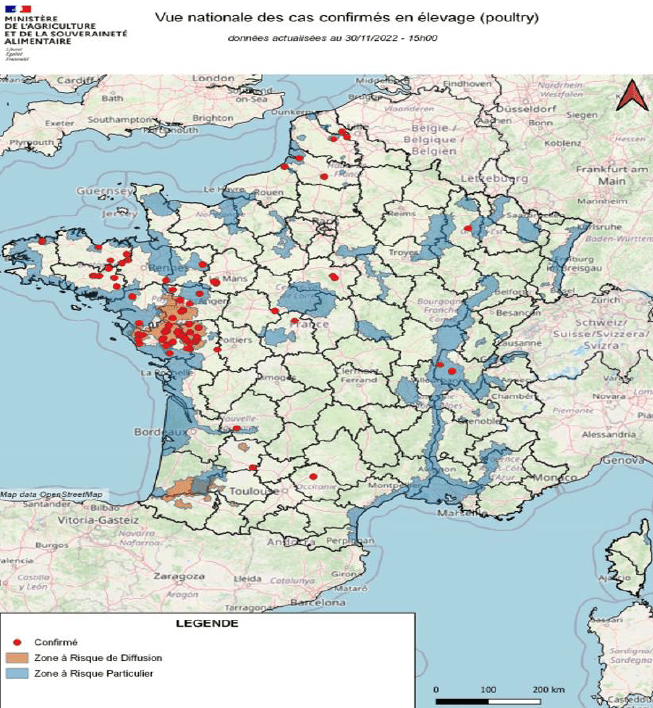
As of November 30, 91 farm outbreaks have been confirmed since August 1.


Number of outbreaks and cases in France since August 1, 2022 (30/11/2022)pdf - 645.46 KB

...

https://agriculture.gouv.fr/influenza-aviaire-la-situation-en-france


------------------------------------

Avian flu: nearly 1.3 million poultry slaughtered in four months

Published on :01/12/2022 - 17:32

Paris (AFP) – Nearly 1.3 million poultry have been slaughtered since August 1 to stem the resurgence of avian flu in French farms, particularly in western France, AFP learned on Thursday from of the Ministry of Agriculture.

This report testifies to a sharp acceleration of the avian influenza epizootic a few weeks before New Year's Eve: the latest figures communicated by the ministry to AFP, on November 10, reported more than 770,000 slaughterings. .

In the meantime, the number of outbreaks discovered in farms has almost doubled, to 91 cases, including 26 in Vendée, 11 in Deux-Sèvres and 9 in Maine-et-Loire.

A meeting with representatives of farmers is organized Thursday evening at the Ministry of Agriculture.

...
https://www.france24.com/fr/info-en...-million-de-volailles-abattues-en-quatre-mois
 
Translation Google
17140_115_RZ.jpg

Pascal Xicluna / agriculture.gouv.fr


02 December 2022 Press release

Avian influenza: strengthening of prevention measures in the Pays de la Loire region

Faced with the acceleration in the number of outbreaks of avian influenza confirmed in the Pays de la Loire region over the past week, mainly in Vendée and Deux-Sèvres, the Ministry of Agriculture and Food Sovereignty has decided to update the control strategy implemented. It is a question of preventing a runaway situation by taking reinforced measures.

As of December 1, 91 breeding outbreaks, including 37 in Vendée and Deux-Sèvres, have been confirmed since August 1.

The migration period is at its peak and the density of animals in the farms is high, as the end of year celebrations approach. Given the worsening of the situation in these two departments with the appearance of several outbreaks in areas at risk of dissemination (ZRD), that is to say with a high density of poultry, it is necessary to adapt the strategy fight.

After consultation with the professional organizations representing the poultry sectors, it was decided to strengthen the control measures to be implemented in the Pays de la Loire region and the Deux-Sèvres department. Specific protection measures had already been taken in mid-October in the Brittany and Pays de la Loire regions, with in particular preventive felling around the outbreaks and the carrying out of tests before movement for waterfowl.

The control measures already in force around the outbreaks are maintained. In addition:

  • the establishment of an additional regulated zone of 10 to 20 km around the hearths in the ZRD: the objective is to de-densify very quickly by an early culling of recoverable batches of waterfowl and turkeys.
  • the establishment of a buffer zone 50 km wide in the ZRD: the objective is to lower the density in the ZRD in the medium term by prohibiting the placement of waterfowl and turkeys and by imposing an extension of the crawl spaces for chickens and laying hens.
Compensation schemes will be deployed to take into account the impact of these measures on the functioning of the poultry sectors.

Carte-Influenza-Loire-min.png


The Ministry of Agriculture and Food Sovereignty as well as its regional and departmental services are fully committed alongside professional actors in the fight against the avian influenza which is hitting them again. Everything must be done to prevent the situation from deteriorating further.

The ministry calls on all players in the poultry sector on national territory to remain vigilant and to apply the strictest biosecurity measures to prevent the virus from entering farms via wildlife and human activities and avoid its spread. between farms.

The same recommendations apply to private owners of backyard and ornamental birds.

A reduction in compensation in the event of non-compliance by breeders with the rules in force will be applied.


REMINDER : the consumption of meat , foie gras and eggs and more generally any poultry-based food product does not present any risk to humans .

...

https://agriculture.gouv.fr/influen...de-prevention-dans-la-region-pays-de-la-loire
 
Translation Google

06 December 2022 Info +

Avian influenza: the situation in France


The health situation with regard to highly pathogenic avian influenza (HPAI) has continued to deteriorate in recent weeks. The number of outbreaks of avian influenza in livestock and in wildlife is still increasing in mainland France and in Europe. Faced with an increased risk of contamination due to the drop in temperatures and the high migratory activity of wild birds, the level of risk has been raised from "moderate" to "high" throughout the metropolitan territory. As of November 11, the protection of poultry farms is reinforced and preventive measures are generalized.

Thus, all poultry must be sheltered throughout the territory and gatherings of poultry are prohibited.

As of December 5, 114 outbreaks in breeding have been confirmed since August 1.


Number of outbreaks and cases in France since August 1, 2022 (06/12)pdf - 646.66 KB


...

https://agriculture.gouv.fr/influenz...tion-en-france
 
Translation Google

December 23, 2022 Info +

Avian influenza: the situation in France

The health situation with regard to highly pathogenic avian influenza (HPAI) in France has deteriorated since August and has worsened in recent weeks. The number of 100 outbreaks of avian influenza in livestock was reached on 2 December. In wildlife, the number of cases has also risen sharply in mainland France and Europe. More than half of the breeding outbreaks are concentrated in the Pays de la Loire region in a zone at risk of dissemination (ZRD) with a high density of poultry (particularly in Vendée and Maine-et-Loire). This situation led to the taking of specific preventive measures detailed in the press release of December 2 .

Faced with an increased risk of contamination due to the drop in temperatures and the high migratory activity of wild birds, the level of risk was raised from "moderate" to "high" on November 11 throughout the metropolitan territory. Throughout metropolitan France, all poultry must be sheltered and gatherings of poultry are prohibited.

As of December 22, 231 farm outbreaks have been confirmed since August 1.


Number of outbreaks and cases in France since August 1, 2022pdf - 646.5 KB


...
https://agriculture.gouv.fr/influenz...tion-en-france
 
Translation Google

December 29, 2022 Info +

Avian influenza: the situation in France

The health situation with regard to highly pathogenic avian influenza (HPAI) in France has deteriorated since August and has worsened in recent weeks. The number of 100 outbreaks of avian influenza in livestock was reached on 2 December last. In wildlife, the number of cases has also risen sharply in mainland France and Europe. More than half of the breeding outbreaks are concentrated in the Pays de la Loire region in a zone at risk of dissemination (ZRD) with a high density of poultry (particularly in Vendée and Maine-et-Loire). This situation led to the taking of specific preventive measures detailed in the press release of December 2 .

Faced with an increased risk of contamination due to the drop in temperatures and the high migratory activity of wild birds, the level of risk was raised from "moderate" to "high" on November 11 throughout the metropolitan territory. Throughout metropolitan France, all poultry must be sheltered and gatherings of poultry are prohibited.

As of December 29, 247 farm outbreaks have been confirmed since August 1.


Number of outbreaks and cases in France since August 1, 2022pdf - 647.29 KB

...
https://agriculture.gouv.fr/influenz...tion-en-france
 
Back
Top Bottom