Pathfinder
Editor, Senior Moderator
Pascal Xicluna/agriculture.gouv.fr
May 25, 2023 Info +
Vaccination experiment of mule ducks in breeding against an HPAI virus

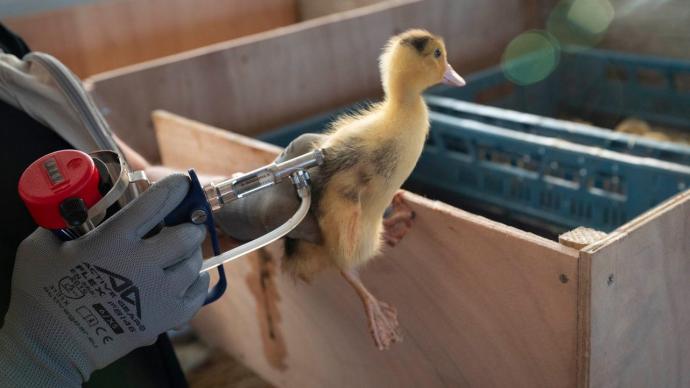
The Ministry of Agriculture and Food Sovereignty initiated an experiment in May 2022 to test vaccines on mule ducks to protect them from avian influenza. The objective is to have scientific proof as to the effectiveness and interest of vaccination against the virus.
In May 2022, the French ministry of agriculture and food sovereignty started trials to test vaccines on Mulard ducks with a view to protection against Highly Pathogenic Avian Influenza (HPAI). The purpose of these trials was to obtain scientific evidence as to the effectiveness and relevance of vaccination when dealing with this virus.
The experiment is governed by an agreement signed between the Ministry of Agriculture, ANSES (Agency for Food, Environmental and Occupational Health Safety, ENVT (National Veterinary School of Toulouse), the CIFOG (Comité interprofessionnel des palmipèdes à foie gras), the laboratories that made two candidate vaccines available (Boehringer Ingelheim animal health and Ceva animal health), as well as the regions of Brittany, New Aquitaine, Occitanie and Pays de la Loire which contributed to financing.
The trials were conducted under the terms of an agreement signed between the Ministry of Agriculture, ANSES (French Agency for Food, Environmental and Occupational Health & Safety), ENVT (National Veterinary School of Toulouse), CIFOG (the interbranch committee for the duck and geese foie gras sector), the pharmaceutical firms supplying the two candidate vaccines (Boehringer Ingelheim Animal Health and Ceva Santé Animale), in addition to the administrations of the French regions helping to fund the programme: Bretagne, Nouvelle-Aquitaine, Occitanie and Pays de the Loire.
This experiment took place in two phases: a first phase in field conditions and a second phase in the confined animal facilities of ANSES's National Reference Laboratory in Ploufragan (NRL).
The study was conducted in two phases, each comprising a series of trials in field conditions and a series of studies in experimental conditions in animal laboratory facilities in order to generate data on Mulard ducks relating to clinical protection and reduction of viral excretion, and to the ability of vaccines to slow transmission of the virus.
The first report presents the results of the field and laboratory component concerning the ability of the vaccines studied to confer clinical protection and to reduce viral shedding.
The second report reports the results of the evaluation of the reduction of viral transmission by mule ducks vaccinated in breeding and then tested at the age of 7 weeks in an A3 containment level animal facility.
These favorable results provide sufficient guarantees to launch a vaccination campaign from autumn 2023.
The results indicate satisfactory effectiveness for the vaccines tested on Mulard ducks. See English summaries below.
Report - "Experimental evaluation of clinical protection and viral excretion" pdf (accessible document) - 2.15 MB
Experimental evaluation of clinical protection and virus excretion pdf - 550.41 KB
Report – “Experimental evaluation of the transmission of an HPAI A(H5N1) clade 2.3.4.4b virus in a population of mule ducks vaccinated and tested at 7 weeks of age” pdf (accessible document) - 1.82 MB
Experimental evaluation of transmission among vaccinated ducks after challenge at 7 weeks of age pdf - 585.47 KB
https://agriculture.gouv.fr/experim...nards-mulards-en-elevage-contre-un-virus-iahp