

Michael Coston
Editor, Senior Moderator
HK CHP: A Cryptic Report of A 2nd H10N3 Case On the Mainland
#17,044
Global tensions being what they are, and with the highly sensitive 20th National Congress of the Chinese Communist Party set for mid-October, in 2022 we've been getting considerably less information out of China on their `bird flu problem' than in recent years.
Reports, when we get them, are often delayed by weeks or even months, and are often lacking in detail (see HK CHP Monitoring Human H5N6 Infection On The Mainland (Guangxi)).
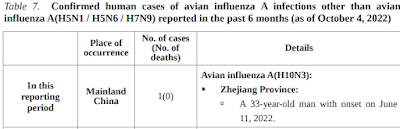
Today, we've a cryptic mention (see above) of a 2nd H10N3 case in China in this week's Avian Influenza Report from Hong Kong's CHP; a simple line listing, with no other details offered, of a case with an onset date nearly 4 months ago.
In June of 2021 (see CHINA NHC Reports 1st Human H10N3 Avian Flu Infection - Jiangsu Province) China's National Health Commission made a very brief announcement on the first known human infection with avian H10N3. In that case, notification occurred just over a month after the patient was admitted to the hospital (April 28th, 2021).
On June 10th, 2021 the WHO published their Risk Assessment On Human Avian H10N3 Infection In China:
The first known human H10 infections were reported in 2004 (see Avian Influenza Virus A (H10N7) Circulating among Humans in Egypt) , followed in 2012 by a limited outbreak among workers at a chicken farm in Australia (see in EID Journal: Human Infection With H10N7 Avian Influenza).
Most of these avian flu infections were mild or asymptomatic, and self limiting. Often only producing conjunctivitis or mild flu-like symptoms.
But in late 2013 a new H10N8 virus emerged in Mainland China (see Lancet: Clinical & Epidemiological Characteristics Of A Fatal H10N8 Case) infecting three people, killing at least two.
While the number of reported H10 infected humans remains small - possibly due to a lack of surveillance and testing - in 2014's BMC: H10N8 Antibodies In Animal Workers – Guangdong Province, China, we saw evidence that people may have been infected with the H10N8 virus in China before the first case was recognized.
Today's announcement follows two recent reports of avian H3N8 infection on the Mainland (see here, and here) and the discovery of Novel Zoonotic Avian Influenza Virus A(H3N8) Virus in Chicken, Hong Kong, China.
We've also seen roughly 50 H5N6 cases over the past year, and a small number of H9N2 infections.
Surveillance and testing is limited in China, and officials are often reluctant to report `bad news', meaning we are probably only seeing the tip of the iceberg.
Hopefully we'll get more details on this latest case sooner rather than later.
https://afludiary.blogspot.com/2022/10/hk-chp-cryptic-report-of-2nd-h10n3-case.html
#17,044
Global tensions being what they are, and with the highly sensitive 20th National Congress of the Chinese Communist Party set for mid-October, in 2022 we've been getting considerably less information out of China on their `bird flu problem' than in recent years.
Reports, when we get them, are often delayed by weeks or even months, and are often lacking in detail (see HK CHP Monitoring Human H5N6 Infection On The Mainland (Guangxi)).
Today, we've a cryptic mention (see above) of a 2nd H10N3 case in China in this week's Avian Influenza Report from Hong Kong's CHP; a simple line listing, with no other details offered, of a case with an onset date nearly 4 months ago.
In June of 2021 (see CHINA NHC Reports 1st Human H10N3 Avian Flu Infection - Jiangsu Province) China's National Health Commission made a very brief announcement on the first known human infection with avian H10N3. In that case, notification occurred just over a month after the patient was admitted to the hospital (April 28th, 2021).
On June 10th, 2021 the WHO published their Risk Assessment On Human Avian H10N3 Infection In China:
(Excerpt)
The case is a 41-year-old male from Zhenjiang City, Jiangsu Province. He developed fever and nausea on 23 April 2021 and was admitted to the intensive care unit of a local hospital on 28 April 2021. The case is currently in a stable condition. The National Influenza Center of the Chinese Center for Disease Control and Prevention, a WHO Collaborating Centre for Reference and Research on Influenza, completed genetic sequencing and analysis of the specimen and confirmed the detection of an influenza A(H10N3) virus of avian origin.
The case had no clear history of exposure to poultry prior to illness onset, based on epidemiological investigation. No avian influenza A(H10N3) virus has been found in the local surroundings or poultry. Close contacts of the case have not shown any symptoms. Based on the local and national assessment, the case was considered to be an incidental infection from avian to human transmission, with a low likelihood of human-to-human transmission.
The case is a 41-year-old male from Zhenjiang City, Jiangsu Province. He developed fever and nausea on 23 April 2021 and was admitted to the intensive care unit of a local hospital on 28 April 2021. The case is currently in a stable condition. The National Influenza Center of the Chinese Center for Disease Control and Prevention, a WHO Collaborating Centre for Reference and Research on Influenza, completed genetic sequencing and analysis of the specimen and confirmed the detection of an influenza A(H10N3) virus of avian origin.
The case had no clear history of exposure to poultry prior to illness onset, based on epidemiological investigation. No avian influenza A(H10N3) virus has been found in the local surroundings or poultry. Close contacts of the case have not shown any symptoms. Based on the local and national assessment, the case was considered to be an incidental infection from avian to human transmission, with a low likelihood of human-to-human transmission.
The first known human H10 infections were reported in 2004 (see Avian Influenza Virus A (H10N7) Circulating among Humans in Egypt) , followed in 2012 by a limited outbreak among workers at a chicken farm in Australia (see in EID Journal: Human Infection With H10N7 Avian Influenza).
Most of these avian flu infections were mild or asymptomatic, and self limiting. Often only producing conjunctivitis or mild flu-like symptoms.
But in late 2013 a new H10N8 virus emerged in Mainland China (see Lancet: Clinical & Epidemiological Characteristics Of A Fatal H10N8 Case) infecting three people, killing at least two.
While the number of reported H10 infected humans remains small - possibly due to a lack of surveillance and testing - in 2014's BMC: H10N8 Antibodies In Animal Workers – Guangdong Province, China, we saw evidence that people may have been infected with the H10N8 virus in China before the first case was recognized.
Today's announcement follows two recent reports of avian H3N8 infection on the Mainland (see here, and here) and the discovery of Novel Zoonotic Avian Influenza Virus A(H3N8) Virus in Chicken, Hong Kong, China.
We've also seen roughly 50 H5N6 cases over the past year, and a small number of H9N2 infections.
Surveillance and testing is limited in China, and officials are often reluctant to report `bad news', meaning we are probably only seeing the tip of the iceberg.
Hopefully we'll get more details on this latest case sooner rather than later.
https://afludiary.blogspot.com/2022/10/hk-chp-cryptic-report-of-2nd-h10n3-case.html