

Michael Coston
Editor, Senior Moderator
The Gift of Preparedness - Winter 2023 Edition
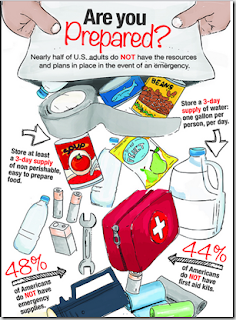

CDC Infographic
#18,008
In late 2007 I penned a blog called Hickory Farms Will Hate Me For This, where I began promoting the idea that instead of gifting cheese platters, fruitcakes and ugly sweaters to friends and family, we should all be giving preparedness gifts for holidays, birthdays, and anniversaries.
Since then, it has become a bit of a Christmas tradition; one which I've expanded each year with new suggestions, and details on items I've purchased over the past year.
When I buy myself a luxury, it is quite likely to be a preparedness item. This year:

In years past I've gifted friends and family first aid kits, cans of long-life dehydrated food, emergency tire pumps, windup/solar NOAA weather radios, Lifestraw water filters, USB battery banks, small solar panels, numerous LED flashlights and lanterns, and ample supplies of AA and AAA batteries.
Stuff that people don't tend to buy for themselves before an emergency, but often wish they had during an emergency. Usually these items are not terribly expensive, but they can be hard to find when a hurricane is approaching or the lights have gone out.
I sometimes find these gifts on sale in discount stores, bargain basements, and flea markets, and stock up whenever I come across a good deal. But it should be stressed that quality counts. You don't want your life to depend on a $1 pocket knife.
Sometimes I make the gifts myself, as when several years back I cobbled together some first aid kits, and distributed them to a number of friends and relatives. You can either put one together yourself, or purchase one already assembled.

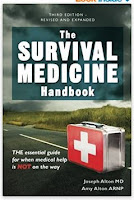
Believe me, there is no substitute for having a well stocked first aid kit when you really need one. Having a kit isn't enough. Knowing what to do in an emergency is equally important. Luckily there are a number of good first aid books available, including:
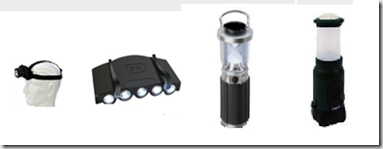
When the lights go out, nothing beats having a couple of good LED flashlights or lanterns. And each year they get brighter, and cheaper. Most run between $5 and $10, and that beats the heck out of cursing the darkness.
High on the list of things to have is a way to make water potable.
Although (unscented) bleach will work, it requires measuring, and imparts a taste to the water many dislike. An option that has gotten a lot less expensive in recent years are personal filtration systems, like the LifeStraw ®.

At just 2 ounces, this personal water filter will reportedly filter 1000 liters down to .2 microns. Not bad for around $20. I've recently added the Sawyer Mini-Filter to my preps, again about $20.

Speaking of water, having a way to store enough water for three days (1 gal/person/day) is essential. A family of 4 will need at least 12 gallons for 72 hours. Personally, I keep enough on hand for a couple of weeks.
A couple of years ago I bought several 5 gal. buckets (with lids) from a home improvement store, along with mylar bags and oxygen absorbers from Amazon, and put together some long-term food storage buckets for friends.

Cost per bucket? About $30. But enough food to keep two people going for ten days or more in an emergency. I keep a couple on hand (one for me, one for the cat), myself.
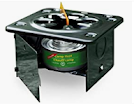
With a propane or butane camp stove or even a single burner Propane burner (see below) and a couple of 1 pound gas cylinders (about $5 each) and you can cook for a week or longer. Typically, a 1lb cylinder proves 1.5 to 2.0 hours of cooking.
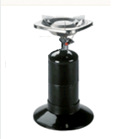
Indoors, even a `Sterno Stove' can be used for basic `heat and eat' cooking.
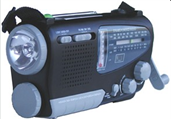
Every home should have a battery operated radio (with NWS weather band), yet many do not. Some are available with crank or solar charging. In any event, you'll want something which can pick up the NOAA NWS Emergency Broadcaster in you region.
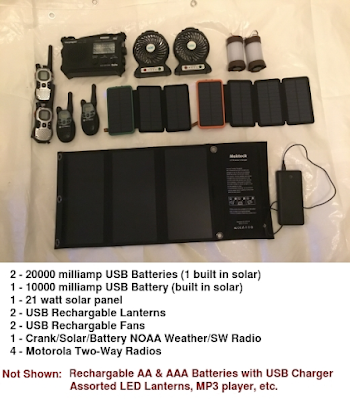
I've also invested (for myself, and some components for friends) in an array of `off-the-shelf' solar items, including fans, LED lanterns, several USB battery packs, and a 21 watt Solar panel (see Some Simple Off-The-Shelf Solar Solutions For Power Outages)..
This year, following Hurricane Ian, I added a second 30-watt solar panel, and have made some upgrades to my Solar Battery Project (for CPAP). In 2023 I upgraded to lighter, and more powerful, LiFePO4 batteries.

While my primary concern in Florida is staying cool during a summer power outage, in colder climes, staying warm can be a major concern. Sleeping bags, pop-up tents (that can be used indoors or out), and propane or kerosene heaters can be lifesaving.

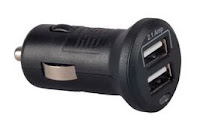
Something as simple, and as utilitarian, as a multi-function `Swiss’ army knife, a`Multi-tool’, a `plug in' auto 12 volt USB charger (see below), or even multi packs of AA or AAA batteries, makes a great preparedness gift.
Disasters often boil down to unscheduled camping - for days, or sometimes weeks - in your home, in a community shelter, or possibly in your backyard. If you think of preparedness that way, it becomes far less daunting.
FEMA, Ready.gov and a myriad of other state and national entities know the risks we face, and would like to see Americans adopt and embrace a culture of preparedness.And we can do that for ourselves, our families, and our friends.
One gift at a time.
https://afludiary.blogspot.com/2023/12/the-gift-of-preparedness-winter-2023.html
CDC Infographic
#18,008
In late 2007 I penned a blog called Hickory Farms Will Hate Me For This, where I began promoting the idea that instead of gifting cheese platters, fruitcakes and ugly sweaters to friends and family, we should all be giving preparedness gifts for holidays, birthdays, and anniversaries.
Since then, it has become a bit of a Christmas tradition; one which I've expanded each year with new suggestions, and details on items I've purchased over the past year.
When I buy myself a luxury, it is quite likely to be a preparedness item. This year:
- I upgraded my solar power generation equipment (see My Upgraded Solar Power System (2023 Edition),
- bought an upgraded USB powered MP3 player (for audio books/music when the power is out),
- replaced my ancient carbon monoxide detector in the kitchen,
- and bought an emergency indoor propane heater (with 20lb tank & hose).
Note: Products mentioned or pictured in this blog post are to provide a general idea of the type of gift, and should not be viewed as an endorsement of one brand over another.
In years past I've gifted friends and family first aid kits, cans of long-life dehydrated food, emergency tire pumps, windup/solar NOAA weather radios, Lifestraw water filters, USB battery banks, small solar panels, numerous LED flashlights and lanterns, and ample supplies of AA and AAA batteries.
Stuff that people don't tend to buy for themselves before an emergency, but often wish they had during an emergency. Usually these items are not terribly expensive, but they can be hard to find when a hurricane is approaching or the lights have gone out.
I sometimes find these gifts on sale in discount stores, bargain basements, and flea markets, and stock up whenever I come across a good deal. But it should be stressed that quality counts. You don't want your life to depend on a $1 pocket knife.
Sometimes I make the gifts myself, as when several years back I cobbled together some first aid kits, and distributed them to a number of friends and relatives. You can either put one together yourself, or purchase one already assembled.
Believe me, there is no substitute for having a well stocked first aid kit when you really need one. Having a kit isn't enough. Knowing what to do in an emergency is equally important. Luckily there are a number of good first aid books available, including:
When the lights go out, nothing beats having a couple of good LED flashlights or lanterns. And each year they get brighter, and cheaper. Most run between $5 and $10, and that beats the heck out of cursing the darkness.
High on the list of things to have is a way to make water potable.
Although (unscented) bleach will work, it requires measuring, and imparts a taste to the water many dislike. An option that has gotten a lot less expensive in recent years are personal filtration systems, like the LifeStraw ®.
At just 2 ounces, this personal water filter will reportedly filter 1000 liters down to .2 microns. Not bad for around $20. I've recently added the Sawyer Mini-Filter to my preps, again about $20.
Speaking of water, having a way to store enough water for three days (1 gal/person/day) is essential. A family of 4 will need at least 12 gallons for 72 hours. Personally, I keep enough on hand for a couple of weeks.
While there are plenty of `free options’ – like rinsed and recycled 2-liter plastic soda bottles or other food-safe plastic jugs – you can also buy collapsible 5 gallon containers.
A couple of years ago I bought several 5 gal. buckets (with lids) from a home improvement store, along with mylar bags and oxygen absorbers from Amazon, and put together some long-term food storage buckets for friends.
Cost per bucket? About $30. But enough food to keep two people going for ten days or more in an emergency. I keep a couple on hand (one for me, one for the cat), myself.
A few years back, however, I added some dehydrated/freeze dried foods (by the bucket, or in #10 cans) to this culinary category, as they only require hot or boiling water to prepare.
With a propane or butane camp stove or even a single burner Propane burner (see below) and a couple of 1 pound gas cylinders (about $5 each) and you can cook for a week or longer. Typically, a 1lb cylinder proves 1.5 to 2.0 hours of cooking.
Indoors, even a `Sterno Stove' can be used for basic `heat and eat' cooking.
Every home should have a battery operated radio (with NWS weather band), yet many do not. Some are available with crank or solar charging. In any event, you'll want something which can pick up the NOAA NWS Emergency Broadcaster in you region.
I've also invested (for myself, and some components for friends) in an array of `off-the-shelf' solar items, including fans, LED lanterns, several USB battery packs, and a 21 watt Solar panel (see Some Simple Off-The-Shelf Solar Solutions For Power Outages)..
This year, following Hurricane Ian, I added a second 30-watt solar panel, and have made some upgrades to my Solar Battery Project (for CPAP). In 2023 I upgraded to lighter, and more powerful, LiFePO4 batteries.
While my primary concern in Florida is staying cool during a summer power outage, in colder climes, staying warm can be a major concern. Sleeping bags, pop-up tents (that can be used indoors or out), and propane or kerosene heaters can be lifesaving.
Something as simple, and as utilitarian, as a multi-function `Swiss’ army knife, a`Multi-tool’, a `plug in' auto 12 volt USB charger (see below), or even multi packs of AA or AAA batteries, makes a great preparedness gift.
The greatest gift is to have - and to be - a disaster buddy (see NPM13: The Greatest Prep Of All); cultivating a network of family, friends, and neighbors to whom you can turn for help in a emergency, who can turn to you for aid, if they need it.
Disasters often boil down to unscheduled camping - for days, or sometimes weeks - in your home, in a community shelter, or possibly in your backyard. If you think of preparedness that way, it becomes far less daunting.
FEMA, Ready.gov and a myriad of other state and national entities know the risks we face, and would like to see Americans adopt and embrace a culture of preparedness.And we can do that for ourselves, our families, and our friends.
One gift at a time.
https://afludiary.blogspot.com/2023/12/the-gift-of-preparedness-winter-2023.html