

Michael Coston
Editor, Senior Moderator
The Realities Of Crisis Standards Of Care
[TABLE="cellpadding: 0, cellspacing: 0"]
[TR]
[TD] [/TD]
[/TD]
[/TR]
[TR]
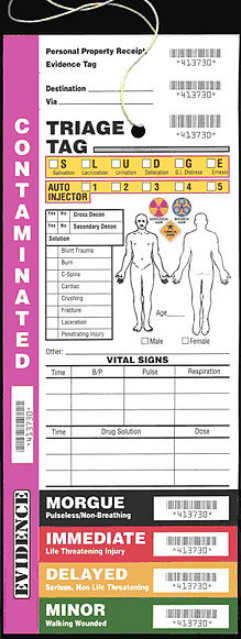
[TD]Triage Tag[/TD]
[/TR]
[/TABLE]
#16,196
Yesterday the Associated Press published an article (see EXPLAINER: What are ‘Crisis Standards of Care?’) describing some of the potential impacts of Idaho's Statewide expansion of Crisis Standards of Care due to the growing burden of the COVID pandemic, which has sparked a bit of consternation on social media overnight.
This is a topic that has long been debated in the medical community, and repeatedly covered in this blog (see here, here, here, and here , just to cite a few), but seems to have flown below the radar of the average American.
What seems to have caught the public's attention over the past 24 hours is the provision in Idaho's Crisis Standards of Care that allows for a `Universal Do Not Resuscitate (DNR)' order when ventilators, or other critical care resources, are no longer available.
As a practical matter - even without a formal declaration of a `Crisis Standard of Care' - resuscitation efforts have been rolled back in many localities since the first pandemic wave (see Standards Of Care During A Pandemic: CPR & Cardiac Arrest).
In April of 2020, multiple media outlets in New York City reported that local EMS will no longer `work' a cardiac arrest on the way to the hospital. If an adult cardiac arrest patient cannot be revived on the scene, they will be pronounced dead by the EMS team, and a mortuary removal service will transport the body.
This report from NYC PIX II:
Unlike on TV and in the movies, most unwitnessed, out-of-hospital cardiac arrests don't survive. And many of those that are `revived' initially end up dying hours or days later. Even inside a hospital, a good outcome following a cardiac arrest is far from assured.
While it is not something we are accustomed to in the United States, with hospitals getting slammed again with COVID cases - and a feared return of flu later this fall - some people are likely to find themselves deemed ineligible for anything more than palliative treatment.
Thirteen years ago, in Triage In A Pandemic, we looked at the media stirfollowing the publication of new guidelines on triage in a pandemic or MCE (Mass Casualty Event) in the May 2008 edition of Chest, the medical journal of the American College of Chest Physicians.
A list of some of the people they suggested might be denied care in a pandemic or MCE included:
Making this fall and winter an inopportune time to have a heart attack, a stroke, get in a car accident, or even need a hospital bed.
Of course, even if Crisis Standards of Care are declared, the situation will be very fluid, with the ability of individual EMS services, hospital ERs, and ICUs to provide care changing by the hour. Simply put, the level of care you might be afforded today might not be available tomorrow.
For those who want to learn about the complex, and ethically challenging process of allocating scarce medical resources in a crisis, there are numerous webinars, and videos available online from the CDC, the APHA, ANA, and other entities.
As you watch, you'll see just how difficult these decisions are going to be for everyone involved.
A few to get you started include:

https://emergency.cdc.gov/coca/calls...nfo_121720.asp

[url]https://www.youtube.com/watch?v=1uhaAW-jybE[/URL]

[url]https://www.youtube.com/watch?v=bx07GlMpSCE[/URL]

[url]https://www.youtube.com/watch?v=vKNWCoueLhc[/URL]
https://afludiary.blogspot.com/2021/09/the-realities-of-crisis-standards-of.html
[TABLE="cellpadding: 0, cellspacing: 0"]
[TR]
[TD]
 [/TD]
[/TD][/TR]
[TR]
[TD]Triage Tag[/TD]
[/TR]
[/TABLE]
#16,196
Yesterday the Associated Press published an article (see EXPLAINER: What are ‘Crisis Standards of Care?’) describing some of the potential impacts of Idaho's Statewide expansion of Crisis Standards of Care due to the growing burden of the COVID pandemic, which has sparked a bit of consternation on social media overnight.
This is a topic that has long been debated in the medical community, and repeatedly covered in this blog (see here, here, here, and here , just to cite a few), but seems to have flown below the radar of the average American.
What seems to have caught the public's attention over the past 24 hours is the provision in Idaho's Crisis Standards of Care that allows for a `Universal Do Not Resuscitate (DNR)' order when ventilators, or other critical care resources, are no longer available.
As a practical matter - even without a formal declaration of a `Crisis Standard of Care' - resuscitation efforts have been rolled back in many localities since the first pandemic wave (see Standards Of Care During A Pandemic: CPR & Cardiac Arrest).
In April of 2020, multiple media outlets in New York City reported that local EMS will no longer `work' a cardiac arrest on the way to the hospital. If an adult cardiac arrest patient cannot be revived on the scene, they will be pronounced dead by the EMS team, and a mortuary removal service will transport the body.
This report from NYC PIX II:
Posted: 5:39 AM, Apr 02, 2020
Unlike on TV and in the movies, most unwitnessed, out-of-hospital cardiac arrests don't survive. And many of those that are `revived' initially end up dying hours or days later. Even inside a hospital, a good outcome following a cardiac arrest is far from assured.
While it is not something we are accustomed to in the United States, with hospitals getting slammed again with COVID cases - and a feared return of flu later this fall - some people are likely to find themselves deemed ineligible for anything more than palliative treatment.
Thirteen years ago, in Triage In A Pandemic, we looked at the media stirfollowing the publication of new guidelines on triage in a pandemic or MCE (Mass Casualty Event) in the May 2008 edition of Chest, the medical journal of the American College of Chest Physicians.
A list of some of the people they suggested might be denied care in a pandemic or MCE included:
- People older than 85.
- Those with severe trauma, which could include critical injuries from car crashes and shootings.
- Severely burned patients older than 60.
- Those with severe mental impairment, which could include advanced Alzheimer's disease.
- Those with a severe chronic disease, such as advanced heart failure, lung disease or poorly controlled diabetes.
Making this fall and winter an inopportune time to have a heart attack, a stroke, get in a car accident, or even need a hospital bed.
Of course, even if Crisis Standards of Care are declared, the situation will be very fluid, with the ability of individual EMS services, hospital ERs, and ICUs to provide care changing by the hour. Simply put, the level of care you might be afforded today might not be available tomorrow.
For those who want to learn about the complex, and ethically challenging process of allocating scarce medical resources in a crisis, there are numerous webinars, and videos available online from the CDC, the APHA, ANA, and other entities.
As you watch, you'll see just how difficult these decisions are going to be for everyone involved.
A few to get you started include:
https://emergency.cdc.gov/coca/calls...nfo_121720.asp
[url]https://www.youtube.com/watch?v=1uhaAW-jybE[/URL]
[url]https://www.youtube.com/watch?v=bx07GlMpSCE[/URL]
[url]https://www.youtube.com/watch?v=vKNWCoueLhc[/URL]
https://afludiary.blogspot.com/2021/09/the-realities-of-crisis-standards-of.html