

Install the app
How to install the app on iOS
Follow along with the video below to see how to install our site as a web app on your home screen.
Note: This feature may not be available in some browsers.
-
FluTrackers.com Inc. does not provide medical advice. Information on this web site is collected from various internet resources, and the FluTrackers board of directors makes no warranty to the safety, efficacy, correctness or completeness of the information posted on this site by any author or poster. The information collated here is for instructional and/or discussion purposes only and is NOT intended to diagnose or treat any disease, illness, or other medical condition. Every individual reader or poster should seek advice from their personal physician/healthcare practitioner before considering or using any interventions that are discussed on this website. By continuing to access this website you agree to consult your personal physican before using any interventions posted on this website, and you agree to hold harmless FluTrackers.com Inc., the board of directors, the members, and all authors and posters for any effects from use of any medication, supplement, vitamin or other substance, device, intervention, etc. mentioned in posts on this website, or other internet venues referenced in posts on this website.
-
We are not asking for any donations. Do not donate to any entity who says they are raising funds for us.
You are using an out of date browser. It may not display this or other websites correctly.
You should upgrade or use an alternative browser.
You should upgrade or use an alternative browser.
Uganda - 21 Ebola cases, incl. 3 deaths (confirmed & probable) - May 15+
- Thread starter Treyfish
- Start date


Pathfinder
Editor, Senior Moderator
Pathfinder
Editor, Senior Moderator
Attachments


Pathfinder
Editor, Senior Moderator
WHO Director-General's opening remarks at the media briefing on the Bundibugyo Ebola outbreak – 3 June 2026
3 June 2026
Русский
Español
Good afternoon to everyone in the room, and good morning, good afternoon and good evening to those joining us online.
Yesterday I returned from a visit to the Democratic Republic of the Congo, including to the epicentre of the Ebola outbreak in the province of Ituri.
I met with political leaders, senior health officials, Ambassadors, partners, WHO colleagues, frontline responders, community and faith leaders, women’s groups, business leaders, traditional healers and more.
I’m very encouraged by the level of commitment I saw everywhere I went. What I saw gave me hope, although challenges remain.
In DRC, 344 cases have been confirmed, including 60 deaths, in 24 health zones across three different provinces: Ituri, North Kivu and South Kivu
The number of suspected cases has now been reduced to 116 from over 1000 last week, as we work through the backlog, either confirming them or ruling them out.
In Uganda, there is one confirmed death and 15 confirmed cases, including a Congolese resident who travelled to the United Arab Emirates, and then to Uganda.
WHO is working with public health authorities in Uganda and the UAE to gather additional information, assess the risk of exposure during travel, and to facilitate contact tracing.
We thank both the UAE and Uganda for their collaboration to mitigate the risks related to this case.
...
https://www.who.int/news-room/speec...g-remarks-at-the-media-briefing---3-june-2026
3 June 2026
Русский
Español
Good afternoon to everyone in the room, and good morning, good afternoon and good evening to those joining us online.
Yesterday I returned from a visit to the Democratic Republic of the Congo, including to the epicentre of the Ebola outbreak in the province of Ituri.
I met with political leaders, senior health officials, Ambassadors, partners, WHO colleagues, frontline responders, community and faith leaders, women’s groups, business leaders, traditional healers and more.
I’m very encouraged by the level of commitment I saw everywhere I went. What I saw gave me hope, although challenges remain.
In DRC, 344 cases have been confirmed, including 60 deaths, in 24 health zones across three different provinces: Ituri, North Kivu and South Kivu
The number of suspected cases has now been reduced to 116 from over 1000 last week, as we work through the backlog, either confirming them or ruling them out.
In Uganda, there is one confirmed death and 15 confirmed cases, including a Congolese resident who travelled to the United Arab Emirates, and then to Uganda.
WHO is working with public health authorities in Uganda and the UAE to gather additional information, assess the risk of exposure during travel, and to facilitate contact tracing.
We thank both the UAE and Uganda for their collaboration to mitigate the risks related to this case.
...
https://www.who.int/news-room/speec...g-remarks-at-the-media-briefing---3-june-2026
Pathfinder
Editor, Senior Moderator
Attachments


Pathfinder
Editor, Senior Moderator
Pathfinder
Editor, Senior Moderator
3:36 AM · Jun 6, 2026
--------------------------------------------------------------------------------------------------
...
https://www.who.int/emergencies/alert-and-response
Attachments


Pathfinder
Editor, Senior Moderator
(screenshot)
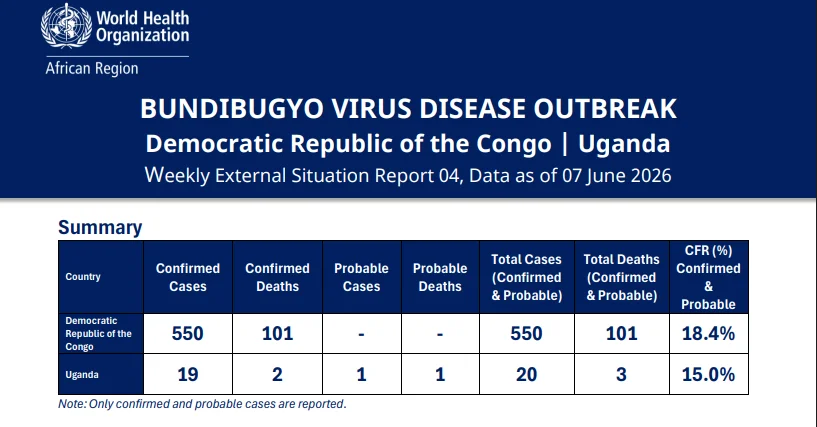
...
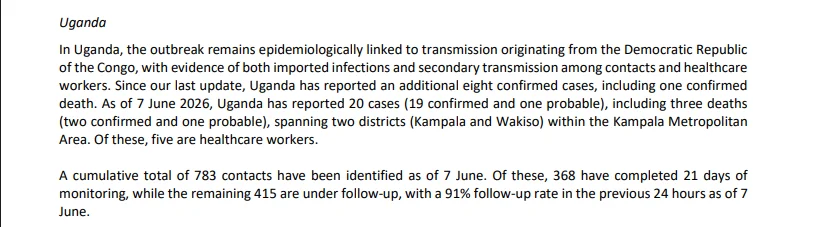
...
https://iris.who.int/server/api/core/bitstreams/a296c3f1-0338-4a05-9ee8-6cf93ad7c292/content
...
...
https://iris.who.int/server/api/core/bitstreams/a296c3f1-0338-4a05-9ee8-6cf93ad7c292/content
Pathfinder
Editor, Senior Moderator
Pathfinder
Editor, Senior Moderator
3:16 AM · Jun 15, 2026
--------------------------------------------------------------------------------------------------------------------
Pathfinder
Editor, Senior Moderator
(screenshots)
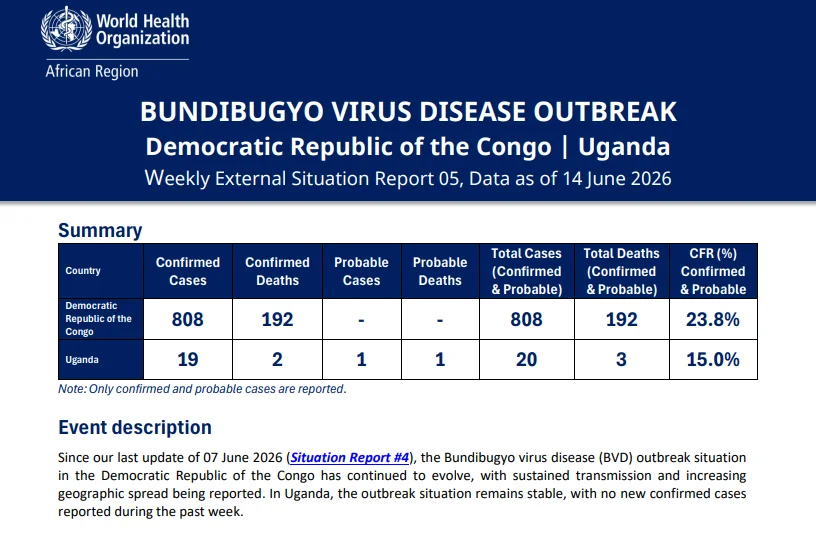
...
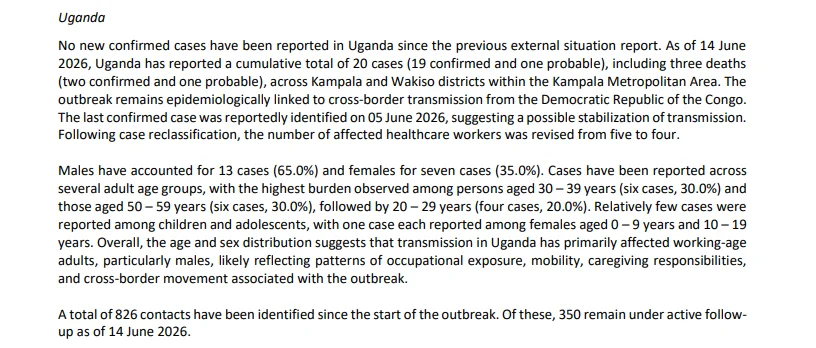
...
https://iris.who.int/server/api/core/bitstreams/360b6ad5-1fff-4054-a41d-f6744919a2d9/content
...
...
https://iris.who.int/server/api/core/bitstreams/360b6ad5-1fff-4054-a41d-f6744919a2d9/content
Pathfinder
Editor, Senior Moderator
Pathfinder
Editor, Senior Moderator
Pathfinder
Editor, Senior Moderator
(screenshots)
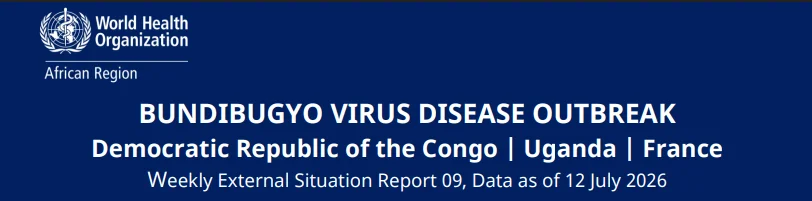
...
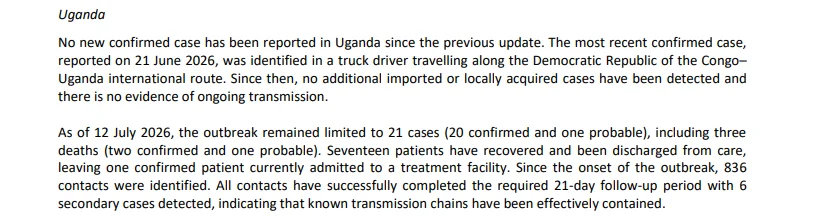
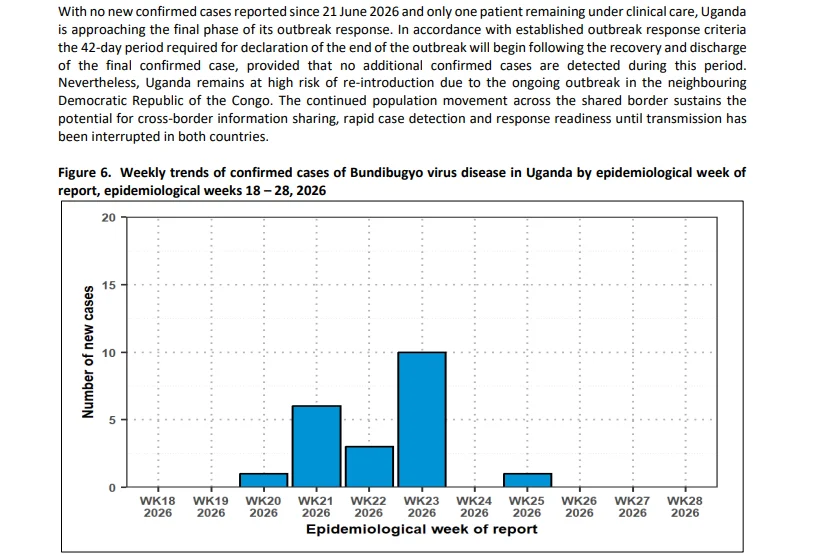
...
https://iris.who.int/server/api/core/bitstreams/46bd6014-40e9-4b5e-9046-9687ce6568c3/content
...
...
https://iris.who.int/server/api/core/bitstreams/46bd6014-40e9-4b5e-9046-9687ce6568c3/content
Pathfinder
Editor, Senior Moderator
Uganda begins countdown to end of Ebola outbreak
16 July 2026
Kampala—Uganda has today entered the 42-day countdown to the end of its Ebola outbreak after the last confirmed case tested negative for the virus for a second time and was discharged from care, marking an important milestone in the country's response.
The 42-day countdown, equivalent to two maximum incubation periods for Bundibugyo virus disease, is the established phase before an outbreak can be declared over, provided no new confirmed cases are detected during this period.
Uganda declared the outbreak on 15 May 2026 and as of 16 July 2026, 20 confirmed cases and two deaths have been reported. Fifteen cases were the result of importation from the Democratic Republic of the Congo and five were locally aquired.
“It has been two months since we declared the outbreak and we are now celebrating the discharge of the last patient. This shows that Ebola is defeatable if we adhere to measures and establish strong systems,” says Dr Chris Baryomunsi, Minister of Health in Uganda. “I thank all the teams involved, including the health workers and support staff, for the courage, resilience, professionalism and charisma, working 24 hours a day to provide care.”
Since the outbreak was declared, the Ministry of Health in Uganda, with support from World Health Organization (WHO) and partners, has implemented an intensive response that included rapid case detection, laboratory testing, contact tracing, infection prevention and control measures, case management, risk communication and community engagement, and cross-border collaboration with the Democratic Republic of the Congo.
As of 16 July 2026, all 836 contacts have been followed up, while surveillance systems were strengthened across 36 high-risk districts and at 38 points of entry. Health workers received training and essential medical equipment and supplies to safely identify, isolate and manage suspected cases, helping to limit further transmission.
WHO has supported health authorities by mobilizing around 70 technical experts into the national response, strengthening laboratory capacity, coordinating logistics, supporting surveillance and contact tracing, providing medical supplies and equipment to protect frontline health workers and working with affected communities across high-risk districts.
"This milestone reflects the dedication of Uganda's leadership, health workers, case investigation teams, communities and partners who have worked hard to interrupt transmission," says Dr Kasonde Mwinga, WHO Representative in Uganda. "While this is an encouraging moment, it is not the end of the response. Maintaining strong surveillance, rapid investigation of alerts and community engagement into the future will be essential to achieving and sustaining success."
Although no new confirmed cases have been reported since 21 June 2026, health authorities continue to enhance cross-border surveillance and operational readiness across all border areas to sustain rapid detection and trigger new response operations when needed. Community members, health workers and leaders are encouraged to keep alert to Ebola, report any symptoms promptly and seek care immediately if the disease is suspected.
Although Uganda has officially begun the 42-day countdown to declaring the end of the outbreak, this remains a single, complex outbreak across international borders with shared communities. As transmission continues in the Democratic Republic of the Congo, there remains a risk of additional imported cases into Uganda during the countdown period. Should this occur, the 42-day countdown would be reset to day zero. This would reflect the realities of responding to a cross-border outbreak with ongoing transmission, rather than any shortcomings in the response of either country.
As Uganda exits this initial acute phase of the emergency, the next phase will require maintaining the highest level of vigilance over a protracted timeframe, so any new cases imported from the Democratic Republic of the Congo can be quickly detected and controlled. To this end, the Ministry of Health of Uganda this week launched a new six-month plan, maintaining and strengthening existing interventions to reduce the likelihood of resurgence and limiting the potential for wider geographical spread of the outbreak from the Democratic Republic of the Congo.
https://www.afro.who.int/countries/uganda/news/uganda-begins-countdown-end-ebola-outbreak

sharon sanders
Editor-in-Chief & President
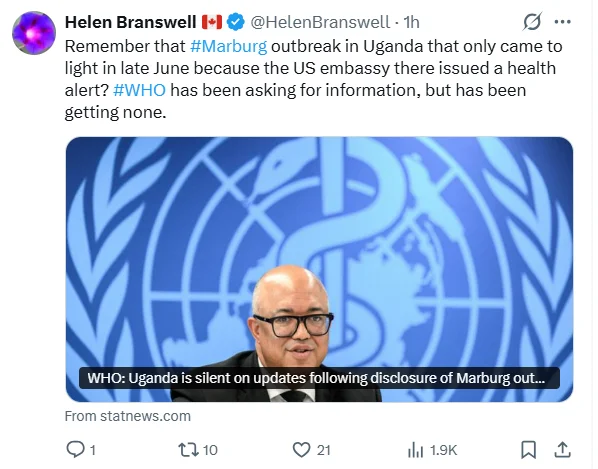
If Uganda is not forthcoming about the Marburg case, how can the Ebola representations be believed?
Pathfinder
Editor, Senior Moderator
4:06 AM · Jul 28, 2026
-------------------------------------------------------------------------------------
Video:
11:21 AM · Jul 28, 2026
Pathfinder
Editor, Senior Moderator
The Bundibugyo virus disease (BVD) outbreak in the Democratic Republic of the Congo is intensifying, with sustained transmission and continued increases in reported cases and deaths. Initially confined to the Mongbwalu health zone in Ituri Province, over the last two months, the outbreak has expanded to five provinces (Ituri, North Kivu, South Kivu, Haut-Uélé and Tshopo), now affecting 49 health zones. The outbreak is now the largest Ebola outbreak ever reported in the Democratic Republic of the Congo. As of 30 July 2026, a total of 3605 confirmed cases, including 1587 deaths, have been reported, corresponding to a crude case fatality ratio (CFR) of 44%. The continued increase in cases, expanding geographic spread, and persistently high mortality underscore the rapidly evolving nature of this public health emergency. During the most recent complete reporting week (epidemiological week 30), the highest weekly number of reported cases (567) and deaths (296) to date were recorded, underscoring the exceptional pace of transmission. The convergence of insecurity, population displacement and mobility, and cross-border movements complicate response operations and increase the risk of further geographical spread. National authorities in the Democratic Republic of the Congo, in collaboration with WHO and partners, continue to implement extensive response measures, however, a substantial scaling up of response activities is needed to get ahead of the outbreak. A regional preparedness and prioritization framework continues to guide readiness and response activities across the African Region. On 28 July, the Ministry of Health of Uganda declared the end of the BVD outbreak in the country, following 42 days without a new confirmed locally transmitted case after the last confirmed case was discharged from care on 16 June 2026. The most recent imported case was discharged from a treatment centre on 16 July after two negative tests results. Following international guidance WHO will be monitoring the situation for 42 days from this date to ensure no chains of transmission have been missed. Uganda remains at risk of imported cases and re-introduction of BVD, due to ongoing transmission in neighbouring Democratic Republic of the Congo. WHO reiterates the need to maintain heightened surveillance, preparedness and control measures, particularly in view of continued population movement and the risk of cross-border transmission.
...
https://www.who.int/emergencies/disease-outbreak-news/item/2026-DON614
Pathfinder
Editor, Senior Moderator
Uganda ends Ebola outbreak following completion of 42-day countdown
27 August 2026|News Release
Uganda ends Ebola outbreak following completion of 42-day countdown
Addis Ababa/Brazzaville/Geneva—The Africa Centres for Disease Control and Prevention (Africa CDC) and the World Health Organization (WHO) today welcomed the end of the Ebola outbreak due to Bundibugyo species in Uganda. This follows 42 consecutive days without a new confirmed case since the country’s last patient, an imported case, was discharged from care on 16 July 2026.
The completion of the 42-day period, equivalent to twice the upper limit of the incubation period for Ebola, is a critical step, as it provides an additional safeguard that no chains of transmission associated with the last imported case have been missed. The 42-day countdown is the internationally established benchmark for determining that transmission linked to an Ebola outbreak has ended.
“Uganda has demonstrated that with decisive action, Ebola outbreaks can be brought under control quickly,” said Dr Tedros Adhanom Ghebreyesus, WHO Director-General. “With a focus on preparedness, increased surveillance to find potential cases in health facilities and communities, and careful management of points of entry, countries can keep people and goods moving while ensuring people stay safe, or receive care if they are sick.”
Uganda, with support of national and international partners, interrupted local transmission rapidly and prevented wider spread through strong government leadership and early comprehensive actions including case detection and confirmation, contact tracing, isolation and clinical care, infection prevention and control, community engagement and strengthened surveillance at health facilities and points of entry.
“Uganda has shown that Ebola can be stopped when leadership acts decisively, communities are trusted and public health systems reach people quickly,” said H.E. Dr Jean Kaseya, Director-General of Africa CDC. “This is a victory for Uganda and an important lesson for our continent. We must now protect this achievement while accelerating the response in the DRC. We will only be secure when transmission is stopped everywhere.”
Uganda announced the interruption of local transmission on 28 July after completing 42 days without a new locally acquired case. Outbreak control measures, including disease surveillance continued after the last imported patient was discharged on 16 July. The completion of this additional monitoring period confirms that no further transmission has been detected in the country.
“Ending an Ebola outbreak is an important milestone, but the lasting achievement is a stronger ability to protect people from future health threats. Uganda has shown what sustained investment in preparedness can deliver. WHO will continue working with the government and partners to help preserve these gains and keep communities safe,” said Dr Mohamed Janabi, WHO Regional Director for Africa.
During the outbreak, Uganda reported 20 confirmed cases of Ebola disease caused by Bundibugyo virus following the declaration of the outbreak on 15 May 2026. Fifteen cases were imported from the Democratic Republic of the Congo, while five were locally acquired among contacts and health workers linked to imported cases. Eighteen people recovered and two died. More than 800 contacts were identified and monitored.
The milestone comes as the Ebola outbreak continues in the Democratic Republic of the Congo. Close social and economic ties, frequent population movement and cross-border trade mean that neighbouring countries remain at risk of imported cases.
WHO continues to advise against travel and trade restrictions related to Ebola outbreaks. WHO does not recommend suspending flights, closing borders, or denying entry to travellers from affected countries. Countries are encouraged to maintain international travel and trade while implementing proportionate public health measures that support early detection, preparedness and cross-border collaboration.
Africa CDC and WHO call for enhanced outbreak preparedness and readiness with continued disease surveillance and testing capacity, rapid alert investigation, strong infection prevention and control in health facilities and communities, sustained community engagement and close operational coordination across borders.
Both organizations will continue supporting the Governments of Uganda and the Democratic Republic of the Congo under the joint continental preparedness and response plan. Ending transmission in the Democratic Republic of the Congo remains a central priority for protecting communities across the region.

Uganda ends Ebola outbreak following completion of 42-day countdown
Uganda has ended its Ebola outbreak due to Bundibugyo virus after 42 consecutive days without a new confirmed case, WHO and Africa CDC announced, urging sustained preparedness across the region.