• FluTrackers.com Inc. does not provide medical advice. Information on this web site is collected from various internet resources, and the FluTrackers board of directors makes no warranty to the safety, efficacy, correctness or completeness of the information posted on this site by any author or poster. The information collated here is for instructional and/or discussion purposes only and is NOT intended to diagnose or treat any disease, illness, or other medical condition. Every individual reader or poster should seek advice from their personal physician/healthcare practitioner before considering or using any interventions that are discussed on this website. By continuing to access this website you agree to consult your personal physican before using any interventions posted on this website, and you agree to hold harmless FluTrackers.com Inc., the board of directors, the members, and all authors and posters for any effects from use of any medication, supplement, vitamin or other substance, device, intervention, etc. mentioned in posts on this website, or other internet venues referenced in posts on this website.
  • We are not asking for any donations. Do not donate to any entity who says they are raising funds for us.

UK: Swine flu virus predicted to weaken

Pathfinder

Editor, Senior Moderator
UK: Swine flu virus predicted to weaken
10/09/2009 - 11:35:41

Swine flu could effectively make its last stand in the UK within weeks, the British Government?s chief scientific adviser said today.

Professor John Bennington said a second wave of infections was expected ?not much before October at the earliest?.

Thereafter research and epidemic modelling suggested the virus would be weakened.

?You can get infections coming back in a number of waves but it?s likely that the next one will be larger than any subsequent ones,? Prof Bennington told the British Science Festival at the University of Surrey.

Tomorrow, members of the Scientific Pandemic Influenza Advisory Committee (Spi), which advises the British government on flu pandemics, will meet for a swine flu update.

?What is likely to happen will depend on a number of things, firstly the number of unreported cases,? said Prof Bennington, speaking in Guildford, Surrey.

?Whether it comes in October early and at a fairly high level, or in more moderate waves later in the year, is hard to predict.?

Long term, the fate of the virus would depend on how it competed with normal seasonal flu, he said.

It was possible swine flu might become the new ?default? seasonal flu.

?There may be some quiescence of incidence in summer next year after which it could come back as a normal seasonal flu; we don?t know, it?s early days,? said Prof Bennington.

He defended the decision to mass-treat large numbers of the population with antiviral drugs. Around 450,000 doses of the drug Tamiflu have been distributed, 10 times the number of confirmed flu cases.

?I think there are really sensible pragmatic issues involved, particularly to do with being precautionary,? said Prof Bennington.

?It?s a perfectly reasonable position to say ?put this out, make it freely available?, when you balance the potential for side effects from Tamiflu against the potential for getting flu really badly.?

Nevertheless, he said, there was disagreement among the Government advisers about whether to mass-treat the population or just target high risk groups. In the end the vote was won by those wanting to take a more precautionary stance.

?I did agree with the majority view,? Prof Bennington added.


http://breakingnews.iol.ie/news/world/eycwojideykf/
 
Re: UK: Swine flu virus predicted to weaken

> Professor John Bennington said a second wave of infections was expected ?not much
> before October at the earliest?.

I haven't seen this anywhere, how they can predict the dates.
Is there some secret knowledge or is it just guessing ?


there must be a curve, how much immunity builds up over
the weeks of a wave and then declines ?!?
 
Re: UK: Swine flu virus predicted to weaken

> Professor John Bennington said a second wave of infections was expected “not much
> before October at the earliest”.

I haven't seen this anywhere, how they can predict the dates.
Is there some secret knowledge or is it just guessing ?

4 weeks after English schools return. Scotland went back earlier and is already increasing.

However as to the timing of the worst peak in the Northern Hemisphere...

It's quite simple and not secret. Here's how I understand it. The virus has established itself everywhere and is increasing at a fairly steady exponential rate in one huge global wave. Monitor that rate and you work out roughly when it is going to peak as it starts to run out of fuel (not immune humans - assuming it doesn't mutate and go on to kill us all of course). Regional outbreaks are modulations of that global wave.

Here's a much overly simplified example with data I just made up. Let's say for argument that the global ili rate at a point in time is quadrupling every month and it is at 100 per 100,000

Month 0 100
Month 1 400
Month 2 1600
Month 3 6400
Month 4 25600

The actual peak infection rate will be somewhere between 3 and 4 months from Month 0. A bit earlier if the attack rate is lower.

Basically at the time of the world-peak, local outbreaks will be the most extreme and the community viral load will be enormous. Local outbreaks up to now have subsided back into the global wave (they are not closed communities) but future local outbreak around the global peak will be terrible. This is what Margaret Chan meant by: "This is a subtle sneaky virus". It establishes itself and quietly builds rather than exploding through a country.

Now those with the best data and the best models I'm sure have done a lot better than my simple example.

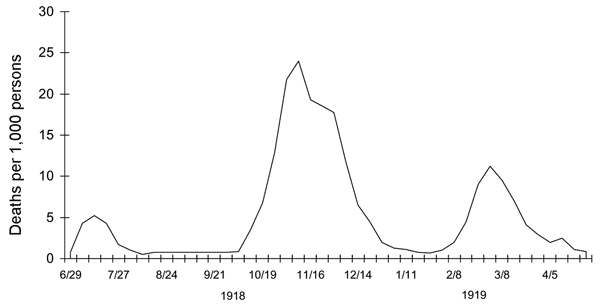
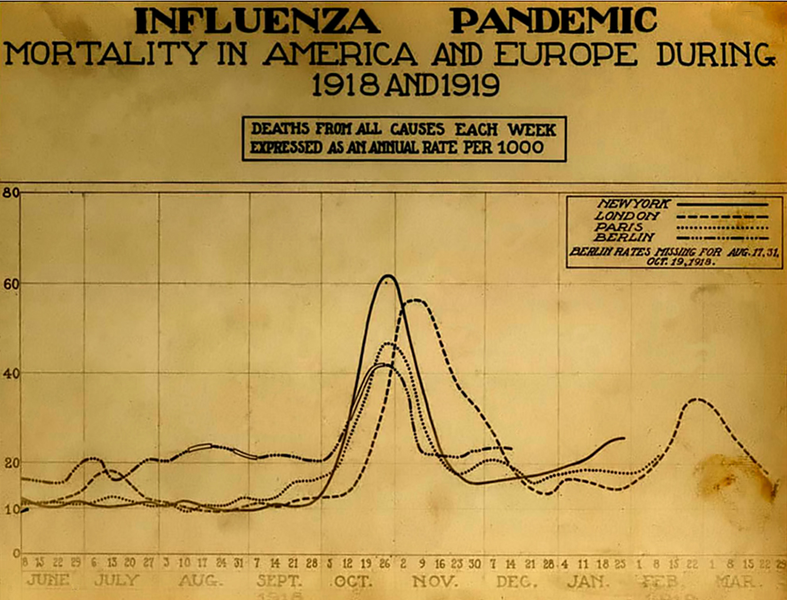
I think these graphs from 1918 point the way. For the general shape of things to come that is - not for the actual death rates I very much hope!

1918_spanish_flu_waves.gif

UK 1918-1919

787px-Spanish_flu_death_chart.png
 
Re: UK: Swine flu virus predicted to weaken

Those are excellent graphs!

Those peaks are in late October. How did the peaks relate to the local school terms?

In the prairies, for example, school may have been started later in October, after harvesting was done. Even kids would have helped out during harvest.

Or what was happening in the weather or global situation to make the peaks happen at nearly the same time?

Seems strange to me that without modern air travel to spread the virus, these major centers would develop peak CFR within days of each other.

J.
 
Re: UK: Swine flu virus predicted to weaken

Those are excellent graphs!
Or what was happening in the weather or global situation to make the peaks happen at nearly the same time?

Seems strange to me that without modern air travel to spread the virus, these major centers would develop peak CFR within days of each other.

J.

There may be a feedback mechanism that synchs the wave to the Northern Hemisphere winter but that's just me guessing.

In 1918 as now the virus had many months to seed itself worldwide even with much slower travel - possibly the local peaks will be even closer this time around.
 
Re: UK: Swine flu virus predicted to weaken

locally we do see these typical ~10-week waves, 5 weeks up, 5 weeks down.

The downtrend sets in, when enough people are immune.

But how long does it last ? Apparantly at least 5 weeks,
else we would see double-peak-waves.

In 1918 it either lasted less than 3 months or a new virus
appeared against which the acquired immunity
didn't help so much.

Can the same virus now infect England in another wave,
in cities where it already had formed a typical wave
just 3 months later ?
If yes, then the number of infections should be lower.

Although it was only ~7% in the first wave
 
Re: UK: Swine flu virus predicted to weaken

In 1918 it either lasted less than 3 months or a new virus
appeared against which the acquired immunity
didn't help so much.

Can the same virus now infect England in another wave,
in cities where it already had formed a typical wave
just 3 months later ?
If yes, then the number of infections should be lower.

Although it was only ~7% in the first wave

The selection pressure on the virus to find more food must be enormous as it runs out of susceptible people so it seems quite possible it managed to mutate just enough to evade some immune systems a second time around and/or become more virulent to catch some of those who stubbornly refused to catch it in the first place.

I think the logic being used to keep the schools open for the moment is sort of a "fire-break" strategy. We won't have the extinguisher (vaccine) in time to put this fire out but we can reduce the maximum intensity (crudely by reducing the available fuel by burning it earlier). However once the general ili rate in a region gets beyond a certain level then it's time to shut down everything as you certainly don't want to stoke the flames at that point. That's my guessing though. Edit: WHO says close schools before 1% of the population is infected at a point in time. That's very roughly approximately 2-4 weeks before the projected peak for a region.

Also because so many people in the UK lied to get free Tamiflu and testing showed that only about 10% who presented apparent symptoms actually had swine flu (lab testing of random samples - not inaccurate rapid tests) I strongly suspect that far fewer than 7% were infected in wave 1. How about 0.7%? The UK estimates the peak of "wave 2" will probably occur when about 7% of the population catches flu at any one time. It's in the planning assumption document http://www.dh.gov.uk/prod_consum_dh/groups/dh_digitalassets/documents/digitalasset/dh_104843.pdf

image2kz.jpg
 
Re: UK: Swine flu virus predicted to weaken

Vaccinate kids early to fight swine flu
Last Updated: Thursday, September 10, 2009 | 11:43 AM PT

Vaccinating children by mid-September and then 70 per cent of the U.S. population could delay the peak of swine flu infections, a new computer modelling study suggests.

In Thursday's issue of the journal Nature, researchers estimated how transmissible the pandemic H1N1 virus is in schools.

So far, half of U.S. cases have been among children aged five to 18. Yang Yang of the University of Washington in Seattle and colleagues estimated that each school child infects 2.4 other children within a school.

"If vaccine were available soon enough, vaccination of children, followed by adults, reaching 70 per cent overall coverage ? in addition to high-risk and essential workforce groups ? could mitigate a severe epidemic," the team concluded.

September peak?
The researchers said availability of an effective vaccine against H1N1 and timing of the outbreak will determine how quickly the epidemic can be slowed, the researchers said.

The current pattern of pandemic spread suggests H1N1 will be similar to the H2N2 pandemic of 1957-58, with a substantial spread expected to begin in early September and a peak in mid- to late October, the team found.

Vaccination increases the immunity of a population and helps slow the spread of infection and reducing the number of cases at the peak of the epidemic while reducing the overall attack rate, hospitalizations and deaths, they added.

The current U.S. plan calls for vaccination to start in mid October, which could still be effective if the epdemic peaked in November or December as the Hong Kong flu of 19668-69 did, said study author Ira Longini, a biostatistician in the Center for Statistical and Quantitative Infectious Diseases at the Fred Hutchinson Cancer Research Center.

The study also looked at where transmission of the H1N1 virus has occurred:

30 to 40 per cent in households.
20 per cent in schools.
40 to 50 per cent in workplaces and the community.
The predicted rate of pandemic H1N1 transmissibility ? how many people an infected person will infect during influenza's infectious period in the beginning of an outbreak ? was estimated to be 1.3 to 1.7. A value of 1.6 could result in 2.2 billion cases worldwide over a year, or a third of a typical population, they said.

The time it takes from when one person is infected until the virus spreads to someone else is about 3.2 days on average, the researchers estimated.

http://www.cbc.ca/canada/british-columbia/story/2009/09/10/swine-flu.html
 
Re: UK: Swine flu virus predicted to weaken

Vaccinating children by mid-September and then 70 per cent of the U.S. population could delay the peak of swine flu infections, a new computer modelling study suggests.

And that's the problem. By mid-October it is too late. This is mid-September now. The window has closed. As Bloomberg puts it more bluntly below

http://www.bloomberg.com/apps/news?pid=20601124&sid=aBimpKBV9564

Swine Flu Shots in October Won?t Curb First U.S. Wave of Cases

By Elizabeth Lopatto

Sept. 10 (Bloomberg) -- Swine flu vaccinations planned to start in October will come too late to prevent the first wave of fall infections, said researchers who did a study on the best way to tame the pandemic.
 
Re: UK: Swine flu virus predicted to weaken

...Seems strange to me that without modern air travel to spread the virus, these major centers would develop peak CFR within days of each other.
J.
In one of the 1918 studies I read, it was speculated that in Europe the flu spread first to large cities by railway, and then spread more gradually to the outlying areas where travel was more limited.
 
Back
Top Bottom