

Michael Coston
Editor, Senior Moderator
Upcoming COCA Call:Evaluating and Supporting Patients with Long COVID in Returning to Work
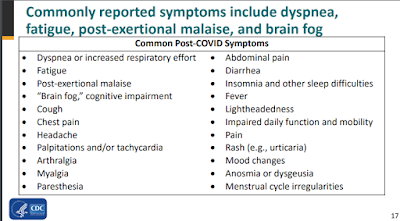
Slide From June 17th, 2021 CDC COCA Call on `Post-COVID' Syndrome
#17,491
Thanks to vaccines, three years of community exposure, and a `less virulent' Omicron variant, many people now consider a COVID infection no worse than a bout with seasonal flu, at least for relatively young and healthy individuals.
As a result, uptake of the booster vaccines have plummeted, almost no one wears masks in public, and most countries no longer report on COVID hospitalizations and deaths. This lack of reporting only increases the public's indifference.
The rub in all of this is there is considerable evidence that - unlike seasonal flu - COVID often produces long-lasting, sometimes chronic, sequelae in a significant (10%-30%) of people infected. Even those who only experienced `mild' COVID illness.
What is now referred to as Post-COVID Syndrome, or `Long COVID'.
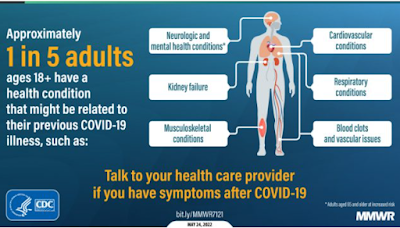
Furthermore, research suggests that with each SARS-CoV-2 reinfection, the risks of complications or developing Long COVID increase. With fewer people getting vaccinated/boosted, and fewer still bothering with NPIs, the risk for seeing multiple reinfections in the months and years ahead is only likely to rise.
For many, these Post-COVID symptoms ease over a period of months or years, but for others, they can represent a permanent disability or chronic illness (see JAMA: Additional Evidence Of A Post-COVID/Diabetes Link).
Many scientists worry that some of the damage from COVID infection may not become apparent for years (see Review Article: Parkinsonism as a Third Wave of the COVID-19 Pandemic? and Nature: Long-term Cardiovascular Outcomes of COVID-19).
Despite a 99% survival rate, among the `recovered' there are tens of millions of people whose health, and lives, have been severely impacted by the lingering effects of their COVID infection (see MMWR: Post–COVID Conditions Among Adult COVID-19 Survivors Aged 18–64 and ≥65 Years). .
That impact on society, on healthcare delivery services, and on the workforce is something we will be forced to deal with for years to come.
Last April, in SSI Preprint: Extended Sick Leave Following COVID Infection (Long COVID), we looked at a preprint which found a steep (3-fold) increase in taking extended sick leave (> 30 days) among those who had `recovered' from COVID , compared to those who have not been infected.
In the past - particularly with ME/CFS and Chronic Lyme Disease - society's response has too often been to ignore the problem, and even ridicule and marginalize the patient. But that will become much harder to do as the number of Post-COVID Syndrome cases increases.
The CDC has produced a number of COCA Calls on diagnosis and management of `Long COVID' over the past couple of years, including:
Next week (June 15th) the CDC will hold another, focusing on COVID's impact on the workforce. These presentations are often technical, and are of greatest interest to clinicians and healthcare providers, but also may be of interest to the general public.
As always, If you are unable to attend the live presentation, these (and past) webinars are archived and available for later viewing at this LINK.
I'll have a bit more after the break.
Evaluating and Supporting Patients with Long COVID in Returning to Work
 = Free Continuing Education
Overview
Long COVID can affect multiple organ systems creating a myriad of different symptoms that may require treatment and affect returning to work. Clinicians play a critical role in evaluating and supporting patients in their return to work. Tailored support and workplace accommodations are an important part of caring for patients with Long COVID. During this COCA Call, presenters will review some of the complex symptoms specific to Long COVID, discuss medical considerations for recommending return to work, and review accommodations to support patients returning to the workplace.
Presenters
John Howard, MD, MPH, JD, LLM, MBA
Director, National Institute for Occupational Safety and Health
Centers for Disease Control and Prevention
Marianne Cloeren, MD, MPH, FACOEM, FACP
Associate Professor
Division of Occupational and Environmental Medicine
University of Maryland School of Medicine
Greg Vanichkachorn, MD, MPH, FACOEM
Occupational and Aerospace Medicine Physician
Medical Director, Mayo Clinic COVID Activity Rehabilitation Program
Mayo Clinic
Call Materials
To be posted. Please check back.
Call Details
When:
Thursday, June 15, 2023,
2:00 PM – 3:00 PM ET
Webinar Link:
https://www.zoomgov.com/j/1612267823
Webinar ID: 161 226 7823
Passcode: 383130
Telephone:
+1 646 828 7666
+1 551 285 1373
+1 669 254 5252
One-tap mobile:
+16692545252,,1612267823#,,,,*383130#
+16469641167,,1612267823#,,,,*383130# US (US Spanish Line)
International numbers
Last week, in Study: SARS-CoV-2 Infection and Viral Fusogens Cause Neuronal and Glial Fusion that Compromises Neuronal Activity, the Queensland University's Brain Institute reported `. . . SARS-CoV-2 can cause brain cells to fuse, initiating malfunctions that lead to chronic neurological symptoms.'
While the long-term impact of this effect remains unknown, it may help explain the large number of COVID survivors who report `brain fog' for months (or longer) after recovery.
But it could also be a harbinger of something worse A few (of many) studies suggesting a COVID link to neurological diseases include:
In the decade following the 1918 H1N1 pandemic, millions of people were struck down by a (still) mysterious global epidemic of Encephalitis Lethargica (The Lancet: COVID-19: Can We Learn From Encephalitis Lethargica?).
Among those who survived, Parkinsonism and other neurological sequelae were common.
While past performance is no guarantee of future results, until we better understand the long-term effects of repeated COVID infections, it is too soon to trivialize the virus as `just another flu'. Which is why I've stayed current with the boosters, and why I still wear a face mask in crowds.
In the years ahead, I may find that my concerns were overblown.
But given the stakes, I consider these to be relatively minor precautions, that I really don't mind taking.
https://afludiary.blogspot.com/2023/06/upcoming-coca-callevaluating-and.html
Slide From June 17th, 2021 CDC COCA Call on `Post-COVID' Syndrome
#17,491
Thanks to vaccines, three years of community exposure, and a `less virulent' Omicron variant, many people now consider a COVID infection no worse than a bout with seasonal flu, at least for relatively young and healthy individuals.
As a result, uptake of the booster vaccines have plummeted, almost no one wears masks in public, and most countries no longer report on COVID hospitalizations and deaths. This lack of reporting only increases the public's indifference.
The rub in all of this is there is considerable evidence that - unlike seasonal flu - COVID often produces long-lasting, sometimes chronic, sequelae in a significant (10%-30%) of people infected. Even those who only experienced `mild' COVID illness.
What is now referred to as Post-COVID Syndrome, or `Long COVID'.
Furthermore, research suggests that with each SARS-CoV-2 reinfection, the risks of complications or developing Long COVID increase. With fewer people getting vaccinated/boosted, and fewer still bothering with NPIs, the risk for seeing multiple reinfections in the months and years ahead is only likely to rise.
For many, these Post-COVID symptoms ease over a period of months or years, but for others, they can represent a permanent disability or chronic illness (see JAMA: Additional Evidence Of A Post-COVID/Diabetes Link).
Many scientists worry that some of the damage from COVID infection may not become apparent for years (see Review Article: Parkinsonism as a Third Wave of the COVID-19 Pandemic? and Nature: Long-term Cardiovascular Outcomes of COVID-19).
Despite a 99% survival rate, among the `recovered' there are tens of millions of people whose health, and lives, have been severely impacted by the lingering effects of their COVID infection (see MMWR: Post–COVID Conditions Among Adult COVID-19 Survivors Aged 18–64 and ≥65 Years). .
That impact on society, on healthcare delivery services, and on the workforce is something we will be forced to deal with for years to come.
Last April, in SSI Preprint: Extended Sick Leave Following COVID Infection (Long COVID), we looked at a preprint which found a steep (3-fold) increase in taking extended sick leave (> 30 days) among those who had `recovered' from COVID , compared to those who have not been infected.
In the past - particularly with ME/CFS and Chronic Lyme Disease - society's response has too often been to ignore the problem, and even ridicule and marginalize the patient. But that will become much harder to do as the number of Post-COVID Syndrome cases increases.
The CDC has produced a number of COCA Calls on diagnosis and management of `Long COVID' over the past couple of years, including:
Next week (June 15th) the CDC will hold another, focusing on COVID's impact on the workforce. These presentations are often technical, and are of greatest interest to clinicians and healthcare providers, but also may be of interest to the general public.
As always, If you are unable to attend the live presentation, these (and past) webinars are archived and available for later viewing at this LINK.
I'll have a bit more after the break.
Evaluating and Supporting Patients with Long COVID in Returning to Work
Overview
Long COVID can affect multiple organ systems creating a myriad of different symptoms that may require treatment and affect returning to work. Clinicians play a critical role in evaluating and supporting patients in their return to work. Tailored support and workplace accommodations are an important part of caring for patients with Long COVID. During this COCA Call, presenters will review some of the complex symptoms specific to Long COVID, discuss medical considerations for recommending return to work, and review accommodations to support patients returning to the workplace.
Presenters
John Howard, MD, MPH, JD, LLM, MBA
Director, National Institute for Occupational Safety and Health
Centers for Disease Control and Prevention
Marianne Cloeren, MD, MPH, FACOEM, FACP
Associate Professor
Division of Occupational and Environmental Medicine
University of Maryland School of Medicine
Greg Vanichkachorn, MD, MPH, FACOEM
Occupational and Aerospace Medicine Physician
Medical Director, Mayo Clinic COVID Activity Rehabilitation Program
Mayo Clinic
Call Materials
To be posted. Please check back.
Call Details
When:
Thursday, June 15, 2023,
2:00 PM – 3:00 PM ET
Webinar Link:
https://www.zoomgov.com/j/1612267823
Webinar ID: 161 226 7823
Passcode: 383130
Telephone:
+1 646 828 7666
+1 551 285 1373
+1 669 254 5252
One-tap mobile:
+16692545252,,1612267823#,,,,*383130#
+16469641167,,1612267823#,,,,*383130# US (US Spanish Line)
International numbers
Last week, in Study: SARS-CoV-2 Infection and Viral Fusogens Cause Neuronal and Glial Fusion that Compromises Neuronal Activity, the Queensland University's Brain Institute reported `. . . SARS-CoV-2 can cause brain cells to fuse, initiating malfunctions that lead to chronic neurological symptoms.'
While the long-term impact of this effect remains unknown, it may help explain the large number of COVID survivors who report `brain fog' for months (or longer) after recovery.
But it could also be a harbinger of something worse A few (of many) studies suggesting a COVID link to neurological diseases include:
In the decade following the 1918 H1N1 pandemic, millions of people were struck down by a (still) mysterious global epidemic of Encephalitis Lethargica (The Lancet: COVID-19: Can We Learn From Encephalitis Lethargica?).
Among those who survived, Parkinsonism and other neurological sequelae were common.
While past performance is no guarantee of future results, until we better understand the long-term effects of repeated COVID infections, it is too soon to trivialize the virus as `just another flu'. Which is why I've stayed current with the boosters, and why I still wear a face mask in crowds.
In the years ahead, I may find that my concerns were overblown.
But given the stakes, I consider these to be relatively minor precautions, that I really don't mind taking.
https://afludiary.blogspot.com/2023/06/upcoming-coca-callevaluating-and.html