

Pathfinder
Editor, Senior Moderator
Small earthquake shakes S.C., Ga.
</SECTION><SECTION id=module-position-M_P4SDnIIOw class="storytopbar-bucket story-byline-module">AP 11:17 p.m. EST February 14, 2014
</SECTION><SECTION id=module-position-M_P4SD1B-_E class="storymetadata-bucket expandable-photo-module"><ASIDE class="single-photo expandable-collapsed" itemprop="associatedMedia" itemscope="" itemtype="http://schema.org/ImageObject">
A small earthquake shook South Carolina and Georgia late Friday, startling residents and shaking homes in both states.
The quake happened at 10:23 p.m. EST and had a preliminary magnitude of 4.4, said USGS Geophysicist Dale Grant. It was centered 7 miles west of the town of Edgefield, S.C.
"It's a large quake for that area," he said. Grant had not yet heard of any reports of damage or injuries.
...
http://www.usatoday.com/story/news/nation/2014/02/14/earthquake-us-sc-ga/5501873/
--------------------------------------------------------------------------
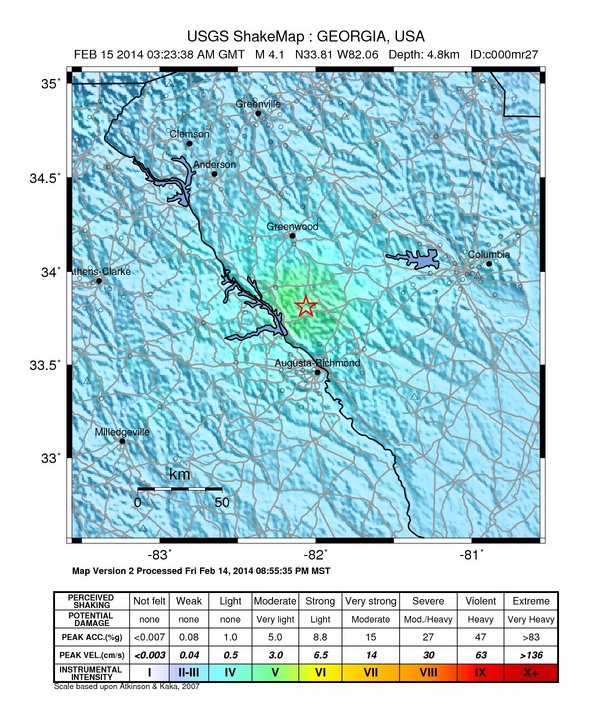
http://earthquake.usgs.gov/earthquakes/eventpage/usc000mr27#shakemap
------------------------------------------------------------------------------------
M4.1 - 12km WNW of Edgefield, South Carolina 2014-02-15 03:23:38 UTC
Event Time
33.812?N 82.063?W depth=4.9km (3.0mi)
Nearby Cities
Tectonic Summary
Earthquakes in the Inland Carolinas Region
Since at least 1776, people living inland in North and South Carolina, and in adjacent parts of Georgia and Tennessee, have felt small earthquakes and suffered damage from infrequent larger ones. The largest earthquake in the area (magnitude 5.1) occurred in 1916. Moderately damaging earthquakes strike the inland Carolinas every few decades, and smaller earthquakes are felt about once each year or two.
Earthquakes in the central and eastern U.S., although less frequent than in the western U.S., are typically felt over a much broader region. East of the Rockies, an earthquake can be felt over an area as much as ten times larger than a similar magnitude earthquake on the west coast. A magnitude 4.0 eastern U.S. earthquake typically can be felt at many places as far as 100 km (60 mi) from where it occurred, and it infrequently causes damage near its source. A magnitude 5.5 eastern U.S. earthquake usually can be felt as far as 500 km (300 mi) from where it occurred, and sometimes causes damage as far away as 40 km (25 mi).
Faults
Earthquakes everywhere occur on faults within bedrock, usually miles deep. Most bedrock beneath the inland Carolinas was assembled as continents collided to form a supercontinent about 500-300 million years ago, raising the Appalachian Mountains. Most of the rest of the bedrock formed when the supercontinent rifted apart about 200 million years ago to form what are now the northeastern U.S., the Atlantic Ocean, and Europe.
At well-studied plate boundaries like the San Andreas fault system in California, often scientists can determine the name of the specific fault that is responsible for an earthquake. In contrast, east of the Rocky Mountains this is rarely the case. The inland Carolinas region is far from the nearest plate boundaries, which are in the center of the Atlantic Ocean and in the Caribbean Sea. The region is laced with known faults but numerous smaller or deeply buried faults remain undetected. Even the known faults are poorly located at earthquake depths. Accordingly, few, if any, earthquakes in the inland Carolinas can be linked to named faults. It is difficult to determine if a known fault is still active and could slip and cause an earthquake. As in most other areas east of the Rockies, the best guide to earthquake hazards in the seismic zone is the earthquakes themselves.
http://earthquake.usgs.gov/earthquakes/eventpage/usc000mr27#summary
</SECTION><SECTION id=module-position-M_P4SDnIIOw class="storytopbar-bucket story-byline-module">AP 11:17 p.m. EST February 14, 2014
</SECTION><SECTION id=module-position-M_P4SD1B-_E class="storymetadata-bucket expandable-photo-module"><ASIDE class="single-photo expandable-collapsed" itemprop="associatedMedia" itemscope="" itemtype="http://schema.org/ImageObject">
A small earthquake shook South Carolina and Georgia late Friday, startling residents and shaking homes in both states.
The quake happened at 10:23 p.m. EST and had a preliminary magnitude of 4.4, said USGS Geophysicist Dale Grant. It was centered 7 miles west of the town of Edgefield, S.C.
"It's a large quake for that area," he said. Grant had not yet heard of any reports of damage or injuries.
...
http://www.usatoday.com/story/news/nation/2014/02/14/earthquake-us-sc-ga/5501873/
--------------------------------------------------------------------------
http://earthquake.usgs.gov/earthquakes/eventpage/usc000mr27#shakemap
------------------------------------------------------------------------------------
M4.1 - 12km WNW of Edgefield, South Carolina 2014-02-15 03:23:38 UTC
Event Time
- 2014-02-15 03:23:38 UTC
- 2014-02-14 22:23:38 UTC-05:00 <ABBR title="Time where earthquake occured">at epicenter</ABBR>
- 2014-02-14 21:23:38 UTC-06:00 <ABBR title="Timezone your computer is configured to use">system time</ABBR>
33.812?N 82.063?W depth=4.9km (3.0mi)
Nearby Cities
- 12km (7mi) WNW of Edgefield, South Carolina
- 31km (19mi) NNE of Evans, Georgia
- 32km (20mi) N of Martinez, Georgia
- 35km (22mi) NNW of North Augusta, South Carolina
- 97km (60mi) WSW of Columbia, South Carolina
Tectonic Summary
Earthquakes in the Inland Carolinas Region
Since at least 1776, people living inland in North and South Carolina, and in adjacent parts of Georgia and Tennessee, have felt small earthquakes and suffered damage from infrequent larger ones. The largest earthquake in the area (magnitude 5.1) occurred in 1916. Moderately damaging earthquakes strike the inland Carolinas every few decades, and smaller earthquakes are felt about once each year or two.
Earthquakes in the central and eastern U.S., although less frequent than in the western U.S., are typically felt over a much broader region. East of the Rockies, an earthquake can be felt over an area as much as ten times larger than a similar magnitude earthquake on the west coast. A magnitude 4.0 eastern U.S. earthquake typically can be felt at many places as far as 100 km (60 mi) from where it occurred, and it infrequently causes damage near its source. A magnitude 5.5 eastern U.S. earthquake usually can be felt as far as 500 km (300 mi) from where it occurred, and sometimes causes damage as far away as 40 km (25 mi).
Faults
Earthquakes everywhere occur on faults within bedrock, usually miles deep. Most bedrock beneath the inland Carolinas was assembled as continents collided to form a supercontinent about 500-300 million years ago, raising the Appalachian Mountains. Most of the rest of the bedrock formed when the supercontinent rifted apart about 200 million years ago to form what are now the northeastern U.S., the Atlantic Ocean, and Europe.
At well-studied plate boundaries like the San Andreas fault system in California, often scientists can determine the name of the specific fault that is responsible for an earthquake. In contrast, east of the Rocky Mountains this is rarely the case. The inland Carolinas region is far from the nearest plate boundaries, which are in the center of the Atlantic Ocean and in the Caribbean Sea. The region is laced with known faults but numerous smaller or deeply buried faults remain undetected. Even the known faults are poorly located at earthquake depths. Accordingly, few, if any, earthquakes in the inland Carolinas can be linked to named faults. It is difficult to determine if a known fault is still active and could slip and cause an earthquake. As in most other areas east of the Rockies, the best guide to earthquake hazards in the seismic zone is the earthquakes themselves.
http://earthquake.usgs.gov/earthquakes/eventpage/usc000mr27#summary