

Michael Coston
Editor, Senior Moderator
Virology: Susceptibilities & Viral Shedding of Peridomestic Wildlife Infected with Clade 2.3.4.4b HPAI Virus (H5N1)
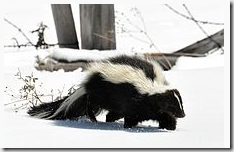
Striped Skunk – Credit Wikipedia
#18,282
While we've been following various incarnations of HPAI H5 for more than 2 decades, since 2020 a new clade (2.3.4.4b) of H5N1 has demonstrated enhanced, and still growing, abilities to infect a much wider range of avian and mammalian hosts.
Bird species that once were thought immune to the virus are now routinely infected (see DEFRA: The Unprecedented `Order Shift' In Wild Bird H5N1 Positives In Europe & The UK), and new species of mammals are being added to the USDA's list of affected wildlife on a regular basis.
While far from complete, the USDA lists > 2 dozen mammals affected, including:

Regular readers will recall that we've looked at a number of studies on the susceptibility of peridomestic wildlife (both avian & mammalian) to HPAI H5 viruses, many of which were led by Dr Jeffery Root; a Research Wildlife Biologist at the National Wildlife Research Center.
All of which leads us to a new study penned by Dr. Root et al., which finds the 2.3.4.4b clade of H5N1 able to readily infect a variety of peridomestic species, and that two (striped skunks and Viriginia Opossums) shed copious amounts of the virus.
The full report is behind a paywall. Due to copyright I've only posted the link, and a snippet from the abstract. Follow the link to read the extended summary or the full report. I'll return with a bit more after the break.
Susceptibilities and viral shedding of peridomestic wildlife infected with clade 2.3.4.4b highly pathogenic avian influenza virus (H5N1)
J. Jeffrey Root 1, Stephanie M. Porter 1, Julianna B. Lenoch 2, Jeremy W. Ellis 1, Angela M. Bosco-Lauth 31U.S.
Received 3 July 2024, Revised 3 September 2024, Accepted 4 September 2024, Available online 5 September 2024.
https://doi.org/10.1016/j.virol.2024.110231Get rights and content
Highlights
When taken with other recent reports, including:
Pathogens: Susceptibility of Synanthropic Rodents to H5N1 Subtype HPAI Viruses
Emer. Microbe & Inf.: HPAI Virus H5N1 clade 2.3.4.4b in Wild Rats in Egypt during 2023
Colorado: CVMA Statement On Influenza A (HPAI H5N1) in Domestic cats
It is pretty clear this HPAI virus is rapidly becoming entrenched in our environment. This not only provides the virus with multiple pathways to infect poultry operations, it increases the chances it will spread to other mammalian species.
And while this virus remains primarily an avian-adapted pathogen, with every mammalian infection comes new opportunities for the virus to better adapt to non-avian hosts.
Whether that leads to a pandemic strain is unknowable, but is seems increasingly unlikely that this virus will simply `burn itself out', as so many seem inclined to believe.
https://afludiary.blogspot.com/2024/09/virology-susceptibilities-viral.html

Striped Skunk – Credit Wikipedia
#18,282
While we've been following various incarnations of HPAI H5 for more than 2 decades, since 2020 a new clade (2.3.4.4b) of H5N1 has demonstrated enhanced, and still growing, abilities to infect a much wider range of avian and mammalian hosts.
Bird species that once were thought immune to the virus are now routinely infected (see DEFRA: The Unprecedented `Order Shift' In Wild Bird H5N1 Positives In Europe & The UK), and new species of mammals are being added to the USDA's list of affected wildlife on a regular basis.
While far from complete, the USDA lists > 2 dozen mammals affected, including:
Regular readers will recall that we've looked at a number of studies on the susceptibility of peridomestic wildlife (both avian & mammalian) to HPAI H5 viruses, many of which were led by Dr Jeffery Root; a Research Wildlife Biologist at the National Wildlife Research Center.
- Dr. Root was one of the authors of a 2014 PLoS One study called Shedding of a Low Pathogenic Avian Influenza Virus in a Common Synanthropic Mammal – The Cottontail Rabbit, which was the first to show shedding of LPAI by cottontail rabbits.
- In 2015, this work was followed up with Virology: Experimental Infection of Peridomestic Animals With Avian H7N9 where Dr. Root et al. demonstrated H7N9’s ability to infect, and to be shed by, peridomestic animals like skunks, raccoons, and rabbits.
- again in 2016, inReport: Skunks and Rabbits Can Catch And Shed Avian Flu, we looked at an AP News report that quoted Dr. Root as saying that small mammals like rabbits and skunks can become infected with avian flu, and they can shed enough of the virus to pass it onto ducks (and presumably other types of birds).
- And in 2018, in HPAI H5Nx Clade 2.3.4.4. Shedding In Cottontail Rabbits, Dr. Root et al. showed that the HPAI H5 clade 2.3.4.4. virus - which previously had shown little ability to infect mammals - could infect cottontail rabbits, and that they could then shed the virus for one or more days.
All of which leads us to a new study penned by Dr. Root et al., which finds the 2.3.4.4b clade of H5N1 able to readily infect a variety of peridomestic species, and that two (striped skunks and Viriginia Opossums) shed copious amounts of the virus.
The full report is behind a paywall. Due to copyright I've only posted the link, and a snippet from the abstract. Follow the link to read the extended summary or the full report. I'll return with a bit more after the break.
Susceptibilities and viral shedding of peridomestic wildlife infected with clade 2.3.4.4b highly pathogenic avian influenza virus (H5N1)
J. Jeffrey Root 1, Stephanie M. Porter 1, Julianna B. Lenoch 2, Jeremy W. Ellis 1, Angela M. Bosco-Lauth 31U.S.
Received 3 July 2024, Revised 3 September 2024, Accepted 4 September 2024, Available online 5 September 2024.
https://doi.org/10.1016/j.virol.2024.110231Get rights and content
Highlights
- Six of six peridomestic wildlife species tested had the ability to replicate HP H5N1.
- HP AIVs circulating in the U.S. during 2022-2024 may have an extremely broad range of species that can be impacted by and/or replicate and shed these viruses.
- Peridomestic mammals shed higher viral titers than peridomestic birds in this study.
Abstract
(SNIP)
(SNIP)
Overall, the results of this study indicate that certain peridomestic species could pose a biosecurity threat to poultry operations in some situations. In addition, this study and field reports indicate that the HP AIVs circulating in the U.S. during 2022-2024 may have an extremely broad range of species that can be impacted by and/or replicate and shed these viruses.
(Continue . . . . )When taken with other recent reports, including:
Pathogens: Susceptibility of Synanthropic Rodents to H5N1 Subtype HPAI Viruses
Emer. Microbe & Inf.: HPAI Virus H5N1 clade 2.3.4.4b in Wild Rats in Egypt during 2023
Colorado: CVMA Statement On Influenza A (HPAI H5N1) in Domestic cats
It is pretty clear this HPAI virus is rapidly becoming entrenched in our environment. This not only provides the virus with multiple pathways to infect poultry operations, it increases the chances it will spread to other mammalian species.
And while this virus remains primarily an avian-adapted pathogen, with every mammalian infection comes new opportunities for the virus to better adapt to non-avian hosts.
Whether that leads to a pandemic strain is unknowable, but is seems increasingly unlikely that this virus will simply `burn itself out', as so many seem inclined to believe.
https://afludiary.blogspot.com/2024/09/virology-susceptibilities-viral.html