• FluTrackers.com Inc. does not provide medical advice. Information on this web site is collected from various internet resources, and the FluTrackers board of directors makes no warranty to the safety, efficacy, correctness or completeness of the information posted on this site by any author or poster. The information collated here is for instructional and/or discussion purposes only and is NOT intended to diagnose or treat any disease, illness, or other medical condition. Every individual reader or poster should seek advice from their personal physician/healthcare practitioner before considering or using any interventions that are discussed on this website. By continuing to access this website you agree to consult your personal physican before using any interventions posted on this website, and you agree to hold harmless FluTrackers.com Inc., the board of directors, the members, and all authors and posters for any effects from use of any medication, supplement, vitamin or other substance, device, intervention, etc. mentioned in posts on this website, or other internet venues referenced in posts on this website.
  • We are not asking for any donations. Do not donate to any entity who says they are raising funds for us.

What to look for in August....

Re: What to look for in August....

Mamabird,

I am not discounting the numbers we are seeing from Australia. This thread is about what to look for in August...if we are going to see a 1918 repeat.

The most difficult part of the problem is that we do not have the first wave 1918 strain. We have the second wave 1918 strain but not the first. So while we know where it ended up, we do not know where it started. Therefore it is impossible to know exactly what changes occured, if any from the first wave 1918 strain to the second wave 1918 strain that made it more lethal.

What we do know, is that sometime in August the cases all of the sudden turned more deadly. Now, maybe the virus was always capable of causing mass deaths and it just needed the right climate, or maybe it evolved along a pre-determined evolutionary path so that it was always going to cause the mass deaths but just needed to time to reach its evolution, or maybe something else.

The point is, we don't know what we don't know. You can't tell me with absolute certaintly that it is going to play out like you and I both hope.

I completely agree with all of your points. Anyone that tells you with any kind of certainty what this virus will do in the future is not to be trusted, including those that take the position that this is an exact repeat of the very ugly 1918 event. We simply do not know what will or will not happen with certainty.

Having said that, we do know what we have in hand in the way of scientific evidence that can be compared to previous pandemics, and by that I mean, not just 1918, but 1957 and 1968 as well. The current Swine Flu virus is simply, in its current form, not the same as any of those prior pandemic viruses in terms of causing serious illness. All three of the previous viruses had genetic markers that this virus does not have, and perhaps as importantly, the seasonal flu viruses have those same genetic markers that this Swine Flu virus does not have. Add to that all of the epidemiology we have in hand to date, and this virus is not what one would categorize as "lethal". Therefore, our expectations for the future should not be too dire based on what we know today.

But, the virus could change for the worse, so we must monitor it closely. We were initially very concerned with the high fatalities we were seeing in Mexico as compared to the experience in the US and Canada. However, on careful review of all of the data and an examiniation of the virus, there was no cause of alarm. The virus that attached Mexico (in its numerous variant forms) is almost the identical virus that has attacked every other country across the globe. But when you get a whole lot of people in close quarters (Mexico City, New York, Sao Paulo, Rio de Janeiro, Buenes Aires, etc.) this virus will cause a whole lot of illness, and therefore, increased hospitalizations and deaths.

To date, all of the viruses from those numerous countries look basically the same as the virus that is circulating in all other parts of the world. There are differences, and that is how we can track their spread, but the differences are not significant in terms of virulence.

The HA segment of the Swine Flu virus looks identical to the 1918 virus as to the material genetic markers, and that is not a surprise. We have known that from the very beginning. The HA came from swine infected by the original 1918 virus that has been evolving in swine herds for 90 years. However, the other gene segments of the Swine Flu virus are not currently comparable to the 1918 virus, so we should not expect this pandemic to necessarily play out like the one in 1918 unless other, material changes occur in the genome.

Based on all this information, the CDC is likely to revise their school guidance on Friday of this week. It will not, and should not, look like the guidance for a country that is expecting another 1918 event.
 
Re: What to look for in August....

I went back and read the flu season summary for 2007-2008: http://www.cdc.gov/flu/weekly/weeklyarchives2007-2008/07-08summary.htm

Here is the relevant sections for mortality:

Pneumonia and Influenza (P&I) Mortality Surveillance*:

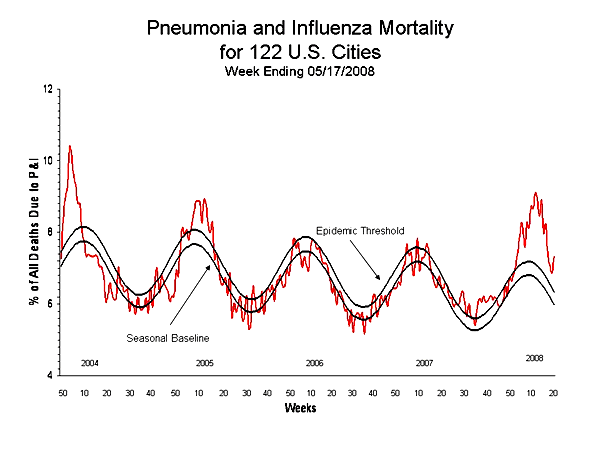
During the 2007--08 influenza season, the percentage of deaths attributed to pneumonia and influenza (P&I) exceeded the epidemic threshold?? for 8 consecutive weeks in the 122 Cities Mortality Reporting System during the weeks ending January 12--May 17, 2008 (weeks 9--16). The percentage of P&I deaths peaked at 9.1% during the week ending March 15, 2008 (week 11). During the previous three influenza seasons, the peak percentage of P&I deaths has ranged from 7.7% to 8.9% and the total number of weeks the P&I ratio exceeded the epidemic threshold has ranged from one to 11. The P&I baseline and epidemic threshold values are projected for each season at the onset of that season and are based on data from the previous five years. The robust regression model used to calculate the 122 Cities Mortality Reporting System baseline and epidemic threshold values was recently modified. This new methodology better takes into account shifts in the long term trends of the 122 Cities data, and will be used in the upcoming 2008-09 influenza season to project the baseline and epidemic threshold values.
<center>
bigpicurvesumary0708_small.gif

View Full Screen</center> Influenza-Associated Pediatric Mortality*:

As of June 19, 2008, 83 deaths associated with laboratory-confirmed influenza infections have occurred among children aged < 18 years during the 2007--08 influenza season that were reported to CDC. These deaths were reported from 33 states (Alaska, Arizona, Arkansas, California, Colorado, Connecticut, Florida, Georgia, Illinois, Indiana, Iowa, Maine, Maryland, Massachusetts, Michigan, Minnesota, Mississippi, Nevada, New Hampshire, New Jersey, New Mexico, New York, North Carolina, Ohio, Oklahoma, Oregon, Pennsylvania, Tennessee, Texas, Utah, Vermont, Washington, and Wisconsin). Among the 83 cases, the mean and median age was 6.4 years and 5.0 years, respectively; seven children were aged < 6 months, 16 were aged 6--23 months, 18 were aged 2--4 years, and 42 were aged 5--17 years. Of the 79 cases for which the influenza virus type was known, 51 were influenza A viruses, 27 were influenza B viruses, and one had co-infection with influenza A and B viruses. Of the 63 cases aged 6 months and older for whom vaccination status was known, 58 (92%) had not been vaccinated against influenza according to the 2007 Advisory Committee on Immunization Practices recommendations. These data are provisional and subject to change as more information becomes available.

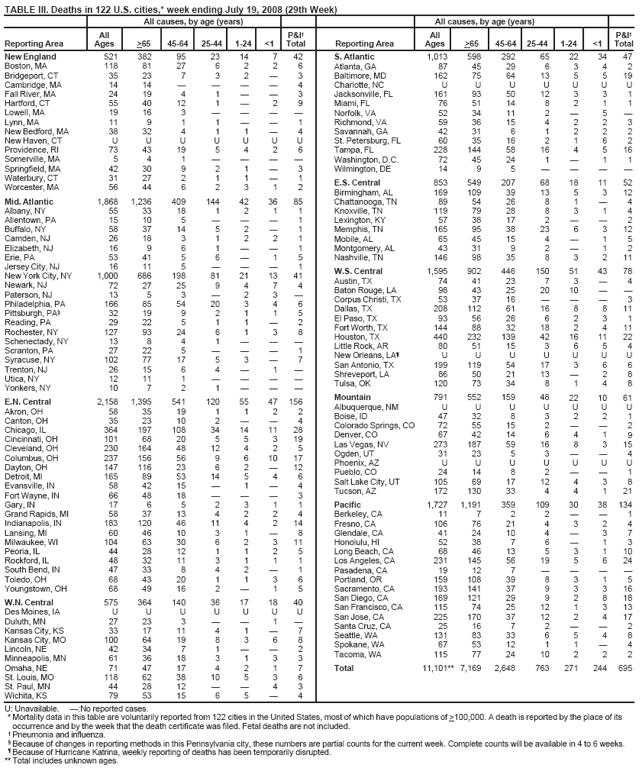
So based on that, it would seem that the only lab confirmation of flu-related deaths in the US are the relatively small number of pediatric cases. It is worth noting that even during the summer, the CDC reports several hundred P&I related deaths each week:

http://www.cdc.gov/mmwr/preview/mmwrhtml/mm5729md.htm#tab3

m729mt3.gif


That is week 29 last year, the week ending July 19th. Note the 695 P&I deaths. I would seriously doubt more than 1 or 2 of those were actually flu related.
 
Re: What to look for in August....

Add to that all of the epidemiology we have in hand to date, and this virus is not what one would categorize as "lethal". Therefore, our expectations for the future should not be too dire based on what we know today.
I have a slightly different take on this. My concern is what is going to happen even if the virus doesn't change appreciably. If we see ~30,000 to ~40,000 deaths from seasonal flu every year and this virus has roughly the same CFR, we could see three to five times the number of deaths due to its novel character. And, as we all know, the demographics are disturbing. For us to lose 100,000 to 200,000 relatively young people in the U.S., though not on par with 1918, would certainly be a social disaster. Also, based on data to date, 5 to 10% of those deaths will be pregnant women and another 5 to 10% might be health care workers.

I don't think this is an unreasonable expectation for the fall. A timely and effective vaccine could mitigate this, and I think that is what the public health community is counting on. However, if the vaccine doesn't help, for whatever reason, we should be making appropriate preparations. Maybe those preparations are going on behind the scenes, but I don't see much evidence of it.

As I've said many times to my friends and colleagues, I'd rather be completely wrong and have to spend a month in a pink tutu with a dunce cap on, than be right.

See this thread:

http://www.flutrackers.com/forum/showthread.php?t=119062

If this happens at major cities across the U.S., I suspect that the outcome would be far more serious than any seasonal influenza outbreak and likely have a greater impact than the more recent pandemics.
 
Last edited:
Re: What to look for in August....

I have a slightly different take on this. My concern is what is going to happen even if the virus doesn't change appreciably. If we see ~30,000 to ~40,000 deaths from seasonal flu every year and this virus has roughly the same CFR, we could see three to five times the number of deaths due to its novel character. And, as we all know, the demographics are disturbing. For us to lose 100,000 to 200,000 relatively young people in the U.S., though not on par with 1918, would certainly be a social disaster. Also, based on data to date, 5 to 10% of those deaths will be pregnant women and another 5 to 10% might be health care workers.

I don't think this is an unreasonable expectation for the fall. A timely and effective vaccine could mitigate this, and I think that is what the public health community is counting on. However, if the vaccine doesn't help, for whatever reason, we should be making appropriate preparations. Maybe those preparations are going on behind the scenes, but I don't see much evidence of it.

As I've said many times to my friends and colleagues, I'd rather be completely wrong and have to spend a month in a pink tutu with a dunce cap on, then be right.

JimO,

I think you raise an excellent point.

There is one more point I would like to raise about the 1918 to 2009 comparison. That is the impact that modern healthcare, drugs, equipment, delivery systems, etc is playing in this pandemic.

In trying to compare the morbidity & mortality rates it becomes extremely difficult because we have no idea what the impact would have been in 1918 if we had the same technology and medicine that we have today.

This is why I always tend to look at the hospitalizations numbers as though as if, in 1918, 50% or more would more than likely have died. Especially those that are on ventilators. So if you have 75 in Australia that have died and 500 hospitalized, then if this was 1918 you would most likely have 300 dead and 200 hospitalized. Then you have to factor in the effect of our modern medicine.

In 2009 we have had a first wave defense, Tamiflu & Relenza & Antibiotics, that we never had in 1918. It might even be a second wave defense.

If you remove our modern defenses and put us at a 1918 technology level I wonder if Mamabird could make the same sound arguments that she made above about "lethality".

In essence, would the 2009 H1N1 virus be "lethal" if it were to appear in 1918?
 
Re: What to look for in August....

Then you have to factor in the effect of our modern medicine.

In 2009 we have had a first wave defense, Tamiflu & Relenza & Antibiotics, that we never had in 1918. It might even be a second wave defense.

If you remove our modern defenses and put us at a 1918 technology level I wonder if Mamabird could make the same sound arguments that she made above about "lethality".

In essence, would the 2009 H1N1 virus be "lethal" if it were to appear in 1918?
I agree. Furthermore, antivirals, vaccines, vents, and cardiac bypass machines have limited capacity for various reasons (none of which were available in 1918). As the antivirals become ineffective and as capacities are maxed out with respect to vaccine availability and life support devices (need vs availability), I think the lethality of the current virus will increase, not because it has changed, but, as you point out, because, to paraphrase, our toolbox is empty. If the virus does mutate unfavorably, then God help us.
 
Re: What to look for in August....

. . . In essence, would the 2009 H1N1 virus be "lethal" if it were to appear in 1918?

In 1918 they were unaware of viruses, much less could they sequence them. Recognition of a "new" pandemic strain was only apparent because of large numbers of simultaneous infections and an equally larger number of deaths. The current outbreak of H1N1 would probably not even have registered with public health officials in 1918.

Elsewhere here at FT, it has been suggested that the current infections represent a "pre-wave". Because of our sequencing abilities today, we may find that there will be multiple recognizable waves over the next 12-24 months based on genetics. Most of us are more concerned about waves associated with increases in mortality. It may be that the classic "three wave" model simply reflects prior generations crude understanding of pandemics and the inability to distinguish multiple waves based on solely on numbers of deaths or infections.
 
Re: What to look for in August....

The robust regression model used to calculate the 122 Cities Mortality Reporting System baseline and epidemic threshold values was recently modified. This new methodology better takes into account shifts in the long term trends of the 122 Cities data, and will be used in the upcoming 2008-09 influenza season to project the baseline and epidemic threshold values.

anybody know what modifications, what new methodology they will be using?
 
Re: What to look for in August....

There is one more point I would like to raise about the 1918 to 2009 comparison. That is the impact that modern healthcare, drugs, equipment, delivery systems, etc is playing in this pandemic.

In trying to compare the morbidity & mortality rates it becomes extremely difficult because we have no idea what the impact would have been in 1918 if we had the same technology and medicine that we have today.

Let me draw a bit of a comparison as to what we should be seeing, or what we might expect to see, in a 1918 type pandemic event, but we will change only one assumption, and that is the case fatality factor. Instead of using 2.3% CFR that the US experienced in 1918, lets use only 1.15% to account for our perceived superior health care system of today.

So, with a current population of 300 million, the clinical infection rate in 1918 was about 28%, therefore, we can expect that by the end of this pandemic event, some 84 million people in the US will become ill. (By the way, this closely matches with WHO's current Swine Flu assumptions). The hospitalization rate of the 1918 pandemic was about 15% of those that became ill, so we should see at least 12 million hospitalizations. And with a CFR of only one half that of 1918, almost 1 million people in the US will die of Swine Flu.

First of all, we are in fact not seeing anything like this in the US (or anywhere else in the world for that matter) as to either hospitalizations or deaths, and secondly, if anyone seriously has expectations of such a dire scenario, we are indeed in deep trouble. Few in America are engaged in any type of planning or preparation toward a scenario that is half as bad as 1918. The above scenario that I painted above will be a social disaster like none seen in a very long time, and quite honestly, I'm not sure we can mentally handle it.
 
Re: What to look for in August....

First of all, we are in fact not seeing anything like this in the US (or anywhere else in the world for that matter) as to either hospitalizations or....

Mamabird,

Does this report today (EST time) from Australia give you any cause for concern?

http://www.news.com.au/perthnow/story/0,21598,25881082-2761,00.html
MORE than 250 children were rushed to Princess Margaret Hospital in the past 24 hours causing chaos in the emergency department.

Australian Medical Association of WA state president Gary Geelhoed said WA hospitals were operating over capacity and until extra beds were put into the system patients, including children, would have to wait dangerously long to get care.

“For more than a week our hospitals have been under siege and the situation is growing more serious by the day,” AMA state president Prof Gary Geelhoed.

Hospitals are trying to operate over capacity and until they get the extra beds and resources they need, patients will have dangerously long waiting times causing unnecessary suffering.”

Prof Geelhoed said the situation had reached crisis point in the past 24 hours resulting in:

MORE than 250 children attending the emergency department at Princess Margaret Hospital, many with flu symptoms. Most children had to wait up to 90 minutes to see a doctor.

AT 9am this morning, 110 patients were still queuing in emergency departments at Perth’s three major hospitals. Many had waited up to six hours to be seen by a doctor and a number had to wait more than 24 hours for a hospital bed.

"Over the last week the hospital system has been struggling to cope,” Prof Geelhoed said.

We have seen serious levels of ramping, with more than half the ambulance fleet tied up outside emergency departments.

“Most elective surgery has been cancelled because of the bed shortage and there’s even been a lack of intensive care beds with hospitals having great difficulty admitting new intubated patients.”
Or is this under what you would be expecting at this point? By this point were you expecting makeshift hospitals to be set up or have high school converted to hospitals? Mind you, that Australia isn't supposed to peak for another 3 weeks.
 
Re: What to look for in August....

. . . how many deaths does Australia *estimate* in a normal flu season, and how many do they actually confirm.

A few countries have mentioned their estimated seasonal flu deaths, and they are consistently the same as the US estimate, proportional to their population. They seem to be applying the same JAMA study to their own population. IIRC, Australia estimates 2500 seasonal flu deaths annually.

Now the seasonal estimate calls for 90% of the deaths to be people 65 and older. So the estimated deaths for people under 65 would be 250 annually.

95% of the pandemic flu deaths have been of people under 65, so there have been about 71 Australian deaths under 65 so far. This may be roughly equal to the seasonal flu estimate for this point in the flu season.
 
Re: What to look for in August....

A few countries have mentioned their estimated seasonal flu deaths, and they are consistently the same as the US estimate, proportional to their population. They seem to be applying the same JAMA study to their own population. IIRC, Australia estimates 2500 seasonal flu deaths annually.

Now the seasonal estimate calls for 90% of the deaths to be people 65 and older. So the estimated deaths for people under 65 would be 250 annually.

95% of the pandemic flu deaths have been of people under 65, so there have been about 71 Australian deaths under 65 so far. This may be roughly equal to the seasonal flu estimate for this point in the flu season.

But again, we are talking two different things. :)~71 confirmed deaths in this age group versus an estimate that we may normally be at the same point. During the first few weeks of last year's season how many confirmed deaths did Australia have in this age group?
 
Re: What to look for in August....

But again, we are talking two different things. :)~71 confirmed deaths in this age group versus an estimate that we may normally be at the same point. During the first few weeks of last year's season how many confirmed deaths did Australia have in this age group?

Here is the final report for Australia for 2008.

http://www.health.gov.au/internet/main/publishing.nsf/Content/cda-ozflu-7-11-08.htm

Interesting graph that showed when Influenza peaked in 2008.
0.gif

http://www.health.gov.au/internet/ministers/publishing.nsf/Content/mr-yr09-je-je047.htm
On average between 1997- 2006, 2,758 Australians died each year from influenza and pneumonia.
 
Re: What to look for in August....

Here is the final report for Australia for 2008.

http://www.health.gov.au/internet/main/publishing.nsf/Content/cda-ozflu-7-11-08.htm

Interesting graph that showed when Influenza peaked in 2008.
View attachment 3819

http://www.health.gov.au/internet/ministers/publishing.nsf/Content/mr-yr09-je-je047.htm
On average between 1997- 2006, 2,758 Australians died each year from influenza and pneumonia.

So we are still where we were. ~2800 deaths from P&I, but that comes from surveillance, not from actually confirming these in the lab. Their surveillance report didn't even talk about fatalities. So I go back to my point, you can't look at *confirmed* deaths this year and compare them to estimated deaths in previous years and say this year is no worse.
 
Re: What to look for in August....

So we are still where we were. ~2800 deaths from P&I, but that comes from surveillance, not from actually confirming these in the lab. Their surveillance report didn't even talk about fatalities. So I go back to my point, you can't look at *confirmed* deaths this year and compare them to estimated deaths in previous years and say this year is no worse.

Agreed.

Furthermore, if you look at the graph that I posted you can see that we are just entering the acceleration phase for Australia. Which means that we are 3-5 weeks away from peaking.
 
Re: What to look for in August....

.........Now the seasonal estimate calls for 90% of the deaths to be people 65 and older. So the estimated deaths for people under 65 would be 250 annually.

95% of the pandemic flu deaths have been of people under 65, so there have been about 71 Australian deaths under 65 so far. This may be roughly equal to the seasonal flu estimate for this point in the flu season.

You make a good point. When someone at age 70-75 dies of influenza complications in a normal years, it's just a blip in the obituaries "died of natural causes", but when it's a 15 year old that may or may not be asthmatic, everyone stands up and takes notice. We far too easily accept the death of the elderly, even though they may have led a good healthy life for many more years without influenza.

.
 
Re: What to look for in August....

........If you look at the genetic sequences that have been made available by dozens of countries all over the world across four months of activity, this virus has been unusually stable, with only minor, insignificant changes. The Swine Flu virus has a very human HA segment allowing for ease of transmission, but PB2, NS, PB1 are missing significant characteristics that are known for virulence.......

So to expect these changes in the near future, may be jumping the gun. If people run around crying wolf, what will be the predictable public/MSM response when there ARE virulence mutations?

.
 
Re: What to look for in August....

So to expect these changes in the near future, may be jumping the gun. If people run around crying wolf, what will be the predictable public/MSM response when there ARE virulence mutations?

.

Although in the mainstream news the people "crying wolf" are not being heard. If the CDC etc started crying wolf too early then that could create a public perception problem if they got it badly wrong.

And as Dr Niman points out we have little or no idea from the public sequences what might be brewing under the table. We seem to concentrate on posted sequences as if the virus is just that sequence at any one snapshot in time when in fact a whole host of mutations will be present in any sample. If it is correct that stable minority viral populations are starting to circulate freely with key mutations then the first we may know of a major problem is when people start dropping dead in large numbers. We may see the occasional "tip of the iceberg" in public sequences when a key mutation turns up somewhere seemingly sporadically but that's all.

We saw what could happen with Tamiflu resistance (as tracked by the public sequences anyway...) in a short period of time. with seasonal flu.
 
Re: What to look for in August....

But you see, I think you are comparing apples to oranges here. I will speak to numbers I am a little more familiar with, US numbers.

The CDC estimates that there are ~36,000 deaths in the US from flu every year. But have you seen how many of those are lab confirmed? Looking through MMWR from past years, including the 2007 summary, so far all I have found is confirmation of <100 pediatric deaths. Now, to be sure, I haven't gone back through influenza surveillance reports yet, and I may very well see that there are more lab confirmed flu deaths in the US each year, but I think it has already been established that it is far fewer than 36,000.

With that in mind, how many deaths does Australia *estimate* in a normal flu season, and how many do they actually confirm.


Wotan,

The reason that you are only finding numbers of influenza pediatric deaths, is that they are 'counted' and reported as one of multiple nationally notifiable infectious diseases in the US

See: http://www.cdc.gov/ncphi/disss/nndss/phs/infdis2009.htm

Influenza cases in general are not 'counted' and reported.
 
Re: What to look for in August....

Wotan,

The reason that you are only finding numbers of influenza pediatric deaths, is that they are 'counted' and reported as one of multiple nationally notifiable infectious diseases in the US

See: http://www.cdc.gov/ncphi/disss/nndss/phs/infdis2009.htm

Influenza cases in general are not 'counted' and reported.

That's my point. :) That number of 36,000 deaths keeps getting thrown around, but we've had "only" 400 some odd deaths from the pandemic. Different types of numbers are being used together and conclusions drawn from them.

In excess of 350 of those confirmed deaths have been since the beginning June. How many deaths from influenza do we confirm in June and July in a normal year. Probably enough to count on one hand.

We estimate 36,000 flu deaths per year in the US. How many estimated swine flu deaths have we had some far? What? There's no estimate?

When we have the same types of numbers then we can start comparing severity between the pandemic and normal flu in terms of the deaths they are causing. We already know from surveillance that the pandemic is attacking a different demographic than normal.
 
Back
Top Bottom