• FluTrackers.com Inc. does not provide medical advice. Information on this web site is collected from various internet resources, and the FluTrackers board of directors makes no warranty to the safety, efficacy, correctness or completeness of the information posted on this site by any author or poster. The information collated here is for instructional and/or discussion purposes only and is NOT intended to diagnose or treat any disease, illness, or other medical condition. Every individual reader or poster should seek advice from their personal physician/healthcare practitioner before considering or using any interventions that are discussed on this website. By continuing to access this website you agree to consult your personal physican before using any interventions posted on this website, and you agree to hold harmless FluTrackers.com Inc., the board of directors, the members, and all authors and posters for any effects from use of any medication, supplement, vitamin or other substance, device, intervention, etc. mentioned in posts on this website, or other internet venues referenced in posts on this website.
  • We are not asking for any donations. Do not donate to any entity who says they are raising funds for us.

WHO Monitoring New Variant BA.2.86 - US, Denmark, UK Report Cases - UKHSA , CDC & PAHO Risk Assessments

Michael Coston

Editor, Senior Moderator
WHO Closely Monitoring New Variant BA.2.86


#17,621


For the past couple of days virologists around the globe have been examining three similar COVID sequences (2 from Denmark, 1 from Israel) recently deposited at GISAID that carry > 30 mutations in their spike protein.

At this point, there isn't enough information to even begin to quantify the risk. We don't know how well it transmits, or how stable it is, or whether it is more - or less - dangerous to humans.​


But there is a lot of interest because 20 months ago, we saw a similar report from South Africa (see NICD Statement On B.1.1.529 Variant) on a variantwhich also carried an unusual number of mutations. That turned out to be the start of the Omicron lineage of COVID, which while milder than Delta, was far more transmissible.

This new variant has been dubbed BA.2.86, and it appears to be a descendant from the BA.2 variant which peaked in the United States over a year ago, and as of the last CDC Nowcast, was estimated at between 0.0% and 0.1% of US cases.​


Yesterday Denmark's SSI posted on Twitter/X:


Today they followed up with:


Today the WHO officially added BA.2.86 to their list of Currently circulating variants under monitoring (VUMs) (as of 17 August 2023)


Whether BA.2.86 turns out to be a brief flash in the pan, or the start of a new phase of COVID, remains to be seen. A large number of mutations in the spike protein is concerning, but it could just as easily undermine the virus's `fitness'.

Time will tell.


In the meantime, EG.5 is on the upswing globally, and in the United States, and regardless of the trajectory of BA.2.86, we will have to deal with that in the near term.

https://afludiary.blogspot.com/2023/08/who-closely-monitoring-new-variant-ba286.html
 
Last edited:
Denmark SSI: 3rd Case Of BA.2.86 Detected In Denmark


AVvXsEjUiVW-SUTLVCbVEM79iQP5yZzJ-BMqm14KL5PheuHPcN7XfDlGOnmC220cPLPagGraKR_c7QvfDmBKfX7di84lAllw5m3W8VJomGDfjlaxUvOBcMCeVHQE-s0RPRADJ18CmMNpAriya1p93gHBOEibxhYdVJUIYVzq8e-1xeQoU7yXAX2uKCyJ_Q


#17,623

Over the past 3 days a newly discovered COVID variant, BA.2.86 has made headlines, sporting no less than 30 mutations in its spike protein. First reported in July, only 3 cases (2 in Denmark, 1 in Israel) had been reported.

But over the past 24 hours the United States and the UK have both reported cases, and Denmark has now reported a 3rd case. Detection in 4 countries suggests this virus has been spreading, under the radar, for some time.​

The (translated) statement from Denmark's SSI follows:

Three cases of BA.2.86 have been detected in Denmark


Statens Serum Institut has detected another case of the new subvariant of omicron, B.2.86.
Updated 18 August 2023

A new corona variant, which has been named BA.2.86, was found in Denmark this week, and now Statens Serum Institut (SSI) has detected another case. Isolated cases with the same variant have also been detected in Israel, the United States and the United Kingdom.

The subvariant differs significantly from the other omicron variants that have been seen in the past, and it is designated as ‘Variant under monitoring’ by the WHO.

"It is unusual for corona to change so significantly and develop 30 new mutations. The last time we saw such a big change was when omicron appeared", says senior researcher at SSI, Morten Rasmussen.

The three cases in Denmark are from different parts of the country, and do not appear to have had contact with each other.

SSI grows viruses and analyzes vaccine efficacy

It is still too early to say anything about the severity and contagiousness of the new variant. SSI is in the process of researching and growing the virus variant to test it against antibodies.

"It is clear that we react when we see something completely new, that is the job. But none of the three preliminary cases have had symptoms other than those normally seen in the course of covid-19. We also have a strong expectation that the vaccines - also with this variant - will provide good protection against serious disease", says Tyra Grove Krause, Executive Vice President for Epidemiological Infectious Disease Preparedness, SSI.

There is a lot of international attention to the findings, and therefore SSI continuously shares information about the cases detected in Denmark with the international researchers and health authorities.

Read more about the
virus variant BA.2.86


Overnight the CDC posted the following on Twitter/X.


The CDC should updated theirCOVID Nowcast today, but it may take some time before enough cases are detected for BA.2.86 to register

https://afludiary.blogspot.com/2023/08/denmark-ssi-3rd-case-of-ba286-detected.html
 
UKHSA Risk Initial Risk Assessment & Update on BA.2.86


AVvXsEi85nzFLOLm-FA8GeMJsnNlDRh3SUql3EpgFXgqd6IbRKFQzIucwxQQUz68PRIz5_VDY1T9LLmxCXvkyvKJrj0KsIcWbPsJtDcgExkfYYXrmzjfTGdY9wFuTkvgDF580yhBOV78IGZkrcnniZ-Qd5Yf2mNRkOY9UoRGhCPsgDxIFJLZcIgHeVGulw=w400-h105


#17,624


While there is much we still don't know about the emerging BA.2.86 variant (most importantly, how much of an impact it will have on infections, hospitalizations, or deaths), it is fair to say it represents the largest genetic leap in the SARS-CoV-2 virus since Omicron arrived in late got 2021.

Within a few of months of its detection (Nov 2021), Omicron had all but supplanted the dominant Delta variant - sparking a massive global surge in cases - but was thankfully less deadly (at least, in a largely vaccinated population) than its predecessors.​

Omicron's arrival also changed the way SARS-CoV-2 evolved; instead of hugely dominant waves (like Alpha & Delta) that lasted for 6 months or longer, we've experienced a jumbled parade of rapidly rising and falling Omicron variants (including BA.1, BA.1.1, BA.2, BA.4/5, followed by XBBs, etc.).

As a result, the CDC is currently tracking more than 2 dozen variants in the United States in their latest Nowcast (note: BA.2.86 isn't even on this list yet).


All of these Omicron variants remain fairly closely related; separated by only a few significant mutations. They may differ slightly in their degree of immune escape or transmissibility, but none have (thus far) demonstrated significant changes in their virulence.

As a result, the world has decided the COVID threat is over, and for the most part has stopped reporting on cases, hospitalizations and deaths. Equally troubling, testing for variants has declined significantly both here in the United States (see Nowcast map below), and around the world.

For now, it remains unknown how disruptive BA.2.86 will become in the months ahead. It may be a flash in the pan, and end up being trampled by the crowded viral field. Or it could be - like Omicron before it - the start of a new phase for COVID.

Only time will tell.​

But it does answer one very important question. New, and radically different COVID variants can still emerge. Which means we dismantle our surveillance and reporting systems at our own peril.

Over the past three days we've seen statements from the WHO and Denmark's SSI on BA.2.86. Late yesterday afternoon, the UK's Health Security Agency issued the following two reports.

UKHSA publishes risk assessment for BA.2.86


The UK Health Security Agency (UKHSA) has published an initial risk assessment of the SARS-CoV-2 variant BA.2.86. This variant was detected in the UK on Friday 18 August, and has also been identified in Israel, Denmark and the US. It has been designated as V-23AUG-01 for the purpose of UKHSA monitoring.

The newly identified variant has a high number of mutations and is genomically distant from both its likely ancestor, BA.2, and from currently circulating XBB-derived variants. There is currently one confirmed case in the UK in an individual with no recent travel history, which suggests a degree of community transmission within the UK. Identifying the extent of this transmission will require further investigation.

There is currently insufficient data to assess the relative severity or degree of immune escape compared to other currently-circulating variants.

Dr Meera Chand, Deputy Director, UKHSA said:
V-23AUG-01 was designated as a variant on 18 August 2023 on the basis of international transmission and significant mutation of the viral genome. This designation allows us to monitor it through our routine surveillance processes.
We are aware of one confirmed case in the UK. UKHSA is currently undertaking detailed assessment and will provide further information in due course.
UKHSA will continue to monitor the situation closely and will publish the results of our analysis when they are available.

Research and analysis
Risk assessment for SARS-CoV-2 variant V-23AUG-01 (or BA.2.86)

Updated 18 August 2023

Part 1. Context and UK case

As of 3 pm, 18 August 2023, 6 unrelated cases of a new variant BA.2.86 have been identified in 4 countries. This variant is notable due to a high number of mutations.

Israel published the first genome on 13 August 2023. Subsequently Denmark has identified 3 cases, and a single case has been identified in both the US and the UK.

The UK case was identified in a patient tested at a London hospital on 13 August 2023, with no recent travel history. The sample was sequenced routinely as part of local hospital based genomic research.
Part 2. Variant technical group assessment

Meeting and assessment 1 pm, 18 August 2023.
  1. The newly identified variant BA.2.86 has a high number of mutations and is distant from both its likely ancestor BA.2 and also currently circulating XBB-derived variants.
  2. Despite the small number of sequences, the appearance of the variant rapidly in multiple countries which are still operating genomic surveillance, in individuals without travel history, suggests that there is established international transmission.
  3. The sequences are similar across the world, potentially suggestive of a relatively recent emergence and rapid growth, but this is a low confidence assessment until further sequences are available.
  4. The UK case has no recent travel history, also suggesting a degree of community transmission within the UK. This clinical site sequenced data rapidly locally, and data from surveillance systems from the same period is likely to follow, thus a more complete assessment of UK transmission will be possible in 1 to 2 weeks.
  5. It is unreliable to attempt to predict the combined effect of the large number of mutations, however there is sufficient information to expect significant antigenic change. There are also mutations in spike which may be associated with changes in other viral properties.
  6. At present the UK Health Security Agency (UKHSA) has designated this a variant for the purposes of tracking and assessment (V-23AUG-01). We will consider as signals of escalating concern the presence of phenotypic data confirming significant immune escape, other relevant phenotypic data, and signals of rapidly changing epidemiology in the UK or other countries where the variant has been detected.
  7. UKHSA will share data from surveillance systems, variant growth rates, and phenotypic laboratory data when available. It is not possible to assess comparative severity by variant based on UK surveillance at present.


We should know a lot more about BA.2.86 in the next week or two, now that it has captured the world's attention. Hopefully, this is much ado about nothing.
But even if we get lucky, COVID still has the ability to deliver new surprises.​

Stay tuned.


​https://afludiary.blogspot.com/2023/08/ukhsa-risk-initial-risk-assessment.html
 
CDC Initial Risk Assessment On COVID BA.2.86


AVvXsEjHsPZ_v0XMBOBZQ2oYqT4Mjy8HXnxtddqUvcMMgQzjFKF2sgSMv6pR8h_xcVa-Efh7WFIcZZYy4ZoBa56NIlOnQYd_lyqkqLhfDGJrKna_4LVGrfrbqHKA2kTfw15kNQDGoR3eSCp8lqhlQsOGgG5eYkr8zrsEQKyfDOrSfkSkoCqgkYZDCSSIdA=w400-h131


#17,632

It's only been about a week since the first alerts were issued on a new, highly divergent, COVID variant (BA.2.86) sporting nearly 3 dozen mutations in its spike protein; the biggest antigenic leap since Omicron emerged 21 months ago.

While there is much we still don't know about this new variant, we now know it has been found in at least 8 countries, and it appears to be spreading rapidly. The $64 question - still unanswered - is how much of an impact it will have on the fall respiratory season.


Today the CDC has released a preliminary risk assessment (below), that outlines what we know - and what we think we know - about this new viral entry into the COVID sweepstakes. I'll have a brief postscript after the break.

Risk Assessment Summary for SARS CoV-2 Sublineage BA.2.86

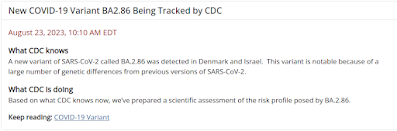
August 23, 2023, 10:10 AM EDT

CDC is posting updates on respiratory viruses every week; for the latest information, please visit
CDC Respiratory Virus Updates.


CDC has detected a new SARS-CoV-2 variant labeled BA.2.86. CDC is continually monitoring for new variants and studying their potential impact on public health.

Background

All viruses, including the virus that causes COVID-19 (SARS-CoV-2), change over time. These viruses with changes are called “variants.” These changes can affect how contagious a virus is, how well it responds to treatment, and how severely it affects people. Last week, a new variant of SARS-CoV-2 called BA.2.86 was detected in samples from people in Denmark and Israel. At least two cases have been identified in the United States. This variant is notable because it has multiple genetic differences from previous versions of SARS-CoV-2.

Current Risk Assessment

Based on what CDC knows now, existing tests used to detect and medications used to treat COVID-19 appear to be effective with this variant. BA.2.86 may be more capable of causing infection in people who have previously had COVID-19 or who have received COVID-19 vaccines. Scientists are evaluating the effectiveness of the forthcoming, updated COVID-19 vaccine. CDC’s current assessment is that this updated vaccine will be effective at reducing severe disease and hospitalization. At this point, there is no evidence that this variant is causing more severe illness. That assessment may change as additional scientific data are developed. CDC will share more as we know more.
Prevention Actions

If licensed/authorized by the FDA and recommended by the CDC, updated vaccines will be available as early as mid-September at your local pharmacy or doctor’s office.

What can you do to protect yourself and others as we learn more?

At this time, we don’t know how well this variant spreads, but we know that it spreads in the same way as other variants. That means you can still take the following actions to protect yourself and others from infection:

  • Get your COVID-19 vaccines, as recommended
  • Stay home if you are sick
  • Get tested for COVID-19 if needed
  • Seek treatment if you have COVID-19 and are at high risk of getting very sick
  • If you choose to wear a mask, wear a high-quality one that fits well over your nose and mouth
  • Improve ventilation
  • Wash your hands
Scientific Understanding of BA.2.86 as of August 23, 2023

What follows is a scientific assessment of BA.2.86’s risk profile based on what CDC knows now.

Human cases: As of August 23, 2023, 9 BA.2.86 variant sequences have been reported globally: Denmark (3); South Africa (2); Israel (1); United States (2) and United Kingdom (1). One of the cases in the United States is in a person detected through CDC’s Traveler-based Genomic Surveillance. The identification of these cases in multiple geographies is evidence of international transmission. Notably, the amount of genomic sequencing of SARS-CoV-2 globally has declined substantially from previous years, meaning more variants may emerge and spread undetected for longer periods of time. It is also important to note that the current increase in hospitalizations in the United States is not likely driven by the BA.2.86 variant. This assessment may change as additional data become available.

Severity: It is too soon to know whether this variant might cause more severe illness compared with previous variants. CDC is closely monitoring hospitalization rates to identify any potential early signals that the BA.2.86 variant is causing more severe illness. At this time, locations where this variant have been detected have not experienced increases in transmission indicators (e.g., cases, emergency department visits) or h
CDC Initial Risk Assessment On COVID BA.2.86

Transmission: With only nine sequences detected, it is too soon to know how transmissible this variant is. Detection across multiple continents suggests some degree of transmissibility. This is notable since scientists have not detected transmission of most other highly diverged lineages, which can arise in immunocompromised persons with prolonged infections.

Wastewater Detection: A U.S. wastewater sample that was collected as part of routine monitoring in the
National Wastewater Surveillance System (NWSS) has preliminarily indicated the presence of the BA.2.86 variant. Scientists are investigating this sample and will continue to closely monitor wastewater for further or more widespread evidence of BA.2.86. NWSS is one of multiple monitoring systems CDC uses to detect variants within the United States, and is meant to be used with other COVID-19 public health data to better understand COVID-19’s spread. Learn more about wastewater monitoring in the United States.

Viral Genomics: BA.2.86 is a newly designated variant of SARS-CoV-2 that has a number of additional mutations compared with previously detected Omicron variants. Specifically, the genetic sequence of BA.2.86 has changes that represent over 30 amino acid differences compared with BA.2, which was the dominant Omicron lineage in early 2022. BA.2.86 also has >35 amino acid changes compared with the more recently circulating XBB.1.5, which was dominant through most of 2023. This number of genetic differences is roughly of the same magnitude as seen between the initial Omicron variant (BA.1) and previous variants, such as Delta (B.1.617.2).

Immune Impacts: The large number of mutations in this variant raises concerns of greater escape from existing immunity from vaccines and previous infections compared with other recent variants. For example, one analysis of mutations suggests the difference may be as large as or greater than that between BA.2 and XBB.1.5, which circulated nearly a year apart. However, virus samples are not yet broadly available for more reliable laboratory testing of antibodies, and it is too soon to know the real-world impacts on immunity. Nearly all the U.S. population has antibodies to SARS-CoV-2 from vaccination, previous infection, or both, and it is likely that these antibodies will continue to provide some protection against severe disease from this variant. This is an area of ongoing scientific investigation.

Therapeutics: Examination of the mutation profile of BA.2.86 suggests that currently available treatments like Paxlovid, Veklury, and Lagevrio will be effective against this variant. Monitoring is ongoing and CDC will update this document as human data on the impact of this variant on therapeutics become available.

Diagnostics (tests): Based on BA.2.86’s mutation profile, the anticipated impact on molecular and antigen-based is low.​


It is too soon to begin to guess how much of an impact BA.2.86 - or its inevitable descendants - will have on the post-pandemic phase of COVID. We could get lucky, and it fizzles, or proves to be no more severe than Omicron.

But it could just as easily go the other way.​

What it does tell us is that COVID still has the ability to radically change the game, and that we can't afford to become complacent. BA.2.86 - or something further down the evolutionary road - could still come back to bite us.

Stay tuned.

https://afludiary.blogspot.com/2023/08/cdc-initial-risk-assessment-on-covid.html
 
PAHO Technical Document & Statement On COVID EG.5 and BA.2.86

AVvXsEilquth1XPi4RUJz2YfqDc7ee5Um9feAWjn2jybYoJQHAx-3ehhNDcNTqC93kTlRQB9q9k4qA3y4NHfjHUi8S2nCz23_rQzUkS5OnVA_mMzst9qdLm-IBwpLuDkb-ie1bjekSt8rd_h1m9cC3luBy2Lppcr8V0F6-WPSHZ4s0WUMzCDGb8h0Ibk2w=w400-h103


#17,633

PAHO (the Pan American Health Organization) has joined the ranks of the CDC, WHO, the UKHSA, and Denmark which have all issued statements and/or risk assessments (see here, here, here, and here) on the recently discovered - and heavily mutated - BA.2.86 variant.

This new variant appears to be a descendant of the BA.2 variant which peaked in the United States over a year ago, and as of the last CDC Nowcast, was estimated at between 0.0% and 0.1% of US cases.​

But quite unexpectedly, along the way it has acquired > 30 mutations in its spike protein (compared to BA.2), and differs from XBB.1.5 by nearly 3 dozen amino acid changes.

Exactly what these changes mean is difficult to say, but most researchers suspect this variant will be better at evading prior immunity (from previous infection, vaccination, or both) than the current batch of already slippery Omicron variants.

The big question - as yet unanswered - is whether BA.2.86 produces more (or hopefully, less) severe illness compared to earlier Omicron viruses. And right now, there are too few cases to even make a guess.​

The recent rise in COVID hospitalization being reported here in the United States (and other countries) is unlikely to be due to BA.2.86, but rather the rapidly rising EG.5 variant, which isn't expected to be any more severe than previous Omicron viruses.

While BA.2.86 has obviously caught the attention of virologists world-wide, it may take a few more weeks before we know if this variant is a contender or a pretender.​

I've reproduced the main sections of the PAHO statement - which a bit unusually - opens with a sharp rebuke of those assigning `nicknames' to emerging variants.

Admittedly, I'm not a fan of the practice, and prefer to use PANGO designations in this blog. I find them more scientifically descriptive, and easier to remember, than the unofficial `popular' names being used in the media.​

But we live in an internet-driven world where memes and emojis rule, and telling people they `can't' is a sure way to build resistance. Which is why I suspect they are facing an uphill battle on this.

I'll have a bit more after the break.

Update on the emergence of SARS-CoV-2 Omicron sublineages

22 August 2023

Key messages

In the context of the emergence of additional Omicron sublineages, PAHO/WHO reiterates that the nomenclature established to address the potential public health impacts of variants has not changed. Nomenclatures based on phylogenetic analysis (e.g., Pango Network and Nextstrain) can also be used to designate lineages or sublineages. However, other nomenclatures or nicknames are not official and should not be used.

PAHO/WHO regularly assesses new Omicron sublineages. Two new variants have recently been identified: EG.5, classified as a variant of interest (VOI), and BA.2.86, classified as a variant under monitoring (VUM).

Based on the available evidence, the public health risk posed by EG.5 has been evaluated as low and it is similar to other circulating variants of interest. Limited information is available for BA.2.86; and the initial risk assessment will be generated soon. To date, there is no evidence of significant changes in the public health impact of these sublineages and there is no justification for the assignment of a new“variant of concern”.

COVID-19 recommendations remain unchanged. In particular, PAHO strongly encourages all countries in the Region to continue collecting representative samples for sequencing and to maintain appropriate SARS-CoV-2 genomic surveillance.

SARS-CoV-2 variant classification

SARS-CoV-2 lineage classification includes the Pango Network nomenclature which is solely based on the analysis of the genetic composition of the virus (phylogenetics). This nomenclature assigns a letter or combination of letters followed by numbers to each lineage (e.g., B.1.1.529). The WHO nomenclature established to address the potential public health impacts of variants is based on Greek letters as designated based on risk assessments conducted by the WHO Technical Advisory Group on SARS-CoV-2 virus evolution (TAG-VE) 1 .

The vast majority of SARS-CoV-2 viruses circulating globally are sublineages of Omicron. Thus, since March 2023, the WHO variant tracking system considers the classification of Omicron sublineages independently as variants under monitoring (VUM), variants of interest (VOIs), or variants of concern (VOCs), while Alpha, Beta, Gamma, Delta and the Omicron original lineages are classified as “previously circulating” VOCs 2 . Greek letters are only assigned to sublineages classified as currently circulating VOCs. However, at present, no Omicron sublineage is classified as such.

The recombinant sublineages XBB.1.5 and XBB.1.16 were classified as currently circulating VOIs in January and April 2023, respectively, while the recombinant EG.5 was classified as VOI on 9 August 2023. Additionally, BA.2.75 and CH.1.1 (two BA.2 sublineages), and recombinants XBB, XBB.1.9.1, XBB.1.9.2, and XBB.2.3 were included in the list of currently circulating VUMs before August 2023, while BA.2.86 was classified as VUM on 17 August 2023. This update focuses on EG.5 and BA.2.86.

Variant of interest EG.5

EG.5 is a descendent lineage of XBB.1.9.2 and was first reported in February of 2023. The spike protein of EG.5 is similar to XBB.1.5. Globally, there has been a steady increase in the proportion of EG.5 reported. This trend has also been observed in some countries in the Region of the Americas, including, Canada, Colombia, Costa Rica, Dominican Republic, and the United States.

Based on the available evidence, the public health risk posed by EG.5 is evaluated as low at the global level, aligning with the risk associated with other currently circulating VOIs. While EG.5 has shown increased prevalence, growth advantage, and is likely to have increased immune escape properties, there have been no reported changes in disease severity to date. Concurrent increases in the proportion of EG.5 and COVID-19 hospitalizations have been observed in countries such as Japan and the Republic of Korea; however, the hospitalization increase has been lower than during previous waves and no associations have been made between these hospitalizations and EG.5. Due to its growth advantage, EG.5 may cause a rise in case incidence in some countries and become dominant.

Variant under monitoring BA.2.86

This variant was initially reported in a sample collected in Denmark at the end of July 2023. It has since been detected in Israel, the United Kingdom, and the United States, but only seven sequences in total have been reported. It carries a significant number (over 30) of mutations in the spike protein and has been called BA.2.86 in the Pango Network nomenclature. WHO has designated BA.2.86 as a VUM due to the large number of mutations it carries but limited additional information is available at this time.

Presently there is no known epidemiological link between the identified cases. However, the fact that BA.2.86 has been identified in distant countries suggests it is present elsewhere. Given the low number of cases, it is currently not possible to determine whether BA.2.86 is associated with any changes in transmissibility, immune escape or severity. It is also difficult to infer whether the large number of mutations identified will increase or decrease viral fitness. Additional sequence data and epidemiological characterization of the cases are required to understand the significance of this variant.

In summary, for EG.5, no significant changes in public health impact have been demonstrated, besides the high transmission capacity already demonstrated by Omicron.
For BA.2.86, additional information is required to better characterize this variant in terms of transmissibility, immune escape, and severity. Both variants, as well as other circulating or emerging sublineages, are continuously monitored by the TAG-VE, and risk assessments will be published/updated as new information becomes available.


Although COVID activity in the United States is far below what we saw last winter, the number of weekly hospitalizations reported to the CDC has doubled over the past 8 weeks (see chart below), and appears to be trending higher.


When you factor in the reduced testing, and reporting, on COVID from around the country, this surge is probably more pronounced than this chart would suggest. Most of this appears to be due to the rise of EG.5. What BA.2.86 will add this fall remains uncertain.

Until we get a better handle on things, I've gone back to wearing a mask in public spaces. Its a personal decision, based on my age (69), current health, and my own level of risk aversion. YMMV.​

And while it may not mean anything, I've noticed the prices for KN95 masks have recently surged (a box I bought in June for $12 is now going for $20 on Amazon).
Given the lack of COVID surveillance and reporting from 90% of the world's countries, that may prove to be a useful metric to follow.​

Stay tuned. Between H5N1, COVID, and heavy flu activity in the Southern Hemisphere, we could be in for a busy fall.


https://afludiary.blogspot.com/2023/08/paho-technical-document-statement-on.html

 
Back
Top Bottom