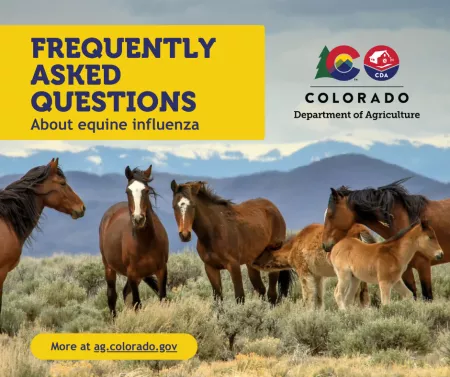
Frequently Asked Questions (FAQ) about Equine Influenza
Friday, April 29, 2022
The following Frequently Asked Questions about Equine Influenza were prepared by the Colorado State Veterinarian's Office. You can
download a PDF of the questions and answers here.
What virus is causing the disease outbreak at the BLM facility located on the Colorado Department of Corrections East Cañon Complex in Cañon City?
The strain of equine influenza identified as the likely cause of the respiratory disease outbreak and associated mortality at the BLM facility in Cañon City was categorized as subtype H3N8 by two leading veterinary diagnostic laboratories in the United States. The diagnostic tests identified the virus in nasal swabs and lung tissue from several horses.
What is the H3N8 strain of equine influenza?
Equine influenza is a highly contagious respiratory disease with a high rate of transmission among horses and a short incubation time (1-3 days). It is spread through aerosols from coughing infected horses as well as through contact with contaminated materials, such as clothing or surfaces. This specific strain is common among both wild and domestic horses in the United States and across the world.
What does this detection of equine flu mean for horse owners in Colorado?
Animal health experts believe this outbreak is confined to the Cañon City facility and does not pose a risk to the general equine population in Colorado. The affected horses are segregated and under voluntary quarantine at the facility. The Bureau of Land Management has instituted rigorous measures to prevent further spread of the disease and has been working with the State Veterinarian’s Office, the Colorado Department of Corrections, as well as the US Department of Agriculture on the investigation and response to the outbreak.
What’s next for the horses at the Cañon City Facility?
The Bureau of Land Management continues to work with the attending veterinarians on scene as well as the diagnostic laboratories, veterinarians, and epidemiologists from the US Department of Agriculture and the Colorado State Veterinarian’s Office to investigate and mitigate the factors that may be contributing to the most severe cases and prevent further spread of the disease. The facility remains under a voluntary quarantine with no horses allowed to leave the premises at this time and for the foreseeable future until it has been determined that the animals are again healthy and pose no risk to the domestic equine population in the community.
Is this virus related to Highly Pathogenic Avian Influenza?
No, the H3N8 strain is not related to the current outbreak of highly pathogenic avian influenza, or HPAI, which is categorized as subtype H5N1. The HPAI strain is currently impacting wild birds and poultry across the United States, including Colorado. More information about avian influenza can be found at ag.colorado.gov/hpai.
What are the symptoms of equine influenza?
Symptoms in horses can include high fever (up to 106°F), nasal discharge, swollen lymph nodes, and a dry, harsh cough. Depression, weakness, and decreased feed consumption are frequently seen. Symptoms usually last less than three days in uncomplicated cases. Mildly affected horses typically recover uneventfully in 2-3 weeks. Equine influenza typically does not result in high mortality of horses, but many factors can play a role in the severity of disease in individual horses and within a herd.
How is equine influenza transmitted?
Equine influenza can be spread through direct contact with infected horses or airborne through coughing from infected horses. The virus can also be transmitted by contaminated clothing, equipment, and tack. Some horses may not show outward signs of infection, but can shed the virus and infect susceptible horses.
Is there treatment for equine influenza?
Treatment generally consists of rest and supportive care for horses affected by the virus. More severely affected horses can also be given treatment by their veterinarian to reduce inflammation and fever.
How can equine influenza be prevented?
Proper vaccination and biocontrol measures are the best available defenses against equine influenza. An equine influenza vaccine is available. Horse owners should work with their veterinarians to determine the best vaccine schedule for their horses.
What should I do if my horse gets sick?
If you are a horse owner whose horse shows symptoms similar to equine influenza, contact your veterinarian. While equine influenza is not a reportable disease in the state of Colorado, the State Veterinarian’s Office continues to support veterinarians across the state as they work within their communities to identify any potential cases.
What do the numbers H3N8 mean?
Strains of influenza A virus are named with Hs and Ns. H stands for hemagglutinin and N for neuraminidase. Both are proteins on the surface of the virus (antigens) that help it invade cells. There are 18 different H subtypes and 11 N subtypes, resulting in 198 possible combinations. Sometimes the strains trade genetic information, taking on new characteristics that our immune systems have never seen. This can lead to severe illness, and even death.
https://ag.colorado.gov/blog-post/frequently-asked-questions-faq-about-equine-influenza