• FluTrackers.com Inc. does not provide medical advice. Information on this web site is collected from various internet resources, and the FluTrackers board of directors makes no warranty to the safety, efficacy, correctness or completeness of the information posted on this site by any author or poster. The information collated here is for instructional and/or discussion purposes only and is NOT intended to diagnose or treat any disease, illness, or other medical condition. Every individual reader or poster should seek advice from their personal physician/healthcare practitioner before considering or using any interventions that are discussed on this website. By continuing to access this website you agree to consult your personal physican before using any interventions posted on this website, and you agree to hold harmless FluTrackers.com Inc., the board of directors, the members, and all authors and posters for any effects from use of any medication, supplement, vitamin or other substance, device, intervention, etc. mentioned in posts on this website, or other internet venues referenced in posts on this website.
  • We are not asking for any donations. Do not donate to any entity who says they are raising funds for us.

CO: Mystery illness kills 149 horses at a federal cañon city holding facility, facility on quarantine - Equine influenza is suspected

Shiloh

Editor, Senior Moderator
Source: https://www.ctvnews.ca/world/mystery...tine-1.5877877


Mystery illness kills 67 horses at a federal cañon city holding facility, facility on quarantine
Rick Sallinger
Published April 26, 2022 10:50 p.m. EDT


CANON CITY, Colorado -

More than five dozen wild horses rounded up are dead after an apparent disease has spread through their holding facilities. They were rounded up by a Bureau of Land Management (BLM) program designed to keep wild horse populations in check.

“It’s extraordinary damage that’s being done to a piece of American heritage here. This is 57 unnecessary deaths,” said Scott Wilson, a board member of the American Wild Horse Campaign and a wildlife photographer.

A short time later the BLM announced 10 more horses had died in the past day bringing the number to 67 since last Saturday...
 
Last edited by a moderator:
...
CAÑON CITY FACILITY


The Cañon City Wild Horse and Burro Facility has been placed under quarantine and laboratory tests are being completed to identify the fatal illness that has killed 95 horses since the outbreak began on April 23. An independent veterinarian and a federal veterinarian are on-site to help diagnose and treat animals. Horses showing signs of contagious illness are quarantined from the population. BLM Colorado's April 25 Press Release is available on our website. An equine influenza is suspected to be the cause of the outbreak.

If you have additional questions, please call (303) 239-3988.

The Outbreak Investigation Report conducted by USDA APHIS Veterinary Services is available here.

Updates and additional information will be posted below.

April 28: The total number of fatalities has increased to 95. The BLM's most recent April 28 Press Release is available. The veterinarian report and addendum are available for review.

April 27: The total number of fatalities has increased to 85.

April 26: The total number of fatalities has increased to 67.

April 25: A total of 57 horses have died. The BLM and its partners are continuing to monitor horses and identify the illness.


https://www.blm.gov/programs/wild-horse-and-burro/herd-management/herd-management-areas/colorado
 
A VIRUS HAS BEEN IDENTIFIED AS THE PRINCIPAL CAUSE OF THE OUTBREAK AND MORTALITY AT BLM’S WILD HORSE AND BURRO FACILITY


CAÑON CITY, Colo. – An equine influenza virus that is not uncommon among both wild and domestic horses has been identified as the likely cause of the respiratory disease outbreak and associated mortality that is occurring at the BLM’s Wild Horse and Burro Corrals located on the Colorado Department of Corrections (CDOC) East Canon Complex in Canon City, CO. Positive polymerase chain reaction (PCR) laboratory test results from two leading veterinary diagnostic laboratories in the United States identified the virus in nasal swabs and lung tissue from several horses.

This strain of equine influenza (subtype H3N8) is not related to the current outbreak of highly pathogenic avian influenza (subtype H5N1) that is currently impacting wild birds and poultry across the United States.

The PCR testing has also identified two equine herpes viruses (EHV-2 and EHV-5) but these commonly occur in normal, healthy horses, and it is unclear to what extent these may also be contributing to the severity of the clinical signs observed in the more severely affected group of horses at the facility.

More typical mild clinical signs of influenza are also being observed in approximately 10-20 percent of the other 2,184 horses at the facility that are not from West Douglas. No mortality has occurred in the larger groups of horses. The West Douglas horses were gathered in an emergency operation in 2021 following a wildfire that impacted their habitat. As of today, April 28, 95 horses have died at the facility since April 23.

“The Bureau of Land Management will review operations at the Canon City facility to prevent future outbreaks like this from occurring,” said BLM Colorado Acting Associate State Director Ben Gruber. “This tragic outcome was influenced by a population of horses that may have been particularly vulnerable given their time in the West Douglas area and their exposure to last year’s wildfire that prompted their emergency gather.”

“This unfortunate event is being taken very seriously by the Department of Corrections and the BLM,” said CDOC Executive Director Dean Williams. “We are working in coordination to mitigate the spread of the virus and identify and prevent any potential risk which could lead to future similar events.”

BLM continues to work with the attending veterinarians on scene as well as the diagnostic laboratories, veterinarians and epidemiologists from the US Department of Agriculture and the Colorado State Veterinarian’s Office to investigate and mitigate the factors that may be contributing to the most severe cases and prevent further spread of the disease. The facility remains under a voluntary quarantine with no horses allowed to leave the premises at this time and for the foreseeable future until it has been determined that the animals are again healthy and pose no risk to the domestic equine population in the community.

The veterinarian report and additional information can be found online at https://www.blm.gov/programs/wild-ho...areas/colorado
:tiphat:https://www.blm.gov/press-release/v...break-and-mortality-blms-wild-horse-and​​​​​​
 
Source: https://www.thedenverchannel.com/ne...y-facility-increases-to-102-blm-officials-say


Number of dead wild horses held in Cañon City facility increases to 102, BLM officials say
Pneumonia characterized by severe pulmonary edema and hemorrhage found in dead horses
By: Óscar Contreras
Posted at 5:28 PM, Apr 29, 2022
and last updated 7:28 PM, Apr 29, 2022

DENVER – The number of wild horses that have died at a Bureau of Land Management corral in Cañon City has increased to 102, according to the latest situation report released by the agency Friday.

Eight additional fatalities occurred Friday at the BLM Wild Horse and Burro Corrals, located on the Colorado Department of Corrections East Canon Complex, where more than one hundred horses have died since April 23, according to the BLM.

Preliminary findings released Thursday pointed to a respiratory outbreak of H3N8 equine influenza, which the BLM says is “not uncommon” in both wild and domesticated horses, as the cause for their deaths.

All the horses that have died so far have come from a group called the “West Douglas horses” – which were rounded up in August 2021 after the Oil Springs Fire burned about 12,000 acres south of Rangely, Colo., last June...
 
Earlier story but it has information about the facility.

https://coloradosun.com/2022/04/26/wild-horse-deaths/
67 wild horses die at federal facility in Cañon City from mysterious illness
The federal Bureau of Land Management says many of the horses are from the West Douglas range, in Rio Blanco County.
Jennifer Brown
7:58 AM MDT on Apr 26, 2022
...

The wild horse facility, on the grounds of a state prison, is under a “voluntary quarantine.” Many of the horses that died were captured on Colorado’s West Douglas range in Rio Blanco County last year, according to federal officials.

The bureau is working with state and local officials to determine the exact cause of death of the horses, which are cared for at the prison facility and then, in some cases, sold for auction, said Stephen Leonard, program manager for the Colorado wild horse and burro program.

The facility has 2,550 horses, including many of the 450 removed last July and August from the West Douglas range. It also has several hundred from a large-scale helicopter roundup conducted last year in the Sand Wash Basin in far northwestern Colorado, along the border of Wyoming.

Nearly 700 horses were herded by a low-flying helicopter into holding pens during the two-week roundup in Sand Wash in September.

The deaths in Cañon City sparked outcry from mustang advocates and animal rights groups across the country. The national Animal Wellness Action called mustang holding pens “cramped, crowded and stressful” and “the perfect environment for infectious pathogens to propagate and spread.”

“The BLM must immediately suspend any ongoing or future horse and burro gather operations until it can demonstrate the ability to provide basic care for these animals, starting with the ability to keep them safe from infectious disease,” Scott Beckstead, director of campaigns for the Center for a Humane Economy, said in a news release.

The BLM has rounded up thousands of wild horses in the past two years, an attempt to thin herds across the West....
...
The American Wild Horse Campaign called on Gov. Jared Polis and First Gentleman Marlon Reis, an animal rights advocate, to “push Congress for greater oversight” of the wild horse management program. “Disease outbreaks and deaths are the direct result of the BLM’s inhumane mass roundups,” said Suzanne Roy, executive director of the campaign.
 
BLM could start a pandemic with their cruel treatment of wild horses.

https://www.ncbi.nlm.nih.gov/pmc/articles/PMC6537720/#
Sack, A., Cullinane, A., Daramragchaa, U., Chuluunbaatar, M., Gonchigoo, B., & Gray, G. C. (2019). Equine Influenza Virus—A Neglected, Reemergent Disease Threat. Emerging Infectious Diseases, 25(6), 1185–1191. https://doi.org/10.3201/eid2506.161846
...
The most common clinical signs of EIV infection in equids are fever, lethargy, anorexia, nasal discharge, and a nonproductive dry cough (4). Mortality rates are generally low during EIV outbreaks; death is most common among foals or equids with preexisting poor health.
...


Records included 21 years in which both horses and humans were involved, 25 years with human-only involvement, and 10 years in which only horses were involved (3). Some of the largest assumed EIV outbreaks with smaller accompanying human influenza outbreaks occurred in 1727, 1750, 1760, and 1872 (3). EIV outbreaks generally occurred in spring or fall and were followed by similar human outbreaks 3 weeks later (12). Human influenza epidemics without equine infections were more common during winter months (12)....
 
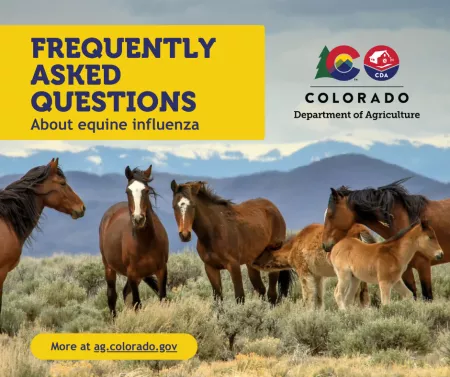
Frequently Asked Questions (FAQ) about Equine Influenza


Friday, April 29, 2022

The following Frequently Asked Questions about Equine Influenza were prepared by the Colorado State Veterinarian's Office. You can download a PDF of the questions and answers here.
What virus is causing the disease outbreak at the BLM facility located on the Colorado Department of Corrections East Cañon Complex in Cañon City?
The strain of equine influenza identified as the likely cause of the respiratory disease outbreak and associated mortality at the BLM facility in Cañon City was categorized as subtype H3N8 by two leading veterinary diagnostic laboratories in the United States. The diagnostic tests identified the virus in nasal swabs and lung tissue from several horses.
equine_influenza_faq_-_fb_image_0.png.webp

What is the H3N8 strain of equine influenza?
Equine influenza is a highly contagious respiratory disease with a high rate of transmission among horses and a short incubation time (1-3 days). It is spread through aerosols from coughing infected horses as well as through contact with contaminated materials, such as clothing or surfaces. This specific strain is common among both wild and domestic horses in the United States and across the world.

What does this detection of equine flu mean for horse owners in Colorado?
Animal health experts believe this outbreak is confined to the Cañon City facility and does not pose a risk to the general equine population in Colorado. The affected horses are segregated and under voluntary quarantine at the facility. The Bureau of Land Management has instituted rigorous measures to prevent further spread of the disease and has been working with the State Veterinarian’s Office, the Colorado Department of Corrections, as well as the US Department of Agriculture on the investigation and response to the outbreak.

What’s next for the horses at the Cañon City Facility?
The Bureau of Land Management continues to work with the attending veterinarians on scene as well as the diagnostic laboratories, veterinarians, and epidemiologists from the US Department of Agriculture and the Colorado State Veterinarian’s Office to investigate and mitigate the factors that may be contributing to the most severe cases and prevent further spread of the disease. The facility remains under a voluntary quarantine with no horses allowed to leave the premises at this time and for the foreseeable future until it has been determined that the animals are again healthy and pose no risk to the domestic equine population in the community.

Is this virus related to Highly Pathogenic Avian Influenza?
No, the H3N8 strain is not related to the current outbreak of highly pathogenic avian influenza, or HPAI, which is categorized as subtype H5N1. The HPAI strain is currently impacting wild birds and poultry across the United States, including Colorado. More information about avian influenza can be found at ag.colorado.gov/hpai.

What are the symptoms of equine influenza?
Symptoms in horses can include high fever (up to 106°F), nasal discharge, swollen lymph nodes, and a dry, harsh cough. Depression, weakness, and decreased feed consumption are frequently seen. Symptoms usually last less than three days in uncomplicated cases. Mildly affected horses typically recover uneventfully in 2-3 weeks. Equine influenza typically does not result in high mortality of horses, but many factors can play a role in the severity of disease in individual horses and within a herd.

How is equine influenza transmitted?
Equine influenza can be spread through direct contact with infected horses or airborne through coughing from infected horses. The virus can also be transmitted by contaminated clothing, equipment, and tack. Some horses may not show outward signs of infection, but can shed the virus and infect susceptible horses.

Is there treatment for equine influenza?
Treatment generally consists of rest and supportive care for horses affected by the virus. More severely affected horses can also be given treatment by their veterinarian to reduce inflammation and fever.

How can equine influenza be prevented?
Proper vaccination and biocontrol measures are the best available defenses against equine influenza. An equine influenza vaccine is available. Horse owners should work with their veterinarians to determine the best vaccine schedule for their horses.

What should I do if my horse gets sick?
If you are a horse owner whose horse shows symptoms similar to equine influenza, contact your veterinarian. While equine influenza is not a reportable disease in the state of Colorado, the State Veterinarian’s Office continues to support veterinarians across the state as they work within their communities to identify any potential cases.

What do the numbers H3N8 mean?
Strains of influenza A virus are named with Hs and Ns. H stands for hemagglutinin and N for neuraminidase. Both are proteins on the surface of the virus (antigens) that help it invade cells. There are 18 different H subtypes and 11 N subtypes, resulting in 198 possible combinations. Sometimes the strains trade genetic information, taking on new characteristics that our immune systems have never seen. This can lead to severe illness, and even death.


https://ag.colorado.gov/blog-post/frequently-asked-questions-faq-about-equine-influenza

 
Source: https://denver.cbslocal.com/2022/05/01/horse-death-toll-canon-city/


Wild Horse Death Toll In Cañon City Climbs To 106
May 1, 2022 at 11:23 am


(CBS4) – The Bureau of Land Management blames equine influenza for the deaths of 106 horses at a facility in Cañon City. Four horses died on Saturday contributing to that death toll.

The illness is hitting the group of wild horses which were rounded up on the Western Slope. The BLM captured more than 1,100 horses last year; 684 came from the Sand Wash Basin and another 457 came from the West Douglas herd.

BLM officials say the sick horses were vaccinated within five to 10 days of getting sick.

Some opposed to the roundups are questioning why the horses, which were brought in late last summer, hadn’t already been vaccinated.

“I think if they didn’t have the facility ready to take proper care of them, absolutely they should never have been rounded up,” said Ginger Kathrens, founder of the Colorado Springs-based group, The Cloud Foundation.

The BLM says it is investigating the vaccines now to see if that could have played a role...
 
COLORADO HERD MANAGEMENT AREAS
...
May 1
: The May 1 Situation Report is available with an additional 11 fatalities today.
...
https://www.blm.gov/programs/wild-ho...areas/colorado

----------------------

Situation Report
2022 Canon City Equine Influenza Outbreak

Prepared by: Steve Leonard, WHB State Lead Dr. Albert Kane
CO BLM USDA APHIS Veterinary Services
Canon City, CO Ft Collins, CO


Submitted: 5/01/22

Outbreak of respiratory disease characterized by high mortality attributed to pneumonia (pulmonary
edema and hemorrhage) primarily among West Douglas horses (445) and more typical mild signs of a
respiratory illness (fever, nasal discharge, coughing) in the balance of the facility (2550 total)

...
Mortality by Date:
...
4/23 40-43 West Douglas 10 10 includes foal from 18th as a possible link to outbreak.
4/24 40-43 West Douglas 22
4/25 40-43 West Douglas 24
4/26 40-43 West Douglas 10
4/27 40-43 West Douglas 18
4/28 40-43 West Douglas 10
4/29 40-43 West Douglas 8
4/30 40-43 West Douglas 4
5/01 40-43 West Douglas 11
...

https://www.blm.gov/sites/blm.gov/f... City mortality_ situation report 5_01_22.pdf
 
Situation Report
2022 Canon City Equine Influenza Outbreak


Prepared by: Steve Leonard, WHB State Lead Dr. Albert Kane
CO BLM USDA APHIS Veterinary Services
Canon City, CO Ft Collins, CO

Submitted: 5/02/22
...
5/02 Further testing of the samples positive for the equine influenza virus has determined the virus to be
the Florida Clade 1 sublineage. This is currently the endemic strains of equine influenza in North
America

...
Mortality by Date:
...
5/02 40-43 West Douglas 2
...
https://www.blm.gov/sites/blm.gov/files/docs/2022-05/Canon City mortality_ situation report 5 _02_22.pdf
 
They aren't enabled to offer the sick horses any treatment. Several adoption events were cancelled over the past 2 years during the pandemic. They could have had homes like this:

https://twitter.com/caroljwalker/status/1521879116680769536?cxt=HHwWgMC9zcm_5p4qAAAA


Carol Walker @caroljwalker

My adopted mustang Helios in May 2020 with his mother Hera and father Apollo. He is 2 years old now. I am so grateful that I was able to get him out of Cañon City after waiting 9 months. He was very thin when I adopted him, but now he is doing very well. #investigatecanoncity


10:47 AM · May 4, 2022·Twitter for iPhone
 
Back
Top Bottom