Shiloh
Editor, Senior Moderator
Source: http://www.cidrap.umn.edu/cidrap/content/influenza/swineflu/news/mar2910georgia.html
Georgia's rise in serious H1N1 cases worries CDC
Maryn McKenna * Contributing Writer
Mar 29, 2010 (CIDRAP News) ? Public health officials are so concerned by an uptick of serious cases of H1N1 flu in the southeastern United States that they called a short-notice press briefing today to urge Americans to be vaccinated against the pandemic strain.
Surgeon General Dr. Regina Benjamin and Dr. Anne Schuchat, director of the Centers for Disease Control and Prevention's (CDC's) National Center for Immunization and Respiratory Diseases, told reporters on a conference call that they are particularly concerned about the "worrisome trend" in Georgia, where "more than 40" people were hospitalized in the past week for lab-confirmed flu.
Since mid-February, Georgia has had more flu-related hospitalizations than any other state, as well as more than that state has seen since its flu peak in October, Schuchat said.
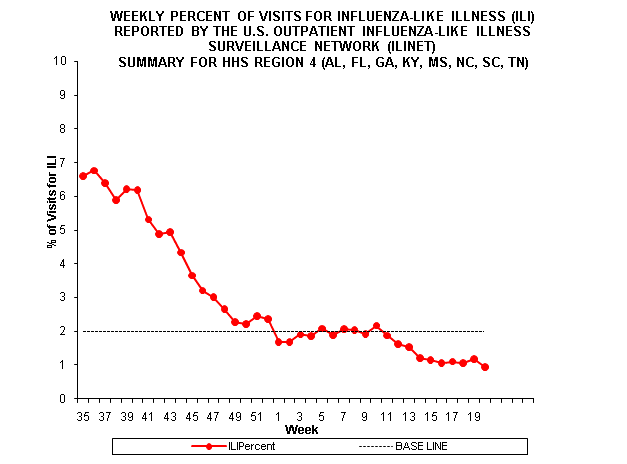
Last week, the CDC said that Georgia, Alabama, and South Carolina were experiencing regional activity, the second-highest level of flu activity, and the American College Health Association said that campuses in southeastern states were reporting increased cases of flu.
Schuchat said the new cases are occurring in adults with chronic medical conditions, a group that health officials have consistently urged to take the H1N1 shot. The new victims were not vaccinated, she said, adding that Georgia had one of the lowest rates of flu-vaccine acceptance last fall.
The CDC is sufficiently concerned about the Georgia cases that it has loaned a team of its disease detectives to the state Division of Public Health to investigate the cases and help crunch data. A full analysis is expected shortly, Schuchat said, but the CDC felt the Georgia signal was so concerning that they went ahead with a briefing in advance of the analysis's delivery.
"Seeing an increase in cases again in Georgia is unusual," Schuchat said. "Does that mean we're going to see that in other states? I really don't know."
Asked whether the Georgia cases might be the first blip in a feared third wave of flu, Schuchat said: "I can't say whether we'll have another wave of infection, but I'm worried about a different possibility. I'm worried that additional cases will be happening day in and day out in people who thought there was no risk anymore."
She and Benjamin both urged people who have not yet received the H1N1 vaccine to take it. "We need to get the vaccination message out to minority groups. They're not participating in the national vaccination at the rate that other population groups are," Benjamin said. "It's important to remind minority groups to get the H1N1 vaccine because we know that minorities experience higher rates of . . . chronic diseases."
About 124 million doses of H1N1 vaccine have been shipped, the two officials said, and more than 30 million remain unused.
Since the beginning of the pandemic almost a year ago, 265,000 Americans have been hospitalized for H1N1 infections and 12,000 have died, according to CDC estimates. In an average year, 36,000 Americans die of flu?but Schuchat said people should not therefore conclude the pandemic has been mild.
"Ninety percent of those people, about 11,000, are people under 65," in contrast to a normal season in which most victims are elderly, she said. "We estimate that the rate of death in young people is probably five times higher than what we would typically see with seasonal influenza."
See also:
Mar 29 CDC briefing transcript
http://www.cdc.gov/media/transcripts/2010/t100329.htm
Mar 26 CDC FluView
http://www.cdc.gov/flu/weekly/
Mar 26 CIDRAP News story "CDC sees sustained H1N1 activity in Southeast"
Georgia's rise in serious H1N1 cases worries CDC
Maryn McKenna * Contributing Writer
Mar 29, 2010 (CIDRAP News) ? Public health officials are so concerned by an uptick of serious cases of H1N1 flu in the southeastern United States that they called a short-notice press briefing today to urge Americans to be vaccinated against the pandemic strain.
Surgeon General Dr. Regina Benjamin and Dr. Anne Schuchat, director of the Centers for Disease Control and Prevention's (CDC's) National Center for Immunization and Respiratory Diseases, told reporters on a conference call that they are particularly concerned about the "worrisome trend" in Georgia, where "more than 40" people were hospitalized in the past week for lab-confirmed flu.
Since mid-February, Georgia has had more flu-related hospitalizations than any other state, as well as more than that state has seen since its flu peak in October, Schuchat said.
Last week, the CDC said that Georgia, Alabama, and South Carolina were experiencing regional activity, the second-highest level of flu activity, and the American College Health Association said that campuses in southeastern states were reporting increased cases of flu.
Schuchat said the new cases are occurring in adults with chronic medical conditions, a group that health officials have consistently urged to take the H1N1 shot. The new victims were not vaccinated, she said, adding that Georgia had one of the lowest rates of flu-vaccine acceptance last fall.
The CDC is sufficiently concerned about the Georgia cases that it has loaned a team of its disease detectives to the state Division of Public Health to investigate the cases and help crunch data. A full analysis is expected shortly, Schuchat said, but the CDC felt the Georgia signal was so concerning that they went ahead with a briefing in advance of the analysis's delivery.
"Seeing an increase in cases again in Georgia is unusual," Schuchat said. "Does that mean we're going to see that in other states? I really don't know."
Asked whether the Georgia cases might be the first blip in a feared third wave of flu, Schuchat said: "I can't say whether we'll have another wave of infection, but I'm worried about a different possibility. I'm worried that additional cases will be happening day in and day out in people who thought there was no risk anymore."
She and Benjamin both urged people who have not yet received the H1N1 vaccine to take it. "We need to get the vaccination message out to minority groups. They're not participating in the national vaccination at the rate that other population groups are," Benjamin said. "It's important to remind minority groups to get the H1N1 vaccine because we know that minorities experience higher rates of . . . chronic diseases."
About 124 million doses of H1N1 vaccine have been shipped, the two officials said, and more than 30 million remain unused.
Since the beginning of the pandemic almost a year ago, 265,000 Americans have been hospitalized for H1N1 infections and 12,000 have died, according to CDC estimates. In an average year, 36,000 Americans die of flu?but Schuchat said people should not therefore conclude the pandemic has been mild.
"Ninety percent of those people, about 11,000, are people under 65," in contrast to a normal season in which most victims are elderly, she said. "We estimate that the rate of death in young people is probably five times higher than what we would typically see with seasonal influenza."
See also:
Mar 29 CDC briefing transcript
http://www.cdc.gov/media/transcripts/2010/t100329.htm
Mar 26 CDC FluView
http://www.cdc.gov/flu/weekly/
Mar 26 CIDRAP News story "CDC sees sustained H1N1 activity in Southeast"